TL;DR:
- Most enterprises fail to realize significant ROI from AI because they focus on automating tasks within outdated processes instead of redesigning workflows.
- Outcome-driven automation platforms are shifting the role of leaders towards overseeing autonomous agents, emphasizing scalability, governance, and measurable business value.
Most enterprises are not getting the return on AI they expected. Fewer than 40% of companies report meaningful bottom-line impact from their AI investments, and the gap between pilot success and enterprise-scale value remains stubbornly wide. The reason is rarely the technology itself. The problem is that most organizations apply automation to the wrong unit of work, targeting individual tasks rather than rethinking the end-to-end processes those tasks belong to. This guide explains how the automation landscape is shifting in 2026, what new models are emerging, and what executives and IT leaders must do differently to capture real, measurable business value.
Key Takeaways
| Point | Details |
|---|---|
| Outcome-driven automation wins | Redesigning workflows for business outcomes drives far greater value than automating individual tasks. |
| Agentish and agentic models co-exist | Most enterprises will blend deterministic helpers and dynamic agents to maximize value through 2026. |
| Governance is essential | Long-running agents need audit, permissions, and control-plane oversight to succeed at scale. |
| Avoid automating broken processes | Value is lost when automation accelerates inefficiency instead of transforming core business flows. |
How workflow automation is evolving in 2026
To understand why many enterprises struggle with limited automation ROI, let’s examine how the automation landscape is fundamentally shifting in 2026.
Automation has moved well past simple rule-based triggers and robotic process automation bots. The next phase is outcome-focused workflow orchestration, where platforms are expected not just to assist humans but to commit to delivering defined business outcomes reliably and at scale. This is a meaningful departure from the assistive intelligence model, where AI tools help workers complete tasks faster but leave the overall process design untouched.
By 2028, over half of all enterprises will favor workflow platforms committing to workflow outcomes over assistive intelligence interfaces.
That shift carries significant implications for how executives think about their role. Rather than managing a set of tools that augment individual productivity, leaders are increasingly becoming agent stewards, responsible for supervising autonomous agent orchestration across business domains. The key drivers pushing enterprises in this direction include:
- Scalability. Assistive tools plateau at the individual user level. Outcome-focused platforms scale across teams, departments, and entire value chains.
- Cost efficiency. Reducing human coordination overhead across complex, multi-step workflows delivers compounding savings over time.
- Governance and audit. Regulators and internal compliance teams increasingly require traceable, auditable decision trails that ad hoc automation tools cannot reliably provide.
- Accountability. Measuring automation success in business value delivered, not tasks completed, forces organizations to align technology investment with strategic priorities.
Understanding advanced workflow management as an outcome-oriented discipline, rather than a collection of point solutions, is the foundation on which everything else in this guide builds. The fintech workflow trends emerging in regulated industries illustrate this clearly: compliance requirements demand traceable orchestration, not just faster task execution.
Agentish vs. agentic automation: What executives need to know
With the shift to outcome-focused automation, it’s critical to understand the practical differences between current AI helpers and more advanced agentic automation.
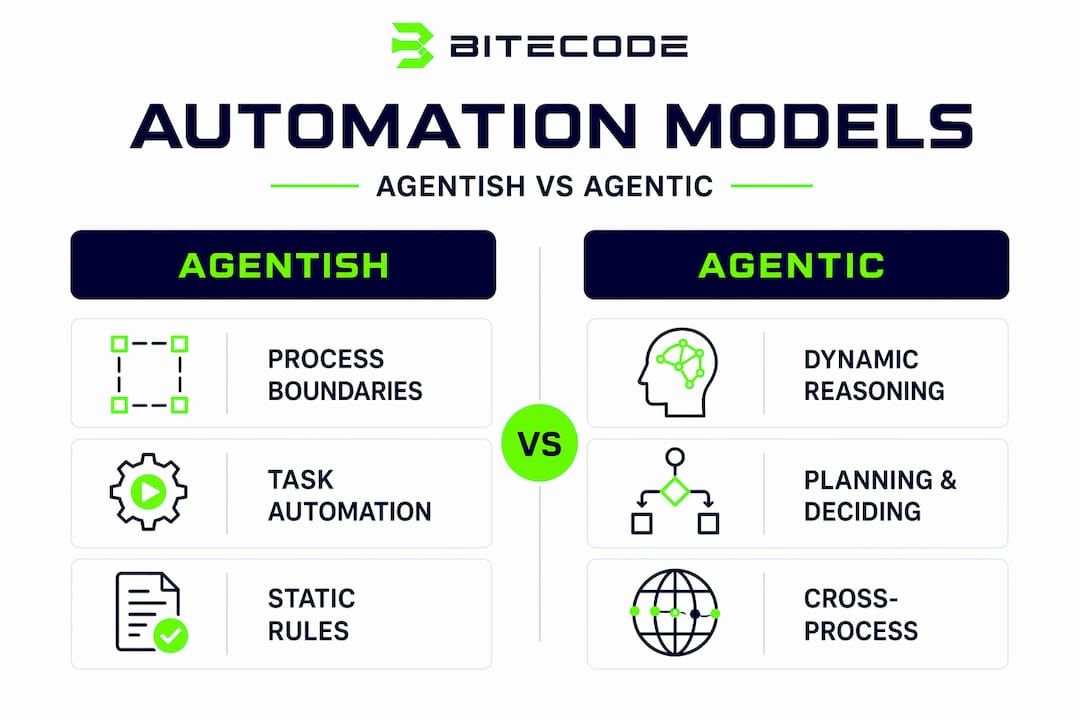
Two distinct patterns are emerging side by side. The first is what analysts call agentish automation: embedded helpers that operate within well-defined process boundaries. These are deterministic, predictable, and relatively low risk. A document classification model integrated into an approval workflow, or a virtual assistant that routes customer queries to the correct team, are both agentish. They deliver fast ROI precisely because their scope is constrained.
The second pattern, agentic automation, involves dynamic reasoning agents capable of planning, deciding, and executing across multiple systems and domains without constant human direction. A procurement agent that identifies a supply chain disruption, evaluates alternatives, initiates vendor communications, and updates ERP records autonomously is agentic. The potential is significant. So is the governance burden.
| Dimension | Agentish automation | Agentic automation |
|---|---|---|
| Scope | Within defined process boundaries | Cross-domain, multi-system |
| Decision type | Deterministic, rule-driven | Reasoning-based, adaptive |
| Risk profile | Low | Medium to high |
| ROI timeline | Fast (weeks to months) | Longer (months to years) |
| Governance need | Moderate | High |
| Current adoption | Widespread | Early stage |
The adoption gap is real. Less than 15% of firms will activate agentic features in automation suites by 2026, and both patterns will co-exist for the foreseeable future. This is not a reason for pessimism. It is a signal that organizations have time to build the capability incrementally, starting with what delivers immediate, traceable value and maturing toward agentic orchestration as governance frameworks mature alongside the technology.
Understanding the essential system features for workflow automation that support both patterns is key to avoiding expensive rework later. Building a modular foundation now means end-to-end automation becomes an extension of what’s already in place, not a separate greenfield initiative.
Pro Tip: Start by embedding agentish helpers in your highest-volume, best-documented core processes. This builds organizational familiarity with automation governance and creates the observability infrastructure that agentic agents will require later. Don’t skip this foundation in pursuit of the more advanced model.
Barriers to enterprise adoption: Strategy gaps, governance, and process redesign
Knowing the distinction between automation models, why do so few organizations make the leap to enterprise-scale, agentic workflow automation?
The data is instructive. Only 11% of organizations have agents in production, while 42% are still developing their strategy and a striking 35% lack any strategy at all. That means roughly three out of four enterprises are either unprepared or only beginning to frame their approach. Three root causes explain this stagnation.

| Barrier | Description | Common symptom |
|---|---|---|
| Poor process redesign | Automating broken or inefficient workflows as-is | ROI plateaus after initial gains |
| Weak governance | No policy framework for agent behavior or escalation | Compliance incidents, rework, low trust |
| Misaligned metrics | Measuring task velocity instead of business outcomes | Automation “succeeds” while margins stay flat |
The most consequential mistake is also the most common: organizations layer AI capabilities onto existing legacy systems without redesigning the underlying processes. Layering AI on legacy apps may cause up to 80% margin compression by 2030 as maintenance costs, integration debt, and operational complexity accumulate faster than efficiency gains.
Automating a flawed process does not fix it. It accelerates it, and every inefficiency compounds at the speed of the machine.
Here is a structured sequence for enterprises ready to move beyond the pilot stage:
- Map and redesign processes first. Before selecting any automation tool or platform, document the current state of the target workflow with genuine rigor. Identify bottlenecks, exception cases, and decision points that require human judgment. Redesign the process so it is automatable in principle, not just partially reducible.
- Define governance before deploying agents. Establish clear policies for what agents can decide autonomously, what triggers escalation, who owns agent behavior, and how decisions are audited. Governance designed after deployment is almost always retrofitted poorly.
- Align success metrics to business outcomes. Measure workflow automation ROI in terms of cycle time reduction, cost per transaction, error rate, or customer outcome improvement. Task-level metrics are useful for diagnostics but not for executive accountability.
- Build incrementally. Resist the pressure to move from pilot to full production in a single step. Phased rollouts allow governance frameworks to be stress-tested and adjusted without the risk of enterprise-wide failure.
Teams that have navigated complex workflow automation successfully share one consistent pattern: they treat process redesign as the primary project and automation as the enabling mechanism, not the other way around. Staying current with enterprise software trends helps executives anticipate which capabilities will be expected as table stakes within 12 to 24 months.
Designing for long-running agents and control-plane execution
With strategy and governance requirements in focus, let’s examine what technical and architectural decisions pave the way for truly autonomous workflow automation.
Short-lived automations are architecturally straightforward. A bot that processes a form and routes it to an approver completes its work in seconds and exits. Long-running agents are fundamentally different. They maintain context across time, spanning multiple sessions, systems, and human participants. A contract review agent that tracks a deal through negotiation cycles over several weeks must retain state, respect evolving permissions, and remain auditable at every decision point throughout that period.
Long-running agents require broader architecture for permissions, decision management, and control, and current implementations remain largely unproven at enterprise scale. This is not a reason to avoid building toward this capability. It is a reason to architect thoughtfully from the start.
The essential architectural requirements for long-running, production-grade agents include:
- Identity and permissions management. Agents must operate under defined, auditable identities with permissions scoped to the minimum necessary for each task. Agents that accumulate permissions over time create security and compliance exposure that is difficult to remediate after the fact.
- Audit and decision logging. Every significant agent decision must be logged in a form that supports regulatory review, incident investigation, and continuous improvement analysis. This logging must be immutable and queryable.
- Escalation and human-in-the-loop pathways. The architecture must support graceful escalation when agents encounter scenarios outside their defined confidence thresholds. Human review must be a first-class capability, not an afterthought.
- Control-plane orchestration. Agents should be coordinated through a dedicated control plane that enforces policy, manages inter-agent communication, and provides operational visibility. Direct interface-level execution without a control plane creates black-box behavior that is nearly impossible to govern at scale.
- Policy-aware APIs. Successful agentic automation embeds governance through identity, permissions, policy-aware APIs, and orchestration in systems of record, not just at the interface layer.
Reviewing proven automation strategies for large organizations surfaces a consistent architectural theme: observability is not optional. Enterprises that build AI risk management into the architecture from day one experience significantly fewer compliance incidents and trust-related setbacks when agentic features go live.
Pro Tip: Design your observability layer before you deploy your first long-running agent. Define what “healthy” agent behavior looks like, set measurable thresholds, and build dashboards that surface anomalies in near-real time. This investment pays dividends in stakeholder confidence and in the speed at which you can diagnose and resolve issues in production.
Executive action plan: Moving from pilots to scalable automation impact
Understanding architectural enablers, here’s how executives can act now to maximize value from workflow automation in 2026 and beyond.
The path from isolated pilot to scalable enterprise impact is not a technology question. It is a strategy and execution question. Redesigning processes for agentic automation, rather than layering AI on existing workflows, is the most significant driver of business value that organizations consistently underinvest in.
Here is a pragmatic action sequence for executive leadership:
- Audit your current automation portfolio. Identify which deployed automations are delivering measurable business value and which are simply digitizing manual steps without changing outcomes. Discontinue or redesign the latter.
- Redesign before you automate. For every candidate process, invest in structured process redesign work before touching tooling. This work surfaces assumptions, eliminates waste, and defines the boundaries within which automation can operate reliably.
- Establish cross-functional governance. Automation governance cannot live in IT alone. Create a steering group that includes operations, legal, compliance, and business unit leadership. Define escalation protocols, ownership, and accountability before agents go live.
- Define outcome-based success criteria. For each agentic process, define what success looks like in terms the CFO can read. Cycle time, cost per transaction, error rate reduction, and customer satisfaction impact are all credible metrics. Task completion velocity is not sufficient on its own.
- Phase production deployment deliberately. Move from controlled pilot to limited production to full scale in clearly defined steps, with review gates between each phase. Allow governance frameworks to be tested under real conditions before expanding scope.
- Continuously evaluate and realign. Automation architectures that are not revisited regularly accumulate technical and process debt. Build quarterly review cycles into your operating model, and be willing to scale back automations that are not delivering against their defined outcomes.
Studying blockchain automation examples from industries that have managed high-stakes workflow transformation at scale reveals that the most successful organizations treat automation as a living capability, not a one-time deployment project.
Why most enterprises still miss automation ROI and how to break the cycle
There is an uncomfortable truth that most automation vendors are reluctant to state plainly: the technology is rarely the bottleneck. McKinsey reports fewer than 40% of enterprises see meaningful bottom-line impact from AI, despite consistently high investment levels. The gap is not closing because organizations keep making the same organizational mistakes.
The most persistent failure mode is what practitioners informally call “pilot purgatory”: a state in which promising proofs of concept never graduate to production because no one owns the end-to-end process redesign required to make them viable at scale. Pilots succeed in controlled environments because teams create the conditions for success artificially. Moving to production exposes the organizational and process debt that the pilot never had to confront.
The second failure mode is automating broken processes. When a team automates a workflow that was inefficient to begin with, they do not solve the inefficiency. They institutionalize it at machine speed. This is not a technology failure. It is a strategy failure, and it is almost entirely avoidable with proper process redesign discipline applied before automation work begins.
The third failure mode is weak governance. Organizations that deploy agents without clear policy frameworks, audit mechanisms, and escalation protocols inevitably face compliance incidents or, worse, silent failures that erode trust in automation broadly. Rebuilding that trust is slow and expensive.
The counterintuitive insight here is that the organizations making the most progress on scaling complex automation are investing more heavily in organizational capability, process discipline, and governance than they are in tooling. They treat the technology as the easy part, because, relative to organizational change, it usually is. Breaking the cycle requires executives to reframe automation as a strategic operating model change, not a technology procurement decision.
Explore advanced workflow automation solutions
Enterprise workflow automation delivers its highest returns when the underlying platform is designed to support modular expansion, governance from day one, and rapid iteration without starting from scratch.
Bitecode.tech provides a modular foundation for building custom enterprise automation systems, starting with up to 60% of the baseline already built. From AI assistant modules and automation workflow systems to blockchain-backed process orchestration, the platform is designed to accelerate work without accelerating chaos. Whether you are moving a pilot into production or redesigning a core enterprise process for agentic execution, Bitecode’s approach means your team spends engineering time on business-domain complexity, not boilerplate infrastructure. Contact the team for a tailored strategy session and explore how the platform’s pre-built components can support your next automation initiative.
Frequently asked questions
What is the difference between agentish and agentic automation in 2026?
Agentish automation refers to embedded helpers operating within defined workflows, while agentic automation features dynamic, reasoning-driven agents able to plan and execute tasks across processes. Two near-term patterns are emerging simultaneously, and most enterprises will operate both models through 2026.
Why do most AI automation projects fail to deliver significant business value?
Most projects automate individual tasks rather than redesigning end-to-end workflows, which limits ROI to incremental gains. Layering AI onto legacy processes yields marginal improvements, while full workflow redesign is where transformative value emerges.
How should enterprises govern long-running automation agents?
Successful enterprises embed governance through audit, identity, and policy-aware APIs within a dedicated control plane for agent orchestration. Agent orchestration tied to governance ensures accountability and auditability at every decision point.
What is the risk of layering agentic AI features onto legacy enterprise systems?
Gartner warns of up to 80% margin compression and project failure when agentic AI is bolted onto outdated processes rather than redesigned systems built to support autonomous orchestration.