Complex workflows drain resources, slow decision making, and create bottlenecks across departments. IT managers face mounting pressure to streamline operations while maintaining quality and compliance standards. Enterprise automation offers a path forward, transforming rule-based tasks and complex processes into efficient, scalable systems. This guide walks you through the complete enterprise automation process, from identifying automation opportunities to measuring ROI, equipping you with frameworks and strategies to implement custom solutions that deliver measurable business impact.
Key Takeaways
| Point | Details |
|---|---|
| High volume tasks | Prioritize automating rule based high volume tasks to maximize ROI quickly. |
| Modular AI and human review | Combining modular AI components with human oversight improves handling of edge cases. |
| ROI measurement | Track speed, quality, and labor savings to quantify value. |
| Low code and CoE | Adopt low code platforms and establish a Center of Excellence to scale solutions and sustain governance. |
Understanding the enterprise automation process prerequisites
Successful automation begins with thorough preparation. You need to identify the right tasks, select appropriate technologies, and build organizational structures that support long-term success. The foundation you establish determines whether your automation initiative delivers transformational value or becomes another abandoned technology project.
Start by identifying rule-based, repetitive, high-volume tasks occurring at least 20 times per week. These processes offer the clearest ROI and lowest implementation risk. Invoice processing, data entry, report generation, and approval routing typically fit this profile. Document each workflow’s inputs, decision points, outputs, and exception scenarios.
Evaluate task complexity by examining data types and decision structures. Structured data in standardized formats suits traditional RPA tools, while unstructured documents, emails, or images require AI augmentation. Consider whether decisions follow explicit rules or demand contextual judgment. This assessment guides your technology selection and helps you set realistic automation scope.
Choose your technology stack carefully. RPA platforms like UiPath, Automation Anywhere, or Blue Prism excel at mimicking human interactions with existing systems. For workflows requiring intelligence, integrate AI modules that handle natural language processing, computer vision, or predictive analytics. Enterprise automation platforms offering modular components let you build custom solutions without extensive coding.
Assemble a cross-functional team combining IT expertise, process knowledge, and business stakeholders. Developers handle technical implementation, process owners identify optimization opportunities, and executives ensure alignment with strategic goals. This collaboration prevents automation that technically works but fails to deliver business value.
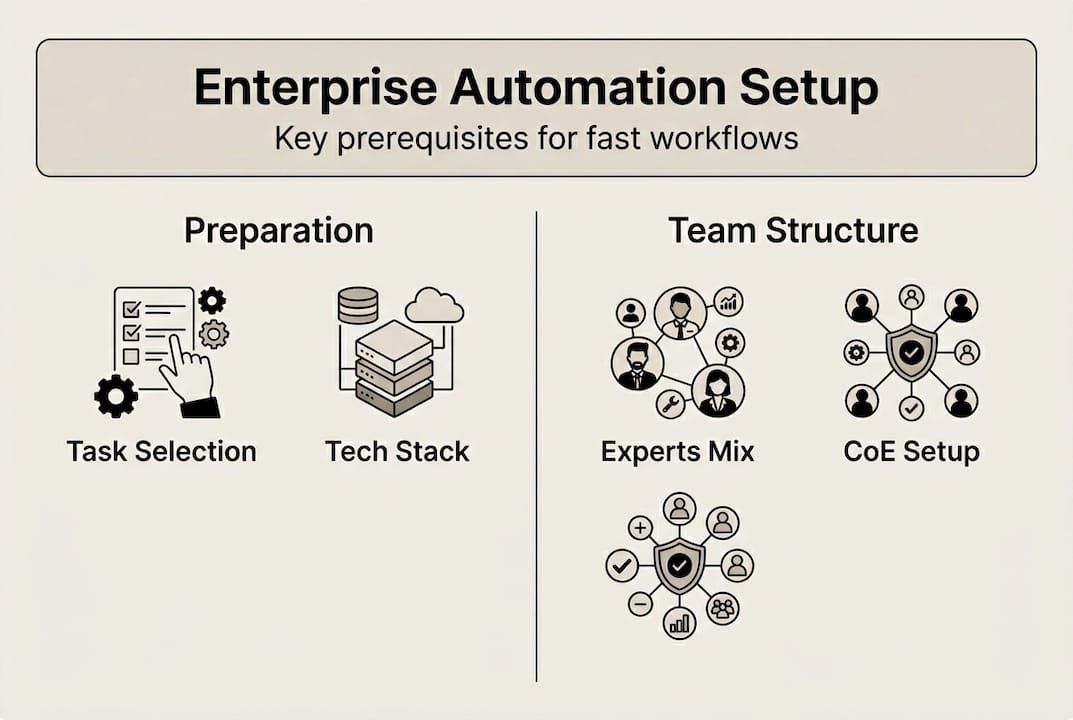
Establish a Center of Excellence to govern automation initiatives across departments. The CoE defines standards, shares best practices, manages vendor relationships, and tracks portfolio performance. This centralized approach prevents redundant efforts and ensures consistent quality as you scale automation across the organization.
Pro Tip: Start with a pilot project targeting a single high-impact process. Use this initial implementation to build internal expertise, refine your methodology, and demonstrate value before expanding to more complex workflows.
Implementing custom automation for complex workflows
Implementation transforms preparation into working automation. A structured approach balances speed with quality, delivering functional solutions while building capabilities for future projects. Break implementation into phases that allow testing, learning, and adjustment before full deployment.
Select modular automation tools supporting low-code or no-code development. These platforms accelerate delivery by providing pre-built connectors, templates, and visual workflow designers. You maintain flexibility to customize logic while avoiding the overhead of traditional software development. Evaluate platforms based on integration capabilities, scalability, security features, and vendor support.
Design workflows that clearly separate rule-based steps from decision points requiring judgment. Map each process stage, identifying where deterministic logic applies and where AI augmentation adds value. Document data flows, system interactions, error handling procedures, and rollback mechanisms. This blueprint guides development and serves as operational documentation.
Implement automation iteratively through these phases:
- Build core workflow covering the happy path with standard inputs and expected outputs
- Add exception handling for known edge cases and error conditions
- Integrate monitoring to track performance, detect failures, and log decision points
- Conduct user acceptance testing with process owners validating outputs and usability
- Deploy to production with phased rollout and fallback procedures ready
Leverage AI modules for unstructured data and complex decision making. Natural language processing extracts meaning from emails and documents. Computer vision interprets images and PDFs. Machine learning models predict outcomes based on historical patterns. These capabilities extend automation beyond simple task execution into intelligent process orchestration.

Consider this comparison of automation approaches:
| Approach | Best For | Implementation Speed | Error Rate | Maintenance |
|---|---|---|---|---|
| Pure RPA | Structured data, fixed rules | Fast (2-4 weeks) | Very low (0.1%) | Low |
| RPA + AI | Mixed data types, some judgment | Medium (6-8 weeks) | Low (1-2%) | Medium |
| Custom AI | Unstructured data, complex decisions | Slow (12+ weeks) | Medium (3-5%) | High |
| Hybrid platform | Enterprise-wide, varied processes | Medium (4-6 weeks) | Low (0.5-1%) | Low |
Research shows low-code automation reduced lead processing time from 185 seconds manually to just 1.23 seconds automated, a 151x improvement. This dramatic acceleration comes from eliminating manual handoffs, reducing data entry errors, and enabling parallel processing. Your implementation should target similar order-of-magnitude improvements for maximum impact.
Pro Tip: Build reusable components for common operations like data validation, system authentication, and notification delivery. This component library accelerates future projects and ensures consistency across your automation portfolio.
Mitigating failures and managing edge cases in automation
Automation failures typically stem from unexpected inputs, system changes, or edge cases not addressed during design. Robust automation anticipates these scenarios and includes mechanisms to detect, handle, and learn from exceptions. Your strategy for managing failures determines whether automation scales successfully or requires constant manual intervention.
Edge cases represent the primary challenge in production automation. Studies indicate edge cases cause 80% of failures in enterprise AI systems. These uncommon scenarios fall outside normal operating parameters but occur frequently enough to disrupt operations. A single unhandled edge case can cascade into broader system failures or require extensive manual cleanup.
Implement comprehensive observability to detect failures early. Monitor key metrics including:
- Process completion rates showing the percentage of workflows finishing successfully
- Execution times revealing performance degradation or bottlenecks
- Error frequencies by type, highlighting patterns requiring attention
- Data quality scores measuring input validity and output accuracy
- System health indicators tracking API availability and resource utilization
Configure alerts that notify operators when metrics exceed thresholds. Real-time visibility lets you address issues before they impact business operations or customer experience. Dashboards should provide both high-level status and drill-down capabilities for troubleshooting.
Design flexible business rules that adapt to changing conditions. Hard-coded logic breaks when business requirements evolve, requiring developer intervention for simple adjustments. Instead, externalize rules into configuration files or rule engines that business users can modify. This approach reduces maintenance overhead and accelerates response to market changes.
Incorporate human oversight at critical decision points. Automation handles routine cases efficiently, but complex or high-stakes decisions benefit from human judgment. Structure workflows so exceptions route to qualified personnel with context needed to resolve issues quickly. Track these interventions to identify patterns suggesting rule refinements or additional training data.
Generate synthetic data sets to improve AI training for rare scenarios. Real-world data often lacks sufficient examples of edge cases for models to learn effective handling. Synthetic data creation tools produce realistic variations that expand training sets without compromising privacy or security. This technique particularly benefits fraud detection, anomaly identification, and safety-critical applications.
“The most successful automation initiatives treat failures as learning opportunities. Each exception provides data to refine rules, improve models, and enhance resilience. Organizations that systematically capture and analyze failure modes build increasingly robust automation over time.”
Document every edge case encountered and the resolution applied. This knowledge base guides future implementations and helps new team members understand system behavior. Regular reviews of exception patterns reveal opportunities to expand automation coverage or simplify processes that generate excessive exceptions.
Consider implementing modular AI software development approaches that isolate failure domains. When one module encounters an issue, other components continue operating normally. This architectural pattern improves overall system availability and simplifies troubleshooting.
Pro Tip: Establish a monthly edge case review meeting where the automation team analyzes recent exceptions, discusses resolution strategies, and prioritizes system enhancements. This practice transforms reactive firefighting into proactive system improvement.
Measuring success: ROI and outcome verification
Measuring automation success requires looking beyond simple activity counts to understand true business impact. Comprehensive ROI analysis examines multiple dimensions including cost savings, quality improvements, speed gains, and strategic enablement. This holistic view justifies continued investment and guides optimization efforts.
Define metrics aligned with business objectives before deployment. Common automation KPIs include:
- Cycle time reduction measuring how much faster processes complete
- Error rate improvement comparing manual versus automated accuracy
- Labor cost savings quantifying hours freed for higher-value work
- Throughput increase showing volume capacity gains
- Compliance enhancement tracking regulatory adherence improvements
- Customer satisfaction reflecting experience improvements from faster, more accurate service
Apply stepwise verification after each deployment phase:
- Baseline measurement capturing pre-automation performance across all defined metrics
- Pilot validation confirming the solution works as designed in controlled conditions
- Parallel operation running automated and manual processes simultaneously to verify equivalence
- Production monitoring tracking live performance and comparing against baseline targets
- Continuous optimization identifying improvement opportunities based on operational data
Use comparison tables to communicate results clearly to stakeholders:
| Metric | Before Automation | After Automation | Improvement |
|---|---|---|---|
| Average cycle time | 4.2 hours | 8 minutes | 97% reduction |
| Error rate | 3.8% | 0.2% | 95% improvement |
| Monthly throughput | 1,200 transactions | 8,500 transactions | 608% increase |
| FTE hours saved | 0 | 520 hours/month | $31,200/month |
| Customer satisfaction | 72% | 89% | 24% increase |
Benchmark ROI through a complete business case including labor savings, quality improvements, speed benefits, and strategic advantages. Calculate total cost of ownership covering licensing, implementation, training, and ongoing maintenance. Compare this investment against quantified benefits over a three to five year horizon.
Communicate ROI to stakeholders using their language and priorities. Executives care about strategic impact and competitive advantage. Department heads focus on operational efficiency and team productivity. Finance emphasizes cost reduction and payback periods. Tailor your reporting to address each audience’s concerns while maintaining consistent underlying data.
Track leading indicators that predict long-term success. Automation adoption rates, user satisfaction scores, and exception handling efficiency signal whether the solution will deliver sustained value. Declining adoption or rising exception rates suggest issues requiring attention before they impact ROI.
Integrate automation metrics into existing business intelligence platforms. This integration provides context by showing how process improvements affect broader organizational performance. Executives can see connections between automation investments and customer retention, revenue growth, or market share gains.
Consider strategic benefits that resist easy quantification but deliver significant value. Automation frees skilled workers from repetitive tasks, enabling them to focus on innovation, customer relationships, and strategic initiatives. Faster processes improve market responsiveness and competitive positioning. Enhanced data capture enables better analytics and decision making. Include these qualitative benefits in ROI discussions.
Connect automation outcomes to customer relationship management improvements when processes directly impact customer experience. Faster response times, more accurate information, and consistent service quality strengthen customer relationships and support revenue growth.
Pro Tip: Focus ROI discussions on process cycle time rather than task completion counts. Stakeholders care about how quickly customer requests resolve or how fast products reach market, not how many individual steps automation completes. Frame benefits in terms of business outcomes, not technical achievements.
Explore custom automation solutions from Bitecode
Transforming complex workflows into efficient automated processes requires the right technology foundation and implementation expertise. Bitecode specializes in delivering modular, customizable automation platforms designed specifically for medium to large enterprises undergoing digital transformation. Our approach combines rapid deployment with deep customization capabilities, letting you start with up to 60% of your baseline system pre-built while tailoring the solution to your unique requirements.
Our enterprise automation solutions provide the flexibility to address varied workflow complexity across departments. Whether you need RPA for structured processes or AI-powered assistants handling unstructured data and complex decisions, our modular architecture adapts to your specific challenges. Integration with custom CRM software ensures automation aligns seamlessly with your customer processes and business systems. We partner with your team throughout implementation, helping you build internal capabilities while delivering production-ready solutions that scale with your organization.
FAQ
What types of tasks are best suited for enterprise automation?
High-frequency, rule-based tasks with structured data offer the clearest automation ROI. Look for processes occurring 20 or more times weekly that follow consistent logic and use standardized data formats. Invoice processing, data entry, report generation, and approval routing typically fit this profile perfectly. Complex tasks involving unstructured data or contextual judgment benefit from AI augmentation rather than pure RPA.
How can we handle exceptions and edge cases in automation workflows?
Implement comprehensive observability to detect failures early, then use flexible business rules that adapt to changing conditions. Route complex exceptions to qualified personnel through human-in-loop processes that provide necessary context for quick resolution. Generate synthetic data sets to improve AI training for rare scenarios that lack sufficient real-world examples. Document every edge case and resolution to build organizational knowledge over time.
What metrics should we use to measure automation success?
Measure cycle time reduction, error rate improvement, labor cost savings, and strategic impact rather than simple activity counts. Track how much faster processes complete, how accuracy improves, and how many hours free up for higher-value work. Include throughput increases, compliance enhancements, and customer satisfaction improvements in your ROI analysis. Leading indicators like adoption rates and exception handling efficiency predict long-term success and highlight issues requiring attention.
How long does enterprise automation implementation typically take?
Implementation timelines vary based on workflow complexity and chosen approach. Pure RPA for structured processes typically takes 2 to 4 weeks from design to deployment. Hybrid solutions combining RPA with AI modules require 6 to 8 weeks for development and testing. Custom AI implementations handling highly complex decisions may need 12 or more weeks. Low-code platforms with modular components often deliver enterprise-wide solutions in 4 to 6 weeks while maintaining customization flexibility.
What organizational structure supports successful automation scaling?
Establish a Center of Excellence that governs automation initiatives across departments. This centralized team defines standards, shares best practices, manages vendor relationships, and tracks portfolio performance. Combine IT expertise, process knowledge, and business stakeholders in cross-functional teams for each project. Build reusable component libraries that accelerate future implementations and ensure consistency. Regular edge case review meetings transform reactive troubleshooting into proactive system improvement.