TL;DR:
- Effective automation prioritizes high-return, repeatable, rules-based processes while reserving humans for high-stakes decisions.
- Proper planning includes assessing costs beyond implementation, such as maintenance, data quality, and governance.
- Focused, disciplined automation reduces operational risk and delivers sustainable ROI over volume-driven approaches.
Automation has become one of the most debated priorities in enterprise IT, yet a persistent misconception continues to slow progress: that automation simply means replacing workers with software. The actual opportunity is far more strategic. Organizations that treat automation as a blunt instrument, applying it broadly without a clear framework, tend to generate complexity rather than efficiency. Those that prioritize carefully, targeting repeatable work for full automation and reserving human judgment for high-stakes decisions, are the ones achieving measurable operational gains. This article offers a practical framework for IT leaders navigating that distinction, covering where to start, what to expect, and how to avoid the traps that derail most automation initiatives.
Key Takeaways
| Point | Details |
|---|---|
| Strategic automation focus | Prioritize repeatable, high-volume tasks for automation and reserve complex or critical work for human oversight. |
| Data-driven prioritization | Use data on frequency, value, and risk to decide what, when, and how to automate. |
| Consider long-term costs | Account for integration, data governance, and monitoring as permanent costs, not just one-time expenses. |
| Frameworks drive results | A structured approach outperforms generic, volume-driven automation every time. |
What does it mean to prioritize automation?
Prioritizing automation is not about finding every manual step and eliminating it. It is about identifying which processes, if automated, would generate the highest return on efficiency, consistency, or risk reduction. For medium to large enterprises, the scope of potential automation is vast, which makes undisciplined approaches especially costly.
The distinction that matters most is between automating and augmenting. Full automation works well for tasks that are high-frequency, rules-based, and predictable. Think invoice processing, compliance data collection, or system health monitoring. These are areas where software can operate without meaningful error risk and where speed is a direct business advantage.
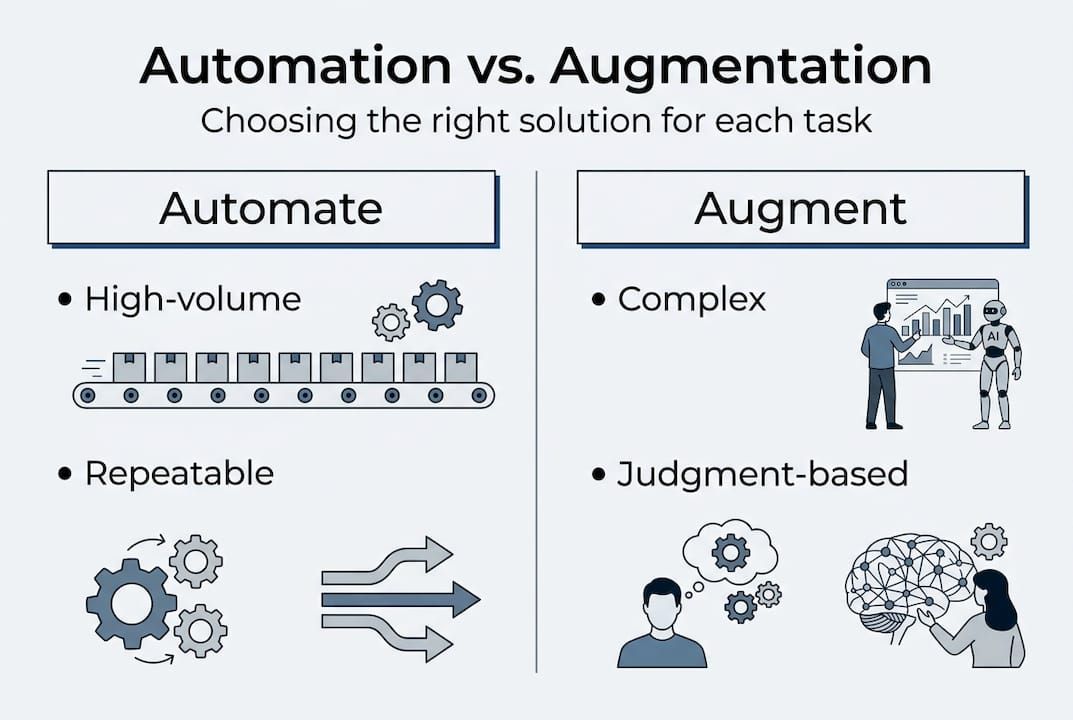
Augmentation is different. It applies technology to support, not replace, human decision-making in contexts where the stakes are high and the judgment required is nuanced. Fraud assessment, contract negotiation, and strategic vendor decisions all fall into this category. As when to automate vs. augment guidance from Harvard Business School makes clear, strategic automation should focus on repetitive and predictable tasks for full automation, while routing high-value and risk-intensive areas toward human augmentation.
Exploring key automation strategies for enterprises reveals that the highest-performing organizations are not the ones automating the most processes. They are the ones being selective. The types of business automation available today range from robotic process automation (RPA) to AI-assisted decisioning, and each serves a different operational purpose.
So where should teams begin? The clearest signal is measurable inefficiency or documented risk. Processes that rely on repetitive human input, produce inconsistent outputs, or require significant exception handling are strong candidates. Here is a practical starting checklist:
- Processes with more than 50 manual steps per cycle
- Tasks where error rates exceed acceptable tolerance
- Workflows that create downstream bottlenecks
- Compliance activities requiring frequent data reconciliation
- Reporting cycles dependent on manual data aggregation
Pro Tip: Before expanding automation scope, map your current process to identify exactly where human intervention adds value and where it only adds delay. This single exercise often surfaces the highest-ROI automation targets.
“Strategic automation separates the mundane from the mission-critical. The question is never whether to automate, but where automation creates leverage and where human judgment creates safety.”
Making the case: Why prioritization matters
Having defined prioritization in automation, it is crucial to understand why this approach delivers better results than ad-hoc or blanket automation. Organizations that automate without a clear prioritization framework often see initial gains followed by growing operational debt: brittle integrations, unmaintained workflows, and staff who work around systems rather than with them.
The contrast between focused and unfocused automation is measurable. As strategic automation guidance from HBS affirms, disciplined prioritization ensures automation ROI by targeting the right tasks rather than maximizing coverage.
| Outcome area | Prioritized automation | Unfocused automation |
|---|---|---|
| Speed of deployment | Faster, scoped rollouts | Delayed by scope creep |
| Error rates | Reduced through targeted design | Variable, often worsened |
| Staff adoption | Higher due to clear use cases | Low, workarounds emerge |
| Cost over 24 months | Predictable, declining | Rising due to maintenance |
| ROI timeline | 6 to 12 months average | Often 18 months or longer |
Building a sound prioritization approach does not require a lengthy consulting engagement. Most organizations can start with a focused process inventory. Here is a repeatable sequence that works across industries:
- Catalog all current workflows and classify them by frequency, volume, and error rate.
- Score each process by potential automation ROI using a simple impact-effort matrix.
- Identify integration dependencies and data quality requirements upfront.
- Pilot the top three candidates before committing to full deployment.
- Establish baseline metrics before launch so improvements can be measured objectively.
The ability to optimize workflow automation for scalable efficiency is directly tied to how well organizations execute this sequencing step. Teams that skip the scoring phase often find themselves automating the wrong things first, which creates resistance and inflates program costs. Understanding enterprise software best practices is equally important because automation does not operate in isolation; it depends on the broader system architecture to deliver reliable results.
Deciding what to automate versus augment
To maximize both impact and safety, you need a clear framework to guide what should be fully automated and where humans should remain in control. The most useful variable is task characteristics. Task characteristics including frequency, business value, and risk level are the primary determinants of whether a process should be automated or augmented.
| Task type | Frequency | Value | Risk | Recommended approach |
|---|---|---|---|---|
| Invoice processing | Very high | Low | Low | Full automation |
| Regulatory reporting | High | Medium | Medium | Automation with audit trail |
| Credit risk assessment | Medium | High | High | Human augmentation |
| Contract review | Low | Very high | Very high | Human led, AI assisted |
| System log monitoring | Very high | Medium | Medium | Full automation with alerts |
Several criteria reliably indicate when full automation is the right call:
- The process follows a documented, rule-based logic with few exceptions
- Output errors are detectable and reversible without serious downstream harm
- Volume is high enough that automation generates clear time or cost savings
- The data inputs are clean, consistent, and machine-readable
And when augmentation is preferable:
- The decision involves ethical, legal, or reputational considerations
- Outcomes require contextual judgment that rules cannot fully encode
- Errors carry significant financial, regulatory, or human consequences
- Stakeholder trust depends on visible human accountability
The compliance domain offers a useful test case. Automating compliance workflows for data collection and flagging can eliminate hours of manual work, but final sign-off decisions often benefit from a human review layer. The HBS automation framework supports this hybrid model as the most operationally sound approach for risk-sensitive environments.

Pro Tip: Use pilot projects as learning labs, not just proofs of concept. A six-week pilot in a bounded workflow teaches you more about integration complexity and edge case volume than months of planning can predict.
Challenges and hidden costs: What most automation projects miss
Even the best-designed automation plans face challenges, from hidden costs to ongoing operational demands, making it essential to consider these aspects upfront. Many organizations budget for the build phase of automation and underestimate what comes after: the permanent operational cost of keeping automated systems running, reliable, and aligned with changing business rules.
The most commonly underestimated costs include:
- Integration maintenance: Systems evolve, and every upstream API or data source change can break automated workflows if not monitored proactively.
- Data quality remediation: Automation amplifies data quality issues. Garbage inputs produce garbage outputs at scale, often faster than teams can catch.
- Governance and compliance overhead: Automated decisions require audit trails, access controls, and documentation to satisfy regulatory requirements.
- Model drift (for AI-assisted automation): Predictive or AI-driven automation requires ongoing validation to ensure outputs remain accurate as conditions change.
- Exception handling capacity: Even highly automated workflows produce exceptions. Teams need a defined process and sufficient capacity to resolve them quickly.
The risks extend beyond cost. Agentic AI challenges research from MIT Sloan highlights that agentic systems require ongoing oversight, data governance, workflow integration, and monitoring, costs that are consistently underestimated during project scoping.
“The real price of automation is not what you pay to build it. It is what you pay every month to keep it trustworthy.”
Organizations that approach mastering automation processes for complex workflows understand this early and build operational support into their initial business cases. When evaluating automation costs and ROI, teams that include the full operational picture consistently outperform those that treat automation as a one-time capital expense. Evidence across financial services and operations indicates that automation cost savings are real, but they require a realistic accounting of the total cost of ownership to hold up over time.
Why conventional approaches to automation may fall short
The instinct in most enterprise automation programs is to scale coverage: more processes, more integrations, more workflows running without human intervention. This volume-based thinking is where many programs quietly accumulate debt. Each new automated workflow adds a dependency. Each dependency adds a failure point. Each failure point requires monitoring, exception handling, and eventually remediation. The result is not operational efficiency; it is operational fragility dressed in efficiency’s clothing.
The organizations that generate lasting ROI from automation are not the most aggressive adopters. They are the most disciplined ones. They pilot before scaling. They measure baseline performance before making claims of improvement. They apply effective automation frameworks that treat automation as a portfolio of targeted interventions, not a single organizational transformation.
The hard-won lesson is straightforward: automate to reduce specific, documented inefficiencies. Augment to make better decisions in high-stakes contexts. Do both with the rigor you would apply to any capital investment. Volume without validation does not accelerate transformation. It accelerates chaos.
Pro Tip: Set a clear success metric for every automation initiative before launch. If you cannot define what good looks like in measurable terms, the initiative is not ready to run.
Accelerate transformation with expert automation solutions
If you are ready to apply these principles to your organization, expert tools and guidance are within reach. Translating a prioritization framework into working software requires both domain knowledge and technical infrastructure that most enterprise IT teams cannot build from scratch quickly enough to stay competitive.
Bitecode’s AI automation modules and custom CRM automation are built for exactly this context: tailored, modular systems that allow organizations to deploy automation across workflows without starting from zero. With up to 60% of baseline infrastructure pre-built, Bitecode reduces the time and cost required to move from strategy to production. Whether your focus is workflow automation, financial processing, or compliance integration, the platform’s modular approach means faster delivery without sacrificing control or scalability.
Frequently asked questions
What tasks should be prioritized for automation first?
High-frequency, low-value tasks benefit most from early automation, particularly repetitive processes where errors are detectable and the volume is high enough to generate meaningful time savings.
How do I avoid hidden costs when implementing automation?
Evaluate ongoing needs like data governance, integration upkeep, and monitoring as part of your initial business case, not as afterthoughts, since agentic AI automation introduces permanent cost considerations well beyond initial deployment.
Can all business processes be fully automated?
Not all processes are good candidates. Tasks requiring judgment, ethical accountability, or high-risk decision-making are better suited for human augmentation where technology supports rather than replaces human oversight.
What’s the difference between automating and augmenting a process?
Automating replaces human steps in predictable, rules-based work, while augmenting uses technology to enhance human decision-making in complex or high-stakes contexts without removing human accountability from the outcome.