Choosing the wrong automation type does not just slow a project down. It burns budget, frustrates teams, and leaves the organization no closer to the efficiency gains that justified the investment in the first place. With options ranging from simple task scripts to agentic AI systems capable of autonomous reasoning, executives and IT leaders face a genuinely complex selection problem. This guide maps every major automation type to the enterprise scenarios where it delivers real value, backed by current ROI benchmarks and practical selection criteria, so your team can move from evaluation to execution with confidence.
Key Takeaways
| Point | Details |
|---|---|
| Match type to process | Choosing the correct automation type for each process drives faster returns and reduces risk. |
| Hybrid strategies win | Combining automation types and orchestrating their use is now the gold standard in leading enterprises. |
| ROI is rapid | Most automation projects in large organizations produce payback in a year and deliver substantial cost savings. |
| Governance is critical | Establishing clear management and phased rollouts prevents pitfalls like uncontrolled bot sprawl. |
| Stay future-focused | Enterprise automation is evolving fast; emerging AI-driven agents and hyperautomation will impact most new business initiatives. |
How to select the right automation type
Before exploring each automation type in depth, it is essential to understand the key factors that drive good selection decisions. Not every process is a candidate for the same tool, and mismatches between automation type and process characteristics are the leading cause of failed deployments.
A solid selection framework rests on four process dimensions. According to a decision tree for matching automation types to process characteristics, the most reliable criteria are:
- Process frequency: High-volume, repetitive tasks justify the setup cost of RPA or IDP; low-frequency tasks rarely do.
- Rule stability: Processes with stable, well-documented rules are ideal for task automation or RPA. Processes with frequent exceptions need IPA or BPM.
- Data structure: Structured data (spreadsheets, databases) suits RPA and task automation. Unstructured data (PDFs, emails, contracts) requires IDP or AI-driven tools.
- Integration needs: Legacy system integration without APIs points toward RPA. Modern API-rich environments open the door to workflow automation and DPA platforms.
Strategic automation programs, such as enterprise automation strategies built around BPM or hyperautomation, require a different governance model than tactical RPA deployments. Phased rollouts with ROI gating at each stage reduce risk and build internal confidence. Reviewing business process automation criteria from Gartner provides a useful baseline for structuring that evaluation. Teams building scalable automation solutions should also factor in long-term maintainability, not just initial deployment speed.

Pro Tip: Start with high-volume, rules-based processes. They deliver the fastest measurable gains and build the organizational credibility needed to fund more complex automation initiatives later.
Core types of business automation: from task to hyperautomation
With the criteria in hand, let’s walk through the automation spectrum, from foundational tools to the cutting edge. Gartner business process automation defines the landscape as spanning nine distinct categories, each with a different risk and reward profile.
- Task automation: Scripts or no-code tools that handle discrete, repeatable digital steps. Low cost, fast to deploy, limited scope.
- Workflow automation: Routes approvals, notifications, and handoffs using BPM-style logic. Ideal for HR onboarding, procurement sign-offs, and compliance workflows.
- Robotic process automation (RPA): Software bots mimic human interactions on legacy systems. Best for structured, high-volume work where no API exists. See workflow automation efficiency for deployment patterns.
- Intelligent document processing (IDP): Combines OCR, machine learning, and NLP to extract and validate data from unstructured documents. IDP benchmarks show 85 to 98% straight-through processing rates on complex documents.
- Intelligent process automation (IPA): Merges RPA with AI and ML to handle cognitive tasks and manage exceptions that rule-based bots cannot resolve.
- Business process management (BPM): A strategic discipline for modeling, optimizing, and governing end-to-end business flows. Less a tool, more an operating model.
- Digital process automation (DPA): Automates customer-facing digital journeys, typically using low-code platforms with strong UX capabilities.
- Hyperautomation: An orchestrated combination of process mining, RPA, AI, and low-code tools. Automation ROI data from Forrester points to hyperautomation as the dominant enterprise strategy through 2026.
- Agentic AI: Autonomous LLM-driven agents capable of reasoning and dynamic planning. Enterprise adoption remains below 15% by 2026, making it high-risk but high-reward for early movers. Explore automation types overview for context on where agentic AI fits.
“The organizations that will lead in automation are not those that deploy the most bots, but those that match the right tool to the right process at the right time.”
Automation types at a glance: key features and ideal use cases
Having explained each type, here is a quick-reference summary to help narrow your shortlist.
| Automation type | Integration complexity | Typical ROI/payback | Data handling | Human intervention | Best-fit scenario |
|---|---|---|---|---|---|
| Task automation | Low | 3-6 months | Structured only | Minimal | Repetitive desktop tasks |
| Workflow automation | Medium | 6-12 months | Structured | Low | Approvals, routing |
| RPA | Medium-High | 6-12 months | Structured | Low-Medium | Legacy system data entry |
| IDP | High | 9-18 months | Unstructured | Low | Invoice, contract processing |
| IPA | High | 12-24 months | Mixed | Medium | Exception handling, decisions |
| BPM | High | 12-24 months | Mixed | Medium | End-to-end process governance |
| DPA | Medium | 6-12 months | Structured | Low | Customer journey automation |
| Hyperautomation | Very High | 18-36 months | Mixed | Low-Medium | Enterprise-wide transformation |
| Agentic AI | Very High | Emerging | Unstructured | Variable | Dynamic, reasoning-heavy tasks |
For teams prioritizing by department, the shortlist looks like this:
- Finance: IDP and RPA for invoice processing, reconciliation, and compliance reporting.
- HR: Workflow automation and IPA for onboarding, benefits administration, and policy exceptions.
- Operations: Hyperautomation for supply chain, logistics, and cross-functional process orchestration.
McKinsey research finds that 60% of occupations have 30% or more of their activities automatable with current technology. That represents a significant untapped ROI pool for organizations that have only scratched the surface. Teams managing complex automation processes will find the table above a useful starting point for scoping initiatives.
ROI and risk: what the data reveals about automation in 2026
Once you have candidates, it is crucial to weigh both the upside and the realities of automation investments. The numbers are compelling, but context matters.
RPA delivers 6 to 12 month payback periods and 100 to 300% ROI over three years under typical enterprise conditions. IDP applied to complex documents achieves 85 to 98% straight-through processing, dramatically reducing manual review costs. Hyperautomation programs targeting end-to-end process transformation have demonstrated 30% operational cost reductions in mature deployments.
The process-level ROI picture is even sharper. Invoice processing automation yields 300 to 500% ROI, employee onboarding automation delivers 150 to 300%, and high-volume data entry automation has reached 847% ROI in documented cases. Teams focused on automating financial transactions consistently report the fastest payback cycles.
Risk, however, is real. RPA is particularly vulnerable to “robot sprawl,” where unmanaged bot proliferation creates a brittle, unmaintainable automation estate. Processes that change frequently break bots and generate hidden maintenance costs that erode ROI. IPA and hyperautomation carry higher upfront complexity and require stronger governance structures to deliver on their promise.
Pro Tip: Score every automation candidate on four dimensions before committing: rule stability, process frequency, data structure, and transaction volume. Processes that score high on all four are your safest first investments.
How enterprises are combining automation types for maximum impact
Forward-thinking enterprises are combining automation types to scale results and reduce risk. Single-tool strategies rarely survive contact with real enterprise complexity.
Hybrid RPA and IDP deployments consistently outperform single-tool approaches for document-heavy and workflow-intensive functions. RPA handles the structured data movement while IDP extracts and validates the unstructured inputs, creating a pipeline that neither tool could manage alone. Adding BPM governance on top of that pipeline turns a tactical win into a strategic capability.
Hyperautomation takes this further by orchestrating legacy tools, AI models, and low-code platforms under a unified process mining layer. The key enabler is a Center of Excellence (CoE), an internal governance body that owns automation standards, manages the bot portfolio, and gates new initiatives through a consistent ROI framework. Without a CoE, hyperautomation programs tend to replicate the sprawl problems that plague unmanaged RPA estates.
Key practices from high-performing automation programs include:
- Pilot before scaling: Run a 90-day proof of concept on a single high-value process before committing to platform-wide rollout.
- Instrument everything: Measure bot performance, exception rates, and maintenance hours from day one to catch ROI erosion early.
- Plan for human-AI handoffs: Even AI-powered automation systems require defined escalation paths for edge cases that exceed model confidence thresholds.
Agentic AI represents the next frontier, but Forrester’s 2026 predictions on automation governance caution that autonomous agents require robust guardrails before enterprise deployment. The reward is significant for organizations willing to invest in the governance infrastructure. Explore AI-driven workflow automation to understand where these capabilities are maturing fastest.
Accelerate your enterprise automation strategy with Bitecode
If you are ready to put these automation strategies into play, Bitecode is built to help organizations move from assessment to deployment without the typical 12-month build cycles. The platform’s modular architecture means up to 60% of your baseline system arrives pre-built, so teams spend time configuring and refining rather than building from scratch.
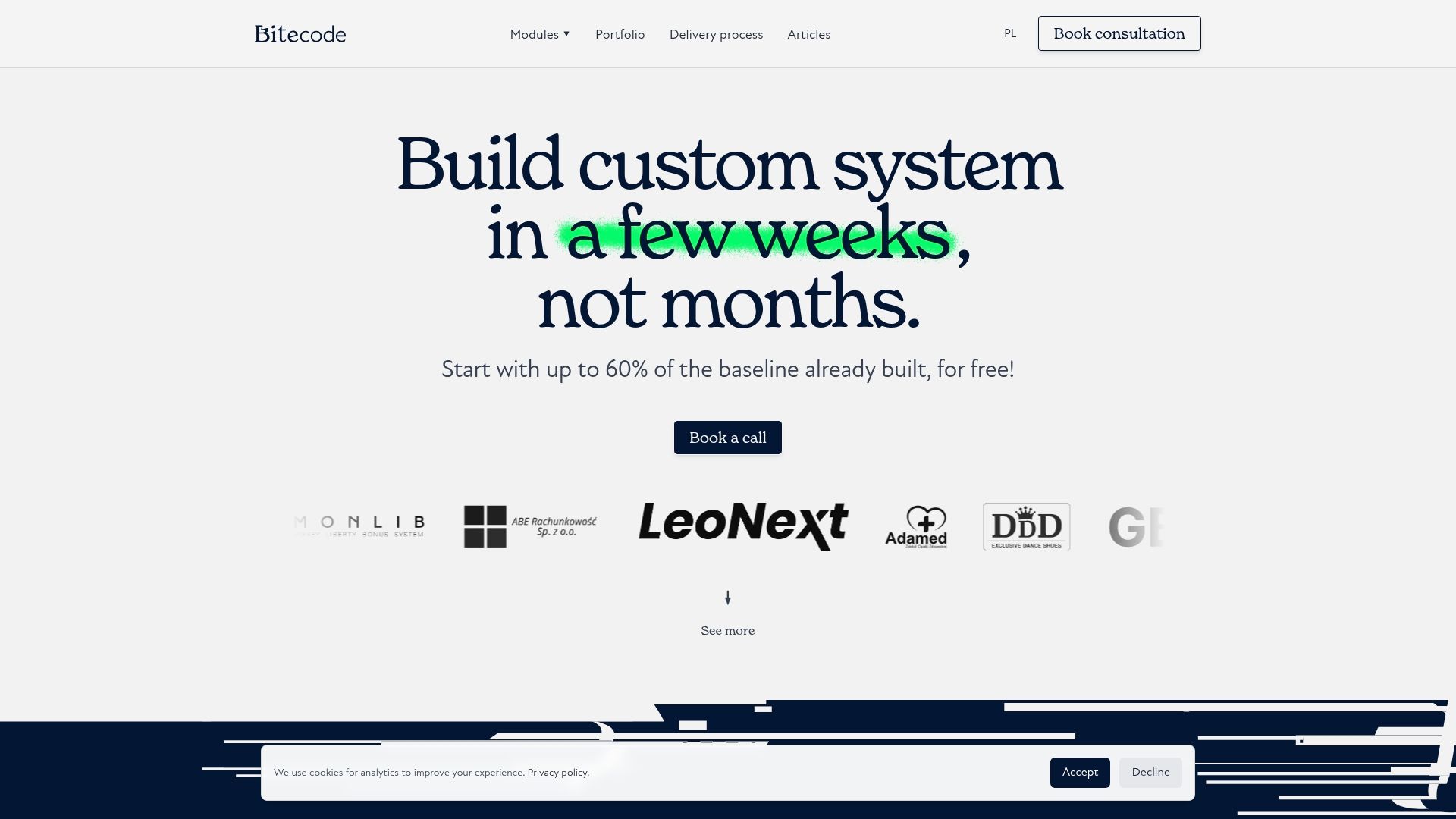
Bitecode’s enterprise automation solutions cover the full spectrum from workflow automation to advanced AI integration, with modules designed for financial processing, compliance workflows, and cross-functional orchestration. The AI-powered automation module supports IPA and agentic AI use cases, while custom CRM solutions connect automation directly to customer-facing processes. For organizations that need a strategic partner rather than just a vendor, Bitecode provides the technical depth and modular flexibility to match the right automation type to every process in your portfolio.
Frequently asked questions
What business processes are best suited for automation?
High-volume, rules-based tasks in finance, HR, and operations are ideal starting points because they deliver measurable ROI quickly and carry lower implementation risk than complex, judgment-heavy processes.
How does hyperautomation differ from RPA?
RPA automates specific rule-based tasks using software bots, while hyperautomation orchestrates RPA, AI, process mining, and low-code tools into a coordinated, enterprise-wide automation strategy.
How quickly can ROI be seen with business automation?
Most automation projects deliver 6 to 12 month paybacks and can generate 100 to 300% ROI within three years, with finance and data entry processes often reaching returns well above that range.
Are there any risks or challenges in business automation?
Poor governance, robot sprawl, and brittle bots are the most common failure modes. Phased rollouts and governance structures like Centers of Excellence significantly reduce these risks and protect long-term ROI.
Recommended
- Top automation strategies for enterprises to boost efficiency
- Master enterprise automation processes in 2026: 151x faster
- Smart contract automation guide for business leaders 2026
- Automate financial transactions: boost efficiency by 40%
- Workflow For Forex Automation: Step-by-Step Trading Setup
- Why use online reservation systems to boost efficiency