Accounts payable automation delivers a 111% ROI with under six months payback, yet 42% of organizations still struggle to close their books on time. That gap tells you something important: knowing automation works and actually deploying it at scale are two very different challenges. Financial process automation (FPA) is the systematic use of technology to handle repetitive, rule-based finance tasks, from invoice processing to reconciliation and reporting. This guide walks financial decision-makers and IT professionals through exactly how FPA works, what it costs, where it breaks down, and how to build something that actually scales.
Key Takeaways
| Point | Details |
|---|---|
| Automation delivers strong ROI | Financial process automation can generate over 100% ROI and significantly reduce processing times. |
| Start small, scale wisely | Begin with automating high-volume tasks like AP/AR for quick impact, then expand strategically. |
| Challenges need careful planning | Scaling automation requires robust data governance, process redesign, and diligent management of edge cases. |
| Custom solutions drive scalability | Custom integrations and composable architectures set the foundation for successful, organization-wide automation. |
| Measuring success goes beyond time saved | Track compliance improvements, forecast accuracy, and change management effectiveness for holistic results. |
What is financial process automation?
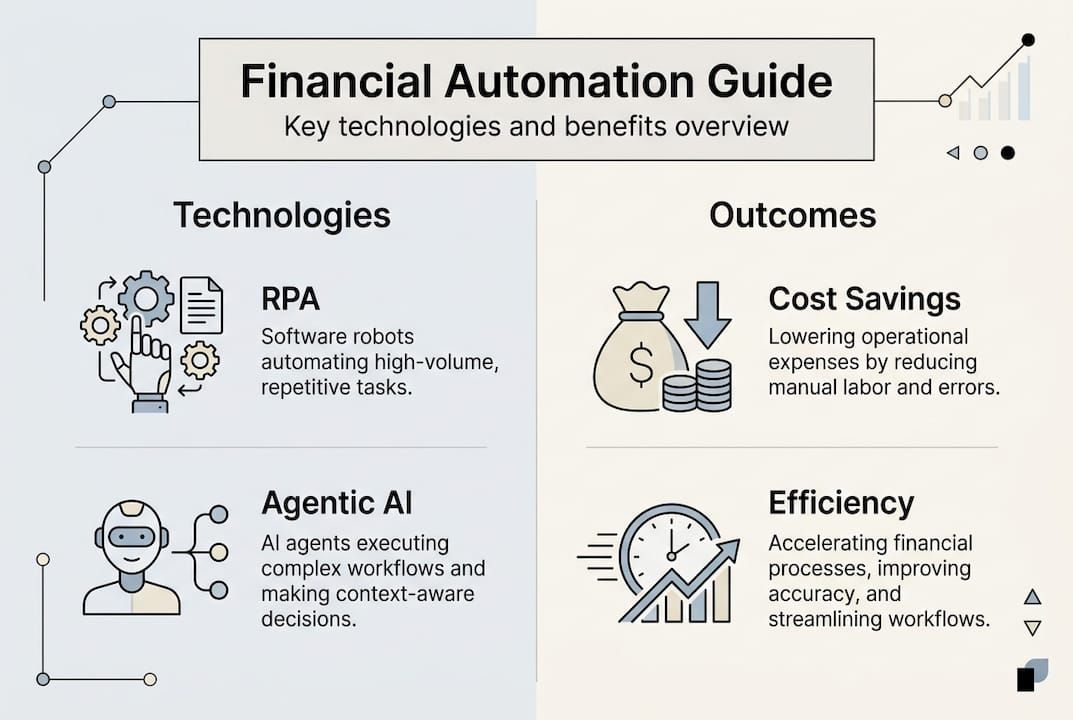
Financial process automation is not a single tool. It is a category of technologies applied to the finance function to reduce manual effort, improve accuracy, and accelerate cycle times. According to Gartner’s finance technology framework, FPA covers robotic process automation (RPA), artificial intelligence (AI), machine learning (ML), and hyperautomation applied to tasks like accounts payable and receivable, financial close, reconciliations, invoicing, and regulatory reporting.
The scope is broader than most teams initially expect. FPA does not just speed up existing workflows. It restructures them. When you automate invoice matching, for example, you are not just removing a manual step. You are creating a data trail, enforcing rules consistently, and freeing your finance team to focus on judgment-intensive work.
Typical tasks covered by FPA include:
- Invoice capture and three-way matching
- Payment processing and approval routing
- Bank reconciliation and intercompany eliminations
- Month-end close task management
- Financial reporting and variance analysis
- Tax calculation and compliance filings
- Expense report processing and audit trails
For a deeper look at how these systems fit into broader enterprise infrastructure, the financial processing systems guide is a useful reference for IT leaders evaluating architecture options.
Core mechanics: Technologies and methodologies
Understanding what sits under the hood helps you make smarter build-versus-buy decisions. Gartner identifies three core layers in modern FPA: RPA for rule-based task execution, AI and ML for intelligent processing of unstructured data, and hyperautomation for orchestrating end-to-end workflows across systems.
Here is how those technologies compare in practice:
| Technology | Best for | Limitation |
|---|---|---|
| RPA | Structured, repetitive tasks | Breaks when UI or data format changes |
| AI / ML | Document extraction, anomaly detection | Requires clean training data |
| Hyperautomation | End-to-end process orchestration | Complex to govern and maintain |
The technology choice matters less than the methodology behind it. Deloitte’s financial close research consistently points to process redesign before automation, phased rollouts, data standardization, continuous close practices, and tight ERP integration as the factors that separate successful deployments from expensive failures.
A proven deployment sequence looks like this:
- Map and redesign the process before writing a single automation rule
- Standardize your data across source systems and ERP
- Pilot on one high-volume, low-risk process (AP invoice matching is a common starting point)
- Integrate with your ERP using APIs rather than screen scraping
- Expand in phases, adding AI layers after the RPA foundation is stable
- Build exception handling for edge cases from day one, not as an afterthought
Pro Tip: Agentic AI, which can reason through multi-step exceptions without human intervention, is becoming the differentiator in mature FPA programs. If your vendor cannot explain how their system handles an invoice with three mismatched fields and a missing PO number, that is a red flag.
For teams managing complex workflows beyond finance, the guides on enterprise automation processes and automation strategies for enterprises provide complementary frameworks. Organizations exploring blockchain-based settlement should also review the smart contract automation guide.
Measuring value: ROI, benchmarks, and outcomes
The numbers on FPA are compelling when you look at them carefully. Forrester’s benchmarks show 75% cost reduction in AP processing, 90% faster invoice cycle times, 150 to 300% ROI for accounts payable automation, 100 to 200% ROI for accounts receivable, and a 38% reduction in reconciliation time. These are not theoretical projections. They come from live deployments.

| Process | Typical ROI | Time savings | Payback period |
|---|---|---|---|
| Accounts payable | 150 to 300% | 90% faster invoicing | Under 6 months |
| Accounts receivable | 100 to 200% | 60 to 80% faster collections | 6 to 12 months |
| Bank reconciliation | 80 to 150% | 38% time reduction | 6 to 9 months |
| Financial close | 100 to 180% | 30 to 50% cycle reduction | 9 to 18 months |
But ROI is not the only metric worth tracking. Gartner’s digital finance transformation research emphasizes measuring forecast accuracy improvements, compliance rate changes, and audit readiness alongside time and cost savings. Organizations that only measure speed miss half the value story.
“Finance automation is not just about doing things faster. It is about creating a data infrastructure that makes better decisions possible.” This is the framing that separates strategic FPA programs from tactical cost-cutting exercises.
For teams building the business case, the workflow automation for ROI guide offers a practical measurement framework. The finance app module at Bitecode also provides pre-built reporting components that accelerate time-to-value on these metrics.
Challenges, risks, and scaling failures
Here is where most FPA programs run into trouble. The pilot works beautifully. The business case looks strong. Then you try to scale, and things get complicated fast.
Spend Matters research on AP automation at scale identifies the most common failure points: fragmented data across business units, compliance variances across jurisdictions, legacy system gaps that RPA cannot bridge cleanly, and AI risks including hallucinations and bias in document processing. These are not edge cases. They are the norm at organizations with more than a few hundred employees.
The most common scaling risks include:
- Data fragmentation: Multiple ERPs, inconsistent chart of accounts, and poor master data quality break automation rules
- Compliance variance: Tax rules, invoice formats, and reporting requirements differ by country and industry
- Legacy system brittleness: RPA bots fail when legacy UI changes, and many finance systems change frequently
- AI hallucinations: ML models trained on limited data can confidently produce wrong outputs on unusual documents
- Change resistance: Finance teams often see automation as a threat rather than a tool, slowing adoption
- Governance gaps: Without clear ownership of automation rules, bots drift out of alignment with business logic
SAPinsider’s analysis of AI transformation challenges notes a sharp divide between optimists who cite ROI and skeptics who warn about regulatory hurdles and the over-hyped promise of full AI autonomy. Both sides have valid points. The organizations that succeed treat AI as an augmentation layer, not a replacement for human judgment on complex decisions.
Pro Tip: Build exception queues into your automation from the start. Every automated process needs a clear escalation path for transactions it cannot handle. Teams that skip this step end up with a backlog of stuck transactions that nobody owns. For fraud-related exceptions, AI for fraud prevention covers detection approaches worth integrating early.
Practical strategies for scalable, custom automation
The organizations that get FPA right share a few common patterns. They start narrow, prove value fast, then expand deliberately. They treat data governance as a prerequisite, not an afterthought. And they allocate serious budget to change management.
Deloitte’s agentic AI research recommends starting with AP and AR because they offer the fastest ROI and the clearest process boundaries. Once those are stable, expand to record-to-report (R2R) and order-to-cash (O2C) cycles. Introduce agentic AI for exception handling after your base automation layer is clean.
Here is a practical implementation sequence:
- Audit your current processes and identify the top five by volume and error rate
- Clean your master data before automating anything that touches vendor or customer records
- Start with AP invoice automation for quick wins and measurable ROI
- Integrate via API with your ERP rather than building fragile screen-scraping bots
- Add AI-powered exception handling once your straight-through processing rate exceeds 70%
- Expand to AR, reconciliation, and close using the same governance model
- Build a center of excellence to own automation rules, monitor performance, and manage change
Gartner’s digital finance transformation guidance is direct on one point: allocate 30 to 40% of your total project budget to change management. That number surprises most IT teams, but the data backs it up. Technology failure is rarely the reason FPA programs stall. People and process failure is.
Critical success factors to keep on your checklist:
- Composable architecture: Avoid monolithic automation platforms that cannot adapt. Deloitte’s technology transformation research flags siloed RPA as a scalability trap
- Clean ERP as the system of record: Automation amplifies data quality problems, it does not fix them
- Phased governance model: Define who owns each automation rule and how it gets updated
- Continuous monitoring: Automation drift is real. Bots need the same maintenance attention as any software system
The automation module and AI assistant module at Bitecode are designed around exactly these principles, with composable components that integrate with existing ERPs rather than replacing them.
How Bitecode empowers your automation journey
Building scalable financial process automation from scratch takes time most organizations do not have. The challenges covered in this guide, from data governance to agentic AI exception handling, require both technical depth and financial domain expertise.
Bitecode starts your project with up to 60% of the baseline system already built, using modular components purpose-built for financial workflows, AI integration, and enterprise-grade scalability. The AI assistant module handles intelligent exception processing, while the automation module provides the workflow orchestration layer your finance team needs. Whether you are building a custom AP automation system, an AR reconciliation platform, or a full AI-powered financial operations suite, Bitecode delivers production-ready solutions without the 18-month development cycle. If you are ready to move from pilot to scale, this is where that conversation starts.
Frequently asked questions
What are the main benefits of financial process automation for large organizations?
FPA delivers 111% ROI and 90% faster invoice processing alongside measurable compliance improvements and stronger forecasting accuracy. Large organizations also gain audit-ready data trails that reduce regulatory risk.
Which financial processes should you automate first?
Start with AP and AR because they offer the clearest process boundaries and fastest payback periods. Once those are stable, expand to reconciliation, financial close, and reporting.
What risks should you watch for when scaling FPA?
Fragmented data and compliance variances are the most common scaling failure points, alongside legacy system brittleness and AI hallucinations on unusual documents. Build exception handling and governance into your architecture before you scale.
How should organizations measure the success of financial automation?
Track ROI, payback period, and time savings, but also measure forecast accuracy and compliance rates to capture the full value of your automation investment. Speed alone understates the strategic impact.
Recommended
- Financial processing systems: A guide for IT leaders
- Master enterprise automation processes in 2026: 151x faster
- Optimize workflow automation for 85% faster ROI in 2026
- Automation – speed up processes in your company | AI software development
- Avtomatizacija procesov: Povečajte učinkovitost in prihranke - ChatTrips