Financial processing systems are often misunderstood as simple accounting tools, but they actually serve as the strategic backbone connecting finance operations with IT infrastructure. These platforms handle everything from transaction processing and compliance automation to real-time reporting and blockchain integration. For IT managers at medium to large organizations, understanding how these systems work and what capabilities they offer is essential for making informed decisions about custom solutions, rapid deployment options, and long-term scalability. This guide breaks down the core components, explores automation and blockchain integration, and provides practical insights for deploying systems that meet your organization’s unique needs.
Key Takeaways
| Point | Details |
|---|---|
| Finance IT centralization | Financial processing systems unify finance and IT operations to create a single source of truth and smoother cross department collaboration. |
| Automation and ERP benefits | Automation and ERP platforms streamline processing, reduce manual work, and enhance real time visibility and compliance across the organization. |
| Blockchain integration tradeoffs | Blockchain can scale capabilities and transparency but introduces added complexity, cost, and regulatory considerations that must be weighed. |
| Rapid deployment agility | Fast deployment options support organizational agility and quicker realization of benefits without sacrificing security or governance. |
What financial processing systems are and why they matter
Financial processing systems serve as the backbone for transaction handling, automation, compliance, and reporting in modern organizations. These platforms go far beyond basic bookkeeping. They integrate with enterprise resource planning tools, customer relationship management systems, and payment gateways to create a unified environment where finance and IT teams can collaborate effectively. For medium to large organizations, this integration is critical because it eliminates data silos, reduces manual intervention, and ensures that financial data flows seamlessly across departments.
The strategic importance of these systems becomes clear when you consider their role in real-time decision making. When finance teams need instant visibility into cash flow, revenue forecasts, or expense patterns, they rely on processing systems that aggregate data from multiple sources and present it through intuitive dashboards. IT managers must ensure these systems are not only functional but also scalable, secure, and compliant with regulations like SOX and GDPR. The right platform can transform how your organization handles everything from invoice processing to multi-currency transactions.
Key components of modern financial processing systems include:
- ERP platforms that centralize financial data and automate core accounting functions
- API integrations that connect payment processors, banking systems, and third-party services
- Real-time dashboards that provide visibility into transactions, balances, and performance metrics
- Compliance modules that enforce regulatory requirements and audit trails
- Workflow automation tools that streamline approvals, reconciliations, and reporting
Understanding these components helps IT leaders evaluate financial software development options and determine which features align with organizational priorities. Whether you need a system that handles high transaction volumes, supports multiple currencies, or integrates with blockchain networks, the foundation starts with knowing what these platforms can and cannot do.
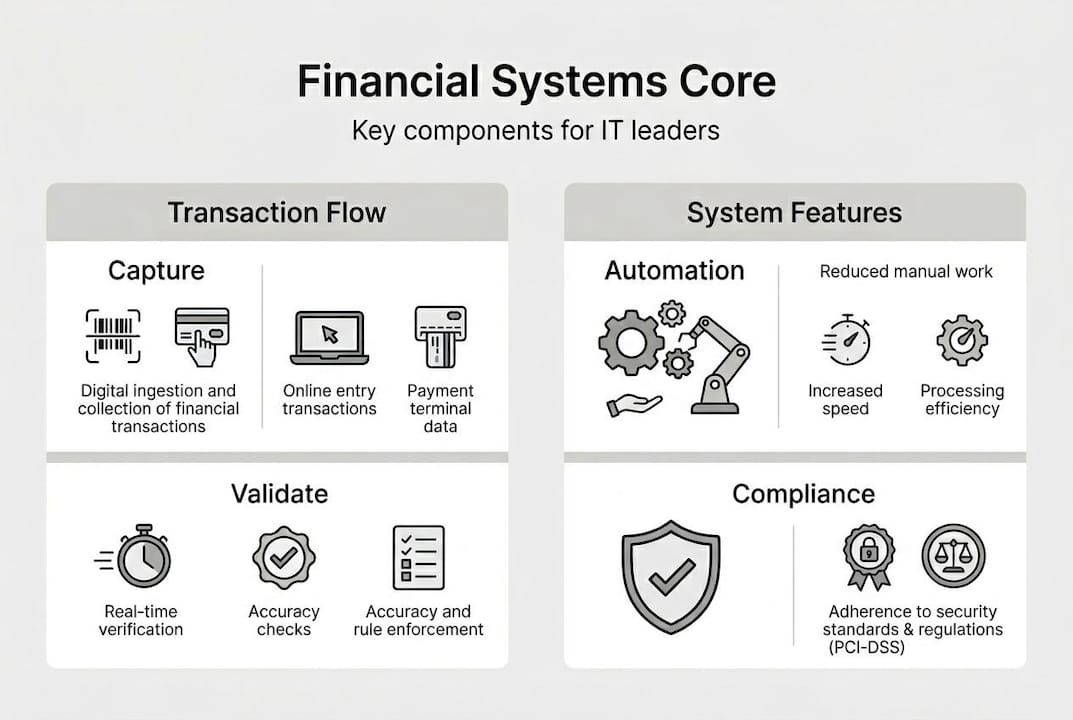
Core components and mechanics of modern financial processing systems
ERP platforms like NetSuite, SAP, and Workday form the foundation of most financial processing systems. These platforms centralize data from accounting, procurement, human resources, and other departments, creating a single source of truth for financial information. They automate routine tasks like journal entries, invoice matching, and financial close processes, which reduces the risk of human error and frees up staff for higher value work. For IT managers, the challenge is selecting an ERP that balances functionality with integration capabilities, especially when connecting to legacy systems or specialized tools.
The mechanics of financial transaction processing follow a structured workflow:
- Transaction initiation through user input, API calls, or automated triggers
- Validation checks to ensure data completeness, format compliance, and authorization
- Processing and posting to the appropriate ledger accounts with timestamps and audit trails
- Reconciliation against external systems like bank feeds or payment gateways
- Reporting and analytics to provide visibility into financial performance and compliance status
Each step involves multiple touchpoints where errors can occur, which is why robust automation software development is essential. API-based integrations enable real-time data exchange between financial systems and external platforms, reducing latency and improving accuracy. For example, when a customer makes a payment through an online portal, the transaction should immediately update the accounts receivable ledger, trigger inventory adjustments if applicable, and reflect in management dashboards without manual intervention.
Compliance mechanisms are built into modern financial processing systems to meet regulatory requirements. SOX compliance demands strict access controls, audit trails, and segregation of duties to prevent fraud. GDPR requires secure handling of personal financial data with provisions for data deletion and portability. These requirements influence system architecture, from encryption protocols to user permission structures. IT leaders must ensure that financial software development security measures are embedded at every layer, not added as an afterthought.

| ERP Platform | Core Strengths | Integration Complexity | Compliance Features |
|---|---|---|---|
| NetSuite | Cloud-native, scalable for growing businesses | Moderate, extensive API library | SOX, GDPR, industry-specific modules |
| SAP | Enterprise-grade, deep functionality | High, requires specialized expertise | Comprehensive regulatory coverage |
| Workday | Strong HR and finance integration | Moderate, modern REST APIs | Built-in audit trails and controls |
| Microsoft Dynamics | Familiar interface, Azure integration | Low to moderate, Microsoft ecosystem | Standard compliance frameworks |
Pro Tip: Testing edge cases like payment retries, chargeback handling, and idempotency checks during development prevents costly failures in production. Systems that gracefully handle duplicate transactions or network timeouts are far more reliable than those that assume perfect conditions.
Incorporating blockchain and automation: benefits and tradeoffs
Blockchain technology offers transformative potential for financial processing, particularly in areas like cross-border payments, supply chain finance, and transparent audit trails. Permissioned distributed ledgers can exceed 100,000 TPS, significantly outpacing traditional payment networks like Visa, which averages around 8,500 transactions per second. This performance advantage makes blockchain attractive for organizations processing high volumes of transactions or seeking real-time settlement capabilities. However, the technology comes with tradeoffs that IT leaders must carefully evaluate.
Automation plays a complementary role by reducing manual touchpoints and accelerating workflow execution. When integrated with financial processing systems, automation software development can handle tasks like invoice approval routing, expense report validation, and anomaly detection in transaction patterns. These capabilities improve accuracy, reduce processing times, and free up finance teams to focus on strategic analysis rather than data entry. The combination of blockchain and automation creates systems that are both faster and more transparent than traditional architectures.
Key benefits of blockchain integration include:
- Immutable audit trails that simplify compliance and fraud detection
- Reduced intermediary costs through peer-to-peer transaction settlement
- Enhanced transparency for multi-party transactions like supply chain financing
- Faster cross-border payments with real-time settlement and lower fees
Despite these advantages, blockchain systems face scalability, energy consumption, and regulatory challenges. Public blockchains like Bitcoin and Ethereum consume significant energy due to proof-of-work consensus mechanisms, raising sustainability concerns. Permissioned blockchains address this issue but introduce questions about centralization and trust. Regulatory frameworks for blockchain-based financial systems remain fragmented across jurisdictions, creating compliance uncertainty for organizations operating internationally.
Hybrid models that combine traditional databases with blockchain components offer a pragmatic middle ground. For instance, a system might use a conventional SQL database for high-frequency internal transactions while recording settlement batches on a blockchain for transparency and auditability. This approach balances performance, cost, and regulatory compliance without requiring a complete architectural overhaul. IT managers considering blockchain application development should evaluate whether the benefits justify the implementation complexity and ongoing maintenance requirements.
“Blockchain’s ability to process over 100,000 transactions per second in permissioned environments fundamentally changes the scalability equation for financial processing, moving beyond the limitations of traditional payment networks.”
Pro Tip: Use domain sharding and optimistic locking techniques to scale ledger systems horizontally. Sharding partitions transaction data across multiple nodes based on criteria like customer ID or geographic region, while optimistic locking reduces contention by assuming conflicts are rare and resolving them when they occur rather than preventing them upfront.
Practical insights for IT leaders: deploying and scaling financial processing systems
Deploying a financial processing system requires a structured approach that balances technical requirements with business objectives. IT leaders should begin by assessing current pain points, whether they involve slow transaction processing, compliance gaps, or limited reporting capabilities. This assessment informs the selection of platforms and modules that address specific needs rather than adopting a one-size-fits-all solution. Expert testing of edge cases like chargebacks, retries, and idempotency checks ensures the system handles real-world scenarios reliably.
The deployment process typically follows these steps:
- Requirements gathering with finance, IT, and compliance stakeholders to define functional and technical needs
- Platform evaluation comparing ERP systems, automation software development tools, and integration options
- Proof of concept testing with representative transaction volumes and workflows to validate performance
- Phased rollout starting with non-critical processes to identify issues before full-scale deployment
- Continuous monitoring and optimization using performance metrics, user feedback, and system logs
Scaling considerations become critical as transaction volumes grow or new business units come online. Domain sharding distributes ledger data across multiple database instances, each handling a subset of accounts or transactions. This technique prevents bottlenecks that occur when all operations target a single database. Optimistic locking complements sharding by allowing concurrent transactions to proceed without waiting for locks, only rolling back and retrying if conflicts are detected. These strategies enable systems to handle millions of transactions daily without degrading performance.
| Factor | Traditional Deployment | Rapid Modular Deployment | Blockchain Integration |
|---|---|---|---|
| Deployment Speed | 6-12 months | 2-4 months | 4-8 months |
| Scalability | Vertical (hardware upgrades) | Horizontal (add modules) | Horizontal (node distribution) |
| Cost (initial) | High (custom development) | Moderate (pre-built components) | High (infrastructure and expertise) |
| Maintenance Complexity | High (ongoing customization) | Low (standardized modules) | Moderate (protocol updates) |
Integration with existing IT infrastructure demands careful planning, especially when connecting financial systems to legacy applications or third-party services. RESTful APIs provide a standardized interface for data exchange, but IT teams must also consider authentication, rate limiting, and error handling. Middleware platforms can bridge gaps between systems that use incompatible data formats or communication protocols. The goal is to create a cohesive ecosystem where financial data flows seamlessly without manual intervention or data transformation scripts.
Pro Tip: Rigorous edge case testing prevents costly production failures. Simulate scenarios like network timeouts, duplicate transaction submissions, and partial payment failures during development. Systems that handle these edge cases gracefully are far more reliable and require less firefighting once deployed.
Integration best practices include:
- Documenting API contracts and data schemas to ensure consistency across systems
- Implementing retry logic with exponential backoff to handle transient failures
- Using message queues to decouple systems and prevent cascading failures
- Monitoring API performance and error rates to detect integration issues early
- Establishing rollback procedures for failed deployments or data migrations
By following these practices, IT leaders can deploy financial software development solutions that scale with organizational growth while maintaining reliability and compliance. The key is to balance technical sophistication with practical implementation timelines, ensuring that systems deliver value without becoming overly complex or difficult to maintain.
Explore custom financial processing solutions with Bitecode
If you’re evaluating options for custom financial processing systems, Bitecode offers tailored solutions that combine financial software development expertise with rapid deployment capabilities. Our modular approach enables organizations to start with up to 60% of the baseline system pre-built, significantly reducing time to market compared to traditional development. Whether you need accounting modules, blockchain payment systems, or workflow automation tools, our platform supports the integration of advanced technologies without lengthy development cycles.
Our team specializes in building scalable, secure financial processing systems that meet the unique needs of medium to large organizations. We understand the complexities of integrating automation, ensuring compliance, and optimizing performance for high transaction volumes. By leveraging our ready-made components and customization capabilities, you can deploy solutions that align with your strategic objectives while maintaining the flexibility to adapt as requirements evolve. Explore our modules to see how we can support your financial processing initiatives.
FAQ
What are the key benefits of integrating automation into financial processing systems?
Automation reduces manual errors by eliminating repetitive data entry and validation tasks that are prone to human mistakes. It accelerates workflows by routing approvals, triggering reconciliations, and generating reports without manual intervention. Automation also supports regulatory compliance by enforcing consistent processes and maintaining detailed audit trails. Real-time data processing enabled by automation improves decision making, giving finance teams instant visibility into cash flow, expenses, and performance metrics.
How do blockchain-based financial systems compare to traditional ones in handling high transaction volumes?
Blockchain permissioned ledgers can process over 100,000 transactions per second, significantly exceeding Visa’s average of 8,500 TPS and traditional banking systems. This performance advantage makes blockchain attractive for organizations with high transaction volumes or real-time settlement requirements. However, traditional systems are proven, widely supported, and often more cost-effective for standard use cases. The choice depends on whether the benefits of transparency, immutability, and decentralized settlement justify the implementation complexity and ongoing maintenance costs.
What considerations should IT managers keep in mind when deploying custom financial processing solutions?
Ensure robust testing for edge cases like payment retries, chargebacks, and idempotency to prevent production failures. Plan for scalability using techniques like domain sharding and optimistic locking to handle growing transaction volumes. Balance automation benefits against integration complexity, especially when connecting to legacy systems or third-party services. Consider compliance requirements early in the design process to avoid costly rework. Finally, evaluate whether rapid deployment options using pre-built modules can reduce time to market without sacrificing customization capabilities.
Why do medium to large organizations need specialized financial processing systems?
Medium to large organizations handle complex workflows involving multiple departments, currencies, and regulatory jurisdictions that exceed the capabilities of basic accounting software. Specialized systems provide the scalability, integration, and compliance features necessary to manage high transaction volumes and diverse business processes. They enable real-time visibility into financial performance, support strategic decision making, and reduce operational risks through automated controls and audit trails. Without specialized systems, organizations face data silos, manual errors, and compliance gaps that can result in financial losses and regulatory penalties.
How does rapid deployment differ from traditional financial system implementation?
Rapid deployment leverages pre-built modules and components that cover up to 60% of baseline functionality, reducing implementation timelines from 6-12 months to 2-4 months. Traditional implementations involve custom development for most features, requiring extensive requirements gathering, coding, and testing. Rapid deployment focuses on configuration and integration rather than building from scratch, which lowers costs and accelerates time to value. However, it still supports customization for unique business requirements, providing a balance between speed and flexibility that traditional approaches often lack.
Recommended
- Create Finance App — Accounting Module, Audit & Subscriptions | Custom software development
- How to build IT systems in 2026: full-code vs no-code vs low-code vs AI (vibe coding) — trade-offs and maintenance
- Build Custom Business Software Without Long-Term Debt
- Custom software development for startups: freelancer vs company
- Qu’est-ce qu’un partenariat informatique ? guide 2026