Smart contracts are often misunderstood as fully autonomous programs that execute flawlessly without oversight. In reality, the real power comes from smart contract automation, which integrates programmable blockchain logic with broader workflow orchestration and external triggers. For business executives and IT managers seeking to optimize processes and secure financial transactions, understanding this distinction is critical. Smart contract automation transforms static code into dynamic systems that respond to real-world events, reduce manual intervention, and enhance operational efficiency. This guide explores what smart contract automation truly means, how it delivers value, the challenges you’ll face, and practical steps to implement it successfully in your organization.
Key takeaways
| Point | Details |
|---|---|
| Core concept | Smart contract automation extends blockchain-based contracts with workflow integration and external triggers to streamline business processes. |
| Primary benefits | Improved efficiency, reduced errors, enhanced security, and real-time auditability make automation valuable for medium to large enterprises. |
| Implementation challenges | Integration complexity, security vulnerabilities, and regulatory compliance require careful planning and cross-functional collaboration. |
| Practical applications | Financial settlements, contract lifecycle management, supply chain coordination, and regulatory compliance are leading use cases. |
| Technology choices | Platform selection in 2026 balances customization, scalability, security, and maintenance requirements against organizational expertise. |
Understanding smart contract automation: definitions and core concepts
Smart contracts are self-executing agreements coded directly onto blockchain networks. The terms, conditions, and outcomes are written in code rather than natural language, and the blockchain executes them automatically when predefined conditions are met. This eliminates the need for intermediaries and creates a transparent, tamper-resistant record of every transaction.
Automation takes smart contracts further by integrating them with external data sources, business systems, and workflow orchestration tools. While a basic smart contract might release payment when a shipment arrives, smart contract automation integrates programmable logic with automated workflows to enhance reliability and efficiency across multiple systems simultaneously. This integration allows contracts to respond to events outside the blockchain, coordinate complex multi-step processes, and adapt to changing business conditions.
The automation layer improves trust by creating verifiable audit trails, accelerates processes by removing manual approval bottlenecks, and reduces errors by eliminating human data entry. Organizations gain real-time visibility into contract status, automated compliance checks, and seamless integration with existing enterprise systems. This capability transforms smart contracts from isolated blockchain transactions into central components of enterprise workflow architecture.
Key components of effective smart contract automation include programmable rules that define business logic, triggering events that initiate contract execution, workflow integration that connects blockchain activity with enterprise systems, and monitoring tools that provide visibility and alerts. Together, these elements create systems that operate reliably across organizational boundaries while maintaining the security and transparency benefits of blockchain technology. Understanding blockchain development challenges helps organizations prepare realistic implementation plans.
Pro Tip: Start by mapping existing manual processes to identify where automation delivers the highest value before designing smart contract logic.
Benefits and challenges of implementing smart contract automation in enterprises
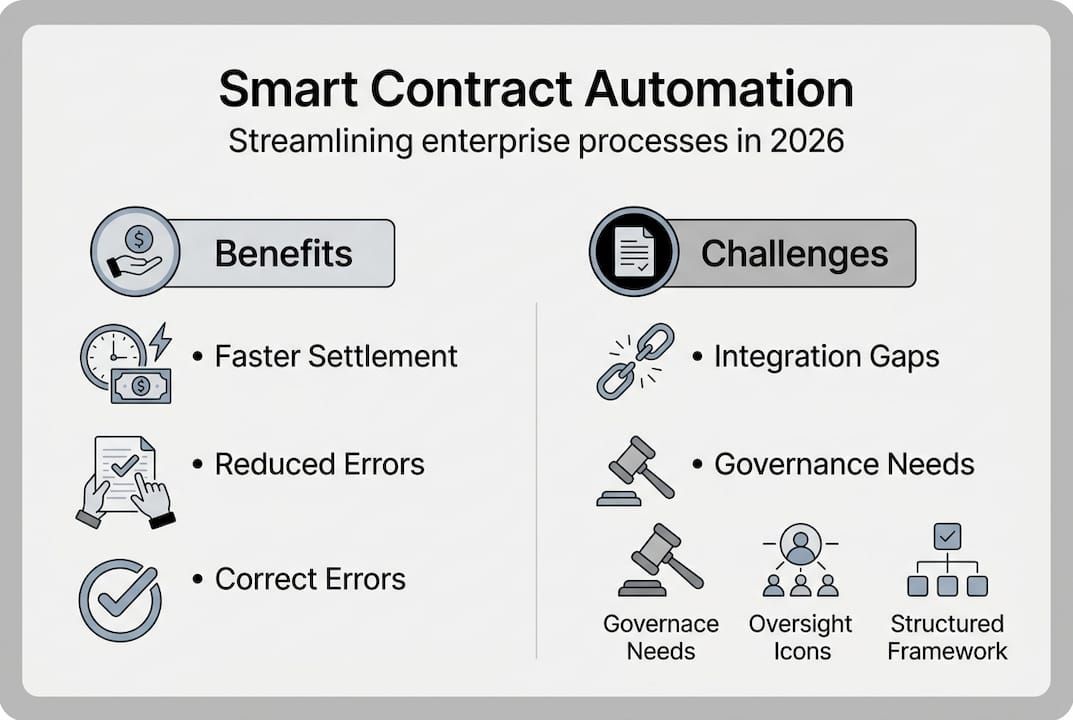
Smart contract automation delivers measurable benefits that directly impact operational efficiency and risk management. Organizations experience improved workflow efficiency through faster transaction processing and reduced cycle times. Manual errors decrease significantly when data flows automatically between systems without human intervention. Enhanced security comes from cryptographic verification and immutable audit trails that make fraud and tampering nearly impossible. Real-time auditability provides compliance teams with instant access to transaction histories and proof of execution.

These benefits translate into tangible business outcomes. Finance teams close books faster with automated settlement processes. Procurement departments reduce contract disputes through transparent execution. Compliance officers demonstrate regulatory adherence with complete, tamper-proof records. IT teams integrate disparate systems without building custom middleware for every connection.
However, implementation presents genuine challenges that require strategic planning. Integration complexity emerges when connecting blockchain networks with legacy enterprise systems that weren’t designed for distributed ledger technology. Security vulnerabilities can arise from coding errors, inadequate testing, or poorly designed access controls. Regulatory compliance becomes more complex when automated processes cross jurisdictional boundaries or handle sensitive data. Automation accelerates processes but requires careful security and compliance planning to avoid creating new risks.
Governance frameworks become essential for managing these challenges. Organizations need clear policies defining who can deploy contracts, how changes are approved, and what controls prevent unauthorized modifications. Thorough security audits must examine both smart contract code and the automation infrastructure connecting contracts to business systems. Regular penetration testing identifies vulnerabilities before attackers exploit them.
Successful implementations balance innovation with risk management by establishing clear governance, conducting comprehensive security reviews, and maintaining ongoing monitoring of automated processes.
Cross-functional collaboration proves critical throughout the implementation journey. Technical teams understand blockchain capabilities but may miss business requirements. Business stakeholders know process needs but may not grasp technical constraints. Legal and compliance teams ensure regulatory adherence but need education on blockchain fundamentals. Bringing these groups together early prevents costly redesigns and ensures the final solution meets all stakeholder needs. Following a comprehensive software development security checklist helps teams address risks systematically.
Pro Tip: Establish a dedicated governance committee with representatives from IT, legal, compliance, and business units to oversee smart contract automation initiatives.
Comparing smart contract automation platforms and technologies in 2026
The smart contract automation landscape in 2026 offers multiple approaches, each suited to different organizational needs and technical capabilities. Full-code platforms provide maximum customization and control, allowing developers to build precisely tailored solutions using languages like Solidity or Rust. Low-code and no-code platforms accelerate development by offering visual interfaces and pre-built components that reduce technical barriers. AI-enhanced automation introduces intelligent decision-making and adaptive workflows that learn from historical patterns.
When evaluating platforms, organizations should assess several critical criteria. Ease of use determines how quickly teams can become productive and whether non-technical stakeholders can participate in development. Customization capability affects whether the platform can handle unique business requirements or forces compromises. Scalability determines if the solution grows with transaction volume and organizational needs. Security features protect against vulnerabilities and ensure regulatory compliance. Total cost includes licensing, infrastructure, development, and ongoing maintenance expenses.
The choice of automation platform impacts scalability, security, and ease of integration with existing systems, making platform selection a strategic decision rather than a purely technical one. Full-code approaches excel when organizations need complete control and have experienced blockchain developers. Low-code solutions work well for standardized processes where speed matters more than perfect customization. AI-enhanced platforms suit scenarios with complex decision logic or where adaptive behavior adds value.
| Platform Type | Best For | Customization | Speed to Deploy | Maintenance Complexity |
|---|---|---|---|---|
| Full-code | Unique requirements, experienced teams | Very High | Slower | High |
| Low-code | Standard workflows, faster delivery | Moderate | Fast | Moderate |
| No-code | Simple processes, non-technical users | Limited | Very Fast | Low |
| AI-enhanced | Adaptive logic, complex decisions | High | Moderate | Moderate to High |
Platform selection should align with organizational capabilities and strategic goals. Companies with strong development teams and unique requirements benefit from full-code flexibility. Organizations prioritizing speed and standardization find low-code platforms more practical. Those exploring cutting-edge capabilities may invest in AI-enhanced solutions despite higher complexity. Understanding IT systems build techniques in 2026 helps leaders make informed technology choices.
Pro Tip: Balance customization needs against long-term maintenance costs and staff expertise availability when selecting your automation platform.
Practical applications and best practices for smart contract automation in business workflows
Smart contract automation delivers value across diverse business scenarios. Financial settlements benefit from automated payment releases when delivery confirmations are verified, eliminating delays and reducing reconciliation effort. Contract lifecycle management automates renewals, tracks obligations, and triggers alerts for upcoming deadlines without manual calendar management. Regulatory compliance workflows automatically verify that transactions meet requirements and generate audit documentation in real time. Supply chain automation coordinates shipments, payments, and inventory updates across multiple parties without centralized coordination.
Smart contract automation has been successfully applied in finance, supply chain, and compliance workflows where transparency and efficiency create competitive advantages. Insurance claims processing uses automation to verify conditions and release payments instantly. Real estate transactions coordinate inspections, financing, and title transfers through automated workflows. Healthcare systems manage consent, data sharing, and billing through compliant automated processes.
Successful implementation follows a structured approach that manages risk while building organizational capability:
- Assess business needs by identifying high-value processes where automation delivers measurable benefits and stakeholder pain points that technology can address.
- Choose appropriate technology based on requirements, organizational capabilities, and long-term strategic goals rather than hype or vendor marketing.
- Pilot with limited scope to validate assumptions, identify integration challenges, and build team expertise before full-scale deployment.
- Secure the solution through comprehensive code audits, penetration testing, and governance controls that prevent unauthorized changes.
- Scale systematically by expanding to additional use cases only after proving value and resolving issues discovered during pilots.
Best practices enhance implementation success and long-term sustainability. Involve stakeholders from business, IT, legal, and compliance throughout the project lifecycle to ensure all perspectives inform design decisions. Implement continuous monitoring that tracks contract execution, identifies anomalies, and alerts teams to potential issues before they escalate. Maintain comprehensive audit trails that document every transaction, change, and decision for regulatory compliance and troubleshooting.
Common pitfalls to avoid during deployment include:
- Underestimating integration complexity with legacy systems
- Skipping thorough security audits to accelerate timelines
- Failing to establish clear governance before deploying production contracts
- Neglecting user training and change management
- Choosing platforms based on features rather than organizational fit
- Ignoring regulatory requirements until late in development
Organizations that follow structured approaches and learn from common mistakes position themselves to capture automation benefits while managing risks effectively. Partnering with experienced providers accelerates learning and reduces costly errors. Exploring automation software development options helps organizations understand available solutions.
Explore smart contract automation solutions with Bitecode
Bitecode specializes in helping medium to large organizations implement smart contract automation that optimizes workflows and secures financial transactions. Our integrated modules for automation, blockchain payment systems, and AI assistant workflows provide the building blocks you need to deploy solutions quickly without starting from scratch.
We understand that every organization faces unique challenges and operates within specific regulatory environments. Our approach begins with understanding your business needs, then tailors automation solutions that integrate seamlessly with your existing systems while positioning you for future growth. Partner with experts who combine deep technical knowledge with practical business experience to unlock efficiency and secure transactions through smart contract automation.
FAQ
What is the difference between smart contracts and smart contract automation?
Smart contracts are self-executing code deployed on blockchain networks that automatically enforce agreement terms when conditions are met. Smart contract automation extends this foundation by integrating contracts with external data sources, business systems, and workflow orchestration tools that coordinate complex multi-step processes. While smart contracts handle on-chain logic, automation connects blockchain activity with real-world events and enterprise systems to create end-to-end business solutions.
How secure is smart contract automation for financial transactions?
Security depends on platform robustness, code quality, and adherence to best practices throughout development and deployment. Well-designed systems use cryptographic verification, immutable audit trails, and multi-signature controls to protect financial transactions. Organizations should conduct comprehensive security audits, implement governance frameworks, and maintain continuous monitoring to identify and address vulnerabilities. Multi-layer security approaches that combine blockchain benefits with enterprise-grade access controls provide the strongest protection.
What industries benefit most from smart contract automation?
Finance, supply chain, legal compliance, and insurance sectors lead adoption because they handle high volumes of standardized transactions that benefit from automation. Financial services use smart contracts for settlements, derivatives, and trade finance. Supply chains coordinate shipments, payments, and inventory across multiple parties. Legal and compliance teams automate contract management and regulatory reporting. Insurance companies process claims and verify conditions automatically. Applications continue expanding into healthcare, real estate, government services, and energy sectors.
What are key steps for a successful smart contract automation implementation?
Successful implementations follow a structured approach starting with needs assessment to identify high-value use cases and stakeholder requirements. Platform selection matches technology capabilities with organizational needs and expertise. Pilot testing validates assumptions and builds team capabilities with limited risk. Security evaluation through comprehensive audits and penetration testing identifies vulnerabilities before production deployment. Scaling strategy expands proven solutions systematically while maintaining governance and monitoring. Cross-functional collaboration throughout ensures technical solutions meet business, legal, and compliance requirements.
How does smart contract automation integrate with existing enterprise systems?
Integration typically uses APIs, middleware, and data connectors that bridge blockchain networks with enterprise resource planning systems, customer relationship management platforms, and other business applications. Modern automation platforms provide pre-built connectors for common enterprise systems, reducing custom development effort. Organizations may use hybrid architectures where smart contracts handle core logic while traditional systems manage user interfaces and legacy data. Successful integration requires careful planning to handle data format differences, transaction timing, and error handling across disparate systems.