TL;DR:
- Compliance automation involves continuous monitoring, reporting, and enforcement using AI and digital systems.
- Automation improves efficiency, accuracy, and proactive risk management, reducing manual workload.
- Human oversight remains essential for judgment-based tasks, with successful implementation involving iterative testing and staff involvement.
Most compliance teams are still buried in spreadsheets, manual checklists, and reactive audit prep cycles, even as automation technology has matured significantly across every other business function. The gap is striking. Organizations that continue relying on manual compliance workflows face mounting pressure: tighter regulations, faster reporting cycles, and a growing volume of data that no human team can reasonably monitor around the clock. Automation offers a fundamentally different operating model, one where monitoring is continuous, documentation is automatic, and your team can focus on the decisions that actually require judgment. This guide breaks down what compliance automation really means, where it delivers the most value, and how to implement it without losing sight of what humans do best.
Key Takeaways
| Point | Details |
|---|---|
| Define automation in compliance | It means leveraging digital tools to continuously monitor and manage regulatory requirements instead of relying on manual tasks. |
| Automation delivers measurable benefits | Compliance automation improves efficiency, accuracy, proactive risk management, and overall ROI for organizations. |
| Human judgment remains essential | Automation doesn’t replace compliance professionals—it enables them to focus on strategic, high-value tasks. |
| Beware of risks and limitations | Automation can introduce new risks like bias and data quality issues, so oversight is still required. |
| Implement with clear steps | Start small, involve your team, and use automation to handle routine work while refining processes over time. |
What does automation in compliance really mean?
There is a persistent misconception that compliance automation simply means replacing paper forms with digital ones. That is digitization, not automation. True automation in compliance goes several layers deeper, and understanding the distinction matters before any investment decision is made.
As defined in practice, automation in compliance involves using digital systems, software platforms, AI, and RegTech tools to automatically monitor, enforce, document, and report on regulatory requirements, shifting from reactive manual processes to proactive, continuous compliance. That shift is the core of the value proposition.
“Automation in compliance involves using digital systems, software platforms, AI, and RegTech tools to automatically monitor, enforce, document, and report on regulatory requirements, shifting from reactive manual processes to proactive, continuous compliance.”
Consider a practical scenario. A mid-sized financial institution must monitor thousands of transactions daily for anti-money laundering (AML) signals. Manually, this requires analysts to review flagged items after the fact, often days later. With automation, AI-driven systems flag anomalies in real time, generate audit trails automatically, and escalate only the cases that require human review. The volume of work does not shrink, but the work that reaches human desks becomes higher quality and more decision-ready.
Automated compliance typically covers several process categories:
- Policy monitoring: Continuously checking system behaviors and user actions against defined rules
- Audit trail generation: Automatic logging of who did what, when, and why
- Regulatory reporting: Pulling structured data and generating required filings with minimal manual input
- Risk scoring: Assigning dynamic risk levels to entities or transactions based on live data
A solid compliance automation guide will always emphasize that not every task is automatable. Judgment calls, ethical assessments, and novel regulatory interpretations still require experienced professionals. Automation handles the repeatable, rule-based layer so that those professionals can focus on the complex layer. Understanding enterprise automation processes at a structural level helps teams draw that boundary correctly from the start.
Key benefits: Why automate compliance processes?
Now that you know what automation in compliance entails, let’s break down its tangible benefits for organizations.
Automation delivers efficiency, accuracy, proactive compliance, and measurable ROI across compliance functions. These are not aspirational claims. They are operational outcomes that organizations document after deployment.
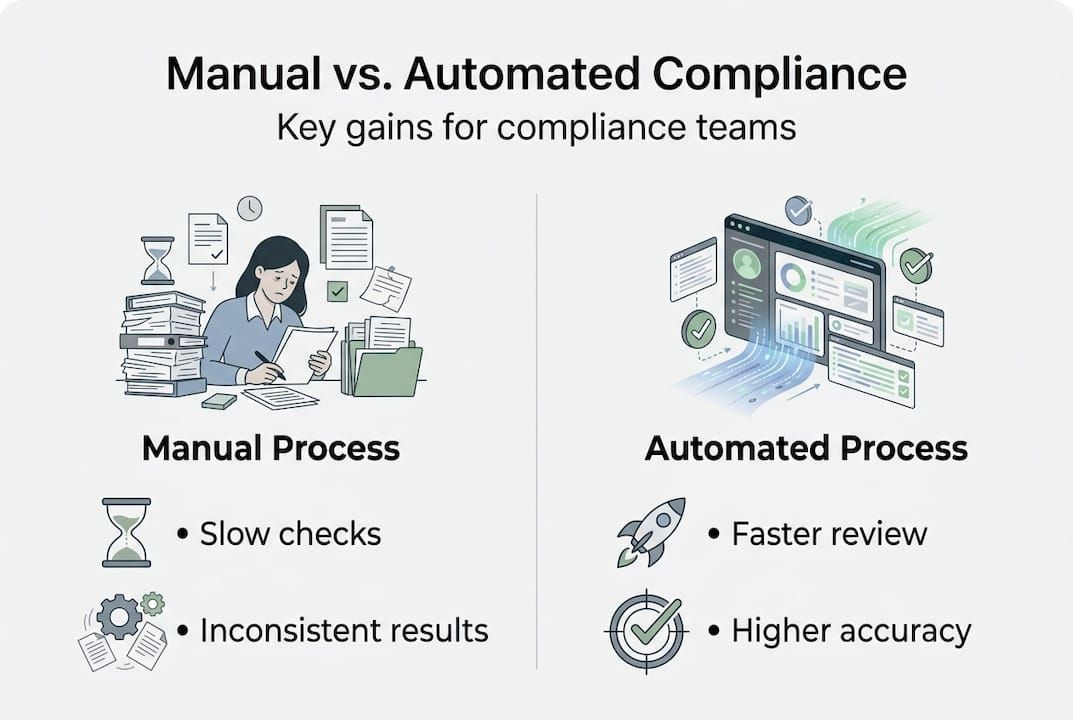
Efficiency is the most immediate gain. Manual compliance checks that take hours or days can run in minutes when automated. Staff hours previously consumed by data gathering and report formatting get redirected toward analysis and strategy.
Accuracy improves because automated systems apply rules consistently, without fatigue, distraction, or interpretation drift. Human error in compliance is not a performance problem; it is a structural one. Automation addresses it structurally.

Proactive risk management becomes possible when monitoring is continuous rather than periodic. Instead of discovering a compliance gap during an audit, automated systems surface it when it occurs, giving teams time to respond before it becomes a regulatory issue.
The ROI case is also strong. Organizations exploring finance automation ROI consistently find that the cost of automation implementation is recovered quickly through reduced labor hours and avoided penalties. For teams focused on fintech workflow efficiency, the compounding effect of faster, cleaner compliance cycles is significant.
| Dimension | Manual compliance | Automated compliance |
|---|---|---|
| Speed | Days to weeks | Minutes to hours |
| Error rate | Higher, inconsistent | Lower, rule-consistent |
| Audit prep | Reactive, labor-intensive | Continuous, always ready |
| Cost over time | Scales with headcount | Scales with data volume |
| Risk visibility | Periodic snapshots | Real-time monitoring |
Pro Tip: Start with the compliance processes that are most repetitive and rule-driven, such as transaction monitoring, access log reviews, or standard regulatory filings. These deliver the fastest ROI and build organizational confidence in automation before you tackle more complex use cases.
Challenges and limitations of compliance automation
While the promise of automation sounds exciting, understanding its real-world challenges is essential before investing further.
The most underappreciated risk is automation bias: the tendency for compliance teams to over-trust automated outputs without sufficient scrutiny. When a system flags or clears something, there is a natural human tendency to accept that verdict. But automated systems are only as good as the rules and data they run on.
“Not all compliance tasks are automatable. Judgment-based decisions, novel regulatory interpretations, and ethical assessments remain firmly in human territory, and organizations that forget this create new risks while trying to eliminate old ones.”
The key challenges organizations encounter when automating compliance include:
- Automation bias: Over-reliance on system outputs without adequate human review
- Black-box outcomes: AI-driven decisions that cannot be easily explained to regulators
- Data quality barriers: Garbage in, garbage out. Poor source data produces unreliable compliance signals
- Non-automatable tasks: Judgment calls, novel interpretations, and ethical decisions require human expertise
- Regulatory scrutiny of AI itself: Regulators increasingly examine whether the automation tools used are themselves compliant, particularly under frameworks like the EU AI Act
Organizations pursuing enterprise automation strategies need to treat these challenges as design constraints, not afterthoughts. For example, AI in GDPR compliance contexts requires careful attention to explainability requirements, since regulators expect organizations to justify automated decisions that affect individuals.
Pro Tip: Involve your compliance officers directly in the configuration and testing of any automated system. They will catch edge cases and regulatory nuances that technical teams miss, and their early involvement builds the trust needed for long-term adoption.
How to implement automation for compliance in your organization
Understanding the limitations of automation helps you plan a smarter adoption strategy, so here’s how to get started.
Implementation is not a single event. It is an iterative cycle of piloting, measuring, and refining. Organizations that treat it as a one-time deployment consistently underperform compared to those that build in structured feedback loops.
- Needs assessment: Map your current compliance processes and identify which are rule-based, repetitive, and data-intensive. These are your automation candidates.
- Tool selection: Evaluate platforms based on regulatory fit, integration capability, and explainability features. Avoid black-box solutions in regulated environments.
- Stakeholder alignment: Secure buy-in from compliance leadership, IT, and legal before any pilot begins. Misalignment here causes costly mid-project pivots.
- Pilot deployment: Run automation in parallel with existing manual processes for a defined period. Compare outputs, measure accuracy, and document discrepancies.
- Integration: Connect automation tools to your existing data sources, case management systems, and reporting infrastructure.
- Training: Equip compliance staff to work alongside automated systems, not just to use them. They need to understand what the system does and does not catch.
- Ongoing monitoring: Establish review cycles to update rules, retrain models, and assess regulatory changes that may affect your automation logic.
As research confirms, AI enhances but elevates human judgment value rather than replacing it. The goal is a system where automation handles volume and consistency, while your team handles complexity and context.
| Process | Automation type | Value delivered |
|---|---|---|
| Transaction monitoring | AI-driven anomaly detection | Real-time fraud and AML signals |
| Regulatory reporting | Workflow and data automation | Faster, more accurate filings |
| Access log review | Rule-based monitoring | Continuous audit trail |
| Policy compliance checks | Automated rule enforcement | Reduced manual review burden |
For organizations exploring AI for transaction monitoring or evaluating SaaS automation ROI, the implementation roadmap above provides a practical starting point that avoids the most common pitfalls.
A fresh perspective: Why automation doesn’t replace compliance teams, it empowers them
The fear that automation will make compliance professionals obsolete is understandable, but it is also misguided. It conflates what automation does well with what compliance work actually requires.
Automation handles volume, consistency, and speed. It does not handle ambiguity, regulatory interpretation, or the kind of judgment that comes from years of experience navigating enforcement actions. When an automated system surfaces a risk signal, a human still decides what it means, what to do about it, and how to document that decision for regulatory scrutiny.
Research consistently shows that AI elevates human judgment value rather than diminishing it. In practice, compliance teams that adopt automation report spending less time on data gathering and more time on strategic risk assessment, policy development, and cross-functional advisory work. That is a role elevation, not a job elimination.
The organizations that get the most from automation custom solutions are the ones that treat their compliance staff as architects of the automated system, not just its users. When experienced professionals define the rules, validate the outputs, and continuously refine the logic, the system gets smarter over time. The result is a compliance function that is simultaneously more efficient and more capable than either humans or technology could achieve alone.
Enhance compliance and efficiency with advanced automation solutions
Ready to put compliance automation into practice? Specialized platforms can accelerate your transformation without the overhead of building from scratch.
Bitecode.tech offers modular, pre-built components designed for exactly this kind of work. The AI Assistant Module enables organizations to deploy intelligent monitoring and decision-support capabilities quickly, while custom CRM automation helps compliance teams manage workflows, case tracking, and regulatory interactions within a single integrated system. With up to 60% of the baseline system pre-built, teams can move from concept to deployment faster than traditional development timelines allow. If your compliance function is ready to move beyond manual processes, these solutions provide a practical, scalable foundation.
Frequently asked questions
What are the first steps to automate compliance in a medium-sized organization?
Start by identifying repetitive, rules-driven tasks, choose trusted automation tools, and involve compliance staff in planning and pilot phases. As digital compliance tools show, the key is selecting systems that can monitor, enforce, and document regulatory requirements automatically from day one.
Can automation fully replace the need for human compliance officers?
No. Automation streamlines routine tasks, but human expertise remains essential for judgment, strategic decisions, and interpreting nuanced regulations. Research confirms that AI elevates judgment rather than replacing it.
What risks should organizations watch for when automating compliance?
Watch for automation bias, black-box results, and data quality gaps, and verify that your automation technology is itself compliant with applicable regulations. The core automation risks include overconfidence in system outputs and non-automatable judgment tasks that still require human review.
How does automation impact compliance costs and ROI?
Automation reduces manual labor, speeds up compliance reviews, and can deliver significant cost savings over time when implemented effectively. Efficiency and ROI gains are most pronounced in high-volume, rule-based processes where human error and processing time are the primary cost drivers.