TL;DR:
- Automation in SaaS replaces human steps with logic-driven, event-triggered processes across systems.
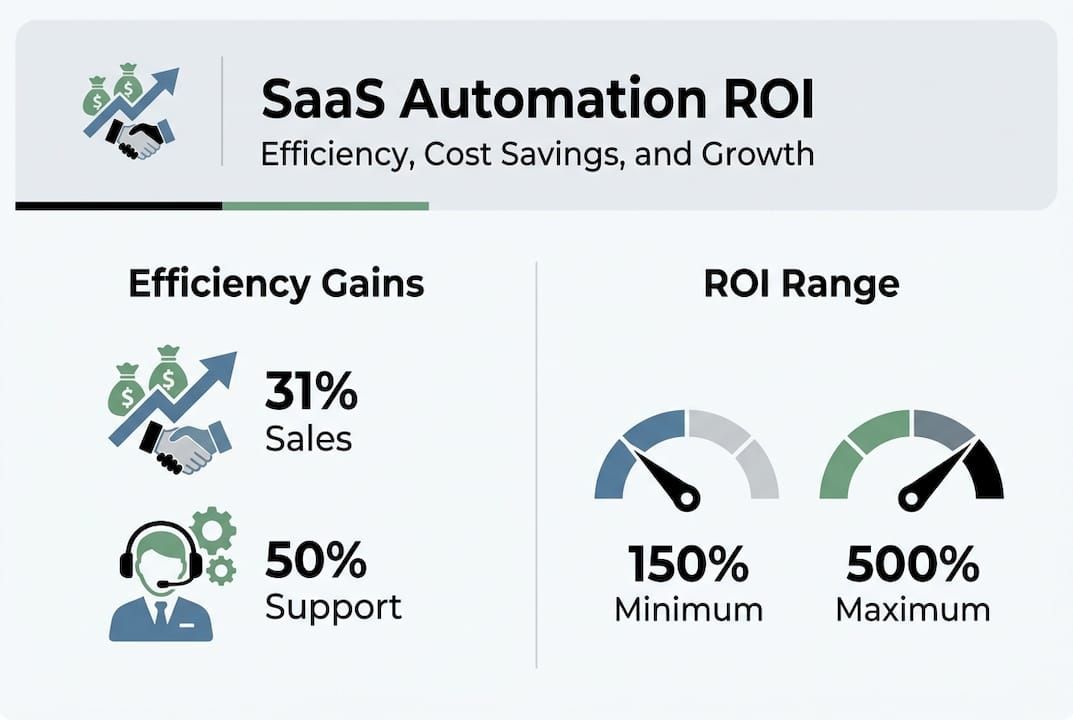
- Documented benefits include a 31% boost in sales productivity and up to 50% support cost reduction.
- Challenges include exception handling, legacy integration, data quality issues, and managing the automation ceiling.
Most executives assume automation trims a few hours off repetitive tasks. The actual numbers tell a different story. Sales productivity up 31%, support costs slashed by up to 50%, and ROI benchmarks landing between 150% and 500% — these are not projections from vendor marketing decks. They are outcomes documented across mid-market and enterprise SaaS deployments. This guide examines what automation genuinely means inside a SaaS environment, where the real gains accumulate, what limits organizations hit when scaling, and how to build an implementation approach that sustains momentum rather than stalling after the first pilot.
Key Takeaways
| Point | Details |
|---|---|
| Tremendous ROI potential | Well-executed SaaS automation drives productivity up and costs down, bringing rapid returns on investment. |
| Challenges demand foresight | Successful automation requires proactive governance, exception handling, and ongoing system integration. |
| Best practices matter | A staged approach with executive support and careful monitoring is key to scaling SaaS automation. |
| Expert partnership advantage | Working with automation specialists like Bitecode helps overcome barriers and achieve operational excellence. |
What automation means for modern SaaS platforms
Automation in SaaS is not the same as running a scheduled script or building a macro in a spreadsheet. It refers to the systematic replacement of human-initiated steps in business workflows with logic-driven, event-triggered processes that operate continuously and at scale. The distinction matters because many organizations underestimate the scope of what is actually automatable within a modern SaaS stack.
The types of business automation relevant to SaaS fall into three broad categories. First, workflow automation handles routing, approvals, notifications, and data handoffs between systems without manual intervention. Second, AI-driven task automation applies machine learning models to decisions that previously required human judgment, such as lead scoring, anomaly detection, or content personalization. Third, lifecycle automation manages customer journeys from trial activation through renewal, triggering the right action at the right moment based on behavioral signals.
What separates these from older process improvement methods is their integration depth. Traditional process improvements optimize steps within a single system. SaaS automation operates across systems, connecting CRM, billing, support, and analytics into a coordinated layer that responds dynamically to real-world events.
Automation in SaaS has delivered support cost reductions of 30-50% across documented enterprise deployments, making it one of the highest-leverage investments available to IT and operations leaders.
The business drivers behind adoption are straightforward: efficiency at scale, reduction of human error, and the ability to grow revenue without proportional headcount growth. Organizations that treat automation as a tactical tool rather than a strategic layer consistently underperform those that build it into their platform architecture from the start.
Proven benefits: Efficiency, cost savings, and growth
The business case for SaaS automation has moved well past theoretical. Empirical benchmarks now give IT leaders and executives a reliable picture of what to expect. Documented results show sales productivity gains of 31%, support cost reductions of 30-50%, overall ROI of 150-500%, payback periods of 4-8 months, error reductions of 70-90%, and cost savings of 20-60% across automated processes.

| Metric | Typical range |
|---|---|
| Sales productivity gain | 31% |
| Support cost reduction | 30-50% |
| ROI | 150-500% |
| Payback period | 4-8 months |
| Error reduction | 70-90% |
| Process cost savings | 20-60% |
Real-world case studies reinforce these figures. BugHerd achieved a 35% trial activation increase through lifecycle automation. Josys and Mach49 reported 10-20% reductions in SaaS-related expenses. HubSpot and RealPage deployments showed a 32% boost in engagement duration through automated customer journey management.
The areas where automation delivers the fastest returns include:
- Sales workflows: Lead routing, follow-up sequencing, and pipeline updates
- Customer support: Ticket triage, auto-resolution for common issues, and escalation logic
- Billing and financial processing: Invoice generation, payment reconciliation, and dunning sequences. Teams looking to automate financial transactions consistently report some of the fastest payback periods.
- Trial and onboarding activation: Behavioral triggers that convert free users to paid accounts
Pro Tip: Focus your first automation initiatives on the highest-volume, most repetitive tasks in your operation. These deliver the fastest measurable ROI and build organizational confidence for larger rollouts.
The strategies for automation success that separate high-performing organizations from average ones share a common thread: they treat automation as a revenue and efficiency multiplier, not a cost-cutting exercise. That framing changes which processes get prioritized and how success is measured.
Key challenges and limitations of SaaS automation
The benefits are real, but so are the constraints. Organizations that approach automation without accounting for its limits often find themselves managing a fragile system that handles 80% of cases well and breaks unpredictably on the remaining 20%.
The most common challenges fall into a recognizable pattern:
- Exception handling: Automated workflows struggle with edge cases that fall outside their defined logic. When a process encounters an unrecognized input or state, the system either fails silently or creates an unowned exception that no one monitors.
- Legacy system integration: Many SaaS environments sit on top of older infrastructure. API mismatches, data format inconsistencies, and authentication gaps create friction that slows automation deployment and increases maintenance burden.
- Data quality: Automation amplifies whatever data quality exists in the source systems. Poor data in means poor decisions out, at scale and at speed.
- Model drift and API changes: AI-driven automation degrades over time as underlying data distributions shift. Third-party API changes can break integrations without warning.
- Auditability and compliance: Automated decisions must be traceable. Regulated industries require clear audit trails, and many automation implementations do not build these in from the start.
The automation ceiling is a documented phenomenon where scaling stalls because unhandled exceptions and edge cases accumulate faster than teams can resolve them.
Good compliance and automation practices and solid integration best practices are not optional additions. They are structural requirements that determine whether an automation program scales or plateaus.
Pro Tip: Establish governance and monitoring procedures before you scale. Define who owns exceptions, how anomalies are flagged, and what the escalation path looks like. Building this in late is far more expensive than building it in early.
Best practices for implementing SaaS automation
Successful automation rollouts follow a disciplined sequence rather than a big-bang deployment. The framework that consistently produces results moves through four phases: assessment, pilot, scaling, and governance.
Assessment maps existing processes to identify automation candidates by volume, error rate, and business impact. This is where teams often discover that the processes they assumed were simple are actually more variable than expected.
Pilot selects one or two high-value, well-defined workflows and automates them with full monitoring in place. The goal is not just to prove the technology works but to surface the exception patterns that will need handling before scaling.
Scaling extends successful pilots across the organization, incorporating lessons from exception handling and integration challenges. Mastering automation processes at this stage requires deliberate architecture decisions, not just replication of the pilot setup.
Governance establishes ongoing monitoring, ownership of exceptions, and a review cadence to catch model drift and process changes before they cause failures.
| Factor | Traditional SaaS rollout | Automated SaaS rollout |
|---|---|---|
| Onboarding time | Weeks to months | Days to weeks |
| Error rate | Variable, human-dependent | 70-90% lower |
| Scalability | Linear with headcount | Decoupled from headcount |
| Cost per transaction | High | Significantly reduced |
| Audit trail | Manual, inconsistent | Automated, consistent |
The enterprise automation best practices that matter most are executive sponsorship, thorough process mapping before any tool selection, and user training that addresses the behavioral change dimension, not just the technical one. Payback for automation projects typically arrives within 4-8 months for mid-market firms that follow a structured rollout.
Why most SaaS automation strategies stall (and how to break through)
Here is what the benchmarks do not show: most automation programs that start strong plateau within 12-18 months. The automation ceiling is not a technology problem. It is a governance and process design problem that masquerades as one.
Leadership teams frequently underestimate process complexity at the edges. The core 80% of any workflow is automatable with standard tooling. The remaining 20% involves judgment calls, context-dependent exceptions, and cross-functional coordination that no rule engine handles cleanly. Organizations that skip exception design during the pilot phase discover this at scale, when the cost of fixing it is much higher.
The other pattern we see consistently is automation without human integration. Automation should accelerate work without accelerating chaos. That means building human review checkpoints into high-stakes decisions, not removing humans from the loop entirely. The teams that sustain automation gains long-term treat it as a collaboration between system logic and human judgment, not a replacement for one by the other.
Advanced automation strategies that break through the ceiling share a common design principle: they are built around adaptive workflows that can escalate gracefully, log exceptions systematically, and improve over time through structured feedback. That is the difference between an automation project and an automation program.
Partnering for advanced SaaS automation
Building automation that scales requires more than selecting the right tools. It requires a platform architecture that supports modular integration, adaptive workflows, and governance from day one.
Bitecode.tech delivers exactly that. Our automation solutions provide pre-built workflow modules that reduce implementation time significantly, while our AI assistant module brings intelligent decision support into your SaaS environment without lengthy development cycles. For organizations managing complex customer relationships, our custom CRM development integrates directly with automation layers to create a unified operational system. With up to 60% of the baseline system pre-built, teams move from concept to deployment faster, with less risk and more confidence.
Frequently asked questions
What are the biggest cost savings from SaaS automation?
SaaS automation delivers 20-60% cost savings across automated processes and up to 50% reductions in support costs, making it one of the highest-return investments available to operations and IT leaders.
How quickly can automation show ROI in SaaS projects?
Most mid-market SaaS automation initiatives achieve payback within 4-8 months, particularly when the initial focus is on high-volume, well-defined workflows with clear success metrics.
What are the primary challenges when automating SaaS?
The top challenges include exception handling, legacy system integration, data quality management, and hitting the automation ceiling where unhandled edge cases prevent further scaling.
Where does automation add the most value in SaaS?
Automation delivers the highest impact in sales workflows, customer support, financial processing, and lifecycle management, with documented gains across trial activation, engagement duration, and expense reduction.