TL;DR:
- Modern enterprise system evaluation prioritizes orchestration, interoperability, and measurable outcomes over feature checklists.
- Agentic AI and blockchain integration enable autonomous workflows, secure records, and advanced automation.
- Successful implementations depend on organizational readiness, change management, and data quality, not just technical features.
Choosing the wrong enterprise system isn’t just an inconvenience. It’s a multimillion-dollar strategic error that can stall operations, erode competitive advantage, and burden IT teams for years. Yet many organizations still approach the selection process the way they did a decade ago: compiling feature checklists, running vendor demos, and comparing module counts. Modern evaluations prioritize orchestration and interoperability over broad module coverage, which signals a fundamental shift in what “capable” actually means in 2026. The organizations that win are the ones reframing their criteria around measurable outcomes, integration depth, and automation quality.
Key Takeaways
| Point | Details |
|---|---|
| Orchestration first | Modern enterprise systems succeed through seamless integration and active automation across applications. |
| Demand real AI automation | Agentic AI and workflow automation must deliver measurable, business-aligned outcomes. |
| Finance automation focus | Evaluate systems for end-to-end financial automation and audit-ready capabilities, not just surface features. |
| Next-gen blockchain readiness | Futureproof enterprises require blockchain for secure, interoperable transactions and compliance. |
| Change is the real challenge | Successful adoption hinges on investing as much in change management and data remediation as in features. |
Framework for evaluating top enterprise system features
Feature lists aren’t enough. That’s the starting point for any serious evaluation in 2026. A vendor can claim support for 200 modules, but if those modules don’t orchestrate cleanly with your existing ERP, CRM, or financial platforms, you’ve added complexity without adding value. The question isn’t whether a system has a feature. It’s whether that feature integrates, automates, and produces verifiable outcomes in your specific environment.
Orchestration and interoperability have become the primary evaluation axes according to Forrester’s ERP landscape analysis, which flags federated application models and API depth as differentiators rather than table stakes. That means evaluating how a system connects outward, not just what it does internally. Does it expose clean REST or GraphQL APIs? Can it consume third-party event streams? Does it support event-driven architecture for real-time orchestration across systems?
A practical evaluation checklist should include:
- API depth and documentation quality — Can developers actually build against these APIs without reverse engineering?
- Pre-built connectors — How many production-grade integrations exist for your existing stack?
- Event-driven capabilities — Can the system react to external triggers, or does it rely entirely on scheduled batch processes?
- Business-aligned automation — Are workflows configurable by operations teams, or does every change require developer intervention?
- Vendor roadmap alignment — Is the platform investing in AI, blockchain, and federated models, or maintaining legacy architecture?
Pro Tip: When vendors demo integration capabilities, ask them to show a live connection to a system you already own. Sandboxed demos with pre-loaded data are not the same as production-grade interoperability.
Following best practices for enterprise software means applying this framework before shortlisting vendors, not after. Teams that apply structured criteria early spend significantly less time in late-stage negotiations discovering architectural incompatibilities.
Agentic AI and workflow automation: what to expect and demand
Agentic AI is no longer a roadmap promise. Enterprise ERP feature sets now include embedded AI agents that act autonomously within business workflows, handling tasks that previously required human routing, review, and approval. Understanding what that actually means, and how to distinguish real capability from marketing language, is essential for any technology evaluation team.

In practical terms, agentic AI in enterprise systems means intelligent agents that can initiate actions, gather context, make decisions within defined parameters, and escalate exceptions without waiting for manual input. Think of an expense processing agent that categorizes submissions, flags policy violations, routes approvals, and posts entries to the general ledger without a single human touchpoint on compliant transactions. Or a payables agent that matches invoices to purchase orders, reconciles discrepancies, and schedules payments based on cash flow rules.
Key benefits teams should expect from genuine agentic automation include:
- Reduction of manual handoffs: Fewer touchpoints mean fewer delays and fewer error injection points across the process lifecycle.
- Actionable intelligence at scale: Agents can process thousands of transactions simultaneously, surfacing anomalies and exceptions rather than requiring humans to find them.
- Speed gains in close and reconciliation: Finance teams using agentic automation report material reductions in period-close timelines.
- Adaptive routing: Intelligent agents can reroute workflows dynamically when rules change, rather than breaking and requiring re-configuration.
“The difference between AI-assisted and agentic AI is authority. Assisted AI suggests. Agentic AI acts. Buyers need to ask: what decisions can the agent make independently, and what triggers human review?”
Effective enterprise automation strategies require teams to go beyond surface demos and ask vendors to produce live evidence of autonomous action, error handling, and exception management. Ask for workflow logs showing agent decisions on real transaction types, not scripted scenarios.
Understanding mastering complex workflow automation also means recognizing that automation quality degrades when edge cases aren’t handled. Any vendor claiming agentic AI should be able to show what happens when an invoice doesn’t match, when an approval timeout occurs, or when a policy exception is triggered. Graceful exception handling is the real test.
Pro Tip: Ask vendors to define what percentage of transactions their agentic AI handles end-to-end without human intervention in customer production environments. A credible vendor will have this number. Vague answers indicate the feature is aspirational.
For teams building a fuller picture of end-to-end automation for IT, agentic AI is only one layer. The evaluation should also cover how AI agents connect to other automation layers: RPA, business rules engines, and API-driven orchestration.
Finance lifecycle automation and audit-ready controls
Automation in finance isn’t just about speed. It’s about accuracy, compliance, and explainability. CFOs and finance IT leaders face a specific challenge: vendors claim automation across record-to-report, close, and compliance processes, but the underlying evidence often doesn’t hold up to scrutiny. Finance automation buyers should require measurable outcomes tied to cash and close timelines, automated controls monitoring, and full audit trail explainability, not just checkbox features.
The following finance lifecycle capabilities represent the non-negotiable baseline for any serious evaluation:
- Automated period close — The system should reduce close timelines by automating reconciliation, journal entries, and intercompany eliminations.
- Continuous controls monitoring — Real-time monitoring of financial controls, not post-period exception reports that arrive too late to prevent issues.
- Detailed audit trails — Every system action, approval, and override must be logged with timestamp, user ID, and decision context.
- Explainability for AI-driven entries — If AI posts a journal entry, the system must be able to explain the logic in human-readable form for auditors.
- Regulatory compliance automation — Automated generation of ASC 842, IFRS 16, or tax jurisdiction-specific reports without manual data assembly.
| Legacy checklist feature | Outcome-driven requirement |
|---|---|
| “Automated journal entries” | Documented reduction in close days with audit log |
| “Compliance reporting module” | Automated regulatory filing with exception alerts |
| “Approval workflows” | End-to-end SLA tracking with escalation rules |
| “Reconciliation tools” | Automated matching rate with variance thresholds |
| “AI-powered insights” | Explainable AI decisions with supporting transaction data |
A solid financial automation checklist forces vendors to move from feature claims to outcome evidence, which is where real differentiation appears. Teams that demand this level of specificity routinely identify gaps that would have gone unnoticed in a traditional demo cycle.
The finance automation ROI case is compelling when automation is done correctly. Measurable gains in close timelines, error rates, and audit preparation hours are realistic targets, but only when the automation is genuine rather than a thin layer of workflow rules relabeled as AI.
For organizations focused on automating financial transactions, the transaction layer is only one part of the picture. The more valuable capability is automation that spans the full record-to-report cycle, connecting transaction processing to controls monitoring to regulatory reporting in a single auditable chain.
Teams building scalable finance automation should also evaluate how the system handles volume growth. A system that works at 10,000 transactions per month must be tested against projections for 500,000 transactions per month, particularly for reconciliation and continuous controls monitoring.
Blockchain integration and advanced interoperability
Beyond AI and finance, modern enterprises increasingly demand next-level interoperability, and blockchain is becoming a practical enterprise feature rather than an experimental one. The value isn’t in the technology for its own sake. It’s in what blockchain enables: immutable transaction records, decentralized verification, and programmable settlement logic that doesn’t require a trusted intermediary.
Enterprise evaluation priorities now include orchestration across federated applications, and blockchain fits directly into that model. When supply chain data, payment confirmations, and compliance records are written to an immutable ledger, audit and reconciliation processes become dramatically simpler. The ledger is the single source of truth.
Practical enterprise use cases for blockchain integration include:
- Cross-border payment automation — Smart contracts that execute settlement automatically when predefined conditions are met, eliminating correspondent bank delays.
- Decentralized audit trails — Compliance records that can’t be altered retroactively, providing regulators and auditors with tamper-proof evidence chains.
- Supply chain provenance tracking — Immutable records of goods movement from origin to delivery, enabling automated compliance and dispute resolution.
- Multi-party contract execution — Smart contracts that execute terms automatically when all parties satisfy conditions, reducing legal and operational friction.
- Identity and access verification — Decentralized identity verification that reduces fraud risk in high-value transaction workflows.
| Legacy integration | Advanced API and blockchain interoperability |
|---|---|
| Point-to-point database connections | Event-driven API mesh with real-time sync |
| Manual reconciliation across systems | Immutable ledger as shared source of truth |
| Periodic compliance reporting | Continuous, tamper-proof audit record |
| Batch payment settlement | Smart contract-driven instant settlement |
| Siloed application data | Federated data with cryptographic verification |
Exploring blockchain automation examples reveals that the most effective implementations don’t replace existing systems wholesale. They augment them, adding a verifiable record layer on top of existing workflows without requiring complete re-architecture.
Comparison summary: which enterprise features stand out?
Pulling together the feature categories examined above, a structured comparison helps IT leaders and executives prioritize their evaluation based on specific organizational drivers.
| Feature area | Business value | Priority use case |
|---|---|---|
| API orchestration and interoperability | High | System consolidation, integration modernization |
| Agentic AI and workflow automation | Very high | Operations, finance, supply chain |
| Finance lifecycle automation | Very high | CFO office, audit, regulatory compliance |
| Blockchain integration | High | Payments, compliance, supply chain |
| Continuous controls monitoring | High | Risk management, internal audit |
As Forrester’s ERP landscape analysis highlights, the shift toward orchestration-first evaluation reflects a broader move away from monolithic systems toward modular, interoperable architectures. That shift changes the selection calculus significantly.
Teams should prioritize based on their most pressing driver:
- Automation-driven IT transformation: Lead with agentic AI capabilities and API depth. The system’s ability to reduce manual touchpoints is the primary value driver.
- Finance transformation and compliance: Lead with finance lifecycle automation, continuous controls monitoring, and explainable AI in financial processes.
- Future-proofing for complex workflows: Lead with interoperability, blockchain integration readiness, and vendor roadmap commitment to federated architectures.
No single feature area delivers value in isolation. The strongest enterprise systems are those where these capabilities reinforce each other: AI agents operating within an interoperable architecture, writing to immutable audit records, and connecting to financial controls that monitor every transaction continuously.
What most enterprise system buyers miss: the hidden success criteria
Here’s the uncomfortable reality that most enterprise system evaluations never surface: the majority of failed or underperforming implementations weren’t caused by missing features. The platform had the capability. The organization wasn’t ready to use it.
Change management, adoption capacity, and data remediation must be funded workstreams from day one, not activities that get scheduled after go-live. Yet in most procurement cycles, these workstreams receive minimal budget allocation because they don’t appear on feature comparison matrices. They’re invisible in vendor demos. And they’re underestimated in project plans because no one wants to be the person who says the organization isn’t ready.
The pattern is consistent across large-scale implementations. A technically capable platform gets deployed into an environment where data quality is poor, process ownership is unclear, and end users haven’t been meaningfully engaged in the design. The result is a system that works technically and fails operationally. Features that should deliver measurable outcomes instead generate exception queues that humans manage manually, which is exactly the outcome the automation was supposed to eliminate.
The organizations that get maximum value from modern enterprise systems treat data readiness and change management as technical workstreams, not soft activities. Data remediation is an engineering problem. Adoption is a systems design problem. Both require budget, ownership, and structured delivery.
The practical advice here is direct: before finalizing any enterprise system selection, map the internal readiness gaps with the same rigor applied to vendor evaluation. If the organization can’t answer who owns process governance, how clean the source data is, or what the adoption plan looks like for affected teams, those are the risks that will determine outcomes, not whether the system has the right AI module.
Feature capability and organizational readiness must be evaluated in parallel. One without the other is an incomplete selection process, regardless of how thorough the feature comparison was.
Next steps: unlock enterprise value with advanced solutions
Enterprise feature evaluation is one thing. Translating that evaluation into a working system is another challenge entirely, and it’s where many organizations stall between strategy and execution.
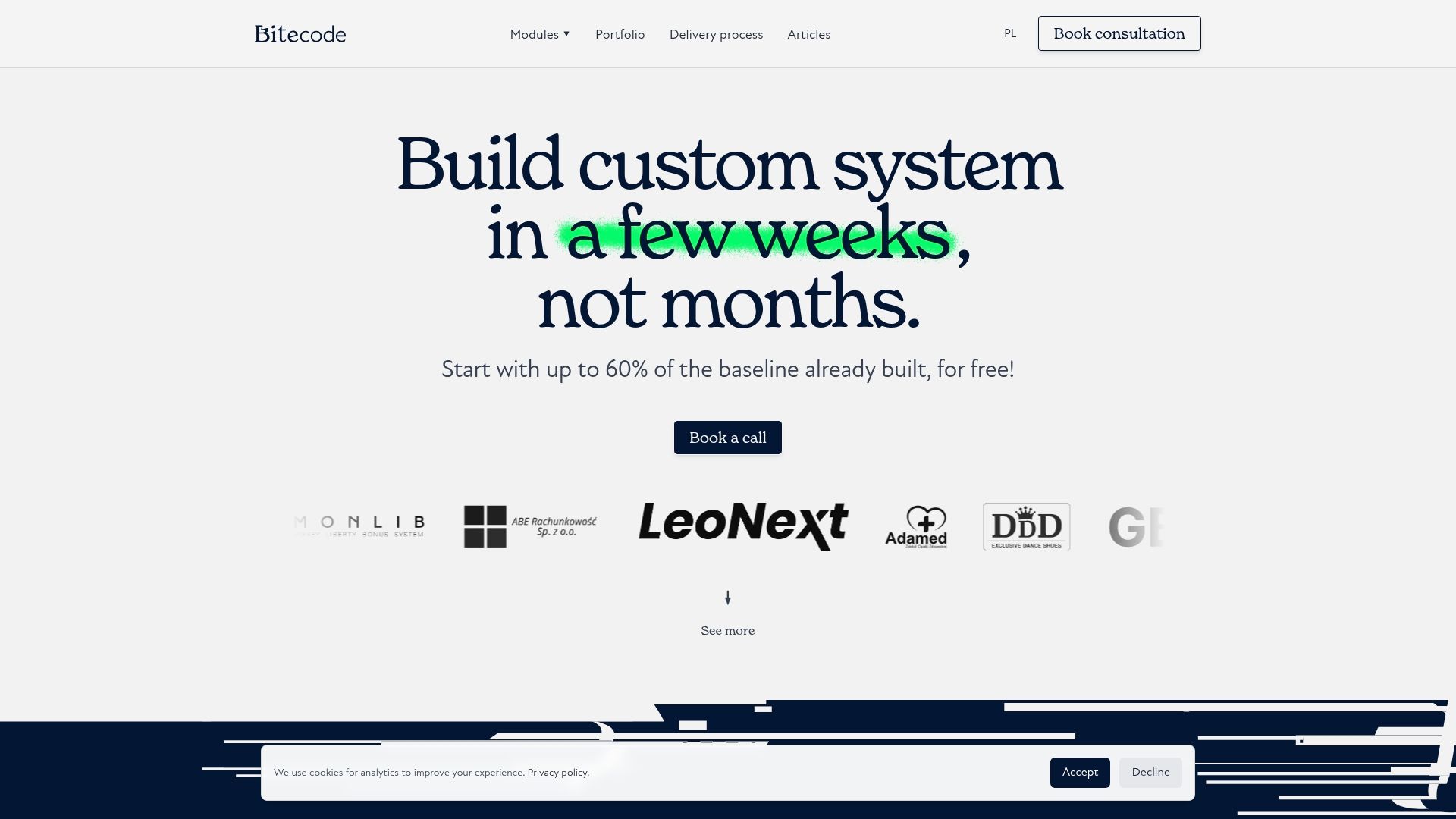
Bitecode.tech provides modular, pre-built components that let teams move from feature requirements to functional systems without rebuilding from a blank slate. Starting with up to 60% of the baseline system already assembled means organizations can focus their effort on business-domain customization rather than boilerplate infrastructure. Explore how purpose-built modules accelerate delivery: the AI assistant module brings agentic automation to your workflows directly, the blockchain-based payment system handles secure, interoperable payment processing with immutable audit trails, and custom CRM solutions connect customer workflows to your broader enterprise architecture. These aren’t theoretical capabilities — they’re modular foundations ready to integrate with your existing stack.
Frequently asked questions
Why are orchestration and interoperability critical for enterprise system selection in 2026?
They enable seamless integration across your full application landscape, supporting active automation and reducing architectural complexity rather than adding to it. Modern evaluations prioritize these capabilities over broad module counts for exactly this reason.
What is agentic AI in an enterprise context?
Agentic AI refers to intelligent agents embedded in business workflows that act autonomously, handling tasks like expense processing and payment approvals without manual intervention. Enterprise ERP platforms now commonly include these agents as core workflow components.
How can buyers verify that automation features produce measurable outcomes?
Buyers should require vendors to present clear metrics tied to accounting close timelines, cash process efficiency, and audit trail completeness rather than accepting general capability claims. Outcome-based requirements tied to explainability and controls monitoring are the appropriate standard.
What role does blockchain integration play in enterprise systems?
It enhances automation, security, and interoperability across payment processing, compliance workflows, and multi-party contract execution by providing immutable, tamper-proof records. Orchestration and interoperability priorities in modern evaluations increasingly include blockchain readiness.
What often causes enterprise modernization projects to fail?
Most failures trace back to underinvestment in change management, data quality, and adoption planning rather than technical feature gaps. Change management and data remediation must be funded workstreams from the project’s outset, not afterthoughts.