Less than 15% of enterprises activate adaptive AI features in their automation projects, even as early adopters report significant efficiency gains across complex workflows and financial transactions. That gap is not a technology problem. It is a clarity problem. Most IT teams understand automation in fragments: a bot here, a scheduled job there, a middleware layer connecting two systems. End-to-end automation is a fundamentally different concept, one that treats the entire workflow as a single, orchestrated system rather than a collection of isolated parts. This guide breaks down what that means in practice, how the technology has evolved, and what enterprise teams need to know before committing to a platform or architecture.
Key Takeaways
| Point | Details |
|---|---|
| Adaptive automation advantage | AI-driven solutions outperform rule-based approaches in efficiency and resilience for enterprises. |
| Process intelligence value | Monitoring and analytics can rescue up to 30% of failed automation projects in complex workflows. |
| Governance is critical | Solid governance frameworks enable reliable ROI validation and safeguard automation investments. |
| Platform selection matters | Choosing the right tools for workflow, finance, and integration is essential to successful end-to-end automation. |
Defining end-to-end automation
End-to-end automation refers to the orchestration of an entire business process, from the initial trigger to the final output, without requiring manual intervention at intermediate steps. It is not about automating one task. It is about connecting every task in a workflow into a coherent, monitored, and adaptive system.
For enterprises managing financial process automation or multi-system workflows, this distinction matters enormously. Partial automation creates handoff points where errors accumulate and human intervention becomes a bottleneck. True end-to-end solutions eliminate those gaps.
The core characteristics of end-to-end automation include:
- Unified orchestration across all systems involved in a process
- Real-time monitoring with feedback loops that detect and respond to failures
- Adaptive decision-making that adjusts process flow based on context
- Cross-system integration connecting ERP, CRM, financial platforms, and custom applications
- Audit trails that support compliance and governance requirements
“The market is shifting from rule-based RPA to AI-agentic automation, where systems can interpret context and make decisions rather than simply follow predefined scripts.”
For teams already working on automating financial transactions, this shift means moving beyond scheduled batch jobs and into real-time, event-driven processing that responds to actual business conditions.
From rule-based RPA to adaptive agentic automation
Once we understand end-to-end automation, the next step is to examine how the landscape has changed from classic rule-based systems to adaptive, agentic models.
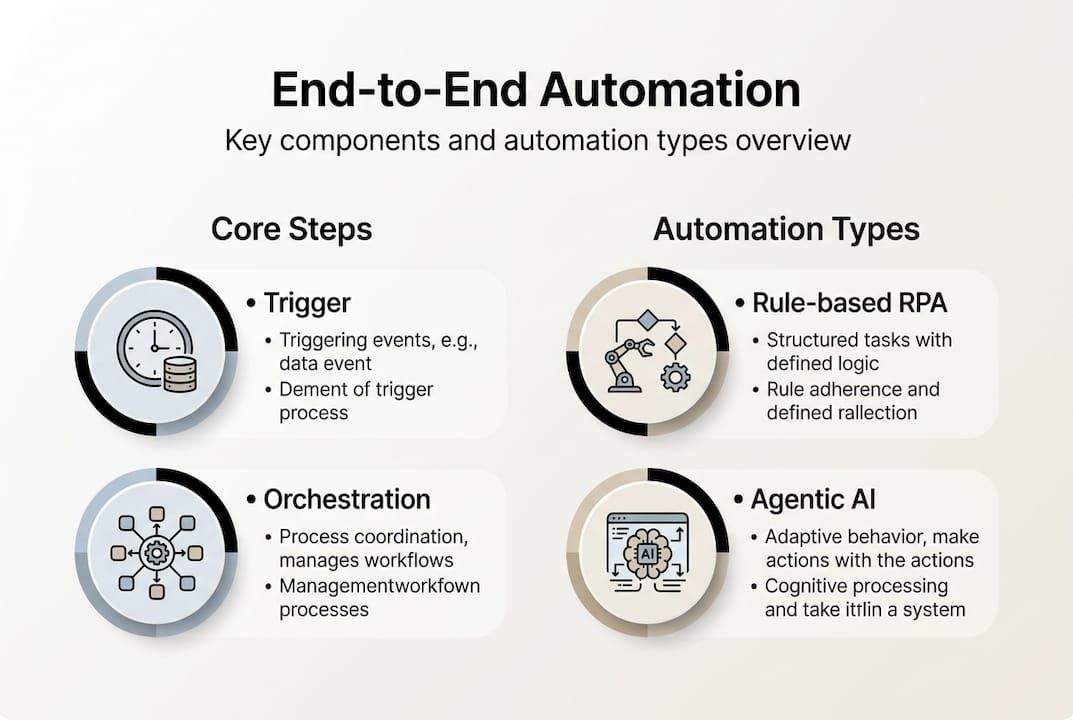
Traditional robotic process automation (RPA) works by following explicit, predefined rules. It is reliable for stable, repetitive tasks, but brittle when processes change or exceptions arise. Agentic automation is different. It uses AI to interpret context, evaluate options, and make decisions within defined boundaries, without waiting for a human to resolve every edge case.
The practical difference is significant. Agentic features adoption remains below 15% across enterprises, yet process intelligence tools have been shown to rescue up to 30% of previously failed automation projects. That recovery rate reflects how much value organizations leave on the table by sticking with rigid, rule-based approaches.
| Dimension | Rule-based RPA | Agentic automation |
|---|---|---|
| Decision logic | Predefined scripts | Context-aware AI reasoning |
| Exception handling | Fails or escalates | Adapts within set parameters |
| Process change tolerance | Low | High |
| Integration complexity | Moderate | High, but more resilient |
| ROI trajectory | Fast initial, then flat | Slower start, compounding gains |
For enterprise automation strategies, the implication is clear: RPA remains useful for stable, high-volume tasks, but agentic models are better suited for complex workflows where conditions shift frequently. Financial transaction monitoring is a strong example. AI for transaction monitoring enables real-time fraud detection that rule-based systems simply cannot match.
Pro Tip: Before selecting an automation model, map every exception type in your target process. If exceptions exceed 10% of total cases, rule-based RPA will likely require constant maintenance. Agentic automation handles that variability by design.
Teams exploring mastering enterprise automation or evaluating a guide to smart contract automation will find that agentic models offer a more durable foundation for scaling.
Key components and processes of end-to-end automation
To build on our understanding of adaptive automation, let’s break down the concrete components and stepwise processes that make end-to-end automation work.

A functional end-to-end automation stack typically includes three layers: orchestration, integration, and monitoring. Orchestration manages the sequence and logic of process steps. Integration connects disparate systems so data flows without manual transfer. Monitoring provides visibility into process health, failure rates, and performance metrics.
The implementation process follows a structured sequence:
- Process discovery — Map existing workflows, identify bottlenecks, and document exception patterns
- Process mapping — Define the ideal automated flow, including decision points and fallback logic
- System integration — Connect all relevant platforms using APIs, middleware, or native connectors
- Automation deployment — Build and test the orchestrated workflow in a staging environment
- Monitoring and feedback — Instrument the live process with dashboards and alerting
- Continuous improvement — Use process intelligence data to refine logic and expand scope
Process intelligence is not optional in this stack. It is the mechanism that rescues 30% of failed automation projects by surfacing where and why processes break down. Without it, teams are flying blind.
| Component | Function | Enterprise priority |
|---|---|---|
| Orchestration engine | Sequences and manages process steps | Critical |
| Integration layer | Connects systems and data sources | Critical |
| Process intelligence | Analyzes performance and failure patterns | High |
| Monitoring dashboard | Real-time visibility and alerting | High |
| Governance controls | Access, audit, and compliance management | High |
For teams working on workflow automation optimization, the automation module approach allows organizations to deploy these components incrementally rather than rebuilding from scratch. Logistics operations, for example, benefit from logistics process automation that integrates warehouse, transport, and billing systems into a single orchestrated flow.
Challenges in governance and ROI verification
Understanding the technical stack is only part of the equation. It is essential to tackle practical challenges with governance and ROI measurement in enterprise automation projects.
Governance gaps and ROI tracking are among the most cited barriers to successful automation adoption in 2026. Many enterprises deploy automation without establishing clear ownership, change management protocols, or measurement baselines, and then struggle to justify continued investment.
Common governance and ROI challenges include:
- Undefined ownership — No clear team or role accountable for automation performance
- Baseline measurement gaps — Failing to document pre-automation process metrics makes ROI calculation impossible
- Shadow automation — Departmental teams deploy bots without IT oversight, creating compliance and security risks
- Scope creep — Automation projects expand without governance checkpoints, inflating costs
- Vendor lock-in — Choosing platforms without exit strategies relocates complexity into the vendor relationship
Pro Tip: Establish a Center of Excellence (CoE) for automation before deploying at scale. A CoE creates the governance structure, sets measurement standards, and prevents shadow automation from undermining enterprise-wide initiatives.
For teams managing handover and documentation, a structured application handover checklist reduces the risk of knowledge loss when automation projects transition between teams. Integrating an AI assistant module into governance workflows can also automate compliance checks and audit trail generation, reducing manual overhead. Industrial contexts face similar pressures, where software for industrial efficiency demonstrates how structured governance directly impacts operational ROI.
Platforms and tools supporting end-to-end automation
With a clear picture of the challenges, let’s look at the tools and platforms that make end-to-end automation possible for enterprise IT teams.
Platform selection is where many projects stall. The market offers a wide range of tools, from general-purpose workflow engines to specialized financial automation platforms and AI-native orchestration systems. The right choice depends on the complexity of your workflows, the systems you need to integrate, and your team’s capacity to manage the platform long-term.
Key categories to evaluate include:
- Workflow automation platforms — Handle process orchestration, task routing, and exception management across departments
- Financial automation tools — Specialize in payment processing, reconciliation, and compliance reporting; explore financial automation platforms for scalable options
- AI-driven orchestration — Incorporate machine learning for adaptive decision-making and anomaly detection
- Blockchain automation — Enable smart contract execution and immutable audit trails for high-stakes transactions
- Modular automation suites — Provide pre-built components that reduce greenfield development time significantly
The adoption rate for agentic AI features remains below 15%, which means most enterprises are still evaluating rather than deploying. That creates a window for teams that move decisively to gain a meaningful competitive advantage.
When evaluating platforms, prioritize those that offer native process intelligence, open integration APIs, and modular deployment. Platforms that require full replacement of existing systems introduce unnecessary risk. The better approach is to layer automation capabilities onto existing infrastructure using an automation solutions framework that supports incremental adoption. Teams managing complex workflow automation will find that modular platforms reduce time-to-value without sacrificing customization.
Unlock tailored enterprise automation solutions
Building end-to-end automation at enterprise scale requires more than selecting the right platform. It requires a foundation that is already partially built, so your team can focus on business-domain complexity rather than boilerplate infrastructure.
Bitecode’s automation module gives enterprise teams a modular, pre-built foundation that covers orchestration, integration, and monitoring out of the box, with up to 60% of the baseline system ready before the first sprint. The AI assistant automation module adds adaptive decision-making and compliance automation without requiring a separate AI platform. For financial workflows, the finance automation module handles payment processing, reconciliation, and audit trail generation at scale. If your team is ready to accelerate work without accelerating chaos, Bitecode provides the structured starting point that enterprise automation projects need.
Frequently asked questions
How does end-to-end automation differ from traditional automation?
End-to-end automation orchestrates complete workflows across integrated systems using adaptive AI, while traditional automation handles repetitive tasks in isolated silos. The shift from rule-based RPA to agentic models is the defining difference in 2026.
What are the main risks when deploying adaptive automation in finance?
Governance gaps and inconsistent ROI tracking are the primary risks. Process intelligence tools can recover up to 30% of failed automation projects by identifying where and why processes break down before they cause significant financial impact.
Which enterprise automation platforms are best for financial workflows?
Platforms that combine AI-driven orchestration with native process intelligence offer the most scalable path for finance automation. The adaptive process orchestration market is maturing rapidly, making platform selection a strategic decision rather than a purely technical one.
How can IT leaders verify automation ROI?
Establish pre-automation baselines for every key metric before deployment, then use a structured governance framework and process intelligence dashboards to track performance. Governance and ROI verification remain the most cited challenges in enterprise automation, making measurement infrastructure as important as the automation itself.