TL;DR:
- Advanced workflow management orchestrates complex, multi-system enterprise operations with adaptive logic and error recovery.
- It uses BPMN modeling, event-driven triggers, and compensation patterns to ensure process reliability and compliance.
- Many organizations underestimate workflow maturity, benefiting most from process redesign aligned with platform capabilities.
Workflow automation has a reputation problem. Most business leaders still associate it with simple, rule-based tasks like routing approval emails or triggering notifications. That framing is outdated and, frankly, limiting. Advanced workflow management operates at a completely different level, orchestrating complex, multi-system business operations with adaptive logic, real-time monitoring, and built-in error recovery. For enterprises managing intricate financial flows, compliance requirements, or cross-departmental processes, the gap between basic automation and advanced workflow management is not a feature difference. It is a strategic one.
Key Takeaways
| Point | Details |
|---|---|
| Advanced workflows go beyond automation | They orchestrate complex, end-to-end business processes across systems with reliability and transparency. |
| Frameworks and patterns matter | Business Process Model and Notation, event-driven architecture, and compensation patterns provide flexibility and error recovery. |
| Strategic benefits | Enterprises gain more efficiency, compliance, and less manual rework compared to standard tools. |
| Implementation is critical | Success depends on stakeholder buy-in, robust integration, monitoring, and continuous improvement plans. |
What is advanced workflow management?
At its core, workflow management has always been about moving work from one state to another in a predictable, repeatable way. Basic tools handle this well for structured, recurring tasks. Advanced workflow management, however, is built for the messy reality of enterprise operations, where processes span multiple systems, involve conditional logic, require human approvals, and must recover gracefully from partial failures.
The distinction matters because most organizations hit a ceiling with standard tools. They automate the easy parts and still rely on manual coordination for everything else. Advanced platforms eliminate that ceiling by introducing capabilities that standard tools simply cannot replicate.
Key features that define advanced workflow management include:
- Process modeling with BPMN (Business Process Model and Notation): a standardized visual language for mapping automation logic across complex workflows
- Event-driven triggers: processes that respond to real-time signals from connected systems rather than scheduled batch runs
- Orchestration layers: a central coordinator that manages the sequence, timing, and dependencies of tasks across distributed services
- Compensation and rollback logic: the ability to reverse completed steps when a downstream failure occurs, preserving data integrity
- Audit trails and traceability: every action is logged, timestamped, and attributable, which is critical for regulatory compliance
Advanced workflow management also differs fundamentally from project management tools. Project tools track human tasks and milestones. Workflow platforms automate the movement of data and decisions across systems, often without human intervention at all. Similarly, a warehouse management system (WMS) is domain-specific. Advanced workflow management is domain-agnostic and designed to integrate across your entire enterprise automation processes.
| Feature | Standard workflow tools | Advanced workflow management |
|---|---|---|
| Process complexity | Linear, rule-based | Dynamic, multi-branch, conditional |
| System integration | Limited connectors | Deep API and event-driven integration |
| Error handling | Manual intervention | Automated compensation and retry logic |
| Auditability | Basic logs | Full traceability and compliance reporting |
| Scalability | Departmental | Enterprise-wide, distributed |
As BPMN orchestration and saga patterns demonstrate, advanced workflow management builds on proven distributed reliability methods that standard tools never attempt to address.
Core components and methodologies
Understanding the definition, it is time to go under the hood and explore the core building blocks of modern workflow management. These are not abstract concepts. They are practical design decisions that determine whether your workflows hold up under real enterprise load.
- BPMN process modeling: BPMN gives teams a shared visual language to design automation logic. It bridges the gap between business stakeholders who understand the process and engineers who build it, reducing misalignment and rework.
- Orchestration versus choreography: Orchestration uses a central coordinator to direct each step, giving you clear visibility and control. Choreography distributes that logic across services, which can reduce bottlenecks but makes tracing failures harder. Most enterprise contexts favor orchestration for its auditability.
- Saga pattern for compensations: In multi-step processes, a failure halfway through can leave data in an inconsistent state. The saga pattern defines compensating transactions that undo completed steps, restoring integrity without requiring a full rollback.
- Idempotency and correlation IDs: Idempotency ensures that retrying a failed operation does not produce duplicate results. Correlation IDs allow you to trace a single transaction across every system it touches, which is essential for debugging distributed workflows.
- Embedded approvals and exception handling: Rather than routing exceptions to a generic inbox, advanced platforms embed approval logic close to the data source, reducing latency and keeping context intact.
These principles apply directly to secure AI and blockchain workflows, where transaction integrity and traceability are non-negotiable. They also inform secure software integration practices, particularly when connecting mission-critical systems across organizational boundaries.
As orchestration patterns, compensations, and correlation IDs illustrate, these are the foundational elements that separate reliable enterprise workflows from fragile automation scripts.
Pro Tip: Before selecting a workflow platform, map your three most failure-prone processes end to end. If the platform cannot model compensation logic for each one, it will not scale to your real operational needs.
Advanced versus standard workflow solutions: A side-by-side comparison
With a deeper grasp of the architecture, let us see how advanced workflow management stacks up against more traditional solutions. The differences are not just technical. They have direct implications for operational risk, scalability, and competitive positioning.
Standard workflow tools are effective within their design scope. They manage recurring, structured tasks with predictable inputs and outputs. The problem arises when organizations try to stretch these tools beyond that scope, patching gaps with manual workarounds that accumulate into operational debt.
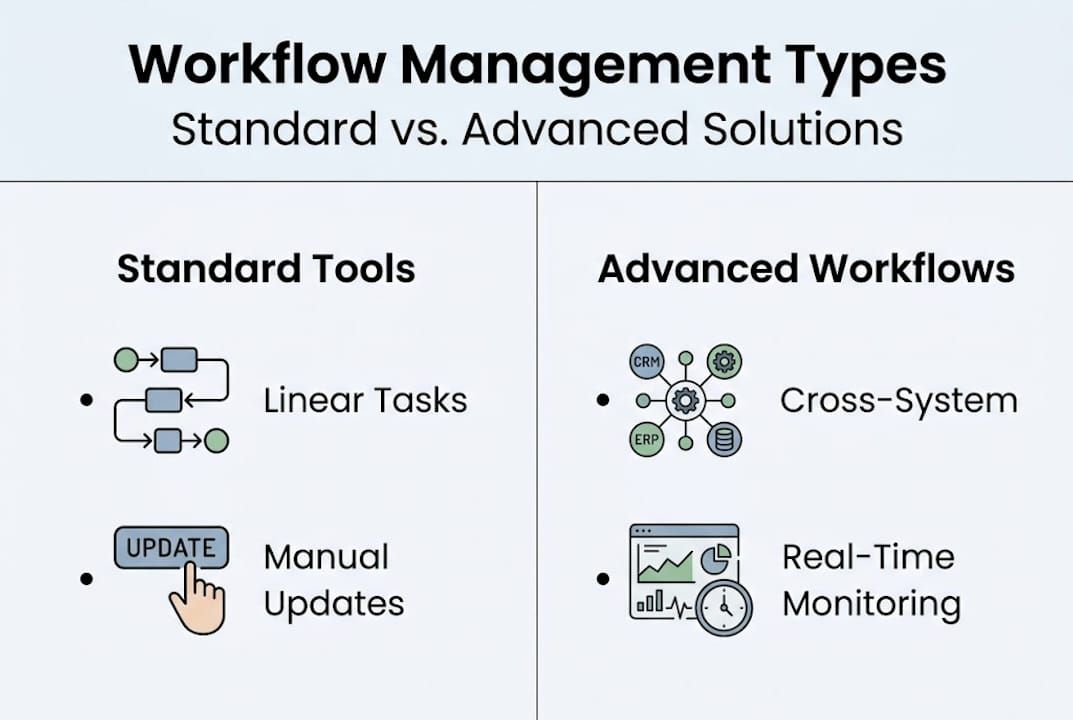
Advanced platforms, by contrast, are designed for dynamic orchestration, real-time process mining, and distributed reliability from the ground up. They do not just automate tasks. They orchestrate outcomes.
Use cases that specifically require advanced workflow management include:
- Multi-system financial processing: where a single transaction touches ERP, banking APIs, and compliance systems simultaneously
- Regulated industry workflows: healthcare, finance, and logistics where audit trails and approval chains are legally mandated
- Cross-departmental operations: procurement, onboarding, or contract management that spans HR, legal, finance, and operations
- AI-driven decision workflows: where model outputs trigger downstream business actions that must be traceable and reversible
| Dimension | Standard solution | Advanced solution |
|---|---|---|
| Architecture | Monolithic, task-focused | Distributed, process-orchestrated |
| Scalability | Departmental use cases | Enterprise-wide, cross-system |
| Analytics | Reporting on task completion | Real-time process mining and bottleneck detection |
| Integration depth | Pre-built connectors | Custom API, event-driven, and middleware support |
| Failure recovery | Manual re-entry | Automated compensation and retry |
Strategic triggers for considering an upgrade include rising error rates in cross-system processes, growing compliance audit burdens, and the inability to get real-time visibility into where work actually stands. If your teams spend significant time reconciling data between systems, that is a signal. Exploring optimizing workflow automation approaches can help organizations identify where standard tools are creating hidden costs.

Implementing advanced workflow management: Key steps and best practices
So, what does it look like to put advanced workflow management into practice in a real organization? Here is how to move forward without creating more complexity than you solve.
- Assess your current process landscape: Identify the five to ten workflows that carry the most operational risk or consume the most manual effort. These are your pilot candidates, not your entire portfolio.
- Involve all stakeholders early: Workflow design fails when it is treated as a technology project. Process owners, compliance teams, and end users must be part of the design phase, not consulted after the fact.
- Prioritize integration with mission-critical systems: A workflow platform that cannot connect reliably to your ERP, CRM, or data warehouse is a liability. Evaluate integration depth before evaluating features.
- Design for failure from day one: Build compensation logic, retry policies, and alerting into every workflow. Do not treat error handling as a phase two concern.
- Pilot, measure, then scale: Run a controlled pilot on one high-value process. Define success metrics before you start. Use what you learn to refine your approach before expanding.
- Invest in monitoring and traceability: As end-to-end trace monitoring across all system layers confirms, operational integrity depends on visibility, not just automation.
The most common implementation failure is not technical. It is organizational. Teams underestimate how much process knowledge lives in people’s heads rather than in documentation, and that gap surfaces only after go-live.
Pro Tip: Build your monitoring dashboard before you launch your first workflow. If you cannot see what is happening in real time, you cannot respond to failures fast enough to maintain operational continuity.
Pitfalls to avoid include ignoring data governance (who owns each data field in a cross-system workflow matters enormously), underestimating user adoption effort, and skipping the compensation design step. Reviewing enterprise automation strategies can help teams avoid these predictable missteps.
Why most enterprises underestimate workflow maturity—and what to do instead
Here is the uncomfortable truth: most organizations treat workflow management as a tool problem when it is actually a maturity problem. They buy a more capable platform and then run the same immature processes on it, wondering why the results disappoint.
Incremental tweaks to existing workflows rarely deliver meaningful gains. The organizations that see transformational results are the ones that redesign processes around the platform’s capabilities, not the other way around. That requires a willingness to question assumptions that have been baked into operations for years.
System-wide visibility is the capability most teams undervalue. Individual workflow automation is useful. But the real leverage comes from seeing how workflows interact, where bottlenecks propagate across systems, and where a failure in one process creates downstream risk in another.
True workflow maturity means thinking fail-safe and proactive, not just automated. As idempotency, correlations, and compensation design principles show, the goal is a system that degrades gracefully under stress rather than one that simply runs faster on a good day. The one thing most business leaders overlook is traceability as a strategic asset. Reviewing software automation best practices reveals that organizations with mature audit trails consistently outperform peers in regulatory audits and incident recovery time.
Unlock workflow excellence with Bitecode advanced solutions
Ready to take action? Here is how Bitecode can accelerate your workflow maturity and digital transformation.
Bitecode’s modular platform gives enterprise teams a practical path to advanced workflow management without starting from scratch. The automation module provides pre-built orchestration components that can be customized to your specific process logic, while the AI assistant module brings adaptive decision-making directly into your workflows. For teams managing customer-facing operations, custom CRM solutions integrate seamlessly with your workflow layer, ensuring data consistency across every touchpoint. With up to 60% of the baseline system pre-built, Bitecode reduces time-to-value significantly. Contact the team to discuss a pilot project tailored to your highest-priority workflows.
Frequently asked questions
What is the difference between advanced workflow management and basic automation?
Advanced workflow management handles complex, end-to-end processes with adaptive logic and error handling, while basic automation executes simple, repetitive tasks without dynamic orchestration, event-driven execution or compensation strategies.
How does advanced workflow management increase enterprise productivity?
It streamlines operations by integrating systems, reducing manual errors, automating approvals, and ensuring real-time compliance across all business flows, which eliminates the reconciliation work that consumes significant team capacity.
What should enterprises look for when selecting an advanced workflow platform?
Prioritize solutions with BPMN support and monitoring, integration flexibility, and robust error handling to ensure the platform can scale reliably across your most complex operational processes.
How can advanced workflows help with compliance and auditing?
Advanced workflow tools provide full traceability and audit trails near data sources, enabling organizations to monitor, document, and demonstrate compliance automatically rather than reconstructing evidence after the fact.