TL;DR:
- Enterprise software is being fundamentally reshaped around AI-native, modular, and composable platforms.
- Organizations that focus on governance, change management, and strategic integration will reap the most benefits.
- Legacy SaaS vendors face disintermediation risk unless they rapidly adopt autonomous and AI-first capabilities.
Enterprise software is not evolving gradually. It is being restructured from the ground up. Global software spending is forecast to hit $1.44 trillion in 2026, growing at 15.1% year over year, and the organizations that treat this as incremental change will find themselves rebuilding under pressure rather than competing from strength. The real challenge for IT executives is not identifying what is changing. It is separating durable structural shifts from vendor noise, and then building an adoption posture that captures genuine value without compounding technical debt or governance risk.
Key Takeaways
| Point | Details |
|---|---|
| Software spending surge | Enterprise software investment will reach $1.44 trillion in 2026 with a strong shift toward AI and automation. |
| AI-native platforms dominate | The move from human- to process-centric systems is accelerating, driving the adoption of AI-native development and multiagent platforms. |
| Governance is essential | Fewer than 15% of firms successfully implement advanced automation due to unresolved ROI and governance challenges. |
| Composable and modular is the future | Hybrid computing, modular automation, and blockchain adoption are becoming competitive differentiators for enterprises. |
| Vendor selection must prioritize AI | Evaluating vendors on their AI integration and composability is critical for future-proofing enterprise transformation projects. |
What’s driving explosive enterprise software growth?
The forecasted slowdown in enterprise software spending never arrived. AI investment absorbed what would have been budget caution, and organizations that delayed automation and platform modernization found the gap widening between themselves and early movers. The data tells a clear story.
| Metric | 2025 Value | 2026/2028 Projection | Growth Driver |
|---|---|---|---|
| Global software spend | ~$1.25T | $1.44T (2026) | AI, SaaS, automation |
| Enterprise SaaS spend | $318B | $512B (2028) | AI-first platform migration |
| Hybrid computing adoption | Under 20% | 40% (2028) | Composable architecture demand |
| AI security platform use | Under 20% | 50%+ (2028) | Zero-trust, multiagent risk surface |
Three forces are accelerating this growth simultaneously. First, AI is no longer a feature layered onto existing software. It is becoming the runtime layer itself, governing process orchestration, data routing, and decision execution. Second, SaaS consolidation is breaking down, with organizations pulling back from sprawling multi-vendor stacks in favor of fewer, deeper platform commitments. Third, regulated industries like financial services, healthcare, and supply chain logistics are entering the AI adoption curve later but with significantly higher budgets, compressing timelines.
Enterprise SaaS spending is projected to grow from $318B in 2025 to $512B by 2028, driven by AI-first platform migration. Legacy incumbents like Oracle and Salesforce face real disintermediation risk unless they can credibly integrate autonomous and composable capabilities at speed.
Understanding software best practices in 2026 requires recognizing that the market forces above are not creating a single winning platform category. They are creating a structural divide between organizations that operate with modular, AI-ready foundations and those still managing brittle, monolithic stacks. That divide will only widen through 2028.
Defining the top 2026 enterprise software trends
Gartner has identified its top 10 strategic technology trends for 2026, and the list is unusually cohesive in its direction. These are not ten independent bets. They are ten facets of the same structural shift: the enterprise becoming an AI-orchestrated system.
Top trends from Gartner’s 2026 list:
- AI-Native Development Platforms — Tools designed to generate, test, and deploy code with AI as the primary developer layer
- AI Supercomputing Platforms — Infrastructure purpose-built for training and inference at scale
- Confidential Computing — Hardware-based data protection enabling use of sensitive data in AI workloads
- Multiagent Systems — Autonomous AI agents coordinating across workflows without constant human intervention
- Domain-Specific Language Models — Narrow, fine-tuned models outperforming general LLMs in regulated or specialized contexts
- Preemptive Cybersecurity — Threat anticipation rather than just detection and response
- Digital Provenance — Verifying the origin and integrity of data and AI-generated content, often via blockchain
- AI Security Platforms — Unified security tooling designed specifically for AI workloads
- Geopatriation — Data sovereignty and localization driven by regulatory and geopolitical pressure
- Physical AI — AI embedded in physical environments, robotics, and operational systems
Forrester’s view adds critical near-term operational detail. The firm predicts that the top five HCM platforms will offer digital employee management for AI agents, that 30% of enterprise application vendors will launch MCP (Model Context Protocol) servers, and that 50% of ERP vendors will launch autonomous governance modules in 2026. These are not long-horizon predictions. They are product roadmap commitments that vendor selection decisions need to account for now.
| Trend Category | Gartner Priority | Forrester Business Impact | Timeline |
|---|---|---|---|
| AI-Native Platforms | Tier 1 | Team restructuring, faster delivery | 2026 active |
| Multiagent Systems | Tier 1 | Autonomous process orchestration | 2026 emerging |
| Digital Provenance / Blockchain | Tier 2 | Compliance, audit integrity | 2026 to 2027 |
| Preemptive Cybersecurity | Tier 1 | Risk surface reduction | 2026 active |
| Geopatriation / Data Sovereignty | Tier 2 | Regulatory compliance, infrastructure cost | 2026 to 2028 |
Pro Tip: Resist the temptation to chase every item on this list. The organizations gaining ground are those aligning two or three of these trends to their core business model rather than attempting broad-front adoption. Automation strategies for enterprises that are scoped to specific workflow pain points consistently outperform generalized AI rollouts in measured ROI. Similarly, an end-to-end automation guide for a logistics use case delivers more defensible value than a scattered multiagent pilot with no clear process owner.
Vendors are adapting faster than most enterprises realize. MCP servers, governance modules, and AI-agent management layers are being released inside existing platform contracts, often without prominent announcements. Teams should audit their current vendor roadmaps immediately, because these capabilities may already be available and underutilized.
From human-centric to AI-centric: Reshaping enterprise systems
The most consequential shift in 2026 is not a technology choice. It is an operating model choice. Enterprise software has historically been designed around human workflows: users enter data, approve requests, and navigate interfaces. AI-centric systems flip this. Processes drive outcomes, and humans are exception handlers, governance owners, or strategic directors.
Here is how this transition typically unfolds in practice:
- Process mapping and baseline automation — Organizations document current workflows and identify high-volume, rule-based tasks suitable for robotic process automation (RPA) or rule engines.
- AI augmentation at the task level — AI models are introduced to assist specific decisions: document classification, anomaly detection, contract review.
- Agentic workflow introduction — Multiagent systems are deployed to coordinate across tasks, replacing multi-step human handoffs with orchestrated autonomous sequences.
- Process-centric governance — Human oversight shifts from task execution to process quality, exception resolution, and outcome accountability.
- AI-native platform migration — Core systems are rebuilt or replaced on platforms where AI orchestration is the default runtime, not an add-on.
According to Gartner’s analysis, the shift from human-centric to process-centric enterprise software is being enabled by agentic and multiagent systems that execute autonomous workflows. But governance and data quality are critical bottlenecks that organizations consistently underestimate. Poor data governance does not become less problematic when AI is executing decisions autonomously. It becomes catastrophically more visible.
The workforce dimension is equally significant. Gartner projects that by 2028, over 50% of enterprises will use AI security platforms, and by 2030, AI-native platforms will have evolved 80% of large software development teams into smaller, AI-augmented teams. This is not a warning about job loss in isolation. It is a signal that team structures, budget models, and vendor relationships need to be redesigned around AI amplification rather than headcount.
Organizations succeeding in mastering enterprise automation are treating this restructuring proactively. They are building governance frameworks now, before full agentic deployment, rather than retrofitting controls after incidents expose gaps. The efficiency gains from automation are real, but they are only sustained when change management and data governance keep pace with technical deployment.

Pro Tip: Build institutional momentum by starting AI-centric transformation where outcomes are visible and stakes are manageable. Internal reporting automation, supplier onboarding workflows, and compliance documentation generation all deliver demonstrable results without exposing core transaction systems to early-stage risk.
Automation suites, blockchain, and composability: Real-world enterprise adoption
The gap between automation technology capability and enterprise activation rates is one of the most underreported stories in enterprise software for 2026. The tools exist. The roadmaps are published. And yet adoption of advanced features remains stubbornly low.
Key adoption dynamics shaping the 2026 automation landscape:
- Less than 15% of firms will activate agentic features in their automation suites despite having licenses that include them
- ROI proof points are the primary barrier, not technical readiness
- Governance gaps prevent organizations from trusting autonomous agents with high-stakes decision paths
- Vendor-level lock-in in automation suites increases switching costs and reduces composability options
- Process intelligence tooling is becoming a prerequisite for safe agentic deployment, not an optional enhancement
“Process intelligence will rescue 30% of failed AI projects in 2026 by surfacing the process gaps that cause autonomous agents to misfire. The lesson is that AI deployment without process visibility is not automation. It is acceleration of existing dysfunction.”
The composability theme is particularly important for organizations evaluating platform architecture. Hybrid computing, which combines cloud, on-premises, and edge infrastructure, is projected to reach 40% adoption by 2028. For enterprise teams, this means that system architecture decisions made now need to support a distributed, heterogeneous compute environment rather than a single-cloud assumption.
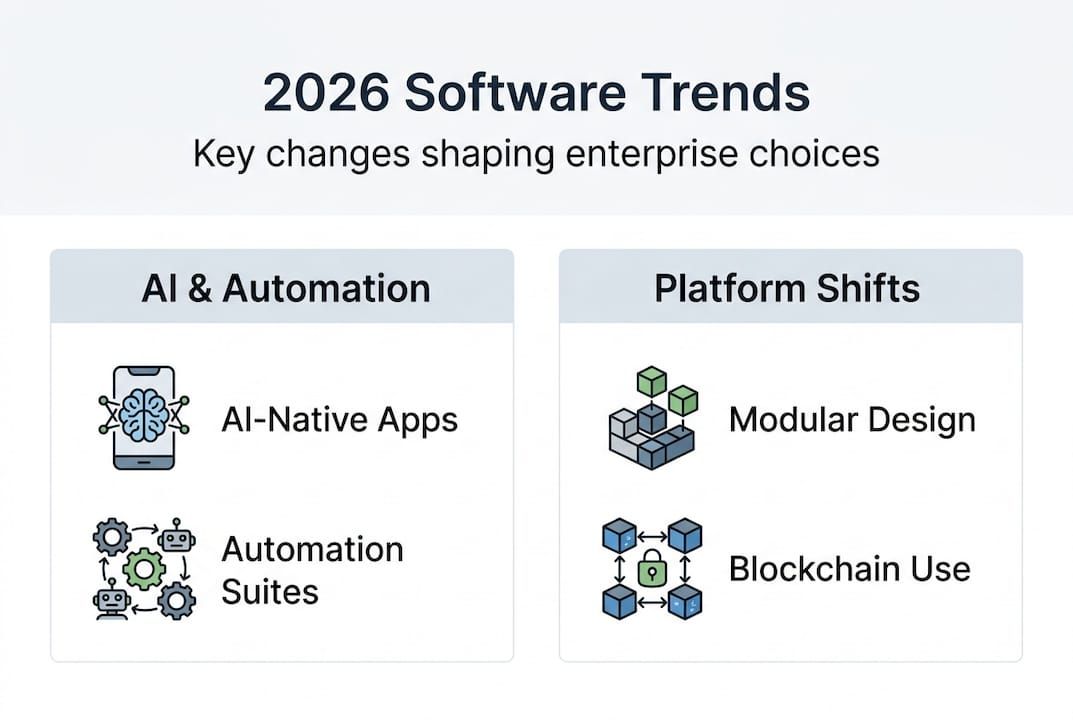
Blockchain is gaining real traction specifically in the digital provenance use case. This is not the speculative blockchain narrative of earlier cycles. It is operational: organizations using distributed ledger technology to verify the origin and integrity of AI-generated content, audit trails for regulated workflows, and supply chain provenance. The blockchain applications for enterprise workflows that are generating genuine ROI are narrowly scoped, integrated with existing ERP and compliance systems, and governed by clear data ownership policies.
Understanding the types of business automation available is essential context here. Not every workflow requires an agentic approach. Many high-value automation opportunities are still being captured by well-configured deterministic rules engines or structured RPA bots. The risk of over-engineering with multiagent systems for processes that do not require autonomous decision-making is real, and it generates technical debt that undermines future composability.
What most decision makers get wrong about 2026 enterprise software
The most common error is treating the 2026 trend cycle as a technology adoption checklist. Executives attend analyst briefings, build initiative inventories, and then measure progress against feature activation rather than business outcome. This approach has always underperformed, but in an AI-driven cycle, it is especially dangerous because the cost of misaligned adoption compounds faster.
The hard-won lesson that experienced transformation leaders share consistently is this: software value does not come from features. It comes from the combination of robust change management, meaningful governance, and user trust. An AI-native platform with poor change management delivers less value than a well-governed legacy system with targeted automation enhancements. The technology is the least constrained variable in most enterprise transformation failures.
There is also a surprising connection that most organizations miss. Reducing SaaS sprawl, consolidating vendors, and simplifying integration architecture often frees more innovation capacity than any headline AI investment. When teams are not managing integration debt across thirty-plus platforms, they have the bandwidth to actually activate and govern advanced AI capabilities. The innovation paradox is real: complexity suppresses the agility that AI adoption requires.
AI-assisted modular software development offers a concrete path through this paradox. Organizations that build on modular foundations, where components are pre-integrated, governance is built in, and AI capability is a configurable layer rather than a custom-coded feature, avoid both the sprawl problem and the greenfield development timeline problem. They can accelerate work without accelerating chaos.
Pro Tip: For every transformation project in 2026, benchmark vendor candidates against their published AI roadmaps and the degree to which their platforms support composability and module-level independence. Raw technology claims matter less than architectural flexibility and governance track record.
Future-proof your enterprise with tailored modular solutions
The trends covered in this article point toward a clear strategic posture: enterprises need modular, AI-ready foundations that can absorb change without requiring system-wide rebuilds every 18 months.
Bitecode.tech is built for exactly this environment. The platform’s AI Assistant Module enables organizations to integrate agentic and intelligent automation capabilities into custom workflows without building from a greenfield state. Up to 60% of the baseline system arrives pre-built, which means governance frameworks, security architecture, and integration boilerplate are already in place when domain-specific development begins. For enterprises managing complex customer relationships, the CRM software solutions module provides a composable foundation that connects naturally with AI orchestration layers. And for organizations where digital provenance and audit integrity are non-negotiable, the blockchain enterprise systems module delivers production-grade distributed ledger capabilities without the infrastructure overhead of a custom implementation.
Frequently asked questions
Which technology trend will impact the most enterprise IT budgets in 2026?
AI-native development platforms and automation suites are set to drive the largest share of enterprise IT budget allocation, as confirmed by Gartner’s top strategic trends for 2026. These categories are drawing both new investment and migration spend from legacy tooling.
What is the main reason enterprises struggle with automation adoption?
ROI ambiguity and governance gaps are the primary barriers, with fewer than 15% of firms activating agentic automation features despite holding active licenses. Organizations without clear process intelligence baselines cannot confidently assign autonomous decision authority to AI agents.
How should IT executives evaluate new enterprise software vendors in 2026?
Evaluation should weight AI integration roadmaps, architectural composability, and proven governance frameworks ahead of feature breadth, given that 40% hybrid computing adoption is projected by 2028. Vendors without credible plans for modular AI integration carry disproportionate migration risk.
What are the risks for legacy SaaS vendors in the 2026 enterprise software landscape?
Legacy SaaS vendors face genuine disintermediation as the market shifts to AI-first platforms, with enterprise SaaS spend projected to grow from $318B to $512B by 2028 but flowing disproportionately to AI-native alternatives. Incumbents like Oracle and Salesforce must integrate autonomous and composable capabilities quickly or cede ground to purpose-built competitors.