Most organizations have invested heavily in best-of-breed software, selecting top-rated tools for CRM, ERP, finance, HR, and operations. Yet many of those same organizations still struggle with slow reporting cycles, duplicate data entry, and decisions made on stale information. The problem is rarely the quality of individual tools. It is the absence of meaningful connectivity between them. Data silos and fragmented workflows cost enterprises millions annually in lost productivity and missed opportunities. This guide breaks down what integration actually means for large organizations, how to measure its ROI, and what frameworks consistently deliver lasting operational value.
Key Takeaways
| Point | Details |
|---|---|
| Integration unlocks efficiency | Breaking down silos lets organizations automate processes and scale productivity. |
| ROI is proven and rapid | Integrating business systems yields up to 350 percent ROI with quick payback. |
| Strategy over tools | The right architecture and governance beat simply picking popular software. |
| Avoid common pitfalls | Success depends on pre-build planning, real-data testing, and ongoing ownership. |
| Think long-term value | Effective integration should be treated as an ongoing business platform, not a one-time project. |
Integration defined: Beyond buzzwords to business reality
For many executives, integration sounds like an IT concern. In practice, it is a strategic business capability. At its core, integration means creating seamless connectivity and orchestration of data and functions across platforms, whether that is an ERP talking to a CRM, a finance system syncing with a procurement tool, or a customer portal feeding real-time data into a service dashboard.
“Integration enables real-time data access, improved efficiency, and breaks down silos that prevent organizations from acting on accurate information.”
The business pain points that integration addresses are familiar to any operations or IT leader:
- Duplicate data entry across systems that do not communicate
- Reporting delays caused by manual data consolidation
- Blind spots in customer or financial data due to platform fragmentation
- Slow approvals and process bottlenecks from disconnected workflows
These are not minor inconveniences. They compound over time, eroding margins and slowing growth. For C-level leaders, integration is not a technical upgrade. It is a competitive advantage. Organizations that treat custom business software as a connected ecosystem rather than a collection of standalone tools consistently outperform those that do not.
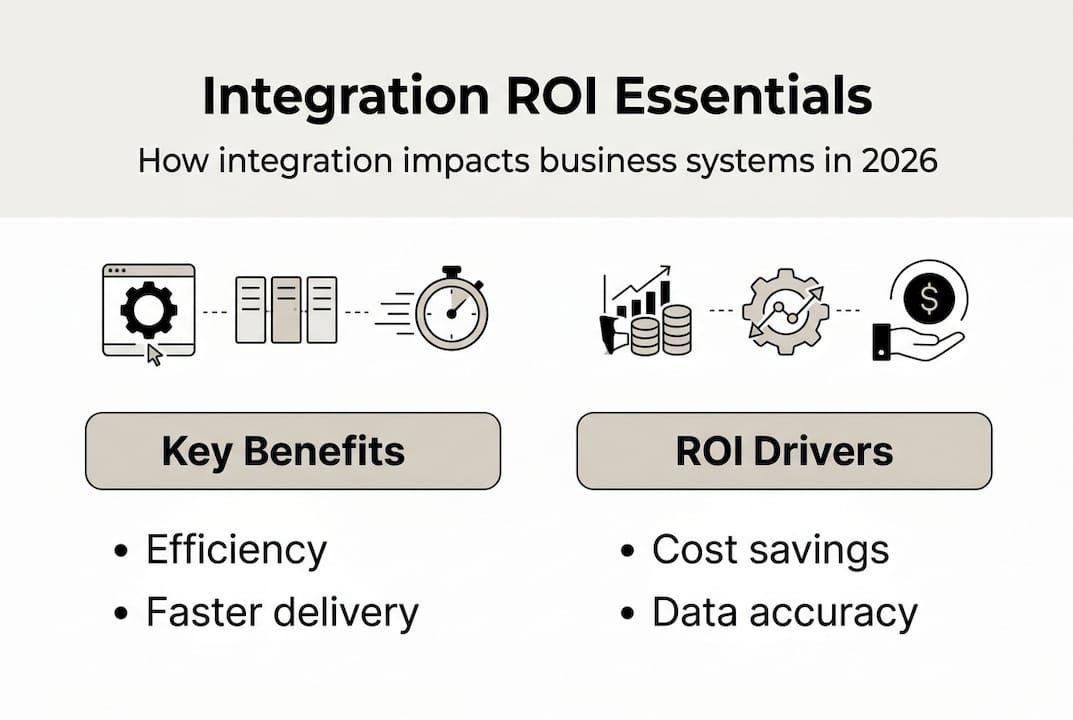
How modern integration drives operational efficiency and resiliency
Once integration is understood as a strategic capability, the next question is: what does it actually deliver? The evidence is substantial. Well-integrated organizations saw a 5% median total shareholder return increase over three years compared to peers with fragmented systems. That is not a marginal gain. It reflects compounding operational improvements across the entire business.
Breaking data silos is the most immediate win. When teams no longer spend hours reconciling spreadsheets or chasing down reports from other departments, that time redirects toward growth activities. Automation compounds this effect. Routine tasks like invoice matching, order status updates, and compliance checks can run without human intervention when systems share data cleanly.
Core operational wins from integration include:
- Faster decision-making through real-time dashboards fed by live system data
- Reduced error rates by eliminating manual data re-entry between platforms
- Improved customer experience when service, sales, and support share a unified data view
- Greater resilience through automated monitoring and exception handling across workflows
- Scalability without proportional headcount increases
Organizations that invest in automation strategies for efficiency alongside integration see compounding returns. For example, automating financial transactions within an integrated system reduces reconciliation time and audit risk simultaneously. The efficiency gains are not isolated. They cascade across every function that touches the integrated data layer.
Key integration methodologies: What works for enterprise IT
Not all integration approaches are equal, and choosing the wrong architecture creates technical debt that is expensive to unwind. The major methodologies each carry distinct trade-offs.

| Methodology | Best use case | Typical pitfall |
|---|---|---|
| API-led connectivity | Reusable, scalable integrations across modern platforms | Governance gaps if APIs are undocumented |
| iPaaS (Integration Platform as a Service) | Cloud-first orgs needing fast deployment | Vendor lock-in and cost at scale |
| ESB (Enterprise Service Bus) | Legacy-heavy environments with complex routing | Monolithic bottleneck if poorly governed |
| Point-to-point | Small, isolated integrations | Becomes unmanageable at scale (“spaghetti”) |
| Federated / hub-and-spoke | Large enterprises with distributed teams | Requires strong central governance |
API-led connectivity, iPaaS, and federated models each enable reusability and separation of concerns, which is critical for organizations that expect their integration layer to evolve alongside the business.
To assess your current integration maturity, follow these steps:
- Catalog all active integrations, including informal ones built by individual teams
- Identify ownership gaps, where no team is accountable for a given data flow
- Evaluate error handling, specifically whether failures are logged, alerted, and recoverable
- Review documentation, checking whether APIs and data contracts are current and accessible
- Score governance, assessing whether integration changes go through a defined review process
Pro Tip: Architecture and governance decisions outlast tool selections by years. Before evaluating vendors, define your integration principles, data ownership model, and observability requirements. Teams that skip this step often find themselves automating complex workflows on a fragile foundation. Choosing between custom integrations and large agency builds also becomes clearer once governance is defined. The goal is to build software efficiently without accumulating long-term technical debt.
The ROI equation: Business value, timelines, and success metrics
Executive buy-in for integration projects often hinges on one question: what is the return, and how fast? The empirical answer is compelling. Integration delivers 181 to 350% ROI with payback periods under six months in best-in-class implementations, alongside documented outcomes including over $20 million in monthly sales throughput and more than $3 million in present value from productivity gains.
| Benchmark metric | Typical range | Source context |
|---|---|---|
| ROI over 2 to 3 years | 181% to 350% | Forrester / SnapLogic TEI |
| Payback period | Under 6 months | Enterprise integration deployments |
| Developer productivity gain | 25% to 30% | Integrated platform case studies |
| Sales throughput increase | $20M+ per month | Fortune 500 integration programs |
| Net present value | $3M+ | Multi-system integration projects |
“After consolidating our order management, CRM, and finance systems onto a unified integration layer, we recovered over $4 million in annual operational costs within the first 18 months. The real surprise was how much faster our sales team could close deals with accurate inventory data at their fingertips.” Senior VP of Operations, Fortune 500 manufacturer
These numbers are not outliers. They reflect what happens when integration is treated as a platform investment rather than a one-time project. For organizations evaluating CRM implementation timelines and ROI, integration quality is often the single largest variable in whether the CRM delivers its projected value.
Challenges, risks, and what most enterprises get wrong
The ROI case is strong, but integration projects fail at a notable rate. 70% of businesses report persistent IT management difficulties, with failures most commonly traced to underestimating data mapping complexity, insufficient API testing, post-launch ownership gaps, and lack of a defined integration owner.
The most common failure patterns include:
- Point-to-point spaghetti: Building direct connections between every system pair, which becomes unmanageable as the system count grows
- No ownership model: Integrations built by project teams that dissolve after go-live, leaving no one accountable for failures
- Testing without real data: QA environments that do not reflect production data volumes or edge cases
- Retry cascades: Failure handling that triggers repeated retries, amplifying load on downstream systems
Solutions that consistently prevent these failures:
- Conduct pre-build analysis of all data flows and transformation requirements
- Assign explicit integration ownership before development begins
- Implement observability tooling from day one, not as an afterthought
- Use circuit breakers to prevent retry storms in event-driven architectures
- Define data contracts between systems and enforce them through automated testing
Pro Tip: The most dangerous integration failures are not technical. They are organizational. When business units and IT teams disagree on data ownership or process definitions, even well-architected integrations produce incorrect outputs. Align on business outcomes and data governance before writing a single line of integration code. For context on how integration principles apply outside IT, the pattern of coordinated systems outperforming isolated ones holds across domains.
Expert recommendations for lasting integration success
Sustainable integration is not a project. It is a practice. Federated governance, ongoing maturity assessment, and investment in observability handle the majority of edge cases that derail integration programs over time. Custom builds, in particular, require business-driven ongoing ownership to remain aligned with evolving operational needs.
Here is an action framework that IT and business leaders can apply immediately:
- Start with capability mapping: Identify which business capabilities depend on data from multiple systems before selecting any integration tool or platform
- Run a maturity review: Score your current integration landscape against governance, observability, documentation, and ownership criteria
- Choose architecture before tools: Define your integration style (API-led, federated, event-driven) based on your scalability and governance requirements
- Build for observability: Every integration should emit logs, metrics, and alerts from the first deployment, not after the first production failure
- Establish a post-launch review cadence: Schedule quarterly reviews of integration health, data quality, and business outcome alignment
- Measure continuously: Track developer productivity, error rates, process cycle times, and business KPIs tied to integrated workflows
Organizations that treat integration as a living system rather than a completed project consistently realize more of their projected ROI. Teams that want to fast-track custom applications benefit most when integration architecture is defined upfront, enabling new modules to connect cleanly without rework.
How Bitecode helps organizations integrate for maximum ROI
The frameworks and benchmarks in this guide point toward a clear conclusion: integration success depends on architecture, governance, and the right development partner as much as it depends on technology selection.
Bitecode specializes in building custom integration layers across CRM, financial processing, legal workflows, and core business platforms, with up to 60% of the baseline system pre-built using modular components. That means organizations can move from architecture to deployment significantly faster than traditional development cycles allow. Paired with AI automation solutions and a purpose-built AI assistant module, Bitecode’s approach compounds ROI by automating the workflows that integration unlocks. For teams evaluating custom CRM solutions or broader enterprise integration programs, Bitecode offers a practical, scalable path from fragmented systems to a connected operational platform.
Frequently asked questions
What are the biggest risks of not integrating business systems?
Siloed and unintegrated systems create data duplication, manual errors, reporting delays, and slower decision-making that can cost large organizations millions annually in lost productivity and missed revenue opportunities.
How do I choose the right integration strategy for my company?
Assess your current IT maturity and data governance model first, then select a scalable architecture such as API-led or iPaaS that aligns with your team’s ownership and observability capabilities before evaluating specific vendors.
Is integration only an IT problem or a business issue?
Integration is fundamentally a business issue. It drives strategic outcomes including automation, faster decision cycles, and measurable ROI improvements that affect competitiveness across every business function.
How fast can integration pay for itself?
Best-in-class integrations deliver payback under six months with total ROI ranging from 180% to 350% over two to three years, depending on the scope and quality of the integration architecture.