TL;DR:
- Digital migration improves efficiency, scalability, and profitability, with measurable operational benefits.
- Risks include data loss, downtime, and organizational friction; careful planning mitigates these challenges.
- Leadership and organizational change are crucial for successful, long-term digital transformation.
Legacy systems feel safe. That intuition is understandable, but it is quietly costing organizations more than most IT leaders realize. The numbers make the case plainly: digitally mature organizations achieve 45% more revenue from digital investments and 38% higher profit margins compared to peers still anchored to aging infrastructure. Yet many enterprises continue to defend legacy platforms on grounds of stability, familiarity, or switching cost fears. This article addresses those misconceptions directly, examines what digital migration actually delivers, and walks through the risks, the trade-offs, and the practical steps that separate successful migrations from expensive failures.
Key Takeaways
| Point | Details |
|---|---|
| Faster ROI | Digital migration drives faster returns through increased revenue and reduced IT operations costs. |
| Risk awareness | Recognizing risks like data loss and skill gaps is crucial to successful digital transitions. |
| Plan strategically | Careful planning, phased implementation, and ongoing buy-in are key to lasting value. |
| Leadership shift | True transformation succeeds when leadership prioritizes adaptability and cross-department collaboration. |
The case for digital migration: Efficiency, scalability, and profit
The business rationale for migrating to digital systems is no longer theoretical. It is measurable, documented, and increasingly urgent for organizations that compete on speed and adaptability.
Cloud migrations alone reduce infrastructure costs by up to 60%, accelerate deployment cycles by 30 to 40%, and improve developer productivity threefold. Those are not marketing projections. They reflect the operational reality for organizations that have made the shift and measured the results. The cost savings alone often justify migration within the first two years, before accounting for revenue-side gains.
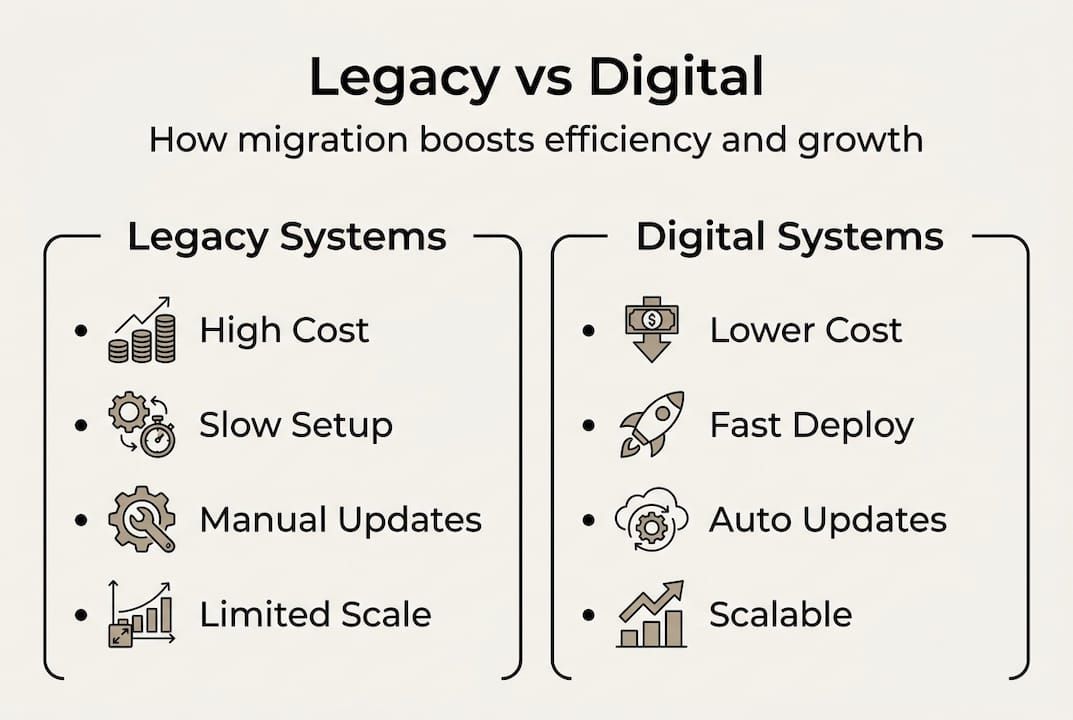
Digital platforms also change how teams work. Automation replaces manual, error-prone handoffs. APIs allow systems to communicate in real time rather than through batch processing cycles that introduce lag and friction. Organizations following enterprise efficiency best practices consistently find that digital workflows reduce processing times and free skilled employees for higher-value work.
Core reasons organizations migrate to digital systems include:
- Efficiency gains: Automated workflows eliminate redundant manual tasks and reduce error rates across operations
- Cost reduction: Cloud infrastructure shifts capital expenditure to predictable operational expenditure
- Scalability: Digital platforms scale on demand without proportional increases in infrastructure spend
- Speed to market: Shorter deployment cycles allow teams to ship features and respond to market shifts faster
- Innovation capacity: Modern stacks support AI, machine learning, and automation strategies that legacy systems cannot accommodate
- Competitive positioning: Digital capabilities are now a baseline expectation in most markets, not a differentiator
For finance functions specifically, digital transformation value is particularly pronounced. Real-time reporting, automated reconciliations, and integrated financial controls replace slow, manual processes that introduce both delay and compliance risk.
“Digital transformation is not just an IT initiative. It is a business strategy that determines which organizations lead and which ones fall behind.”
The efficiency and profit case is strong. But it is worth noting that these results are not automatic. They depend on how migration is planned and executed, which brings us to the challenges that derail even well-funded projects.
Challenges and risks: Understanding the migration hurdles
Understanding the benefits is essential, but confronting the risks ensures decision-makers are prepared for the journey. Digital migration is genuinely difficult, and the failure rates are sobering.
Only 48% of digital initiatives meet or exceed their business outcome targets, according to Gartner. Meanwhile, McKinsey research shows that 70% of organizations spend 70% of their IT budget simply maintaining legacy systems, leaving limited resources for transformation work. That structural constraint compounds the difficulty.
| Risk factor | Description | Mitigation approach |
|---|---|---|
| Data loss or corruption | Incomplete migration or format mismatches | Pre-migration audits, staged transfers |
| Operational downtime | System unavailability during cutover | Phased rollouts, parallel running |
| Overcustomization | Excessive tailoring that increases maintenance cost | Modular, standardized components |
| Skills gaps | Insufficient in-house expertise | Training programs, specialist partners |
| Poor change management | Resistance and adoption failure | Stakeholder engagement, clear communication |
| Compliance exposure | Regulatory gaps during transition | Early legal and compliance review |
The numbered list of failure patterns is similarly consistent across industries:
- Underestimating technical debt: Legacy systems often have undocumented dependencies that only surface mid-migration
- Skipping dependency mapping: Moving components without understanding upstream and downstream connections breaks integrations silently
- Insufficient testing: Compressed timelines push teams to skip regression testing, which introduces production defects
- Neglecting system integration pitfalls: Third-party connections frequently fail when core systems change
- Ignoring compliance timelines: Regulatory requirements in M&A, carve-outs, and data residency rules create edge cases that demand early attention
Cybersecurity deserves specific mention. Migrations create temporary attack surfaces as data moves between environments. Cybersecurity considerations and cloud security challenges should be integrated into the migration plan from day one, not addressed after the fact. A compliance automation guide can help teams build these controls systematically.
Pro Tip: Assign a dedicated risk owner for each migration workstream. When ownership is diffuse, critical risks get discovered late, usually during cutover, when the cost of course-correcting is highest.
“Migrations fail more often from organizational friction than from technical complexity. The technology is rarely the hardest part.”
Comparing legacy and digital systems: A strategic framework
To make informed investments, it helps to directly compare what legacy and digital systems deliver, both day-to-day and strategically.

| Dimension | Legacy systems | Digital systems |
|---|---|---|
| Infrastructure cost | High capital expenditure, fixed capacity | Variable operational expenditure, elastic capacity |
| Deployment speed | Weeks to months | Hours to days |
| Scalability | Manual, costly hardware additions | On-demand cloud scaling |
| Developer productivity | Low due to outdated tooling | Up to 3x higher with modern stacks |
| Integration capability | Limited, proprietary APIs | Open standards, broad ecosystem support |
| Compliance adaptability | Slow to update, high change risk | Modular updates, faster compliance response |
| Risk profile | Stable but brittle | More change exposure, better long-term resilience |
| Revenue impact | Constrained by system limitations | 45% more revenue for mature digital organizations |
The data tells a clear story. Organizations that continue to direct 70% of IT budgets toward legacy maintenance are choosing to fund yesterday’s architecture instead of tomorrow’s capability.
Key decision considerations when evaluating migration timing and scope:
- Time-to-market: Can your current system support feature releases at the speed your market demands?
- User experience: Are employees and customers tolerating friction that digital systems would eliminate?
- Integration readiness: Does your architecture support the APIs and data flows that modern operations require?
- Financial system complexity: Review the financial systems guide to assess whether your current platform can support real-time financial processing
- ROI horizon: Understand integration for ROI and set realistic payback period expectations before committing
For teams evaluating architectural options, the build IT systems options comparison provides a useful framework for weighing greenfield builds versus modular migration paths. Finance teams in particular should examine finance automation savings evidence before scoping their migration investment.
Pro Tip: Structure your migration in phases, each with a defined business outcome, not just a technical milestone. Phases tied to measurable business results maintain executive sponsorship and make course corrections easier to justify.
Best practices for a successful digital migration
With the stakes understood and comparisons clear, let’s walk through the most effective ways to implement digital migration in your organization.
A structured, disciplined approach consistently outperforms ambitious big-bang migrations. The organizations that succeed treat migration as a program of incremental, validated change rather than a single high-risk cutover event.
Numbered best practices for migration execution:
- Build a rigorous business case first. Quantify the cost of inaction alongside the cost of migration. Vague ROI projections erode stakeholder confidence when complications arise.
- Map all system dependencies before touching production. Undocumented integrations are the most common source of mid-migration surprises.
- Run a contained pilot. Migrate a low-risk workload first, measure the results, and use those findings to refine your approach before scaling.
- Scale in phases, not all at once. Each phase should have clear success criteria, rollback procedures, and a defined owner.
- Maintain and monitor continuously after go-live. Migration does not end at cutover. Performance baselines, security posture, and user adoption all require sustained attention.
Following established software best practices throughout the migration reduces the risk of the governance gaps that Gartner identifies as central to why only 48% of digital initiatives meet their targets.
Additional actions that prevent common failure modes:
- Avoid overcustomizing the new platform in early phases. Lock in core workflows before extending functionality.
- Invest in training before go-live, not after. Adoption failure is predictable when users encounter an unfamiliar system without preparation.
- Establish a cross-functional governance board with authority to make decisions, not just observe progress.
- Apply fintech workflow optimization principles if financial or payment workflows are in scope.
Pro Tip: Identify two or three internal champions in the business units most affected by migration. Peer credibility within those teams accelerates adoption far more effectively than top-down mandates.
Why successful digital migration means changing how you lead
Most migration guides focus on tooling, timelines, and technical architecture. Those elements matter. But they are not where most migrations actually fail.
The harder problem is leadership. Conventional wisdom treats digital migration as a project to be managed. The organizations that succeed treat it as a permanent shift in how decisions get made, how teams are structured, and how success is defined. That is a meaningfully different posture.
What tends to go wrong is not the technology selection. It is the absence of cross-functional buy-in, the incentive structures that reward stability over adaptability, and the organizational inertia that quietly resists change at every level below the C-suite. Tools do not change culture. Leaders do.
The practical implication is this: treat migration as an ongoing evolution rather than a one-off project with a go-live date. Organizations that adopt this framing, and embed it in their enterprise leadership practices, are the ones that extract lasting value from their technology investments. Those that treat it as a finite initiative typically find themselves repeating the exercise within five years.
Explore advanced digital solutions with Bitecode
Ready for your own transformation? The path from legacy architecture to a scalable digital platform is clearer when you start with the right foundation.
Bitecode helps IT leaders accelerate that journey without the typical overhead of greenfield builds. With up to 60% of the baseline system pre-built using modular components, organizations can deploy AI automation solutions and blockchain payment integration without starting from scratch. Whether your team needs tailored workflow automation, financial processing, or a scalable SaaS foundation, custom workflow automation is built into the platform from day one. Explore what a modular migration strategy looks like for your organization and get to production faster than traditional development timelines allow.
Frequently asked questions
What are the top three benefits of migrating to digital systems?
Migrating to digital systems boosts operational efficiency, reduces long-term infrastructure costs, and increases organizational adaptability. Digitally mature organizations achieve 45% more revenue from digital investments and 38% higher profit margins than those still on legacy platforms.
What percentage of digital initiatives actually meet their business goals?
Only 48% of digital initiatives meet or exceed their business outcome targets, according to Gartner, which means the majority fall short without careful planning and governance.
What are the biggest risks of digital migration?
The main risks are data loss, unplanned downtime, excessive customization costs, compliance exposure during transition, and a shortage of skilled staff to execute the migration. These risks are well documented and largely preventable with structured planning.
How can organizations reduce the risks when migrating systems?
Strong change management, phased rollouts with clear success criteria, and investing in employee training before go-live all significantly reduce migration risk. Poor change management and skill gaps are among the most cited causes of migration failure.
What role does automation play in digital migration?
Automation accelerates process improvements, reduces manual errors, and sustains efficiency gains after migration is complete. Cloud migrations accelerate deployments by 30 to 40% and improve developer productivity threefold, with automation driving a significant share of those gains.