TL;DR:
- Successful enterprise integration aligns technical efforts with strategic business outcomes.
- Cloud-native iPaaS platforms offer scalable, agile solutions over traditional heavy on-premise ESBs.
- Addressing organizational challenges and governance is crucial for lasting integration value.
Enterprise system integration is one of those initiatives where the gap between expectation and reality can cost millions. IT leaders often assume the hard part is technical: connecting APIs, mapping data fields, and configuring middleware. The real challenge runs deeper. Integration decisions shape how fast your organization can respond to market changes, how reliably data flows between teams, and whether your AI and blockchain investments will ever deliver on their promise. This guide cuts through the noise to deliver a practical framework covering integration models, platform choices, measurable ROI benchmarks, and the pitfalls that derail even well-funded projects.
Key Takeaways
| Point | Details |
|---|---|
| Integration is strategic | Enterprise system integration drives more than connectivity—it powers agility, data quality, and business innovation. |
| Modernize with iPaaS | iPaaS platforms offer scalable, rapid integration compared to legacy ESB approaches, enabling hybrid and cloud strategies. |
| ROI is dramatic | Integration, when executed strategically, achieves over 100% ROI, huge cost savings, and major efficiency gains. |
| Pitfalls are avoidable | Governance, high-quality data, and reusable APIs help prevent the common failures that derail enterprise projects. |
What is enterprise system integration?
At its core, enterprise system integration is the practice of connecting disparate applications, data sources, and business processes so information moves reliably and efficiently across an organization. It is not simply about making two systems talk to each other. It is about creating a coherent information architecture that eliminates redundancy, reduces manual handoffs, and supports real-time decision-making at scale.
Following data integration maturity and methodology models, enterprise system integration connects disparate applications, data sources, and processes using methodologies assessed across six maturity dimensions: strategy, organization, styles and architecture, technology and tools, governance, and metadata. Each dimension reflects how intentional and scalable an organization’s integration posture actually is.
Three core integration models define most enterprise architectures today:
- Data-centric integration uses ETL (extract, transform, load) or ELT pipelines to move and transform data between databases and warehouses. This model suits analytics, reporting, and compliance use cases where latency is acceptable.
- Application-centric integration relies on middleware, APIs, and service-oriented architecture to connect business applications directly. It is the dominant model for ERP, CRM, and HRMS connectivity.
- Event-centric integration uses event buses and streaming platforms (such as Apache Kafka) to trigger real-time responses across systems. This model powers fraud detection, logistics tracking, and dynamic pricing.
Integration exists on a spectrum. At one end, organizations operate with ad hoc, point-to-point connections that grow into unmaintainable webs of dependencies. At the other end, mature organizations run centralized, orchestrated architectures with clear governance and reusable integration assets. Most enterprises sit somewhere in the middle, which is exactly where the risk accumulates.
Understanding where your organization sits on that spectrum is the first step toward making informed decisions. Reviewing enterprise software best practices before committing to an integration architecture can prevent costly rework. Similarly, working through a software selection checklist helps teams align platform choices with actual business requirements rather than vendor marketing.
Key methodologies: ESB, iPaaS, and the move to cloud-native integration
For years, the Enterprise Service Bus (ESB) was the standard answer to enterprise integration complexity. ESBs excel in on-premise environments where centralized message routing, complex data transformation, and strict protocol mediation are required. They are powerful but heavy: deployment cycles are long, configuration is specialized, and scaling requires significant infrastructure investment.
The shift toward cloud and hybrid environments changed the calculus. Modern methodologies favor iPaaS over traditional ESB for cloud-native, scalable integrations supporting hybrid environments, API-led connectivity, and rapid deployment. Leading iPaaS vendors including Boomi, Informatica, MuleSoft, Microsoft Azure Integration Services, and Oracle Integration Cloud now dominate enterprise procurement conversations.
| Factor | ESB | iPaaS |
|---|---|---|
| Deployment | On-premise | Cloud or hybrid |
| Setup cost | High | Low to medium |
| Scalability | Limited by infrastructure | Elastic, on-demand |
| API management | Manual, complex | Native, built-in |
| Ease of management | Requires specialists | Low-code friendly |
| Best fit | Legacy, monolithic stacks | Cloud, modern, hybrid |
API-led and event-driven patterns have become the default for organizations prioritizing speed and agility. API-led connectivity breaks integration into three layers: system APIs that expose core data, process APIs that orchestrate business logic, and experience APIs that serve specific consumer needs. This layered approach means teams can change one layer without disrupting the others, which is a significant advantage in fast-moving environments.
For teams evaluating Java for enterprise integration, the language’s maturity and ecosystem make it a strong foundation for both ESB customization and iPaaS connector development.
Pro Tip: Use iPaaS for quick wins and early experimentation, but invest in governance architecture from day one. Without clear ownership of APIs, data contracts, and versioning policies, iPaaS environments can generate their own form of sprawl just as damaging as legacy point-to-point connections.
Getting results: Integration ROI and efficiency benchmarks
Integration projects are expensive and time-consuming. The business case needs to be concrete. Fortunately, the data is compelling when projects are executed well.

SnapLogic iPaaS delivers 181% ROI over three years, with $3.3M in total benefits against $1.2M in costs, a net present value of $2.2M, and a payback period under six months. A retailer that replaced MuleSoft with SnapLogic cut delivery time by 70% and reduced project costs by 40 to 65%. In a Deloitte case study, order configuration time dropped from 30 minutes to 2 minutes with a 98% reduction in errors, supporting $11B in revenue operations.
These numbers are not outliers. They reflect what happens when integration is treated as a strategic investment rather than a maintenance task.
| Metric | Benchmark result |
|---|---|
| 3-year ROI (iPaaS) | 181% |
| NPV | $2.2M |
| Payback period | Under 6 months |
| Delivery time reduction | Up to 70% |
| Project cost reduction | 40 to 65% |
| Error rate reduction | Up to 98% |
To track integration success, IT leaders should monitor these core KPIs:
- System uptime and latency: Are integrations running reliably and within acceptable response times?
- Data error rates: How often does bad or incomplete data move between systems?
- Time-to-deploy new integrations: Is your team getting faster, or does each new connection require the same effort?
- Cost per integration: Are you building reusable assets, or rebuilding from scratch each time?
- Business process cycle time: Is the underlying business process actually faster after integration?
Understanding business system ROI in concrete terms helps IT leaders justify budget and prioritize the integrations with the highest impact. Teams exploring enterprise automation results will find that integration quality is consistently the differentiating factor between automation projects that deliver and those that stall.
Integration challenges, pitfalls, and how to avoid them
Even well-resourced organizations fail at integration. The reasons are predictable, which means they are also preventable.
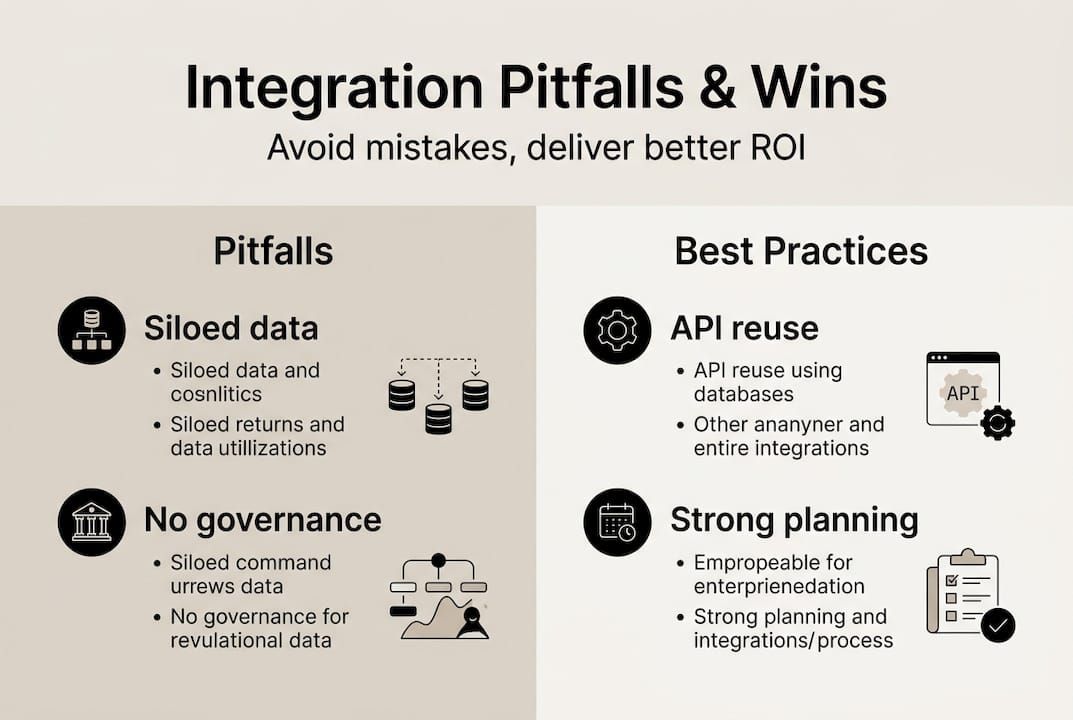
Common integration failures include data silos and quality issues, legacy system incompatibility, human error in EDI processes, security reviews that stall pilots, and point-to-point sprawl that becomes unmanageable at scale.
For AI and blockchain integration specifically, the stakes are higher. Roughly 46% of AI pilots and up to 60% of broader AI projects fail due to integration and data quality problems, not model performance.
“95% of AI pilots fail not because of the AI, but due to integration gaps.”
Here are the five most common integration pitfalls and how to address them:
- Data quality neglect: Teams rush to connect systems without auditing data quality first. Fix this by establishing data contracts and validation rules before any pipeline goes live.
- Legacy incompatibility: Older systems often lack APIs or use proprietary protocols. Address this with adapter layers or middleware that translates legacy formats without requiring system replacement.
- Security review delays: Security teams are often brought in too late, stalling deployments. Involve security architects at the design phase, not after the build.
- Point-to-point sprawl: Each new connection adds complexity. Prevent this by mandating that all integrations route through a governed platform layer rather than direct system-to-system links.
- Governance gaps in AI and blockchain: Non-deterministic outputs from AI models and oracle dependencies in blockchain require explicit error handling and fallback logic that most integration designs skip entirely.
Pro Tip: Prioritize reusable APIs and platform governance from the start. Every integration built as a reusable asset reduces the cost and risk of the next one. Teams that skip this step typically spend 60 to 70% of their integration budget on maintenance rather than new capability.
Reviewing automation risk pitfalls in financial workflows and consulting a business automation guide can help teams build integration strategies that anticipate failure modes rather than react to them.
The real integration challenge: It’s a business (not just a tech) transformation
Here is the uncomfortable truth most integration vendors will not tell you: the technology is rarely the limiting factor. The real constraint is organizational. Most integration projects are scoped, funded, and measured as IT infrastructure work, which means they optimize for technical connectivity rather than business outcomes.
The organizations that extract the most value from integration treat it as a strategic asset. They assign business owners to integration domains, not just technical leads. They measure success by process cycle time and revenue impact, not just uptime. They build governance structures that allow the integration layer to evolve as the business changes.
Without that holistic vision, most “modernized” stacks simply create new silos with shinier tools. The ESB gets replaced by an iPaaS, but the same fragmented data ownership and unclear accountability patterns persist underneath. Understanding integration and ROI at the business level, not just the technical level, is what separates organizations that achieve durable agility from those that run perpetual integration projects.
Achieve seamless integration with tailored enterprise solutions
Bitecode.tech works with medium to large organizations that need integration done right the first time. Whether you are bridging legacy ERP systems with modern cloud platforms or embedding AI and blockchain into core workflows, the modular foundation approach means up to 60% of the baseline system arrives pre-built, dramatically reducing time-to-value.
The platform’s ready-made modules for AI assistant and workflow automation, blockchain-based integrations, and enterprise automation solutions give IT teams a governed, scalable starting point rather than a greenfield build. If your organization is ready to move from integration strategy to execution, Bitecode.tech provides the technical depth and pre-built components to accelerate work without accelerating chaos.
Frequently asked questions
How is iPaaS different from traditional ESB?
iPaaS platforms are cloud-native, support easier API integration, and scale rapidly, while ESBs are on-premise, heavier, and better suited to legacy workflows. Modern methodologies favor iPaaS for cloud-native, scalable integrations in hybrid environments.
What causes most AI integration pilots to fail?
Most failures come from poor data quality, incompatible system architectures, and neglected security or process reviews. 95% of AI pilots fail due to integration gaps, not the AI itself.
What are the top three measurable benefits of modern integration?
Organizations see reduced project delivery time, significant cost savings, and lower error rates with properly executed integrations. SnapLogic iPaaS delivers 181% ROI over three years alongside up to 98% error reduction.
Can integration be achieved without replacing all existing legacy systems?
Yes, hybrid and phased approaches allow integration between legacy, cloud, and new systems while limiting business disruption. Integration styles and technology selection strategies are designed to suit both legacy and modern architectures simultaneously.