TL;DR:
- Digital finance transformation involves strategic change in processes, talent, and technology, not just tools.
- Successful transformation depends on CFO-led roadmaps, governance, and organizational alignment.
- Common failure causes include talent gaps, poor leadership, and treating transformation as a one-time project.
Most finance leaders know they need to transform. Far fewer understand what transformation actually requires. The common assumption is that deploying a new ERP or layering on automation tools constitutes digital transformation. It does not. Digital finance transformation addresses expanded CFO responsibilities, data analytics, AI adoption, and cost optimization as interconnected imperatives, not isolated upgrades. For CFOs navigating rising complexity, tighter margins, and accelerating regulatory demands, the distinction matters enormously. This article examines the strategic drivers, proven frameworks, documented ROI, and recurring failure patterns that define digital transformation in finance today.
Key Takeaways
| Point | Details |
|---|---|
| CFO leadership matters | CFO-driven digital transformation initiatives are twice as likely to succeed. |
| ROI and cost savings | Digital transformation in finance typically delivers significant cost reductions and fast ROI for top performers. |
| Focus beyond tech | Transformation fails when approached as a technology-only project—operating models and culture are crucial. |
| Plan for talent and change | Investing in digital upskilling and cultural change is essential for sustained digital finance success. |
What drives digital transformation in finance?
Finance functions have always faced pressure to do more with less. What has changed is the pace, the complexity, and the strategic expectations placed on the CFO role. Today’s finance leaders are expected to operate as enterprise strategists, not just financial stewards. That shift creates a clear imperative for transformation.
The core drivers are well-documented. CFOs need to evolve finance functions into strategic value drivers, with advanced analytics and talent upskilling at the center of that effort. This is not optional positioning. It reflects a structural change in how boards and executive teams expect finance to contribute.
Several pressures converge to make transformation urgent:
- Cost optimization: Finance teams are expected to reduce operational overhead while maintaining accuracy and compliance.
- Data and analytics: Real-time decision support requires infrastructure that most legacy finance systems cannot provide.
- Talent gaps: The skills required for modern finance, including data literacy and process design, are scarce and increasingly competitive.
- Regulatory complexity: Evolving reporting standards and cross-border requirements demand systems that can adapt quickly.
- Market volatility: Scenario planning and forecasting agility have become baseline expectations, not advanced capabilities.
Understanding finance automation ROI is increasingly central to building the business case for transformation. Finance leaders who can quantify the return on process automation are better positioned to secure executive buy-in and allocate resources effectively.
The risk of inaction is no longer abstract. Organizations that delay transformation face compounding disadvantages: slower reporting cycles, higher manual error rates, and reduced capacity to support strategic decisions. The drivers above are not trends. They are structural realities that define the operating environment for finance in 2026.
How digital transformation works: Key frameworks and technologies
Understanding the why, let’s make sense of how digital transformation unfolds in practice. The most important insight here is that successful transformation is not defined by which technologies a team adopts. It is defined by the operating model, leadership alignment, and strategic roadmap that govern how those technologies are deployed.
Successful transformations use strategic roadmaps and emphasize the CFO’s cross-functional role, roughly doubling the success rate compared to IT-led or tool-first approaches. That finding has significant implications for how finance leaders should frame and own transformation initiatives.

| Approach | Focus | Typical outcome |
|---|---|---|
| Tech-driven | Tools and platforms first | Short-term efficiency gains, fragile integration |
| Operating model-centric | Process, governance, and talent | Sustainable capability building |
| People-centric framework | Culture, skills, and leadership | Higher adoption, lower change fatigue |
The technologies most commonly deployed in finance transformation include robotic process automation (RPA) for repetitive transaction processing, AI and machine learning for forecasting and anomaly detection, and cloud-based ERP platforms that consolidate financial data across business units. Each of these tools delivers value only when embedded in a well-designed process.
Building a transformation roadmap that holds up in practice requires a structured sequence:
- Define the strategic objective: What does finance need to deliver that it currently cannot?
- Audit current capabilities: Map existing processes, tools, and talent gaps honestly.
- Prioritize use cases: Focus on high-impact, achievable improvements first to build momentum.
- Align leadership: Secure CFO-level sponsorship and cross-functional commitment before any deployment.
- Design for adoption: Build change management and training into the roadmap from the start.
- Measure and iterate: Establish clear KPIs and review cycles to course-correct early.
Reviewing enterprise software best practices and consulting a solid financial processing systems guide can help teams avoid common architectural missteps before they become costly.
Pro Tip: Tie every technology deployment to a specific talent or culture change. If your team cannot explain how a new tool changes their daily workflow and decision-making, the adoption will stall regardless of how well the software performs.
What finance leaders can expect: Benefits, benchmarks, and ROI evidence
With frameworks and tools charted, let’s examine the concrete benefits CFOs can expect, and the numbers behind them. The evidence base here is stronger than many finance leaders realize.
Top-performing banks and finance programs report cost reductions exceeding 10%, with ROI of 200 to 450% achievable within 12 to 18 months under well-managed conditions. These are not outlier results from technology-native firms. They reflect what disciplined, operating-model-focused transformation can deliver in traditional finance environments.
| Metric | Typical range | Best-in-class |
|---|---|---|
| Cost reduction | 8 to 15% | 20%+ |
| Reporting cycle time | 30 to 50% faster | 70%+ faster |
| ROI (12 to 18 months) | 100 to 200% | 450% |
| Error rate reduction | 40 to 60% | 80%+ |
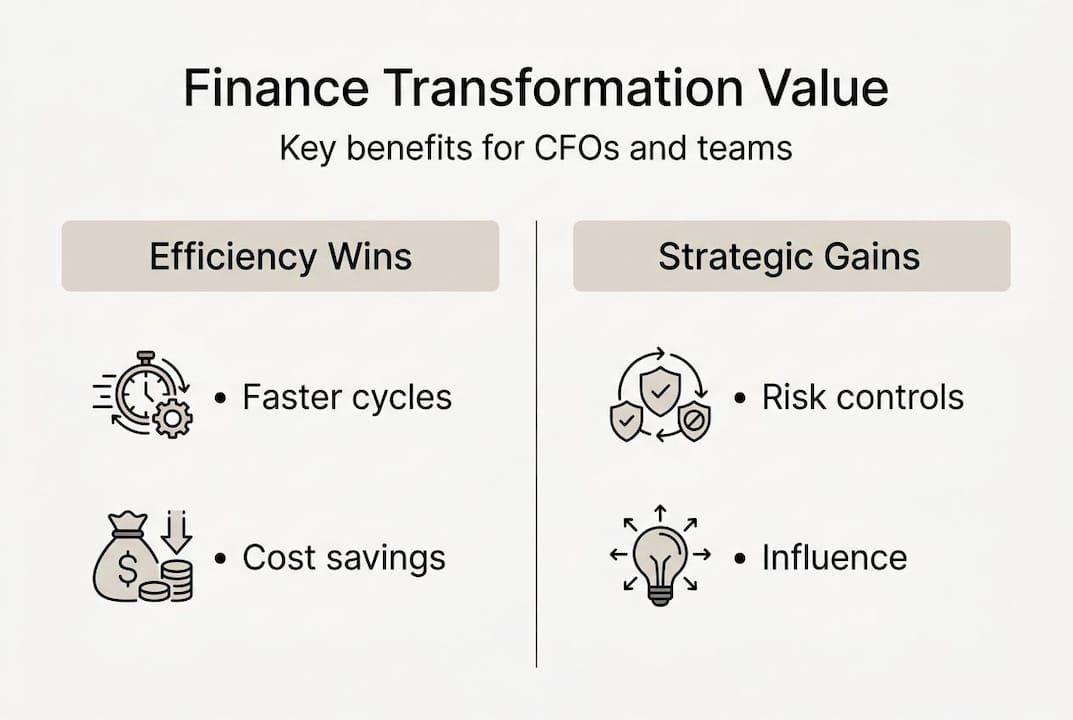
The benefits extend well beyond cost. Finance teams that complete structured transformation programs report measurable improvements across several dimensions:
- Decision-making speed: Automated data pipelines reduce the time from data collection to executive reporting from days to hours.
- Regulatory agility: Cloud-based systems can be updated to reflect new reporting requirements far faster than on-premise alternatives.
- Risk visibility: AI-driven anomaly detection identifies control failures and fraud signals earlier in the transaction lifecycle.
- Strategic influence: Finance teams with strong analytics capabilities are more frequently included in strategic planning discussions.
Understanding finance automation cost savings at the process level, and evaluating business system ROI across integrated platforms, gives CFOs a clearer picture of where transformation investment compounds over time. The quick wins, such as automated reconciliation and real-time dashboards, tend to fund the longer-term capability investments that drive sustained competitive advantage.
Common pitfalls: Why finance digital transformations fail
Of course, success is never guaranteed. Here’s what often goes wrong with digital transformation, and how to sidestep these risks.
The failure rate is sobering. 69% of transformations are slow or fail to meet goals, mostly due to talent gaps, traditional mindsets, and treating digital transformation as a technology-only initiative.
“When technology is asked to do organizational work, it fails. The tools are not the problem. The operating model is.”
The most common failure patterns are predictable and preventable:
- Technology-first framing: Selecting platforms before defining the business problem they need to solve.
- Weak governance: No clear ownership of transformation outcomes across finance and business units.
- Talent neglect: Investing in software without investing in the people who must use and maintain it.
- Change fatigue: Stacking multiple initiatives without adequate recovery time or communication.
- Regulatory blind spots: Failing to account for compliance implications of new data architectures or automated workflows.
Research on digital transformation failure causes consistently points to the same root issue: organizations treat transformation as a project with a defined end date rather than an ongoing capability-building effort.
Reviewing automation strategies for enterprises and studying a practical financial process automation guide can help teams build automation programs that are resilient to these common failure modes.
Pro Tip: Structure transformation as an organization-wide initiative with explicit people and process workstreams, not just a technology deployment. Assign a transformation lead who is accountable for adoption outcomes, not just go-live dates.
Our perspective: Why technology is not enough—rethinking CFO leadership
Having covered both opportunities and obstacles, here is our take on what really separates success from failure.
The most persistent misconception in finance transformation is the belief that better tools produce better outcomes automatically. They do not. Technology is a force multiplier. It amplifies whatever operating model, governance structure, and talent base already exist. Deploy sophisticated AI on top of fragmented processes and misaligned incentives, and you accelerate chaos, not performance.
Success demands CFO-led, company-wide change, not tech-first rollouts delegated to IT. The CFO who leads transformation from the front, who owns the roadmap, champions the talent agenda, and holds the organization accountable for adoption, is the single most reliable predictor of success.
The real test of digital transformation is not whether the software went live on schedule. It is whether finance operates differently, makes better decisions faster, and contributes more meaningfully to enterprise strategy. Reviewing enterprise software best practices is useful, but no set of tools substitutes for leadership clarity and organizational commitment.
Accelerate your finance transformation with advanced digital solutions
If you are ready to apply these lessons in your own finance organization, the next step is choosing the right technical foundation to support your roadmap.

Bitecode.tech builds modular, enterprise-grade systems with up to 60% of the baseline already pre-built, so finance teams can deploy AI assistant for finance capabilities, custom CRM solutions, and blockchain payment systems without the extended timelines of traditional development. The platform is designed for organizations that need to move quickly without sacrificing security, scalability, or control. For CFOs who have a clear transformation roadmap and need a trusted technical partner to execute it, Bitecode offers a practical, accelerated path forward.
Frequently asked questions
What is digital transformation in finance?
Digital transformation in finance means rethinking processes, talent, and technology together to make finance more strategic, automated, and resilient. It is not a technology upgrade. It is an operating model shift.
What are the main benefits of digital transformation for CFOs?
CFOs gain faster reporting cycles, measurable cost reductions, stronger risk controls, and greater strategic influence. Top finance transformations achieve over 100% ROI while cutting costs and increasing decision speed significantly.
Why do most finance digital transformation projects fail?
Most projects fail because of talent gaps, over-reliance on technology to solve organizational problems, and insufficient leadership sponsorship. 69% of programs miss their goals, with people and mindset gaps as the primary cause.
How should CFOs get started on digital transformation?
CFOs should lead with a strategic roadmap that aligns technology choices, leadership accountability, talent development, and measurable business goals. CFO-led, cross-functional roadmaps roughly double the success rate of transformation programs.