TL;DR:
- Many enterprises waste time due to unexamined workflows, requiring systematic analysis and continuous improvement. Effective workflow optimization involves assessing end-to-end processes, removing inefficiencies, and integrating multiple methodologies like Lean, Six Sigma, and Agile. Success depends on thorough mapping, data benchmarking, stakeholder alignment, and leveraging scalable technology solutions that support ongoing operational discipline.
Most enterprises waste more time than they realize — not because their teams lack effort, but because their processes have never been systematically examined. Workflow optimization is widely misunderstood as simply automating repetitive tasks, yet the reality is far more strategic. As workflow optimization is defined, it is the systematic practice of analyzing existing workflows, removing inefficiencies, and continuously improving them to reduce time, effort, errors, and cost while maintaining or improving quality. For enterprise leaders navigating scale, integration complexity, and competitive pressure, that distinction is not semantic. It is mission-critical.
Key Takeaways
| Point | Details |
|---|---|
| Holistic approach wins | Effective workflow optimization tackles the full process—not just isolated tasks—to drive true efficiency. |
| Methodology matters | Leaders blend Lean, Six Sigma, Agile, and technology for robust, tailored optimization. |
| Data drives results | Continuous benchmarking and process mining reveal what works and where to improve in real time. |
| Start small, iterate | Piloting with mapped workflows and measured improvements leads to lasting value at scale. |
What is workflow optimization?
To lay a strong foundation, let’s clarify exactly what workflow optimization means in enterprise contexts.
At its core, workflow optimization is a structured discipline. It is not a one-time project or a technology rollout. It is an ongoing commitment to evaluating how work flows through an organization, identifying where friction accumulates, and systematically removing it. This means looking beyond individual tasks to understand the end-to-end logic of a process: who does what, when, in what order, and with what dependencies.
According to the core definition, removing inefficiencies such as redundant steps and bottlenecks is central to the practice. But equally important is the phrase “continuously improving.” Optimization is not a destination. It is a cycle.
What makes this discipline particularly valuable for enterprises is the compounding effect of scale. A process that wastes 20 minutes per employee per day costs a 500-person organization thousands of hours every month. When those inefficiencies cross departmental lines, the cost becomes even harder to quantify.
Key targets in any workflow optimization effort include:
- Time reduction: Shortening the time from process initiation to completion
- Error reduction: Minimizing rework, defects, and compliance failures
- Cost efficiency: Reducing labor hours, tool redundancy, and delay-related expenses
- Quality preservation: Ensuring that speed improvements do not compromise output standards
“Optimization without a quality benchmark is just acceleration toward the wrong outcome.” Understanding this principle separates teams that achieve lasting efficiency from those that simply move faster through a broken process.
Pro Tip: Before investing in any optimization technology, document your current workflow in enough detail to identify its three biggest friction points. Technology applied to an undocumented process rarely delivers its promised ROI.
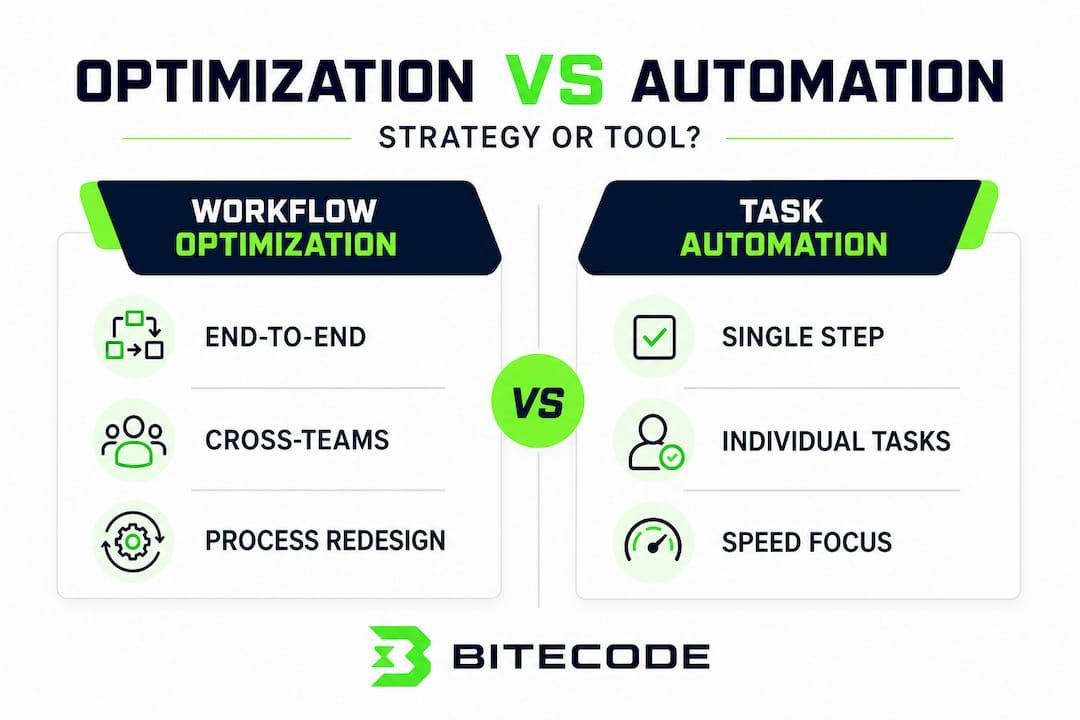
Understanding the difference between automation vs optimization is the first conceptual step every enterprise team needs to take before building a strategy.
Key methodologies and frameworks for enterprise optimization
Now that the fundamentals are clear, let’s break down the frameworks leaders rely on to systematically optimize workflows.
Enterprises do not optimize in a vacuum. They rely on proven methodologies that have been tested across industries, refined over decades, and adapted to different operating contexts. The key insight from research is that effective optimization typically involves combining Lean, Six Sigma (via DMAIC), Agile/Kanban, and TOC frameworks rather than applying a single approach.
Here is how the major frameworks compare:
| Framework | Core focus | Best suited for | Primary tool |
|---|---|---|---|
| Lean | Eliminating waste across value streams | Manufacturing, logistics, service delivery | Value stream mapping |
| Six Sigma / DMAIC | Reducing process variation with data | Quality control, financial ops | Statistical process control |
| Agile / Kanban | Managing work-in-progress and flow | Software, product, iterative processes | WIP limits, sprint cycles |
| Theory of Constraints (TOC) | Identifying and removing the single biggest bottleneck | Complex multi-step production | Constraint analysis |
| Business Process Reengineering (BPR) | Radical redesign of broken processes | Legacy system transformation | Process mapping |
Each framework has a distinct entry point. Lean asks, “Where is value being destroyed?” Six Sigma asks, “Where is variation creating unpredictable outcomes?” Agile asks, “How do we improve responsiveness to change?” TOC asks, “What single constraint limits the entire system’s throughput?”
For enterprises managing software best practices across large IT portfolios, a hybrid approach tends to be the most effective. For example, a financial services firm might use Lean principles to streamline customer onboarding, Six Sigma DMAIC to reduce transaction errors, and Agile to manage continuous improvement sprints within its operations team.
A practical sequence for selecting a methodology:
- Define the nature of the problem: Is it waste, variation, bottleneck, or complexity?
- Assess your team’s existing capability with each framework.
- Select a primary methodology and identify a complementary secondary approach.
- Run a pilot on a contained, measurable process before scaling.
- Establish baseline metrics before any changes are made.
Pro Tip: Avoid “methodology shopping.” Many teams cycle through frameworks without completing a full improvement cycle in any of them. Commit to one primary framework for at least two full cycles before layering in additional approaches.
Workflow optimization vs. task automation: What’s the difference?
With optimization models in hand, it’s vital to distinguish comprehensive strategy from ad hoc task automation.
This distinction matters more than most teams acknowledge. Automation is a tool. Optimization is a strategy. When organizations conflate the two, they risk automating inefficient processes, which does not solve the problem. It entrenches it.
As Workday’s process automation guide makes clear, optimization is broader than task automation: it focuses on end-to-end process design and integration so the right steps happen in the right way, often across multiple systems and owners.
| Dimension | Workflow optimization | Task automation |
|---|---|---|
| Scope | End-to-end, cross-departmental | Single task or step |
| Goal | System-wide efficiency and quality | Speed and volume at a specific point |
| Risk | Low if process is sound | High if underlying process is flawed |
| Ownership | Process owners and leadership | IT or operations team |
| Duration | Ongoing, cyclical | Project-based, often one-time |
Consider a common scenario: a company automates its invoice approval workflow because approvals are slow. If the slowness is caused by approval routing logic that sends every invoice above $500 to a senior VP regardless of category, automation simply delivers that inefficient routing faster. Volume increases. Bottleneck deepens.
The risks of over-indexing on automation without optimization include:
- Accelerating flawed logic: Faster execution of a broken process creates larger-scale errors
- Creating system silos: Point automation tools rarely communicate across departments
- Eroding visibility: Automated black boxes make it harder to diagnose future problems
- False confidence: Teams assume the problem is solved when throughput metrics improve temporarily
For enterprises managing automating financial processes, this is especially relevant. Financial workflows carry compliance and accuracy requirements that demand process integrity before automation is applied.
Similarly, teams managing complex workflow automation need to ensure that cross-system integration logic is designed from a workflow-first perspective, not a tool-first one.
How enterprises approach workflow optimization: From visibility to improvement
After clarifying what makes for true, system-level optimization, here’s how enterprises put insight into action at scale.
The journey from inefficient workflow to optimized system follows a recognizable pattern in high-performing organizations. It begins not with technology selection but with visibility. You cannot improve what you cannot see.
Research on process mining and benchmarking demonstrates that an empirical benchmarking mindset, using process mining and execution benchmarking to contextualize performance with completion and throughput data, is what separates organizations that achieve targeted, lasting improvements from those stuck in a cycle of reactive fixes.
The enterprise improvement sequence:
- Map the current state: Document every step, handoff, decision point, and system touchpoint in the workflow as it actually operates, not as it was designed on paper.
- Mine the data: Use process mining tools to extract event logs from enterprise systems and reconstruct actual process execution patterns.
- Benchmark performance: Compare cycle times, error rates, and throughput against internal historical data and external industry standards.
- Identify high-impact gaps: Focus on the gaps with the highest combined impact on cost, time, and quality.
- Design and test interventions: Develop targeted changes, test in a contained environment, and measure against baselines.
- Deploy and monitor: Implement changes at scale with continuous monitoring dashboards to detect regression or new friction points.
Organizations operating in regulated industries, or those managing high-transaction-volume environments, benefit from purpose-built digital infrastructure. Insights from fintech workflow efficiency practices show that combining process design discipline with secure, integrated technology architecture produces the most durable results.
For teams building or refining enterprise infrastructure, advanced workflow management principles provide a practical framework for designing scalable, auditable systems.

Pro Tip: Do not skip the benchmarking step. Teams often jump from mapping directly to solution design. Without baseline data, there is no way to objectively measure improvement or justify further investment to leadership.
The role of the CIO in orchestrating this journey is significant. Digital transformation workflows require executive sponsorship, cross-functional alignment, and a technology strategy that supports iterative improvement rather than one-time fixes.
Metrics that matter in enterprise workflow optimization:
| Metric | What it measures | Why it matters |
|---|---|---|
| Cycle time | Total time from start to completion | Reveals end-to-end efficiency |
| Throughput | Volume of completed work per unit time | Indicates capacity utilization |
| Error rate | Frequency of defects or rework | Quantifies quality degradation |
| Handoff delay | Time lost between process steps | Identifies coordination failures |
| Cost per transaction | Total cost to complete one process unit | Enables ROI calculation |
Practical steps: How to get started with workflow optimization
Now, with the why and how in view, here’s a proven path forward you can start today.
Starting a workflow optimization initiative inside a large organization is not primarily a technology challenge. It is an organizational one. The most common failure point is not selecting the wrong tool — it is failing to align stakeholders around a shared definition of the problem.
As the core practice makes clear, the discipline begins with analyzing workflows, removing inefficiencies, and committing to continuous improvement. That sequence is important. Analyze first. Remove second. Improve continuously. Skipping the analysis phase in favor of immediate solution deployment is one of the most expensive mistakes enterprise teams make.
A proven starting roadmap:
- Diagnose before prescribing: Map the workflow in its current state using cross-functional workshops and system-generated data. Avoid relying solely on documentation or tribal knowledge.
- Prioritize strategically: Not every inefficiency deserves equal attention. Use impact-versus-effort scoring to focus initial resources on the highest-value problems.
- Select the right methodology: Match the framework to the problem type. Use Lean for waste, Six Sigma for variation, TOC for constraints, and Agile for iterative complexity.
- Implement with appropriate technology: Choose tools that integrate with existing systems rather than creating new silos. Modular platforms reduce implementation risk significantly.
- Monitor with structured feedback loops: Establish dashboards, reporting cadences, and escalation protocols before go-live. Optimization without monitoring reverts to the prior state.
- Build iterative improvement into culture: Optimization is not a project with an end date. It requires scheduled review cycles, ownership clarity, and executive accountability.
Key questions to ask at the diagnostic stage:
- Where do work items stall most frequently, and why?
- Which handoffs between teams or systems generate the most errors?
- What percentage of process time is spent on value-adding vs. non-value-adding activities?
- What data is currently available to measure process performance objectively?
For organizations redesigning their operational infrastructure, modular workflow design offers a practical model for building systems that support optimization from the ground up rather than retrofitting improvement onto rigid architectures.
Pro Tip: Identify one “quick win” in the first 60 days. A visible improvement early in the initiative builds stakeholder confidence, secures continued support, and demonstrates the value of a systematic approach to teams that may be skeptical.
The uncomfortable truth: Why most workflow optimization projects fail (and how to get it right)
Having covered the playbook, let’s step back to address why so many real-world initiatives don’t deliver their promise — and how to change that.
The failure rate of workflow optimization initiatives is not a data gap. It is an observable pattern in enterprise transformation programs, and the causes are consistent. Most organizations enter these initiatives with the right intent but with two critical blind spots: they overweight technology selection and underweight process diagnosis, and they treat optimization as a discrete project rather than an operational discipline.
Technology amplifies whatever it touches. If the underlying process is sound, technology makes it faster and more reliable. If the process is broken, technology scales the failure. Buying a sophisticated process mining platform does not produce insights if the team does not know how to interpret the data or act on it. Deploying an AI-driven automation layer on top of a poorly designed approval workflow does not streamline operations — it accelerates chaos.
The second blind spot is stakeholder alignment. Workflow optimization crosses departmental boundaries by definition. A procurement workflow touches finance, operations, and IT. An onboarding workflow touches HR, IT, and the hiring manager’s team. When optimization projects are scoped within a single department or driven by a single function’s priorities, they optimize locally and create friction globally.
What actually works is less glamorous than most technology marketing suggests. Rigorous data collection. Honest process mapping. Cross-functional workshops where stakeholders confront the gap between how they believe the process works and how it actually operates. A methodology commitment that outlasts the initial enthusiasm. And a governance structure that assigns ownership, not just accountability.
Teams working in emerging technology environments, such as those exploring workflow automation in crypto or blockchain-integrated operations, face an additional layer of complexity. The novelty of the technology can distract from the foundational work of process design. The discipline remains the same regardless of the technology stack.
Optimization is never done. That is not a failure of planning. It is the nature of operating in a dynamic business environment. The organizations that sustain performance gains over time are the ones that build continuous improvement into their operating rhythm rather than treating it as a correction to an exceptional problem.
Accelerate your workflow optimization journey with Bitecode
If you’re ready to transform theory into results, enterprise solutions are closer than you think.
Building optimized workflows at scale requires more than a good methodology. It requires technology infrastructure that supports integration, visibility, and iteration without demanding years of custom development. Bitecode.tech is designed precisely for this challenge, enabling organizations to deploy tailored enterprise systems with up to 60% of the baseline architecture already in place.
Bitecode’s modular platform incorporates AI automation modules, blockchain integration, and financial processing components that align with enterprise workflow requirements from day one. Rather than building from a greenfield position, teams start with a proven foundation and customize from there — accelerating work without accelerating the risk of getting it wrong. For organizations ready to move from optimization theory to operational results, Bitecode offers a practical, scalable path forward built for complex, high-stakes business environments.
Frequently asked questions
What is the first step in workflow optimization for enterprises?
Begin by mapping your current workflows to identify where inefficiencies, bottlenecks, and redundant steps are concentrated, then prioritize which areas offer the highest impact for improvement. As the core practice establishes, analyzing before acting is what separates effective optimization from reactive change.
How does workflow optimization differ from automation?
Optimization redesigns the entire process end-to-end across systems and owners, while automation typically targets speed at a specific task level. As Workday’s guide clarifies, optimization is broader than task automation because it focuses on end-to-end process design and cross-system integration.
Which methodologies are most effective for workflow optimization?
Enterprises typically combine Lean, Six Sigma, Agile, and Theory of Constraints, adapting the blend to their specific process challenges. Research confirms that effective enterprise optimization relies on hybrid methodology approaches rather than single-framework adoption.
How can leaders measure the success of workflow optimization?
Key metrics include cycle time, error rate, throughput, handoff delay, and cost per transaction, tracked against documented baselines established before changes were made. Process mining benchmarking enables organizations to move from simple visibility into prescriptive, data-driven improvement decisions.