TL;DR:
- Workflow design, customization, and strategic translation are key to tech initiative success.
- The Gartner A.R.T. framework guides adaptive, non-linear digital transformation decision-making.
- Agentic AI platforms and expert-driven workflows support scalable, flexible financial processing.
Technology investments that miss workflow precision routinely underperform, regardless of budget size. CIOs pursuing financial outcomes from tech initiatives are 25% more likely to excel, yet only 33% do so consistently. The gap is rarely about technology capability. It is almost always about workflow design, customization depth, and the ability to translate strategic intent into measurable operational outcomes. This guide presents a structured, actionable workflow plan built for CIOs navigating complex financial processing and document-heavy enterprise environments, where agility and expert judgment matter far more than off-the-shelf automation.
Key Takeaways
| Point | Details |
|---|---|
| Adopt robust frameworks | Structured models like Gartner’s A.R.T. ensure agility and outcome-focused workflow transformation. |
| Choose scalable solutions | Agentic AI platforms and no-code tools offer rapid customization for complex, document-heavy enterprise workflows. |
| Prioritize change management | Effective digital transformation depends on structured training and two-way communication between IT and business units. |
| Avoid reductionism | Expert-driven workflows and pattern recognition prevent automation from failing in complex, financial operations. |
| Cocreate in the ‘no-blueprint’ phase | GenAI prompts CIOs to cocreate solutions and reimagine job roles for lasting, mission-driven transformation. |
Essential frameworks for digital transformation
Having framed the challenge, let’s look at the foundational models CIOs must use to structure digital transformation workflows that actually hold up under operational pressure.
Gartner’s A.R.T. framework structures CIO decisions across three dimensions: Agility, Risk management, and Tenacity. These are not abstract values. They translate directly into decision-making priorities when workflows become complex, budgets tighten, or integration timelines slip. Agility means redesigning workflows dynamically rather than freezing them at design time. Risk management means distributing exposure across vendors, platforms, and processes rather than concentrating it in a single black-box platform. Tenacity means maintaining outcome focus even when individual initiatives stall.
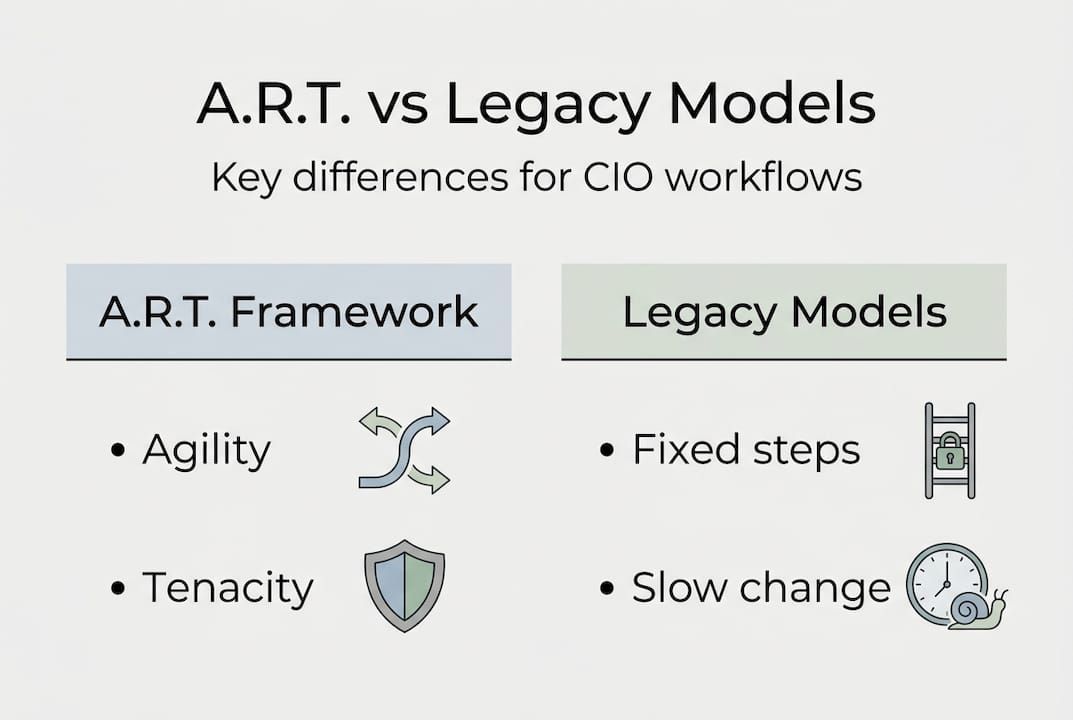
Legacy transformation models, by contrast, tend to treat digital change as a linear project with fixed milestones. They struggle when business-domain complexity intersects with regulatory constraints or when a financial workflow needs rapid adjustment mid-cycle. The A.R.T. framework is explicitly designed for non-linear environments, which is why it has become the reference standard for enterprise CIOs building workflows at scale.
A.R.T. framework vs. legacy transformation models
| Dimension | A.R.T. framework | Legacy models |
|---|---|---|
| Adaptability | Dynamic reprioritization | Fixed milestone planning |
| Risk posture | Distributed across components | Concentrated in single platform |
| Outcome focus | Continuous, measurable | Defined at project close |
| Workflow design | Iterative and modular | Sequential and monolithic |
| Response to change | Built-in flexibility | Change order process |
Alongside A.R.T., five core imperatives shape effective digital transformation: user interactions, data insights, platform management, connectivity, and trust with security. Each imperative maps directly to a workflow decision point. User interactions determine how interfaces are designed for financial analysts and operations teams. Data insights govern how transactional data is captured, processed, and surfaced. Platform management defines how middleware and integration layers are maintained without accumulating technical debt.
Key areas where frameworks drive real workflow outcomes include:
- Connectivity ensures that financial processing pipelines integrate with ERP, CRM, and regulatory reporting systems without brittle point-to-point connections
- Trust and security governs data residency, access control, and audit trail requirements that are non-negotiable in regulated industries
- Reprioritization cadence allows teams to redirect resources when a workflow bottleneck emerges in accounts payable or document verification
Exploring automation strategies for enterprises alongside these frameworks gives teams a clearer picture of where structured models intersect with practical implementation. Understanding the full range of business automation types also helps CIOs map each framework imperative to a concrete automation category before technology selection begins.
Tools and architecture: Choosing rapid, customizable solutions
Once frameworks are set, selecting the right tools and architecture becomes the most consequential decision in the transformation roadmap.

For document-heavy and financial workflows, the architecture question is not simply “which platform.” It is “which combination of platforms can scale modularly without locking teams into a vendor’s roadmap.” Agentic AI platforms with modular, hybrid architectures consistently outperform monolithic solutions for rapid, customizable financial processing. Platforms like Nutrient, ABBYY, Cflow, and Kissflow each address specific workflow segments, from intelligent document processing to no-code process orchestration, but the differentiator is always integration depth and customization flexibility.
Workflow tool comparison: Key features for enterprise financial processing
| Platform type | Customization depth | Financial processing support | No-code capability | Integration model |
|---|---|---|---|---|
| Agentic AI platform | High | Native | Partial | API-first, modular |
| Hybrid modular solution | Very high | Configurable | Yes | Composable architecture |
| No-code workflow tool | Moderate | Limited | Full | Connector-based |
| Legacy BPM suite | Low | Basic | Minimal | Proprietary |
Steps to evaluate and integrate the right tools for your environment:
- Map workflow complexity first. Identify which processes involve conditional logic, regulatory exceptions, or multi-party approvals before selecting tooling. Financial workflows with high exception rates need agentic AI, not simple rule engines.
- Assess modular composability. Confirm that each tool exposes APIs and webhooks that allow it to be replaced or upgraded without rebuilding the surrounding architecture.
- Pilot on a bounded workflow. Select one financial subprocess, such as invoice reconciliation or vendor payment approval, and run a time-boxed pilot to measure throughput, error rate, and exception handling before scaling.
- Evaluate vendor roadmap alignment. Hybrid architectures are only as resilient as the vendors maintaining their components. Review roadmap documentation and contractual commitments before committing to a modular stack.
- Integrate incrementally. Layer new tools into existing ERP and CRM environments one integration point at a time. This approach surfaces data mapping conflicts early without disrupting live financial operations.
Pro Tip: When evaluating enterprise automation processes, weight the exception-handling capability of each tool as heavily as its standard-path throughput. Financial workflows live and die in the exceptions, not the happy path.
The workflow management efficiency literature consistently shows that teams which invest in architecture planning before tool selection reduce integration rework by a significant margin. The AI workflow automation module category in particular rewards early architectural decisions, because retrofitting agentic AI into a monolithic stack is far more costly than designing for it from the start.
Managing change and aligning teams
With technology and architecture in place, effective change management ensures sustainable adoption across teams rather than a technically successful system that no one uses correctly.
Change management, training, and user involvement are consistently ranked as critical success factors by CIOs leading digital transformation. The specific failure mode is well documented: IT teams build and deploy a workflow system that meets technical requirements, but business units continue using workarounds because they were not meaningfully involved in design. AI-driven workflows compound this problem because they require structured training to calibrate expectations, particularly when the system surfaces recommendations that differ from established practice.
The most effective change management approaches for financial workflow transformation share several characteristics:
- Two-way dialogue between IT and business units from the requirements phase forward, not just during user acceptance testing
- Role-specific training programs that address how each team member’s responsibilities shift when an AI assistant handles initial document classification or flags anomalous transactions
- Feedback loops with measurable checkpoints, such as 30, 60, and 90-day reviews of adoption metrics alongside operational throughput data
- Executive sponsorship that extends past go-live, ensuring that workflow changes are reinforced through management communication and performance frameworks, not just training sessions
Pro Tip: Structured training for AI-assisted fintech workflow optimization should include explicit sessions on how the AI makes recommendations, not just how to accept or reject them. Teams that understand the logic behind AI outputs develop far more productive working relationships with automated systems.
“The organizations that sustain digital transformation gains are those that treat change management as a continuous operating discipline, not a one-time project phase. The dialogue between IT and the business must be structured, regular, and genuinely bidirectional.” — Enterprise transformation practice leadership
Measuring workflow automation ROI requires tracking both efficiency metrics and adoption metrics in parallel. A workflow that processes invoices 40% faster but has a 60% user bypass rate is not delivering transformation value. Both dimensions need active management, and change management is the mechanism that closes the gap between technical performance and operational reality.
Avoiding digital reductionism: Expert-driven workflows for financial processing
Sustainable transformation requires avoiding reductionism, especially in financial workflows where expert judgment handles edge cases that no decision tree can fully anticipate.
Digital reductionism is the practice of simplifying complex workflows into checklists, linear automation steps, or rigid rule sets that fail whenever an edge case or contextual nuance emerges. In financial processing, this failure mode is particularly costly. A fraud detection workflow built entirely on rules will miss novel patterns. A loan approval process encoded as a checklist will mishandle applications with non-standard income structures. Experts in these domains do not use decision trees; they use pattern recognition developed through extensive domain experience, and they adapt their reasoning based on the specific context of each case.
The practical risks of digital reductionism in financial workflows include:
- Systematic blind spots where edge cases are automatically routed to exceptions queues without meaningful guidance, creating bottlenecks that negate efficiency gains
- Compliance exposure when a simplified workflow fails to capture a regulatory nuance that an experienced analyst would have flagged
- Staff deskilling when automation handles all standard cases but teams lose the judgment capacity needed to resolve complex exceptions correctly
- Vendor dependency escalation when a rigid, black-box automation platform cannot be adjusted to reflect changes in business rules or regulatory requirements without a formal change request
Steps CIOs can take to build adaptive, expert-driven workflows instead:
- Embed domain experts in workflow design. Financial analysts, compliance officers, and operations leads should have active input into how exception paths are structured, not just how standard paths are automated.
- Design for pattern recognition, not just rules. Use machine learning models trained on historical transaction data to surface anomalies rather than relying solely on threshold-based rules.
- Build escalation paths that preserve context. When a workflow routes a case to human review, it should pass along all relevant data, flags, and reasoning, not just the case identifier.
- Review and update workflows regularly. Expert knowledge evolves. Workflows that are not updated to reflect new regulatory interpretations or business model changes will drift toward reductionism over time.
Blockchain workflow examples in financial processing demonstrate how immutable audit trails and smart contract logic can support expert judgment rather than replace it. The most effective expert workflow automation architectures treat automation as the vehicle and expert logic as the engine.
Pro Tip: When auditing existing financial workflows for reductionism, look for processes where the exception rate exceeds 15%. High exception rates almost always indicate that the workflow’s decision logic is too simplified for the actual complexity of the domain.
Breaking the blueprint: What most guides miss about digital workflows
Most transformation guides assume there is a stable blueprint to follow. That assumption is increasingly wrong.
GenAI is actively pushing digital transformation into what Forrester calls a “no-blueprint” phase, where the capabilities of agentic AI systems are evolving faster than organizations can design fixed workflows around them. This is not a temporary disruption. It is a structural shift that changes how CIOs should approach workflow design, vendor relationships, and organizational role definition.
The practical implication is that cocreation with technology providers becomes a core competency rather than a vendor management activity. Organizations that treat their workflow platform vendors as strategic cocreators rather than component suppliers gain a meaningful advantage. They are positioned to incorporate new AI capabilities as they emerge rather than waiting for the next planned upgrade cycle.
Agentic fabrics, which are coordinated networks of AI agents handling distinct workflow segments, are beginning to redefine job roles in ways that most guides do not address. Financial analysts in organizations using agentic workflows are increasingly functioning as AI supervisors, reviewing and calibrating agent outputs rather than processing transactions manually. This is not a reduction in the value of human expertise. It is a renegotiation of where that expertise is applied. CIOs who explicitly design role frameworks around AI supervision rather than AI replacement will see better adoption outcomes and stronger long-term performance. The business process automation guide that actually serves organizations well in 2026 is the one built for continuous adaptation, not static implementation.
Accelerate your digital transformation workflow with Bitecode
Now that you have seen the frameworks, architecture decisions, and expert-driven principles that drive sustainable transformation, the next step is connecting those best practices to execution capability.
Bitecode is built specifically for organizations that need to move fast without sacrificing customization depth. With up to 60% of the baseline system pre-built through modular, ready-made components, teams can deploy tailored enterprise workflows without the extended development cycles that typically slow transformation initiatives. The platform’s AI Assistant Module supports intelligent document processing and decision automation. Its blockchain payment solutions bring auditability and finality to complex financial transactions. And custom CRM solutions integrate seamlessly into existing enterprise environments, giving CIOs a composable foundation that scales with operational demands.
Frequently asked questions
What frameworks should CIOs use to plan digital transformation workflows?
CIOs should apply Gartner’s A.R.T. framework, which structures decisions around agility, risk management, and tenacity, while also prioritizing user interaction design, data insights, and measurable outcome metrics across every workflow phase.
How can enterprises avoid failed workflow automation?
Sustained success requires active change management and user involvement throughout the implementation lifecycle, combined with expert-driven workflow design that avoids the oversimplification pitfalls of checklist-based automation in complex financial processes.
Why is modular architecture important for digital transformation?
Modular, hybrid architectures support rapid customization and scalability because each component can be upgraded or replaced independently, which is especially critical in finance and document-heavy workflows where regulatory requirements and business rules change frequently.
How does GenAI change digital transformation workflows?
GenAI shifts workflows into a no-blueprint phase where fixed implementation plans quickly become obsolete, requiring CIOs to cocreate continuously with providers and redesign job roles around AI supervision rather than traditional task execution.