TL;DR:
- Business process automation reduces manual friction, saving millions annually through faster, more accurate workflows.
- Correct process selection using high-frequency, rule-based, low-exception tasks ensures high ROI.
- Phased implementation, stakeholder buy-in, and tailored tools are essential for successful enterprise automation.
Manual inefficiencies quietly drain millions from enterprise budgets every year, not through dramatic failures, but through accumulated friction: redundant approvals, rekeyed data, and delayed handoffs that compound across thousands of transactions. Business process automation (BPA) offers a direct remedy. Strategic BPA delivers 200-400% ROI within 12 months when applied with the right methodology. This guide gives executives and IT decision-makers a practical, step-by-step framework for identifying the right processes, selecting appropriate technologies, executing a phased rollout, and measuring results that actually move the needle on operational performance.
Key Takeaways
| Point | Details |
|---|---|
| Focus on core processes | Automate mission-critical workflows for the biggest impact on efficiency and ROI. |
| Apply the 4-factor filter | Select processes by frequency, volume, rules, and exceptions to maximize automation success. |
| Use a phased rollout | Pilot, expand, scale, and optimize automation for fast payback and minimal disruption. |
| Choose the right technology | Select tools and platforms based on scalability, integration, and customization needs. |
| Avoid automation pitfalls | Secure stakeholder buy-in and target strategic value beyond just cost savings. |
What is business process automation?
Business process automation is the use of technology to execute recurring, rule-based, or event-driven workflows across core enterprise functions with minimal human intervention. It goes well beyond simple task automation like scheduling emails or generating reports. According to Gartner’s BPA definition, BPA automates complex, mission-critical processes beyond mere data manipulation, coordinating people, systems, and data across entire business functions.
It helps to understand where BPA sits relative to adjacent technologies:
| Technology | Scope | Complexity handled | Best suited for |
|---|---|---|---|
| Task automation | Single, isolated actions | Low | Scheduling, notifications |
| RPA (Robotic Process Automation) | UI-level repetitive tasks | Medium | Data entry, screen scraping |
| BPA | End-to-end process workflows | High | Finance, HR, supply chain |
| AI-driven BPA | Adaptive, decision-aware workflows | Very high | Exceptions, predictions, compliance |
RPA mimics human clicks on a screen. BPA orchestrates the entire process underneath those clicks, including approvals, exceptions, integrations, and audit trails. That distinction matters enormously when you are targeting enterprise software efficiency best practices at scale.
Processes well suited for BPA share common traits:
- High transaction volume with predictable inputs and outputs
- Rule-based decision logic that does not require human judgment on every instance
- Cross-system dependencies that create bottlenecks when handled manually
- Compliance or audit requirements that demand consistent documentation
Typical candidates include accounts payable processing, employee onboarding, purchase order approvals, contract lifecycle management, and logistics coordination. Understanding the types of business automation available helps teams match the right tool to each workflow without over-engineering simpler tasks.
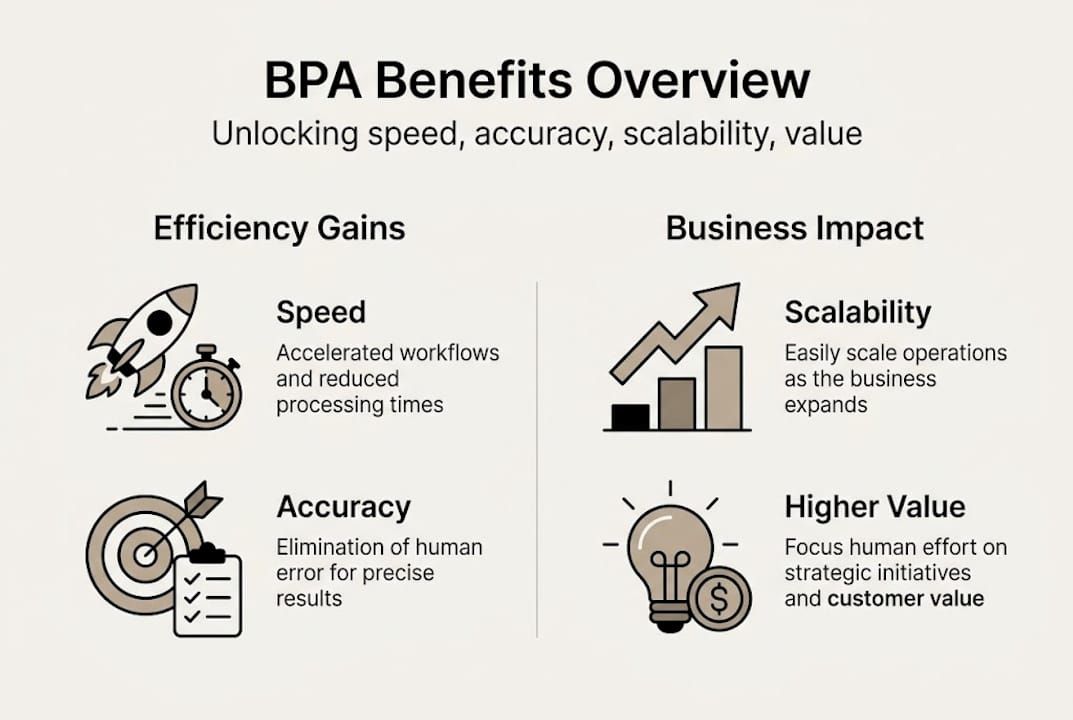
The core benefits of BPA are speed, accuracy, scalability, and the ability to redirect knowledge workers toward higher-value decisions. When a finance team is no longer reconciling invoices manually, they are analyzing variance trends. That shift in capacity is where real organizational value accumulates.
Strategic preparation: How to identify processes for automation
Understanding BPA’s definition lays the foundation, but success depends on selecting the right processes. Choosing poorly means automating dysfunction at scale, which accelerates problems rather than solving them.
The most reliable selection methodology is the 4-factor filter: frequency, volume, rules clarity, and exception rate. Score each candidate process on these four dimensions before committing resources.

| Factor | What to measure | High-priority signal |
|---|---|---|
| Frequency | How often the process runs | Daily or multiple times per day |
| Volume | Number of instances per cycle | Hundreds to thousands per month |
| Rules clarity | How well-defined the decision logic is | Documented, consistent rules |
| Exception rate | Percentage of non-standard cases | Below 15% of total instances |
Processes that score high on all four factors are your automation priorities. Those with high exception rates or poorly defined rules need process redesign first, not automation.
Here is a practical prioritization sequence:
- Map your current-state processes with actual cycle times and error rates, not estimates.
- Score each process using the 4-factor filter and rank by combined score.
- Estimate automation ROI by calculating labor hours saved, error reduction value, and compliance risk reduction.
- Select a pilot process that scores high and has a visible business owner willing to champion the initiative.
- Exclude low-impact or highly variable tasks from the initial roadmap regardless of how technically automatable they appear.
Pro Tip: Accounts payable, employee onboarding, and contract review consistently rank as the highest-ROI starting points across industries. They are high-frequency, rule-based, and have clear success metrics that make pilot results easy to communicate to leadership.
Exploring top enterprise automation strategies alongside advanced workflow management practices helps teams build a prioritization model that balances quick wins with long-term process transformation goals.
Step-by-step implementation roadmap
With process selection in hand, it’s time to execute the rollout using proven frameworks. A phased approach reduces risk, builds internal confidence, and creates the evidence base needed to justify broader investment.
A phased rollout delivers payback under 12 months with 200-400% ROI when each stage is executed with discipline. Here is how to structure it:
- Pilot phase (months 1-3): Automate one high-priority process end to end. Measure baseline performance before go-live. Track cycle time, error rate, and staff hours. Capture qualitative feedback from users.
- Expansion phase (months 4-6): Apply lessons from the pilot to two or three adjacent processes. Standardize your integration patterns and approval workflows. Begin building an internal center of excellence.
- Scaling phase (months 7-9): Extend automation across departments. Introduce role-based dashboards and exception-handling protocols. Ensure IT governance and compliance controls are embedded.
- Optimization phase (months 10-12): Analyze performance data to identify bottlenecks in automated workflows. Introduce AI-assisted decision support where exception rates remain elevated. Refine and document for long-term maintainability.
Two mistakes derail more automation programs than any technology limitation. First, insufficient stakeholder buy-in: process owners who feel bypassed will find ways to route around automated workflows. Second, underestimating change management: automation changes job roles, not just job tasks, and teams need structured support to adapt.
Pro Tip: Assign a named business sponsor to each automated process, not just an IT owner. When the business owns the outcome, adoption rates increase significantly and ROI materializes faster.
Research suggests 45% of enterprise tasks are automatable with current technology, yet most organizations have automated less than 10%. The gap represents both a risk and an opportunity. Teams that move methodically through mastering enterprise automation and connect SaaS automation ROI to measurable financial outcomes build the internal case for sustained investment. Finance automation ROI strategies in particular demonstrate how rapid the payback curve can be when the right processes are targeted first.
Technologies and tools for business process automation
With steps mapped out, selecting the right tools is essential for a successful automation project. The technology landscape has matured significantly, but the range of options can create decision paralysis if teams don’t apply clear selection criteria.
BPA leverages advanced technologies for event-driven processes and supports knowledge workers by handling structured workflow logic at scale. The major solution categories are:
| Solution type | Key strengths | Limitations | Best fit |
|---|---|---|---|
| Workflow management platforms | Fast deployment, visual design | Limited customization | Standard HR, approval flows |
| RPA tools | UI automation, legacy system support | Fragile to UI changes | Data entry, screen-based tasks |
| Custom AI-driven BPA | Adaptive logic, exception handling | Higher build cost | Finance, compliance, logistics |
| Low-code enterprise platforms | Rapid iteration, modular components | Vendor dependency risk | Cross-functional workflows |
Key considerations when evaluating tools:
- Compliance and audit trail support: Regulated industries need immutable logs and role-based access controls built in.
- Integration depth: The tool must connect to your existing ERP, CRM, and data systems without brittle point-to-point connectors.
- Scalability: A solution that handles 500 transactions per day must also handle 50,000 without architectural rework.
- Customization ceiling: Black-box platforms accelerate early deployment but create constraints as business-domain complexity grows.
Industry-specific considerations matter here. Finance teams benefit from automating financial transactions with tools that embed reconciliation logic and exception routing. Legal and procurement teams gain from automating financial processes that include contract milestone tracking. Organizations exploring blockchain-based settlement or tokenized assets should review the smart contract automation guide for architecture patterns that support programmable transaction logic.
The right technology choice is rarely the most feature-rich platform. It is the one that fits your compliance environment, integrates with your existing stack, and can be maintained by your team without permanent vendor dependency.
Executive perspective: What most automation projects miss
After reviewing dozens of enterprise automation programs, one pattern stands out clearly. Most projects fixate on the easiest wins, automating low-complexity tasks that generate modest savings and then declaring success. The real transformation potential sits in mission-critical processes, and that is exactly where most teams hesitate.
High-ROI automation does not come from eliminating data entry. It comes from restructuring how decisions flow through an organization. When accounts payable, contract review, or compliance reporting runs on a well-designed automated backbone, the entire business operates with greater predictability and less operational drag.
The uncomfortable truth is that transformation doesn’t happen in a spreadsheet. It happens in user engagement and process clarity. Teams that invest in pilot phase excellence, capturing real metrics and building genuine user confidence, create the momentum that carries automation from one department to the entire enterprise. Finance automation lessons consistently show that organizations which treat the pilot as a proof of value, not just a proof of concept, see dramatically better adoption in subsequent phases. Focus on strategic value first. Cost savings will follow.
Explore tailored business process automation solutions
For executives ready to move from theory to action, purpose-built automation solutions offer the next step. Bitecode’s modular platform is designed to accelerate exactly this kind of enterprise transformation, with up to 60% of the baseline system pre-built so teams spend time on business logic, not boilerplate.
Whether your priority is a custom CRM solution that integrates with existing workflows, an AI assistant for workflow automation that handles exception routing and decision support, or blockchain payment automation for programmable financial transactions, Bitecode’s modular components give your team a scalable foundation without the lengthy development cycles. Connect your digital transformation goals to measurable business outcomes by scheduling a discovery session with the Bitecode team.
Frequently asked questions
What types of business processes are best suited for automation?
High-frequency, rule-based, and structured-data processes like finance, HR, and supply chain deliver the largest gains. The 4-factor filter of frequency, volume, rules clarity, and low exception rate identifies the strongest candidates.
How quickly can business process automation projects deliver ROI?
Most well-targeted projects achieve payback within 12 months. 200-400% ROI in year one is achievable when process selection and phased execution are handled with discipline.
How does BPA differ from robotic process automation (RPA)?
BPA orchestrates end-to-end workflows across systems, people, and data, while RPA automates UI-level repetitive tasks. BPA automates complex, event-driven mission-critical processes that RPA alone cannot address.
What are common pitfalls in automation projects?
Poor process selection and missing stakeholder buy-in are the two most frequent failure points. A phased methodology with named business sponsors and clear success metrics significantly reduces both risks.