TL;DR:
- Modular workflow design decomposes complex processes into independent, reusable, and testable units.
- It reduces risks, improves scalability, and accelerates deployment in rapidly changing environments.
- Use modular workflows when handling complexity, multiple teams, or integrating advanced technologies like AI or blockchain.
Modular workflow design is often treated as an enterprise luxury, something only large software houses with dedicated platform teams bother implementing. That assumption is costing mid-size organizations real money and real agility. When complex business processes get locked inside a single, rigid pipeline, every change becomes a high-risk event and every new technology integration requires a near-complete rebuild. This article breaks down what modular workflow design actually is, how it addresses the specific pain points of monolithic systems, and how it enables teams to integrate AI, blockchain, and automation without starting from scratch each time.
Key Takeaways
| Point | Details |
|---|---|
| Modularization boosts agility | Breaking workflows into independent modules lets teams adapt and innovate faster even in complex tech environments. |
| Balance simplicity and scale | Start with monolith or hybrid modular design for simplicity, then modularize as workflows and teams grow. |
| Essential for advanced tech | Modular workflow design is key to safely integrating AI, blockchain, and automation into enterprise systems. |
| Watch for operational overhead | Effective modularization requires good orchestration, versioning discipline, and attention to distributed tracing. |
What is modular workflow design?
At its core, modular workflow design is a structural approach to building business processes. Rather than encoding an entire operation into one interconnected pipeline, teams decompose that process into smaller, self-contained units. Each unit handles a specific function, exposes a defined interface, and can be tested and updated independently. As LangGraph’s modularization pattern describes it, modular workflow design decomposes complex workflows into smaller, independent, reusable modules that can be composed, tested, and maintained separately.
This is a meaningful departure from how most enterprise workflows are initially built. Monolithic structures co-locate logic, state management, error handling, and integrations into a single codebase or process definition. That approach works fine at low complexity. But as requirements grow, so does the cost of every modification.
Key components of a well-designed modular workflow include:
- Trigger modules: Initiate workflow execution based on events, schedules, or API calls
- Processing modules: Handle transformation, enrichment, or validation logic
- Integration modules: Connect external systems such as CRMs, ERPs, or financial platforms
- Decision modules: Route data or actions based on business rules
- Notification modules: Manage alerts, logging, and audit trails
Here is a quick comparison of the two structural approaches:
| Dimension | Monolithic workflow | Modular workflow |
|---|---|---|
| Changeability | High risk per change | Isolated, low-risk updates |
| Testability | Full-pipeline tests required | Unit-level testing per module |
| Reusability | Low, logic is tightly coupled | High, modules plug into new flows |
| Onboarding speed | Slow, complex codebase | Faster, bounded context per module |
| Scaling individual steps | Requires full-system scaling | Scale specific modules independently |
Modularity matters most in IT environments where workflow requirements change frequently, where multiple teams contribute to the same pipeline, or where the organization anticipates integrating new technology, such as AI or blockchain, in the near future. For teams building modular web applications, this structural thinking applies equally to how workflows underpin application logic. Organizations looking to implement secure AI and blockchain workflows will find that modularity is essentially a prerequisite for doing so reliably.
How modular workflow design solves monolithic pain points
Now that you know what modular workflow design is, let’s see what problems it actually solves compared to monolithic approaches.
Monolithic workflows suffer from three compounding failure modes as they grow: state explosion, tight coupling, and testing difficulty. State explosion occurs when a single workflow accumulates so many conditional paths and data transformations that tracking the current state of any execution becomes nearly impossible. Tight coupling means that changing one step in the process requires validating the entire downstream chain. Testing difficulty follows naturally: you cannot isolate a single behavior without triggering the full pipeline.
“Monolithic workflows suffer state explosion; modular fixes via isolation but introduces orchestration overhead, interface versioning, distributed tracing needs.” — Workflow Modularization Pattern, LangGraph
Modular design addresses each of these directly. Isolation contains state within each module’s boundary, so a change to an approval step does not ripple into reporting logic. Defined interfaces between modules create explicit contracts, making version control and backward compatibility far more tractable. And because each module is self-contained, unit testing becomes meaningful and fast.

However, modularization is not a free solution. It relocates complexity rather than eliminating it. Teams that shift from monolithic workflows gain cleaner internals but must manage orchestration overhead, which means coordinating module execution order and handling failures across distributed components. Interface versioning becomes its own discipline. Distributed tracing, the practice of following a transaction across multiple independent modules, requires dedicated tooling.
What modular workflow design directly improves:
- Deployment independence, so teams push updates to one module without touching others
- Fault isolation, meaning one failed module does not crash an entire pipeline
- Parallel development, where separate teams own separate modules
- Reuse across workflows, reducing boilerplate and redundant logic
For a detailed look at efficiency in workflow management, the operational gains from modularization are most visible in environments with frequent regulatory updates or rapidly changing business rules. Organizations that have measured their workflow automation ROI consistently report that modular architectures shorten the time from requirement change to production deployment.
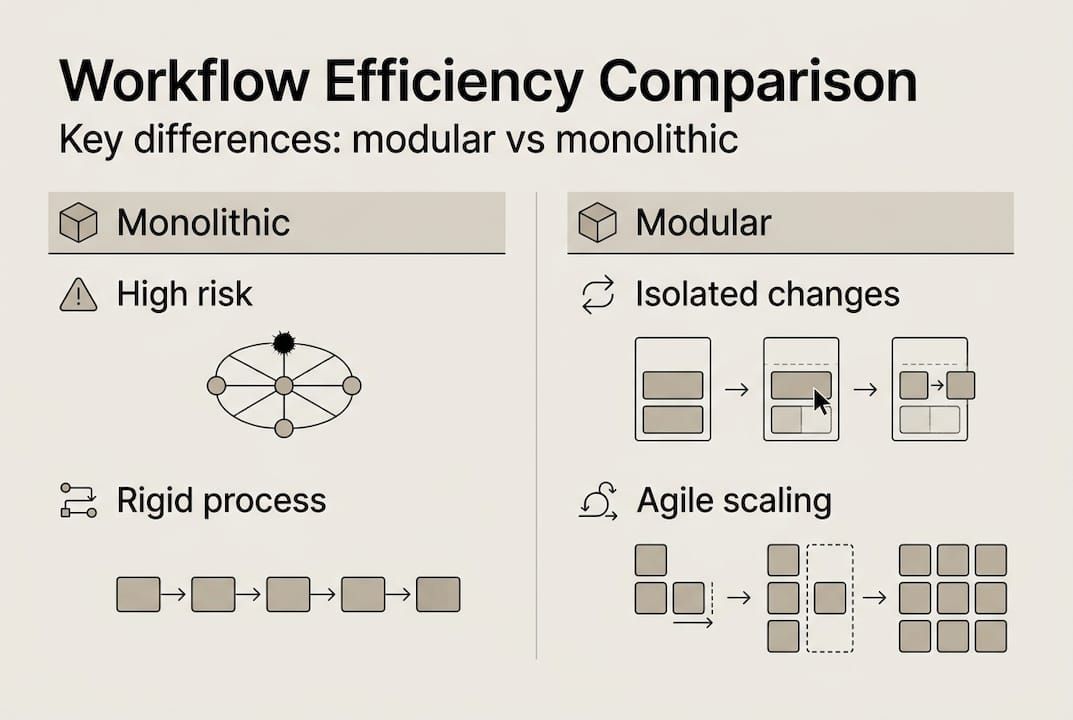
Modular workflow design in action: AI, blockchain, and beyond
Having established the value of modularization, let’s look at how it works with cutting-edge technologies.
AI and machine learning components are inherently modular by nature. A model that classifies documents, a scoring engine that evaluates credit risk, or a language model that drafts responses all function as discrete processing units. The challenge is integrating these capabilities into live business workflows without making the entire system brittle. Modular workflow design solves this by treating each AI component as a replaceable module with a defined input/output contract. When a model is retrained or upgraded, only that module changes. The surrounding workflow remains stable.
Blockchain integration follows a different pattern. According to SAP’s workflow orchestration guide, blockchain integration via event choreography decouples participating systems effectively, though the practical focus tends toward smart contract modularity rather than workflow orchestration itself. In practice, this means teams design blockchain interactions as self-contained trigger or validation modules that participate in a broader workflow without requiring other modules to understand blockchain-specific logic.
Practical steps for future-proofing workflows with modularity:
- Map your current workflow into discrete functional areas before writing any code
- Define explicit input/output schemas for each module boundary
- Use event-driven communication between modules to reduce direct dependencies
- Build versioning into module interfaces from day one, not as an afterthought
- Instrument each module independently for observability and tracing
Pro Tip: When introducing AI modules into an existing workflow, start with a shadow mode deployment. The AI module runs in parallel with the existing logic, logs its decisions, but does not yet control outcomes. This lets teams validate model behavior against real data before committing to a full cutover, dramatically reducing integration risk.
Organizations pursuing modular AI development are finding that this architecture also accelerates the development cycle itself, since AI-assisted tooling works best when scoped to bounded, well-defined modules. For sectors such as financial services, the fintech modular workflow benefits are particularly pronounced, where compliance modules can be updated independently of core transaction processing.
When (and when not) to modularize: choosing the right approach
Understanding the practical implications, let’s focus on when modularization delivers the most value, and when to hold back.
As noted in community analysis of workflow architectures, monoliths are simpler for small teams and uncomplicated domains, while modular architectures scale for complexity but add operational overhead. That tension is real and should inform every architecture decision.
Modular workflow design pays dividends when the following conditions are true:
- Workflow complexity spans multiple teams or departments
- Individual components need to scale at different rates
- Regulatory or business requirements change frequently and unpredictably
- The organization plans to integrate AI, blockchain, or third-party APIs over time
- Multiple workflows share common processing logic that should not be duplicated
Conversely, premature modularization is its own form of technical debt. A small team managing a straightforward approval workflow does not benefit from a distributed module architecture. The overhead of orchestration, interface contracts, and distributed tracing will outpace any flexibility gains. In these cases, a monolithic approach is simply the right tool.
For most organizations, the practical starting point is a hybrid modular monolith, a single deployable unit internally organized into clearly separated modules. This approach captures most of the code organization and testability benefits of full modularity without the operational cost of distributed orchestration. Teams can extract individual modules into independent services later, when specific scaling or team-isolation needs justify it.
Pro Tip: Avoid the architecture astronaut trap. Over-designing a modular system for a workflow that handles a few hundred events per day creates maintenance overhead without measurable returns. Let actual complexity and team friction be the signal, not technology trends.
Our perspective: Modular workflow design, but not at all costs
After advising multiple enterprise implementations, one pattern stands out clearly: organizations that modularize in response to a felt problem succeed far more often than those that modularize in response to a conference talk.
The most common mistake is treating modular workflow design as an architectural ideology rather than a practical tool. Teams decompose workflows prematurely, before the pain of monolithic coupling has actually been felt, and then spend months managing interface contracts and orchestration logic for workflows that were never complex enough to warrant it.
The harder lesson is that business objectives should always drive the modular decision. If a workflow needs to onboard new AI capabilities every quarter, modularity is a strategic investment. If that same workflow runs unchanged for two years, the hybrid monolith is the smarter choice. Strong expert workflow tips consistently point in the same direction: start with clarity about what you need to change and how often, then let that answer determine your architecture. Modular design should accelerate work without accelerating chaos.
Take the next step with modular workflow solutions
If the value of modular workflow design is clear but the path to implementation feels uncertain, that is exactly where practical tooling makes the difference.
At Bitecode.tech, we build custom enterprise systems using a modular foundation that starts up to 60% pre-built. Our platform includes ready-to-deploy components across core domains: custom CRM modules for client and relationship management, an AI assistant workflow module for intelligent process automation, and blockchain modules for secure, auditable transaction workflows. Instead of rebuilding from scratch, your team plugs into a proven architecture and customizes from there. If you are evaluating modular workflow options for your organization, our team can walk you through what a tailored modular stack looks like for your specific environment.
Frequently asked questions
What are the major benefits of modular workflow design?
Modular workflows allow teams to adapt, test, and scale individual components independently, reducing the risk and cost of changes. Because each module is composed and maintained separately, teams can update one part of a workflow without destabilizing the rest.
What risks come with adopting modular workflow design?
The primary risks include orchestration overhead, the challenge of interface versioning across modules, and the need for distributed tracing tooling. As LangGraph notes, modular isolation introduces overhead that monolithic pipelines simply do not carry.
Does modular workflow design work with AI and blockchain?
Yes, but each technology introduces distinct architecture requirements. AI components fit naturally as replaceable processing modules, while blockchain integration, as SAP’s guide highlights, tends to center on smart contract modularity and event choreography for decoupling.
When should a business avoid modular workflow design?
For simple domains or small teams, a monolithic workflow is often faster to build and easier to maintain. As community analysis confirms, monoliths outperform modular architectures in low-complexity, small-team scenarios where the overhead of orchestration exceeds the flexibility gains.