TL;DR:
- Manual crypto transaction management introduces errors, delays, and compliance risks at scale.
- Workflow automation speeds processes, reduces mistakes, and enhances auditability and cost efficiency.
- Proper planning, platform choice, governance, and phased implementation are critical for success.
Manual management of blockchain and cryptocurrency transactions is no longer a viable strategy for organizations operating at scale. Every manual reconciliation step introduces error risk, compliance exposure, and processing delays that compound quickly across thousands of daily transactions. One documented case study showed that API-driven automation cut crypto tax preparation time from 100 to 40 hours per quarter, reduced tool costs by 55%, and decreased exception rates by 40%. This guide walks IT decision-makers through every essential layer of workflow automation for crypto operations, from foundational concepts through deployment and ongoing optimization.
Key Takeaways
| Point | Details |
|---|---|
| Rapid efficiency gains | Workflow automation can reduce crypto processing time and costs by more than half. |
| Strategic platform selection | Choosing the right automation technology, like Hyperledger Fabric, ensures better performance for large-scale operations. |
| Governance is essential | Strong oversight prevents cost overruns and project delays in automated crypto workflows. |
| Continuous improvement | Post-launch KPIs and audits keep automated workflows optimized and compliant. |
Understanding workflow automation in crypto operations
Workflow automation in the crypto context means replacing manual, human-driven transaction processing steps with rule-based or AI-driven software sequences that trigger, execute, and log actions without human intervention at each stage. This spans reconciliation, compliance reporting, wallet management, tax preparation, and audit trail generation. The goal is not simply to speed things up. It is to create repeatable, auditable, and scalable processes that operate reliably regardless of transaction volume.
The strategic benefits are measurable and significant:
- Time savings: Automated pipelines reduce processing cycles from days to minutes in reconciliation-heavy environments.
- Error reduction: Rule-based automation eliminates the class of mistakes that arise from manual data entry and copy-paste workflows.
- Auditability: Every automated step generates a timestamped log, which is essential for financial compliance and regulatory reporting.
- Cost efficiency: Fewer manual hours and consolidated tooling directly reduce operational overhead.
These benefits are not theoretical. Organizations exploring blockchain automation examples in enterprise contexts consistently report compressing multi-step workflows into single automated sequences that run on a schedule or trigger.
Platform selection matters enormously for throughput-sensitive financial operations. Two dominant frameworks illustrate the range of options:
| Platform | Architecture | Typical TPS | Best use case |
|---|---|---|---|
| Hyperledger Fabric | Permissioned, modular | Up to 20,000 (optimized) | Enterprise, regulated industries |
| Ethereum (public) | Permissionless, smart contract | 15 to 30 (base layer) | Public DeFi, token issuance |
| Ethereum L2 rollups | Off-chain compute, on-chain settlement | 1,000+ | Scaling public chain applications |
| Hyperledger Besu | EVM compatible, permissioned | 1,000+ | Hybrid enterprise deployments |
The throughput gap is striking. Hyperledger Fabric achieves up to 20,000 TPS in optimized permissioned configurations, while public Ethereum operates at dramatically lower rates on its base layer. For high-frequency financial operations, this is not a minor technical detail. It is a core architectural decision that shapes everything from settlement speed to infrastructure cost.
Transactions per second (TPS) matters because financial operations require deterministic timing. A payroll disbursement or settlement cycle that takes 15 minutes instead of 15 seconds compounds into real operational and compliance risk when it happens across hundreds of daily workflows. Choosing a platform with appropriate throughput capacity is the first step toward scalable workflow efficiency in crypto operations.
Pro Tip: When evaluating automation platforms, always benchmark both peak TPS under realistic load and compliance feature sets. A platform that handles volume but lacks native audit logging will create downstream governance headaches that offset any speed gains.
Planning for successful automation: prerequisites and requirements
With the basics covered, it is crucial to assess readiness and plan for a seamless rollout. Many organizations underestimate the pre-implementation work required before a single automated workflow goes live. Skipping this phase is where most projects accumulate technical debt and governance gaps that cause expensive delays later.
The core technical prerequisites for crypto workflow automation include:
- Blockchain node access or managed API connectivity to the relevant chains (public or permissioned)
- Standardized API interfaces between your internal systems (ERP, accounting, CRM) and the automation layer
- Secure data flows with encryption in transit and at rest, plus access controls aligned to your security policy
- Wallet management infrastructure that supports programmatic signing without exposing private keys to the automation layer directly
- Audit logging at every integration point, capturing inputs, outputs, and exception states
A critical decision at this stage is whether to build automation on a centralized model, where a single orchestration engine manages all flows, or a decentralized model, where smart contracts and on-chain logic handle portions of the workflow autonomously.
| Dimension | Centralized automation | Decentralized automation |
|---|---|---|
| Control | Single owner, easier to modify | Distributed, harder to change post-deploy |
| Auditability | Internal logs, configurable | On-chain, immutable |
| Latency | Lower for off-chain steps | Higher due to block confirmation |
| Governance | Easier | Requires formal protocol governance |
| Compliance | Familiar to regulators | Emerging regulatory clarity |
| Best for | Enterprise internal workflows | Multi-party, trustless settlement |
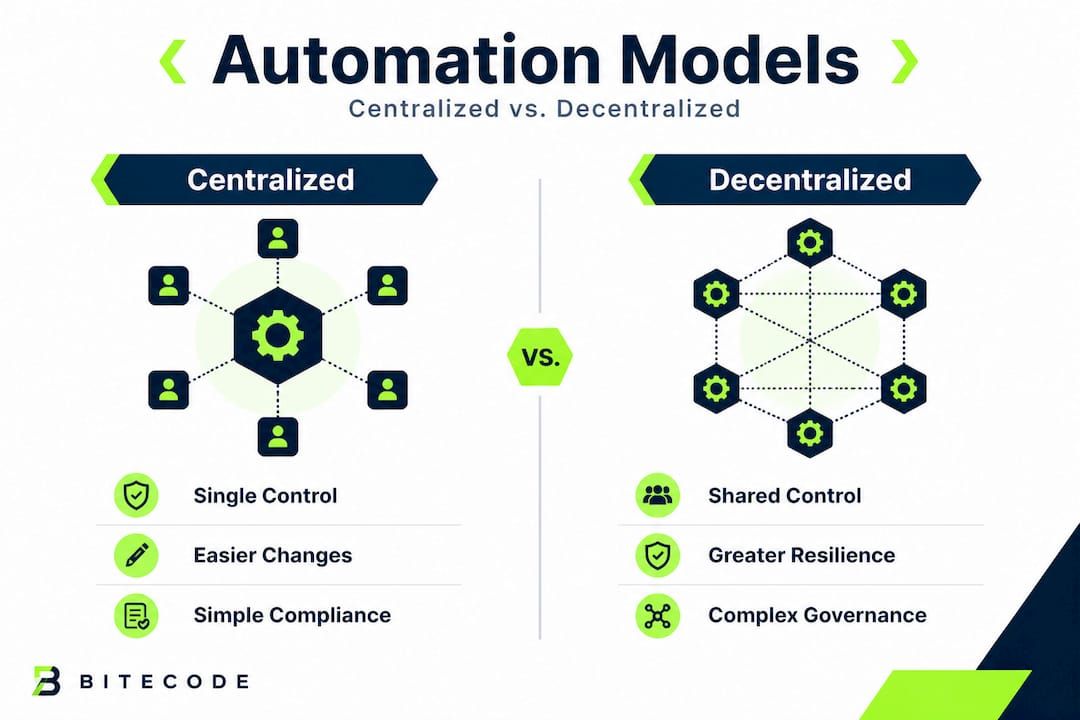
For most medium to large organizations managing internal crypto operations, a centralized or hybrid approach that uses smart contracts only for settlement finality, while orchestrating all business logic through a governed automation platform, represents the most practical starting point. Refer to guidance on secure transaction workflow steps to understand how these integration layers are typically structured.

Governance is where projects most frequently fail. A documented case study of automation system sprawl showed a major bank experiencing a 34% budget overrun and a 27-month implementation delay, attributable directly to poor cross-departmental governance and uncontrolled scope expansion. The lesson is that automation project scope must be locked early, with clear ownership at every integration point and a formal change control process from day one. Solid frameworks for AI and blockchain governance outline how to structure these controls in practice.
Before beginning implementation, confirm that your organization has addressed the following:
- Designated a single executive owner (project sponsor) with budget authority
- Defined success metrics tied to specific business outcomes, not just technical milestones
- Mapped all data flows from source to destination across every automated step
- Engaged legal and compliance teams to validate the automation design against applicable regulations
- Established a rollback plan for each integration point in case of failure
Step-by-step workflow automation for crypto transactions
After preparation, it is time to move step by step through the actual automation process. This is where planning translates into running infrastructure. The sequence below reflects how successful enterprise teams structure these rollouts.
-
Define specific automation goals. Start with one concrete workflow, for example, end-of-day transaction reconciliation across three wallets. Avoid automating everything simultaneously. Contain the initial scope to a single process with clear inputs and outputs.
-
Select your automation platform and tooling. Based on your TPS requirements and compliance needs identified in the planning phase, choose your primary orchestration platform. Validate that it supports your blockchain integration points via established APIs or SDKs.
-
Map on-chain and off-chain data sources. Identify every data feed your workflow requires: wallet transaction logs, exchange APIs, fiat banking feeds, and internal accounting systems. Each connection needs a documented API contract specifying data format, authentication method, and error response behavior.
-
Build the integration layer. Connect on-chain data (via node APIs or blockchain explorer APIs) to your internal systems using middleware or an integration platform. This layer is where automated financial transactions converge. Ensure that every API call is logged with request and response payloads for audit purposes.
-
Implement exception handling. Before launch, code explicit exception routes for every known failure mode. What happens if the blockchain API times out? What if a transaction hash is missing? What if a balance mismatch exceeds a threshold? Unhandled exceptions are how manual work re-enters automated pipelines silently.
-
Run parallel processing for validation. Before switching off manual workflows, run the automated system in parallel for at least two full reconciliation cycles. Compare outputs systematically and document every discrepancy.
-
Deploy and monitor. Go live with the automated workflow and establish real-time monitoring from day one. Set alerts for exception rates, processing latency, and any compliance-relevant thresholds.
One practical data point reinforces why this investment pays off. Organizations that implemented automating crypto tax preparation via API-driven reconciliation reduced quarterly processing time by 60%, dropping from 100 hours to 40, while cutting tool costs by 55% and reducing exceptions by 40%. These are outcomes from real production implementations, not projected estimates.
Warning: Resist the temptation to automate poorly documented manual processes without first standardizing them. Automation accelerates existing workflows, including broken ones. If the underlying process has ambiguous rules or inconsistent data handling, the automated version will produce errors faster, not fewer of them.
Pro Tip: Design your exception-handling routines during the integration design phase, before writing a single line of workflow code. If you cannot describe exactly what the system should do when something goes wrong, you are not ready to automate it. Clear exception logic is also where compliance automation requirements are best enforced programmatically.
Verification and optimization: measuring success post-automation
Once deployed, continuous monitoring ensures automation delivers on its promise. Deployment is not the finish line. It is the point where the real performance data begins to accumulate, and where intelligent teams shift from building to refining.
The following KPI table provides a practical before-and-after benchmark framework based on documented automation outcomes:
| KPI | Pre-automation baseline | Post-automation target | Documented outcome |
|---|---|---|---|
| Quarterly processing hours | 100 hours | 40 hours | 60% reduction achieved |
| Tool licensing and integration cost | Baseline | 55% reduction | Confirmed via API consolidation |
| Exception rate | Baseline | 40% fewer exceptions | Fewer manual corrections required |
| Audit trail completeness | Partial | 100% automated logging | Achievable with proper logging design |
| Reconciliation cycle time | Days | Minutes to hours | Dependent on transaction volume |
Measurable signs that your automation is working as designed include:
- Decreasing exception rates over the first 90 days as edge cases are identified and handled
- Positive audit feedback confirming that log completeness and accuracy meet regulatory standards
- Reduced tool costs as redundant manual tooling is decommissioned following automation consolidation
- Faster close cycles in financial reporting periods, reflecting the compounding benefit of automated reconciliation
For weekly monitoring, focus on exception volume, processing latency per workflow, and any API error rates from connected systems. Monthly reviews should assess cost trends against the pre-automation baseline and audit log completeness. Review the full set of benchmarks and methods relevant to fintech workflow efficiency to calibrate your own targets.
Post-launch governance refinement is equally important. As automated workflows stabilize, new edge cases emerge that require rule updates. Establish a formal change request process for workflow modifications so that well-intentioned quick fixes do not silently introduce new compliance gaps. Guidance on financial process compliance provides a practical framework for maintaining this discipline after the initial deployment excitement fades.
A smarter approach: why most workflow automation projects fail in crypto (and how to beat the odds)
Here is the uncomfortable reality that most implementation guides skip: the majority of workflow automation projects in the crypto sector do not fail because of bad technology choices. They fail because of organizational and governance problems that technology cannot solve.
System sprawl is the most common culprit. Teams add automation tools incrementally, often without a unified integration strategy, until they are maintaining a fragmented web of scripts, APIs, and third-party connectors that no single person understands end to end. This is precisely the pattern that produced the CBA bank outcome, where a 34% budget overrun and a 27-month delay were traceable to uncontrolled system growth and absent cross-functional ownership.
The most striking lesson from these failures is counterintuitive: the biggest automation risk is adding complexity, not reducing work. Every new integration point is a new failure mode. Every additional tool is a new governance responsibility. Teams that automate thoughtfully, starting with one well-defined workflow and expanding only after it is stable, consistently outperform teams that attempt broad automation initiatives on aggressive timelines.
Lack of end-to-end ownership is the second major failure pattern. When the engineering team owns the integration layer, the finance team owns the reconciliation rules, and the compliance team reviews outputs independently, there is no single party accountable for the full workflow. This structure guarantees that edge cases fall through the cracks. Successful automation projects assign one workflow owner who is accountable from data input to final output, with explicit sign-off authority over every rule change.
Lessons from enterprise automation initiatives across multiple industries reinforce the same pattern. The organizations that sustain automation value over time are those that treat governance as a continuous operational discipline, not a one-time project phase.
Pro Tip: Maintain a single source of truth for all automation rules, thresholds, and exception logic. Store it in a version-controlled repository, document every change with business justification, and review it quarterly. When cross-functional crypto workflows break, the problem is almost always a rule that was updated in one place but not reflected everywhere it applies.
A brief checklist for sustainable automation success:
- One named owner per automated workflow with full end-to-end accountability
- Formal change control for all rule and threshold modifications
- Monthly exception rate reviews tied to root-cause analysis
- Quarterly governance audits comparing live workflow behavior to documented design
- A decommissioning plan for any manual process that automation replaces
Take your crypto automation further with expert help
Building the automation architecture described in this guide is achievable, but the integration complexity across blockchain layers, financial systems, and compliance requirements is substantial. Getting the foundation right from the start is where experienced partners add disproportionate value.

Bitecode’s modular platform is purpose-built for exactly this challenge. Organizations can accelerate their automation rollout by starting with up to 60% of the baseline system pre-built, using purpose-specific modules including the AI assistant for automation for intelligent exception handling, the blockchain automation system for on-chain integration, and custom CRM automation for client-facing workflow orchestration. Rather than building from a greenfield state, teams inherit a proven modular foundation and configure it to their specific business-domain complexity, dramatically reducing both development time and governance risk.
Frequently asked questions
What are the biggest risks when automating crypto workflows?
The main risks are system sprawl, budget overruns, and governance gaps that compound over time. Documented cases show that uncontrolled system sprawl led to a 34% budget overrun and a 27-month implementation delay at one major financial institution.
How much time and cost can workflow automation save in crypto finance?
Real-world implementations have demonstrated 60% reductions in processing time and over 55% in tool costs, based on API-driven reconciliation projects measured across full quarterly cycles.
Which platforms are best for high-throughput automated workflows?
Hyperledger Fabric is the leading choice for permissioned enterprise environments, supporting up to 20,000 TPS in optimized configurations, which far exceeds public Ethereum’s base-layer capacity.
How do you measure the success of crypto workflow automation?
The three most reliable indicators are reductions in quarterly processing hours, decreases in exception and error rates, and lower tool and integration costs, all benchmarked against documented pre-automation baselines captured during the planning phase.
Recommended
- Build secure transaction workflows: step-by-step guide
- Streamline compliance: automation & custom solutions guide
- Fintech Workflow Optimization: Boost Efficiency 60%
- Secure business workflows with AI and blockchain in 2026
- Ensuring Secure Crypto and Forex Trading Automation - Tickerly
- How Smart Contracts Work in Crypto Trading: The Complete Plain-English Guide | Crypto Watchdog