A software proof of concept (PoC) is a small, time-boxed build that answers one question: can this idea work in your environment, with your data and your constraints? It is not a product and not a pitch. It is evidence gathered before production-level money is committed, and it is only useful if the question, the pass criteria and the decision it supports are written down before anyone writes code.
This guide covers what a PoC should and should not do, how it differs from a prototype and an MVP, how to choose what to test, how to write success criteria that cannot be argued away afterward, and what to do with the result.
TL;DR
- A PoC tests technical and business feasibility, not market demand. It exists to retire the single uncertainty most likely to change your go or no-go decision.
- Test the hardest assumption, not the easiest workflow: difficult integrations, realistic data volumes, security and failure behavior.
- Write numerical pass criteria, an owner and a time limit before building, then evaluate against them without renegotiating.
- A prototype tests design and usability, and an MVP tests the market. Do not ask a PoC to do either job.
- End every PoC with a report and a decision: proceed, reshape, delay or stop. All four are good outcomes if the evidence is clear.
What a proof of concept in software actually is
A proof of concept is a demonstration that tests whether an idea can be turned into reality before the organization commits production-level resources. TechTarget’s definition adds that it helps surface technical and logistical problems and lets stakeholders judge whether the core idea deserves further investment.
The same source draws a boundary worth remembering: the goal of a PoC is not to measure market demand or to pick the best way to produce the idea. It tests feasibility and explores financial potential. Teams that blur this line end up with a half-built product that answers no question well.
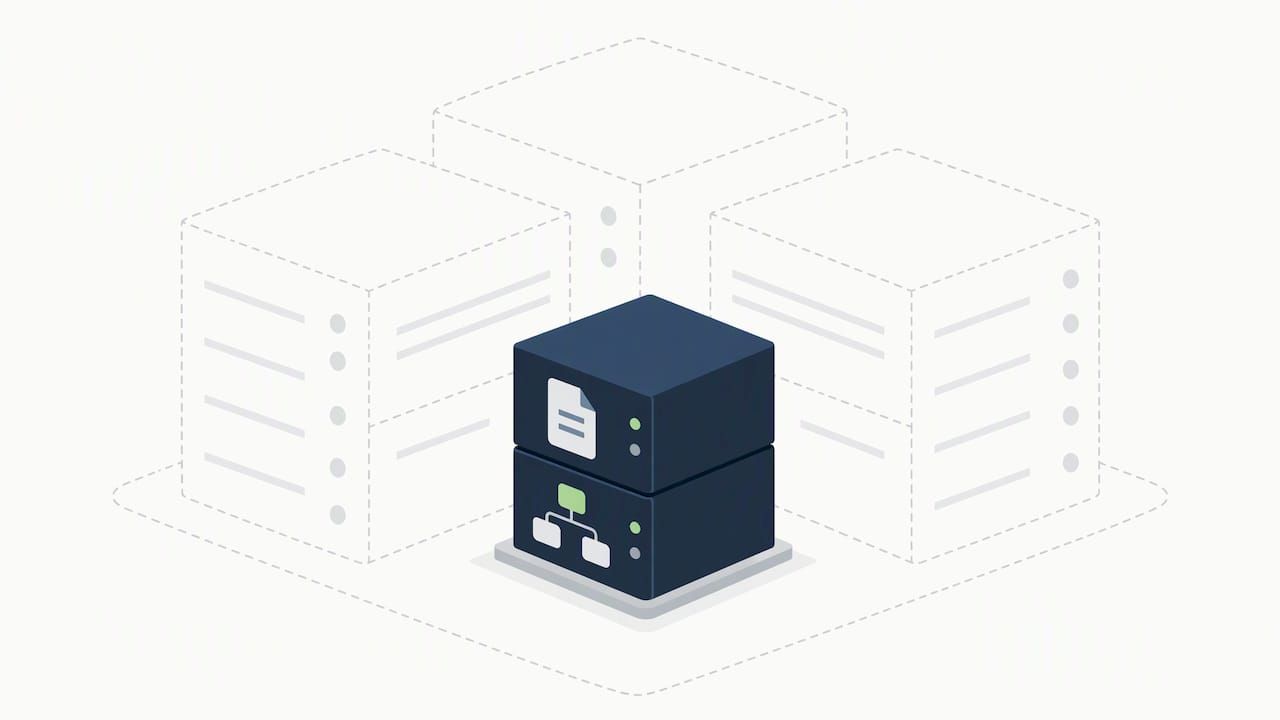
In enterprise settings the PoC often takes the form of a deliberately reduced system. IBM’s documentation describes a proof-of-concept installation that demonstrates basic functionality, such as document management and simple workflow, on a single-server configuration with only the core components needed for the demonstration. That is the right instinct: the smallest setup that can still prove the point.
PoC, prototype and MVP: three tools for three questions
Most wasted PoC budgets come from using the wrong tool. TechTarget’s comparison frames it this way: a PoC tests technical feasibility, a prototype demonstrates ideas through an early sample so mistakes surface, and an MVP is a functional iteration with enough features to gather market feedback. An MVP also requires more investment because it is fielded to real users.
Another way to say it: a software PoC assesses technical feasibility, while a prototype assesses design and user experience.
| Proof of concept | Prototype | MVP | |
|---|---|---|---|
| Question it answers | Can this be built and made to work here? | Will people understand and want to use this design? | Will the market pay for or adopt this? |
| Typical audience | Technical leads, architects, sponsors | Designers, users, stakeholders | Real customers |
| Output | Evidence and a report | A clickable or visual sample | A working, released product |
| Throwaway? | Usually | Often | No, it is the base for iteration |
| Relative investment | Lowest | Low to moderate | Highest of the three |
The order is not fixed. A fintech team unsure whether a ledger can reconcile multi-currency settlements needs a PoC first. A consumer startup unsure whether anyone wants the idea may skip straight to a prototype. The question decides the tool.
When a PoC is worth running
Run one when the risk is technical or structural and a wrong answer would be expensive. Typical triggers:
- A new product, method or approach that has not been tried in your industry or stack.
- An integration with a legacy system, a payment network or a third-party API whose real behavior is unclear.
- An AI component where accuracy on your own data is unknown.
- A build-versus-buy decision where the vendor’s claims have not been tested against your workloads.
- A regulated process, such as financial processing, where audit and security requirements might constrain the design.
Skip it when similar systems already exist and are well understood. In that case market research or a reference check is cheaper and just as informative, as Asana’s guidance points out: a PoC suits something not tried before, while established patterns call for research instead.
For teams comparing vendors, a PoC is also an evaluation instrument. Our business software selection checklist covers the surrounding criteria, and a PoC is where you verify the answers that matter most.
Test the riskiest assumption, not the easiest workflow
The most tempting PoC demonstrates a clean happy path. It looks good in a meeting and proves almost nothing. A better design exposes the uncertainty most likely to change the decision. Trustangle’s enterprise guidance names difficult integrations and representative, complex data sets as the usual candidates.
A practical way to choose: list every assumption behind the project, then score each on two axes, how uncertain it is and how badly the project suffers if it is wrong. Test the top of that list. If the answer is “the core integration might not support our transaction volume,” the PoC is a load test on that integration, not a dashboard demo.
What enterprise PoCs should cover
Functionize’s evaluation guidance for enterprise software lists non-functional requirements that routinely get skipped: realistic workload, transactions per second, concurrency, resilience, availability, the impact of failure, edge cases, future scale, cost at higher usage and data portability. Functional checks tell you the software can do the task. These tell you whether it will keep doing it on a Monday morning at month-end close.
For AI-driven systems, IBM’s guidance on experimenting with new AI technologies recommends testing performance, accuracy and reliability on sample datasets or in a PoC, checking compatibility with existing systems and APIs, confirming alignment with business objectives, and examining cost and licensing. Accuracy on a vendor’s demo data is not accuracy on yours.
Integration is where many PoCs earn their keep. If your project touches payment data, identity or third-party systems, read our guide to secure software integration before you define scope, because security constraints often reshape what a fair test looks like.
Writing success criteria before you build
The single most common failure of a PoC is not technical. It is that nobody agreed what “success” meant, so every result gets interpreted favorably by whoever wanted the project in the first place.
Good criteria share four properties:
- Numerical. “Fast” is not a criterion. “95% of reconciliation runs finish within a stated time on a dataset of a stated size” is.
- Committed in advance. Written, shared and signed off by the sponsor before implementation starts.
- Tied to the decision. Each criterion maps to a go or no-go consequence.
- Covering more than function. Cost, performance, security, reliability and operability belong beside features.
AWS’s guidance for a data warehouse PoC is a good template even outside that product. It asks teams to define current and target architectures, business goals, success criteria such as cost, performance and security, evaluation criteria such as SLAs, and the dataset and schemas before implementation. Its database counterpart goes further, asking for minimum acceptable planned or unplanned downtime, operational-efficiency metrics and monitoring, and business goals such as cost reduction. The lesson is that reliability, observability and business outcomes belong in the test plan from day one.
A sample criteria sheet
Here is the shape we would use for a financial-workflow PoC. The thresholds are placeholders to replace with your own.
| Area | Criterion | Evidence |
|---|---|---|
| Accuracy | Reconciliation matches the ledger on the agreed test set with no unexplained differences | Comparison report |
| Performance | Agreed batch completes within the stated window at stated volume | Timed runs, three repeats |
| Security | Access roles enforced, every change recorded in an audit trail | Test cases, log export |
| Integration | Round trip with the named external system succeeds, including error responses | Positive and negative test cases |
| Operability | A failed job can be detected and recovered without developer help | Failure drill |
| Cost | Projected run cost at higher volume stays within the sponsor’s ceiling | Estimate with assumptions |
Include negative cases. TechTarget’s PoC template guidance calls for testing in an operational environment with both positive and negative test cases, which is what separates evidence from a demonstration.
How to run the PoC: six steps
The sequence is consistent across credible sources: define, organize, set criteria, test, evaluate, report. AWS describes it as discovery, implementation and evaluation, and the discipline is the same: define the decision and the evidence before building, implement only the bounded scope, collect metrics, then judge against what was agreed.
- State the question and the decision. One sentence each. “Can our platform settle in two currencies with audit-ready records? If yes, we fund phase one.”
- Bound the scope. List what is in, and, more importantly, what is explicitly out. Authentication polish, reporting and edge-case UI usually belong outside.
- Name the team and the sponsor. A sponsor with authority to decide, a technical owner, and a business owner who can supply real data and judge relevance.
- Fix the criteria and the time box. Keep the time box short. Practitioners generally advise limiting a PoC to a few weeks at most, because an open-ended PoC drifts into an unfunded MVP.
- Build and test in a realistic environment. Real or representative data, real integrations where possible, positive and negative cases, and a log of every assumption that turned out wrong.
- Evaluate and report. Score each criterion, record the evidence, and present results with a recommendation.
Our software development procedures guide describes the team practices that keep this kind of bounded work disciplined, from ticketing to review.
A worked example from the public record
The clearest public example we found comes from the U.S. National Institute of Standards and Technology. Its case-study page on combinatorial testing reports that a Collins Aerospace proof of concept applied automated combinatorial unit and integration testing to a 196-KSLOC avionics system. It evaluated cost-effectiveness, accuracy, rigor, thoroughness, scalability, maturity, learnability and usability, generating 47,040 test cases in 75 seconds and executing and analyzing them in 2.6 hours.
Notice the structure, whatever your industry. The question was specific (does this testing method work on a system this size?). The criteria were a mix of technical and organizational (accuracy and scalability, but also learnability and usability). The output was numbers a decision-maker could read. That is the template to copy.
Our perspective: prove the hard part on a real foundation
We see the same pattern in PoC requests from companies building financial, automation and blockchain-enabled systems. Teams either build a throwaway that cannot survive contact with production, or they commit to a full build without proving the risky part. Both put risk into the wrong place.
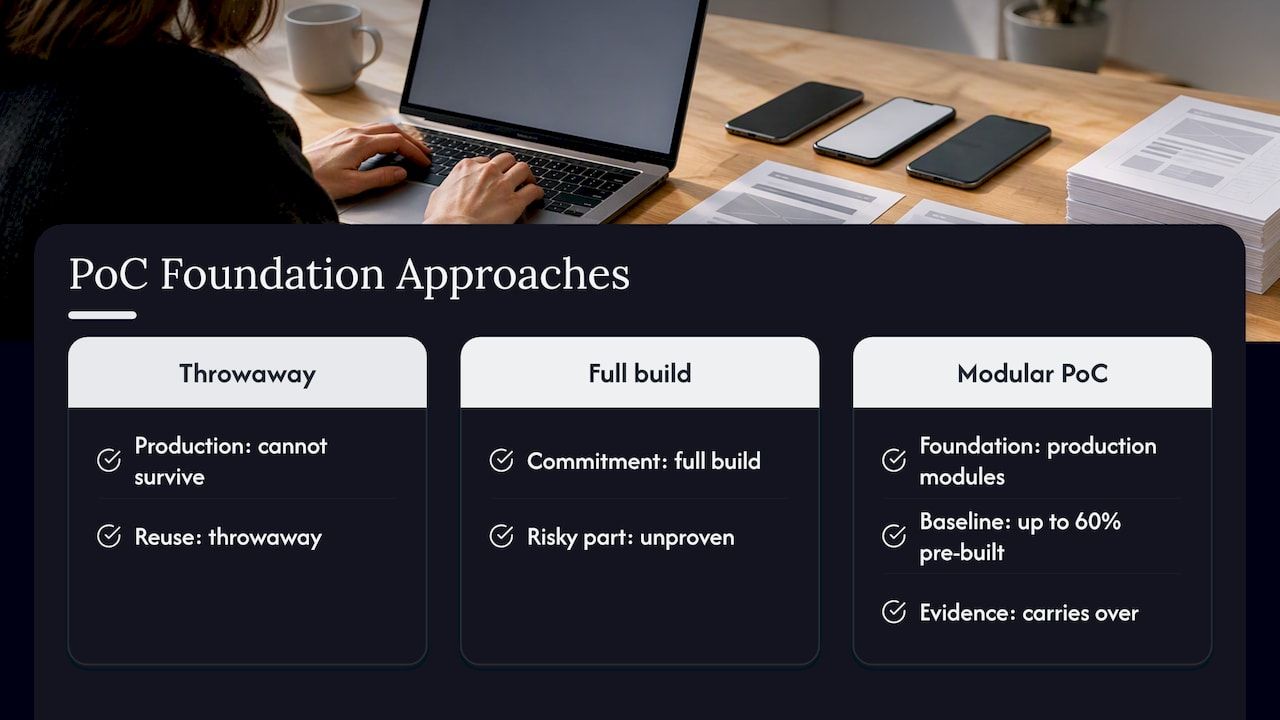
Our view is that a PoC should be built on the same modular foundation the production system would use whenever that is possible. When the PoC runs on components such as financial processing, workflow automation, an AI assistant or a CRM layer that already exist as reusable modules, the evidence it produces carries over. You are testing the real architecture rather than a mock-up that tells you little about what the final system will do. It also changes the economics: our approach starts projects with up to 60% of the baseline system pre-built, so the time and effort go into the part that is genuinely unknown to your business, not into rebuilding boilerplate.
We also think a good PoC is candid about trade-offs. Low-code and modular approaches accelerate work without accelerating chaos only when the customization boundaries, security model and ownership of the code are clear. A black-box platform can pass a demo and still relocate complexity into the vendor relationship. So we ask that a PoC test the exit conditions too: can the system be self-hosted, can the data be exported, can your team maintain it? Those questions are cheap to answer early and ruinous to discover late.
— Bitecode
Where a modular starting point helps
If your PoC question involves AI automation, financial processing, workflow approvals, CRM logic or token-based settlement, starting from ready-made modules lets you test the real behavior sooner. Our team builds small MVPs and larger custom systems from a modular foundation, and the AI, finance, automation, CRM and token modules are the building blocks we typically begin with. For process-heavy projects, see our AI business process automation service, or the financial module for accounting, audit and subscription logic.
If you have a feasibility question and want to scope a bounded test against it, talk to us about your project. We will help you define the question, the criteria and the time box before any build begins.
After the results: reporting and deciding
The PoC is finished when a decision is made, not when the demo works. Report your findings and test data to stakeholders, often with budget information, so they can use the report for project planning and approval, or to reconsider, delay or cancel the project, as TechTarget describes.
A strong report is short and has five parts:
- The question and the decision it supports.
- The criteria, agreed in advance, with pass or fail beside each.
- Evidence: measurements, logs, test results, with the data used.
- What surprised the team, including failed assumptions.
- A recommendation with a rough budget range and the next smallest step.
If the PoC passes, resist the urge to promote it directly to production. Treat it as a learning artifact. Carry over the architecture decisions and the validated integrations, then plan the build properly, including delivery and handover. If you are moving toward a first release, our guides on rapid SaaS development and measuring and shortening time to value show how to sequence the work. When the project eventually ships, a handover checklist keeps ownership clean.
If it fails, that is a result, not a setback. A PoC that stops a poor investment at a small fraction of the full cost has done exactly its job.
Common mistakes to avoid
- Testing the easy case. The happy path is the least informative scenario. Choose the hardest or most uncertain one.
- Changing the criteria midway. If results disappoint, the temptation is to redefine success. Fix the numbers first and keep them.
- Using synthetic data only. Clean sample data hides the messy records that break real systems.
- Letting scope creep turn the PoC into an MVP. An MVP needs more investment and answers a market question. Keep the two separate.
- Skipping non-functional tests. Concurrency, failure behavior and cost at scale decide whether a system survives production.
- No decision-maker in the room. Without a sponsor who can say yes or no, the report becomes a document nobody acts on.
- Treating the PoC as the first sprint of the product. Quick PoC code is usually not production quality. Decide upfront whether it will be discarded or hardened.
FAQ
What is the purpose of a proof of concept in IT projects?
Its purpose is to confirm that an idea is technically and financially feasible before significant resources are committed. It surfaces technical and logistical issues early and gives stakeholders evidence to decide whether to proceed. It does not measure market demand.
What is the difference between a POC and an MVP?
A PoC tests whether something can work, usually internally and at small scale. An MVP is a functional product with enough features to collect feedback from real users, and it requires more investment. Run a PoC to decide whether to build, and an MVP to learn whether the market wants what you built.
How do you write a POC?
Start with a one-sentence question and the decision it supports. Then define scope, team, numerical success criteria, the dataset and the time box. After testing with positive and negative cases, document the evidence against each criterion and finish with a recommendation for stakeholders.
What should POC success criteria look like?
They should be numerical, agreed before implementation and tied to the go or no-go decision. Cover performance, accuracy, security, reliability and cost, not only features. For example, a response-time limit or an accuracy percentage on a named dataset is testable, while “works well” is not.
How long should a PoC take?
Long enough to answer the question and no longer. Many practitioners keep a PoC to a few weeks at most. If the scope keeps growing, you are probably building an MVP, and it is better to stop and reset.
Sources
- What is a proof of concept (POC)? TechTarget
- Overview of installation types, IBM FileNet P8 documentation
- How to kickstart a proof-of-concept IT project, TechTarget
- Reasons You Need a Software Proof of Concept, Anyday
- Proof of Concept (POC): Definition, Steps and Examples, Asana
- Proof of Concept for Enterprise Software, Trustangle
- How to do a product evaluation for enterprise software, Functionize
- A guide to experimenting with new AI technologies, IBM
- Successfully conduct a proof of concept in Amazon Redshift, AWS
- Aurora proof of concept guidance, AWS documentation
- How to create a proof of concept with 6 free templates, TechTarget
- Combinatorial Methods for Trust and Assurance, NIST CSRC