A software testing methodology is a structured framework that defines the strategy, processes, and timing for how testing is planned, executed, and managed throughout the software development lifecycle (SDLC). It is not a single technique or tool. It is the governing logic that determines when testing begins, who owns it, and how results feed back into development decisions. Methodologies like Agile, Waterfall, V-Model, and Iterative each impose a different philosophy on that logic, and choosing the wrong one for your project context is one of the most reliable ways to accumulate technical debt.
The core elements every methodology must address:
- Strategy: What will be tested, at what depth, and against which requirements
- Processes: The specific testing activities, their sequence, and their dependencies
- Timing: When testing occurs relative to development phases
- Management: How defects are tracked, prioritized, and resolved
Getting these four elements right before a project starts is what separates teams that catch defects early from teams that discover them in production.
How functional and non-functional testing methodologies differ
Software testing divides into two primary categories, and conflating them leads to coverage gaps that no amount of sprint velocity can compensate for.

Functional testing
Functional testing verifies that the system performs the specific behaviors defined in its requirements. The question it answers is direct: does the software do what it is supposed to do? Testing is conducted from the outside in, treating the application as a black box where inputs produce expected outputs.
Common functional testing types:
- Unit testing: Validates individual functions or components in isolation
- Integration testing: Confirms that combined modules exchange data and interact correctly
- System testing: Validates the complete, integrated application against functional and business requirements
- Acceptance testing (UAT): Final validation by stakeholders or end users before release
- Regression testing: Rechecks existing functionality after code changes to prevent regressions
- Smoke and sanity testing: Quick checks confirming that major functions work before deeper test cycles begin
Non-functional testing
Non-functional testing evaluates how well the system operates, not just whether it operates. Performance under load, resistance to attack, accessibility, and cross-platform behavior all fall here. These qualities are often invisible until they fail in production, which makes early non-functional coverage particularly valuable.
Common non-functional testing types:
- Performance testing: Evaluates speed, throughput, and real-time responsiveness, including load and stress scenarios
- Security testing: Identifies vulnerabilities, exploits, and data protection weaknesses
- Usability testing: Assesses ease of use, navigation logic, and user satisfaction
- Compatibility testing: Verifies behavior across devices, browsers, and operating system versions
- Reliability and maintainability testing: Checks system stability and the ease of ongoing maintenance
Pro Tip: Schedule non-functional testing requirements during the requirements phase, not after development. Teams that define performance thresholds and security acceptance criteria upfront avoid the expensive rework that comes from discovering those thresholds only during pre-release testing.
What the most common testing types actually cover
Understanding the distinction between static and dynamic testing is foundational before selecting any methodology. Static testing finds defects without executing code, through activities like code reviews, walkthroughs, and static analysis. Dynamic testing exercises the running application with actual inputs.
Static vs. dynamic techniques
| Technique | When applied | Primary purpose |
|---|---|---|
| Static analysis | During or after coding, before unit testing | Detect coding standard violations, security vulnerabilities |
| Code reviews | Throughout development | Identify logic errors, design flaws early |
| White-box testing | Unit and integration phases | Verify internal logic, paths, and branches |
| Black-box testing | System and acceptance phases | Validate behavior against specifications |
| Experience-based testing | Any phase | Leverage tester expertise to find edge-case defects |
Static testing techniques applied early, particularly code reviews, are among the most cost-effective defect detection methods available, because defects found before execution cost a fraction of what they cost to fix post-deployment.
Structure-based, specification-based, and experience-based approaches
Structure-based (white-box) testing treats the software as a transparent box. Test cases are designed around the internal implementation: specific statements, branches, or data-flow paths. Coverage criteria such as path coverage, branch coverage, and data-flow coverage define completeness.
Specification-based (black-box) testing derives test cases entirely from requirements or design specifications, with no knowledge of internal implementation. Functional testing is predominantly black-box.
Experience-based testing relies on tester judgment, domain knowledge, and historical defect patterns. Exploratory testing and error guessing fall into this category. It is not a replacement for structured techniques, but it consistently surfaces defects that formal test case design misses.
Pro Tip: No single technique finds all defects. Combining white-box and black-box testing with experience-based methods creates the coverage depth that any one approach leaves incomplete.
The major software testing models compared
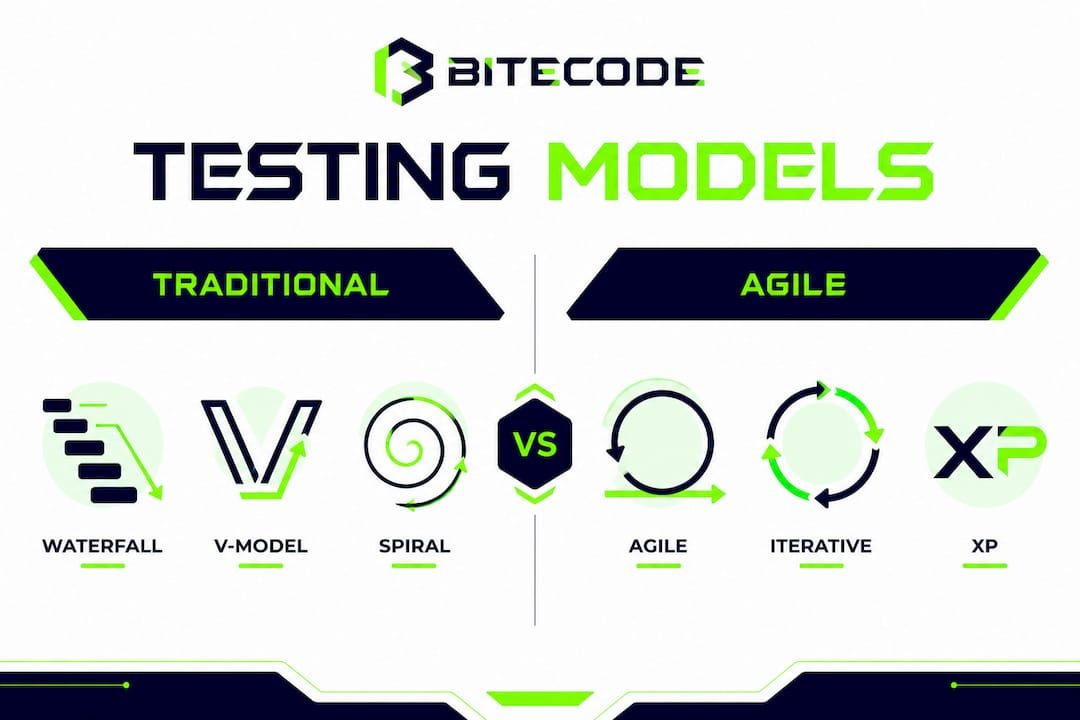
The primary difference among testing methodologies lies in testing timing and philosophy. Waterfall treats testing as a terminal phase with fixed requirements. Agile embeds it continuously for projects where requirements evolve. Every other model sits somewhere on that spectrum or addresses a specific structural need.
Waterfall

Waterfall is a linear, sequential model where requirements, design, implementation, testing, and deployment occur in distinct phases with minimal overlap. Testing is a separate final phase that begins only after development is complete.
Strengths: Clear documentation, predictable timelines, straightforward stakeholder reporting.
Weaknesses: Defects found late are expensive to fix. Requirements changes mid-project are disruptive. Poor fit for complex or evolving systems.
Best for: Small projects with well-defined, stable requirements.
Agile
Agile testing uses continuous testing, collaboration, and automation to integrate quality assurance into every iteration. Teams perform testing during every sprint, catching defects when they are cheapest to fix and delivering working software incrementally. Frameworks like Scrum and Kanban structure the sprint cadence.
Strengths: Early defect detection, rapid feedback loops, adaptable to changing requirements.
Weaknesses: Requires disciplined test management to prevent coverage drift across sprints. Documentation can be lighter than regulated environments require.
Best for: Complex, evolving projects where requirements are expected to change.
V-Model
The V-Model pairs each development phase with a corresponding testing phase, forming the two legs of a V. Business requirements map to acceptance testing. System design maps to system testing. Architecture design maps to integration testing. Module design maps to unit testing. This structure enables early test planning and strong traceability between requirements and test evidence.
Strengths: Defects can be identified at each phase before the next begins. Traceability between requirements and tests is explicit. Well-suited to regulated environments.
Weaknesses: Rigid structure makes it difficult to accommodate requirement changes. Like Waterfall, it can create bottlenecks in continuous delivery environments.
Best for: Projects in regulated industries where documentation and traceability are compliance requirements.
Iterative
The iterative model builds a system through repeated cycles. Each iteration produces a working increment that is reviewed, tested, and refined before the next cycle begins. This approach is particularly useful for large, complex projects where requirements are not fully understood at the outset, because it allows adaptation based on feedback without restarting the entire project.
Strengths: Defects are detected and fixed earlier than in Waterfall. Flexibility to incorporate feedback between cycles.
Weaknesses: Requires strong iteration planning to avoid scope creep. Integration complexity grows as iterations accumulate.
Best for: Large projects with loosely defined requirements and a need for incremental delivery.
Spiral
The Spiral model combines iterative development with explicit risk analysis at each cycle. Risk-based testing is central to this approach: testing resources are concentrated on the highest-risk components first, maximizing efficiency when time and budget are constrained.
Strengths: Risk is managed proactively. Suitable for large, high-risk projects.
Weaknesses: Complex to manage. Cost can be high due to the overhead of repeated risk assessments.
Best for: Large-scale, high-risk projects where risk quantification justifies the management overhead.
Extreme Programming (XP)
XP takes standard Agile principles further. Pair programming, where two developers work at a single workstation simultaneously, is a defining practice. One writes code while the other reviews, catches errors, and maintains awareness of the broader system design. Test-driven development (TDD) is integral: tests are written before the code they validate, ensuring that every feature has a corresponding test from the start.
Strengths: Very high code quality. Near-constant testing and peer review catch defects immediately.
Weaknesses: Requires experienced teams. Pair programming doubles the personnel cost per task.
Best for: Small, high-performance teams on complex, quality-critical projects.
Methodology comparison
| Methodology | Testing timing | Team size fit | Project complexity | Regulatory suitability |
|---|---|---|---|---|
| Waterfall | End of development | Small | Low to medium | Moderate |
| Agile | Continuous, every sprint | Any | Medium to high | Lower (lighter docs) |
| V-Model | Paired with each dev phase | Small to medium | Low to medium | High |
| Iterative | End of each iteration | Medium to large | High | Moderate |
| Spiral | Each risk cycle | Large | Very high | Moderate |
| XP | Continuous, TDD-driven | Small | High | Low |
For teams exploring how these models integrate across the full SDLC, Bitecode’s software methodologies guide covers the workflow implications in detail.
How to select and implement a testing methodology effectively
Selecting a testing methodology is not a theoretical exercise. It is a risk allocation decision. Every methodology puts risk somewhere: Waterfall puts it at the end, Agile distributes it across sprints, Spiral surfaces it explicitly at each cycle. The question is where your project can absorb that risk most effectively.
Criteria that actually drive the decision
Project size and complexity: Waterfall and V-Model work for small, well-scoped projects. Agile and Iterative handle complexity better because they allow course corrections before the full system is assembled.
Requirement stability: Fixed requirements favor Waterfall or V-Model. Evolving requirements demand Agile or Iterative, where the methodology accommodates change rather than resisting it.
Regulatory environment: Highly regulated US industries in sectors like aerospace, finance, and healthcare often prefer V-Model or Waterfall because documentation and traceability are compliance requirements, not preferences. Teams working in fintech specifically can reference Bitecode’s fintech compliance checklist for a concrete view of what those documentation requirements look like in practice.
Team expertise: XP and Agile require experienced teams comfortable with self-organization and continuous testing. Waterfall is more forgiving of teams that need clear, sequential direction.
Timeline pressure: Agile delivers working software early and often. Waterfall delivers nothing until the final phase. For projects where stakeholders need visible progress, Agile reduces the risk of a long silence before delivery.
Hybrid approaches
Few real-world projects fit cleanly into a single model. A common pattern is a Waterfall-style requirements and design phase followed by Agile sprints for development and testing. This hybrid preserves the documentation rigor that stakeholders and compliance teams need while capturing Agile’s defect detection advantages during build.
Pro Tip: When adopting Agile for the first time, define your Definition of Done (DoD) to explicitly include testing completion criteria for each sprint. Teams that skip this step routinely accumulate untested code that resurfaces as defects in later sprints, which is exactly the problem Agile is designed to prevent.
For teams looking to build a quality engineering practice around these principles, Bitecode’s software quality playbook offers a structured implementation framework.
Testing methodologies in practice: real-world application examples
Abstract methodology descriptions are useful. Seeing how they play out under actual project constraints is more useful.
Waterfall in a government contract
A US federal agency contracting for a new case management system specifies fixed requirements in a Statement of Work. The vendor uses Waterfall because the contract structure mirrors the model: requirements are locked, deliverables are defined, and the agency requires documented test evidence at each phase gate. Testing begins after development is complete, and the formal test report becomes a contractual deliverable. The rigidity that makes Waterfall a poor fit for a startup is exactly what makes it appropriate here.
Agile in a SaaS product team
A mid-sized SaaS company building a B2B analytics platform runs two-week sprints. Each sprint includes unit tests written by developers, integration tests run in the CI/CD pipeline, and exploratory testing by a dedicated QA engineer before the sprint closes. Requirements evolve based on customer feedback between sprints. Defects discovered in sprint 4 are fixed in sprint 4, not discovered six months later during a final test phase. The regression testing burden grows as the product matures, which is why automated test suites become critical infrastructure by sprint 10 or 12.
V-Model in medical device software
A medical device manufacturer developing embedded software for a diagnostic instrument uses V-Model because FDA 21 CFR Part 11 compliance requires documented traceability between requirements and test evidence. Each design specification has a corresponding test protocol. Verification testing confirms that the software meets its design inputs. Validation testing confirms that the design inputs correctly represent user needs. The V-shape is not just a diagram here; it is the compliance audit trail.
Spiral for a financial platform migration
A large financial institution migrating a core banking platform to a cloud-native architecture uses Spiral because the risk surface is enormous: data integrity, regulatory compliance, performance under peak load, and security all represent potential failure modes that could be catastrophic. Each spiral cycle begins with a risk assessment that determines which components receive the most intensive testing in that cycle. High-risk components like transaction processing and authentication get tested first and most thoroughly. Lower-risk components like reporting dashboards follow. The quality assurance integration across these cycles requires careful coordination between QA, security, and compliance teams.
Key Takeaways
Matching your software testing methodology to project context, regulatory requirements, and team capability is the single most consequential quality decision a team makes before writing the first line of code.
| Point | Details |
|---|---|
| Methodology defines timing and philosophy | The core difference between models is when testing occurs and how requirements are treated: fixed vs. evolving. |
| Functional and non-functional coverage both matter | Functional testing verifies behavior; non-functional testing verifies operational quality. Neither replaces the other. |
| Regulated industries favor V-Model or Waterfall | Documentation and traceability requirements in sectors like healthcare and finance often make sequential models the compliance-safe choice. |
| No single technique covers all defects | Combining white-box, black-box, and experience-based testing produces more complete coverage than any one approach alone. |
| Hybrid methodologies are common in practice | Most real-world projects borrow structure from multiple models rather than applying one methodology in its pure form. |
Building software with a well-defined testing strategy from day one is significantly easier when the underlying platform is designed for it. Bitecode’s custom software development approach starts projects with up to 60% of the baseline system pre-built using modular components, which means testing frameworks, CI/CD integration points, and quality gates are part of the foundation rather than retrofitted after the fact. Teams that need AI-driven workflow automation alongside that foundation can explore Bitecode’s process automation services to see how both capabilities combine in practice.