Software development methodologies are structured frameworks that define how software projects are planned, executed, and delivered. They prescribe the phases a project moves through, the roles team members play, and the processes that govern quality and collaboration. Choosing the right framework is not a stylistic preference; it directly determines whether a project ships on time, within budget, and at the quality level stakeholders expect.
Every methodology addresses a core set of concerns:
- Phased planning: How work is divided into stages, from requirements gathering through deployment
- Team coordination: Who owns which decisions and how communication flows
- Documentation standards: How much written specification is produced and when
- Quality assurance: When and how testing is integrated into the development cycle
- Process adaptability: Whether the framework accommodates changing requirements mid-project
- Iterative vs. sequential delivery: Whether the team ships working software in cycles or completes all phases before release
What are the main software methodologies used today?
Four methodologies dominate modern software project management: Waterfall, Agile, DevOps, and Rapid Application Development. Each reflects a different philosophy about where risk should be placed and how teams should respond to uncertainty.
Waterfall is the oldest formal methodology. It requires each phase, requirements, design, implementation, testing, and deployment, to be fully completed and approved before the next begins. This sequential development approach suits projects with fixed requirements and regulatory compliance obligations, where rework is expensive and documentation is legally critical. Medical device software and government procurement systems are classic examples.
Agile is an umbrella term for iterative frameworks built around the values published in the 2001 Agile Manifesto: individuals and interactions over processes and tools, working software over comprehensive documentation, customer collaboration over contract negotiation, and responding to change over following a plan. Agile breaks work into short cycles called sprints or iterations, typically one to four weeks, each producing a testable increment of the product.
DevOps bridges development and operations teams to enable continuous integration, automated testing, deployment, and monitoring. It complements Agile by extending the delivery pipeline beyond the development team into production environments, shortening the feedback loop between code commit and live release.

Rapid Application Development (RAD) minimizes upfront planning in favor of rapid prototyping and reusable components. It works best when a functional prototype can serve as the final product, though it carries real risk if the development team lacks discipline or personal commitment to quality.
Within Agile, three frameworks deserve specific attention:
- Scrum organizes work into fixed-length sprints with defined ceremonies: sprint planning, daily standups, sprint review, and retrospective. A Product Owner prioritizes the backlog; a Scrum Master removes blockers.
- Kanban visualizes work as cards moving across a board through defined stages. It limits work in progress to prevent bottlenecks and suits teams with continuous, unpredictable incoming work rather than project-based delivery.
- Extreme Programming (XP) pairs developers for continuous code review and mandates test-driven development. The result is high-quality, well-tested code, though XP roughly doubles development cost compared to solo programming.
How Agile frameworks actually work in practice
Agile is a mindset before it is a method. The Agile Alliance defines it as a set of conventions a team agrees to follow in alignment with the values and principles of the Agile Manifesto, not a fixed process imposed from outside. That distinction matters because it explains why two teams can both call themselves “Agile” and operate very differently.
Scrum, Kanban, and XP each address different layers of the development problem. Scrum manages the flow of work and team accountability. Kanban controls throughput and queue depth. XP focuses on the engineering practices that determine whether the code itself is trustworthy. Most high-performing teams blend elements from more than one framework.

The technical practices underneath Agile are where many teams fall short. Continuous integration, automated testing, pair programming, and active technical debt management are not optional extras. Ignoring them while running Scrum ceremonies produces what practitioners call “faux-agile”: the rituals without the results. As the Atlassian engineering guides note, technical debt must be treated as a first-class backlog item alongside new features, or delivery velocity will erode over time.
Key technical practices that support genuine Agile delivery:
- Continuous integration with automated build verification on every commit
- Test-driven development, writing tests before writing production code
- Pair programming for real-time code review and knowledge transfer
- Refactoring as a regular discipline, not a deferred cleanup task
- Acceptance test-driven development to align business expectations with code behavior
Pro Tip: Before adopting Agile ceremonies, audit whether your team has the technical infrastructure to support them. A CI/CD pipeline and a meaningful automated test suite are prerequisites, not follow-on investments. Running sprints without them accelerates chaos, not delivery.
Sequential vs. iterative approaches: how do they compare?
The most consequential choice in methodology selection is whether to work sequentially or iteratively. Sequential approaches complete each phase before the next begins; iterative approaches cycle through planning, building, and testing repeatedly, incorporating feedback at each turn.
| Approach type | Best suited project types | Advantages | Limitations |
|---|---|---|---|
| Sequential (Waterfall) | Regulated industries, fixed-scope contracts, large infrastructure projects | Predictable timelines, thorough documentation, clear phase gates | Inflexible to change, late defect discovery, expensive rework |
| Iterative / Agile | Product development, SaaS, evolving requirements, customer-facing software | Fast feedback, adaptable scope, early risk detection | Requires disciplined teams, harder to estimate total cost upfront |
| Hybrid (Scrumban, Lean) | Mid-size teams with mixed project types | Balances structure with flexibility, reduces planning overhead | Requires methodology maturity to avoid the worst of both worlds |
| DevOps-integrated | Continuous delivery products, cloud-native systems | Rapid release cycles, operational feedback loops, reduced deployment risk | High tooling investment, cultural change required across teams |
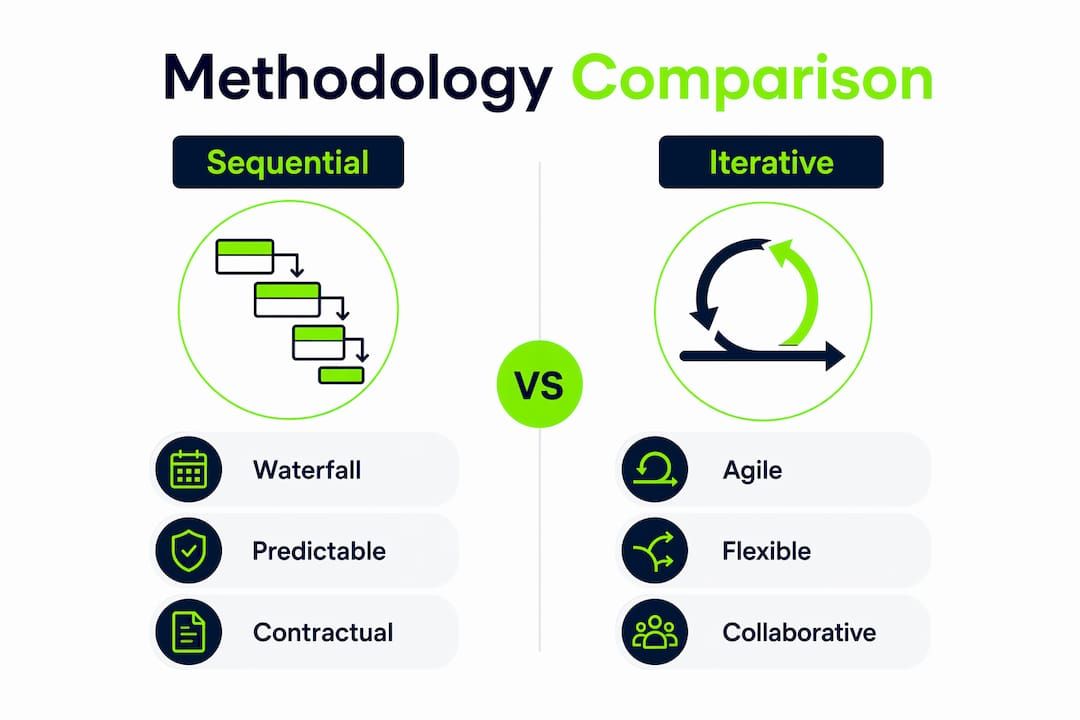
Waterfall remains the pragmatic choice for projects where predictability and contracts dominate. Imposing Agile on a fixed-price government contract, for example, typically creates stakeholder friction rather than resolving it. Conversely, building a consumer SaaS product with Waterfall means waiting months for user feedback that could have reshaped the product in week three.
Hybrid methodologies like Scrumban blend Scrum’s sprint structure with Kanban’s flow-based work management. Feature-Driven Development (FDD) takes a different hybrid path, combining upfront architecture planning with iterative feature delivery, making it well-suited to larger teams that need both structure and agility.
How to choose the right development methodology for your project
Methodology selection is a risk allocation decision. Every framework puts risk somewhere: into upfront planning, into late-stage integration, into team autonomy, or into vendor relationships. The question is which risk profile fits the project’s constraints.
Key decision factors:
- Requirements stability: Fixed requirements favor Waterfall; evolving requirements favor Agile
- Regulatory environment: Compliance-heavy domains often mandate documentation standards that align with sequential approaches
- Team size and experience: Agile methods work best with small, experienced teams; larger teams benefit from more structured coordination like FDD or the Unified Process
- Release frequency: Products needing weekly or monthly releases require iterative or DevOps-integrated approaches
- Risk tolerance: High-stakes, low-reversibility projects warrant more upfront planning
- Organizational culture: A command-and-control culture will struggle with Agile’s self-organizing team model
Pro Tip: Pilot a methodology on a contained project before committing it to a full program. Run one two-week sprint or one Waterfall phase on a low-stakes feature, then assess team friction and output quality. Methodology fit is empirical, not theoretical.
Teams should also account for business-domain complexity. A greenfield SaaS product with a small cross-functional team is a different problem than a legacy enterprise system with hundreds of integrations. The former can absorb the ambiguity that Agile thrives on; the latter often needs the structure that sequential planning provides, at least for the architectural phases.
Emerging trends reshaping how teams build software
The most significant shift in software project management over the past two years is the integration of AI agents into the development workflow. Modern project environments increasingly use AI to automate task assignment, surface risks before they become blockers, and retrieve relevant context from across a codebase or backlog. This AI-driven project management approach reduces the cognitive load on team leads and improves alignment between strategy and execution.
Digital transformation elements currently reshaping methodology practice:
- AI-assisted code review and automated test generation reducing manual QA overhead
- Continuous delivery pipelines that push production-ready builds multiple times per day
- Hybrid methodologies like Scrumban gaining adoption among teams that outgrow pure Scrum
- Lean software practices reducing waste by limiting work in progress and cutting non-value-adding process steps
- Platform engineering teams building internal developer platforms that standardize tooling across methodology boundaries
Bitecode’s modular development approach reflects this direction directly. By starting projects with up to 60% of the baseline system pre-built, including AI automation modules, workflow automation, and financial processing components, Bitecode compresses the early phases that consume the most time in traditional development cycles. The methodology question shifts from “how do we build this?” to “how do we configure and extend what already works?” That reframing is where AI automation implementation delivers its clearest value. For teams exploring how AI tools cut workflow overhead, the pattern applies beyond software development into content and research operations as well, as demonstrated by AI-powered content workflows that reduce research time substantially.
How software methodologies evolved over six decades
The history of software development frameworks is largely a history of reacting to failure. The waterfall model emerged in the 1970s as companies applied industrial project management to software, matching user requirements to delivered products through sequential phase gates. It worked reasonably well for large-scale business systems where requirements were stable and teams were large.
By the 1990s, the rigidity of heavyweight sequential methods had become a recognized problem. A wave of lightweight alternatives emerged: RAD in 1991, the Unified Process and DSDM in 1994, Scrum in 1995, Crystal Clear and XP in 1996, and FDD in 1997. These methods shared a common critique of waterfall’s late feedback loops and expensive rework cycles.
The 2001 Agile Manifesto formalized the philosophy underlying these methods, giving the movement a shared vocabulary and set of values. Since then, the trajectory has been toward shorter cycles, more automation, and tighter integration between development and operations. DevOps, which emerged as a distinct practice around 2009, extended Agile’s iterative logic into deployment and monitoring. The current generation of AI-assisted tooling represents the next inflection point in that progression.
Real-world methodology applications: what teams actually do
Abstract methodology descriptions rarely survive contact with real projects unchanged. Teams adapt frameworks to their constraints, and the most instructive examples come from that adaptation.
A financial services firm building a regulatory reporting platform will typically use a Waterfall-adjacent approach for the compliance documentation layer, with detailed requirements sign-off and formal phase gates, while running Agile sprints for the user interface and reporting dashboard. The two tracks run in parallel, synchronized at defined integration points. This is not a compromise; it is an accurate response to the fact that different parts of the system carry different risk profiles.
A startup building a consumer mobile app operates differently. With no fixed regulatory requirements and a user base whose preferences are unknown at launch, the team runs two-week Agile sprints, ships to a beta cohort, and adjusts the backlog based on usage data. The methodology serves the feedback loop, not the other way around.
Enterprise teams adopting DevOps often discover that the cultural change is harder than the tooling. Automating a CI/CD pipeline is a solved engineering problem. Getting development and operations teams to share ownership of production incidents requires deliberate organizational work that no framework prescribes in detail.
How testing and quality assurance fit inside each methodology
Quality assurance is not a phase that happens after development. In every modern methodology, testing is woven into the development process itself, though the mechanism differs by framework.
In Waterfall, a dedicated testing phase follows implementation. Defects found late in this phase are expensive because they require reworking completed, approved work. This is the primary structural weakness of sequential development for complex systems.
Agile methodologies address this by integrating testing into every sprint. Acceptance test-driven development aligns test cases with business requirements before a line of production code is written. Continuous integration runs automated test suites on every commit, catching regressions within minutes rather than weeks. XP’s test-driven development discipline goes further, requiring developers to write a failing test before writing the code that makes it pass.
DevOps extends quality assurance into production through monitoring, alerting, and automated rollback. A deployment that degrades key metrics triggers an automated response rather than waiting for a support ticket. This software quality engineering approach treats production observability as part of the QA system, not separate from it.
The practical implication for teams choosing a methodology: the later testing occurs in the development cycle, the more expensive defects become. Methodologies that push testing earlier, whether through TDD, CI, or acceptance test-driven development, consistently produce lower defect rates at lower total cost.
Key Takeaways
The right software methodology is determined by requirements stability, team size, regulatory context, and risk tolerance, not by industry trends.
| Point | Details |
|---|---|
| Agile is a mindset, not a ceremony | Running Scrum rituals without CI, automated testing, and technical debt management produces faux-agile, not genuine agility. |
| Waterfall fits fixed-scope, regulated projects | Sequential approaches remain pragmatic where contracts, compliance, and documentation standards dominate. |
| Testing belongs inside development | Methodologies that integrate QA early, through TDD or CI, consistently reduce defect cost compared to end-phase testing. |
| Hybrid approaches are common in practice | Most real projects blend sequential and iterative elements, matching the methodology to each component’s risk profile. |
| AI is reshaping project management | AI agents now automate task assignment and risk detection, compressing the overhead that traditional project management carries. |
Bitecode builds custom enterprise software starting with a modular foundation that covers a substantial portion of the baseline system, including AI automation, workflow orchestration, and financial processing components. Teams skip the greenfield boilerplate and focus immediately on business-domain complexity. Explore custom software development or learn how AI process automation can accelerate your next project.