TL;DR:
- Software development procedures follow structured, repeatable phases defined by the SDLC to ensure reliable delivery. Implementing disciplined practices such as code reviews, shift-left testing, and maintained SOPs improves quality and reduces errors. Different lifecycle models like Waterfall, Agile, and DevOps vary in sequencing, iteration, and automation but share core procedural principles.
Software development procedures are defined as the structured, repeatable sequences of steps that teams follow to plan, design, build, test, deploy, and maintain software reliably. The industry term for this framework is the Software Development Life Cycle, or SDLC. Standards bodies including IEEE, ISO, and NIST have codified these processes to move teams beyond chaotic, ad hoc development toward integrated management and technical workflow. Well-executed procedures reduce defects, cut maintenance overhead, and give project managers the predictability they need to hit delivery targets. This guide covers the core phases, quality practices, SOP priorities, lifecycle model differences, and practical steps for teams adopting or refining their processes.
What are the core phases of software development procedures?
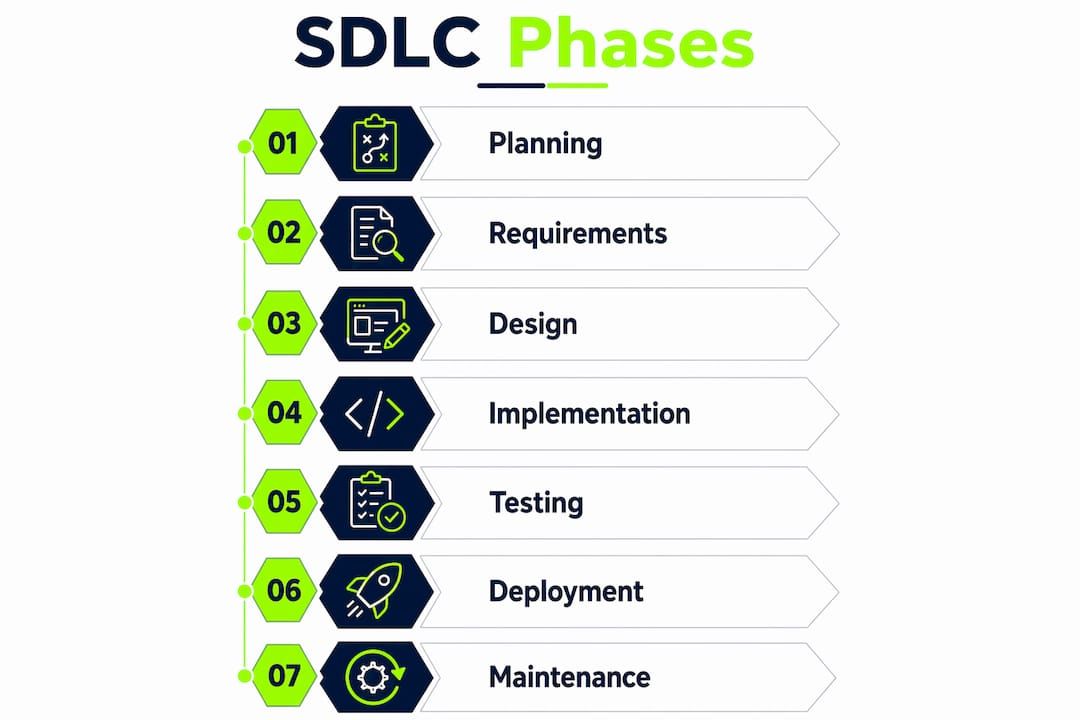
Most standardized SDLCs define 6 to 7 phases that carry a project from initial concept through long-term maintenance. Each phase has a clear entry condition, a set of activities, and a defined deliverable that gates entry to the next phase. Skipping or compressing phases without explicit risk acceptance is the single most common cause of late-stage defects.
The seven phases and their primary deliverables are:
| Phase | Primary Activities | Key Deliverable |
|---|---|---|
| Planning and feasibility | Scope definition, resource estimation, risk assessment | Project charter, feasibility report |
| Requirements analysis | Stakeholder interviews, use case mapping | Software requirements specification (SRS) |
| System design | Architecture decisions, data modeling, API contracts | System design document |
| Implementation | Coding, code review, refactoring | Tested source code in version control |
| Testing | Unit, integration, regression, and acceptance testing | Test reports, defect logs |
| Deployment | Release packaging, environment configuration, rollout | Production release, deployment runbook |
| Maintenance | Bug fixes, performance tuning, feature updates | Updated codebase, incident reports |
Requirements analysis deserves particular attention. Errors introduced at this phase cost significantly more to fix in later stages than errors caught during design or implementation. Teams that invest in a thorough Software Requirements Specification document before writing a single line of code consistently deliver closer to scope and on schedule.
The design phase is where enterprise system design workflow decisions lock in the most consequential technical trade-offs. Architecture choices made here, such as monolith versus microservices or synchronous versus event-driven communication, shape every subsequent phase. Changing them mid-project is expensive.
How do code reviews and shift-left testing improve quality?
Quality does not emerge at the end of a project. It is built into each phase through disciplined practices, and two of the most impactful are structured code reviews and shift-left testing.

Code reviews work best when reviewers examine 200–400 lines of code at a time. Larger review batches reduce defect detection efficiency because reviewers lose focus and begin skimming rather than reading. Teams that enforce this size limit through pull request policies catch more logic errors, security vulnerabilities, and maintainability issues per review session than teams with no size guidance.
Shift-left testing means embedding quality checks into every phase rather than concentrating them in a dedicated testing phase. Integrating quality controls early prevents costly late-stage defects that require rework across multiple modules. A team that writes unit tests alongside implementation code, runs static analysis on every commit, and performs design reviews against the SRS will find defects when they are cheap to fix.
- Code review size limits: Cap pull requests at 400 lines to maintain reviewer focus and defect detection rates.
- Automated static analysis: Run linters and security scanners on every commit, not just before release.
- Unit test coverage gates: Require a minimum coverage threshold before merging to the main branch.
- Design review checkpoints: Validate architecture decisions against requirements before implementation begins.
- Regression test automation: Automate regression suites so deployment pipelines catch regressions without manual effort.
Pro Tip: Pair shift-left testing with a software quality audit at the end of each major phase. This gives teams a structured moment to confirm that quality gates were met before committing to the next phase.
Which processes benefit most from formal documented SOPs?
A Standard Operating Procedure, or SOP, is a written document that specifies exactly how a repeatable, high-stakes task must be performed. Not every development task warrants an SOP. Elite engineering teams document only high-stakes, repeatable processes to increase efficiency without creating bureaucracy.
The processes that most benefit from formal SOPs share three characteristics: they are performed repeatedly, errors carry significant consequences, and inconsistent execution produces measurably different outcomes. The following processes meet all three criteria:
- Code review process. A documented review checklist prevents reviewers from skipping security checks or ignoring test coverage requirements under deadline pressure.
- Deployment procedure. A step-by-step deployment runbook with rollback instructions prevents environment configuration errors and reduces mean time to recovery when releases fail.
- Incident response. Incident response SOPs with defined severity levels and communication protocols reduce downtime and prevent ad hoc decisions during high-pressure outages.
- Developer onboarding. A documented onboarding SOP eliminates tribal knowledge gaps and gets new team members to productive contribution faster.
- Bug triage. A triage SOP with defined priority criteria prevents high-severity bugs from sitting in a backlog while low-priority issues consume sprint capacity.
Assigning ownership and version-controlling every SOP document is non-negotiable. An unowned SOP decays within months as the codebase and tooling evolve around it. Each document needs a named owner responsible for reviewing it at a defined cadence, typically quarterly, and updating it when the underlying process changes.
Pro Tip: Store SOP documents in the same version control repository as the codebase. This keeps documentation changes traceable alongside code changes and makes it far less likely that procedures fall out of sync with actual practice.
How do procedures differ across Waterfall, Agile, and DevOps?
The seven SDLC phases exist in every major lifecycle model. What differs is how those phases are sequenced, how long each lasts, and how much iteration occurs between them. IEEE Std 15288-2015 provides lifecycle process scaffolding but explicitly requires adaptation to project risk profiles. Choosing the wrong model for a project’s risk and delivery context is a procedural failure before a single line of code is written.
| Model | Phase execution | Quality integration | Best fit |
|---|---|---|---|
| Waterfall | Sequential, each phase completes before the next begins | Testing concentrated in phase 5 | Fixed-scope, low-change-risk projects |
| Agile | All phases compressed into 1–4 week sprints, repeated iteratively | Quality checks embedded in each sprint | Evolving requirements, frequent stakeholder feedback |
| DevOps | Phases parallelized and automated via CI/CD pipelines | Continuous testing and monitoring in production | High-frequency release environments |
Agile compresses and repeats all SDLC phases within short sprints, which means requirements, design, implementation, and testing all happen within the same two-week window. This demands tighter procedural discipline, not less, because the feedback loops are faster and errors propagate quickly across sprints.
DevOps goes further by automating and parallelizing phases through CI/CD pipelines. Deployment is no longer a discrete phase performed by a separate team. It is a continuous, automated process triggered by a passing test suite. Teams adopting DevOps need documented procedures for pipeline configuration, environment promotion, and production monitoring just as much as Waterfall teams need deployment runbooks. The procedures change in form, not in necessity.
For teams designing SDLC adaptations, design system principles offer a useful parallel: just as design systems codify reusable UI decisions, SDLC procedures codify reusable engineering decisions that teams apply consistently across projects.
What practical steps help teams implement better procedures?
Procedure adoption fails most often not because the procedures are wrong, but because teams try to document everything at once and end up with a library of stale documents that nobody reads. The correct approach is incremental and ownership-driven.
- Start with two or three high-value SOPs. Identify the processes where inconsistency is currently causing the most pain, typically deployments or incident response, and document those first.
- Assign a named owner to every document. Ownership is not a committee. One person is accountable for keeping each SOP current and accurate.
- Store procedures in version control. Documentation that lives in a shared drive or wiki decouples from the codebase and drifts. Keeping it in the repository makes drift visible.
- Integrate procedures into existing workflows. Link the deployment SOP from the CI/CD pipeline configuration. Embed the code review checklist in the pull request template. Procedures that require developers to leave their workflow to find documentation will be ignored.
- Review and update on a fixed cadence. A quarterly review cycle for each SOP prevents decay without creating excessive overhead.
Developers spend about 42% of their workweek on maintenance tasks. That figure reflects the cost of undocumented, inconsistent procedures that force teams to rediscover solutions rather than follow established ones. Clear, maintained procedures convert that rediscovery time into productive work.
Pro Tip: Treat procedure documentation like code: require a review before merging changes, track a changelog, and deprecate outdated versions explicitly. A web application handover checklist is a practical model for how procedural documentation can be structured to survive team transitions.
Key Takeaways
Effective software development procedures combine standardized lifecycle phases, disciplined quality practices, and maintained SOP documentation to produce reliable, maintainable software at a predictable pace.
| Point | Details |
|---|---|
| Seven-phase SDLC is the baseline | Every major lifecycle model, including Agile and DevOps, executes the same core phases in different sequences. |
| Code review size matters | Reviewing 200–400 lines at a time maximizes defect detection without overwhelming reviewers. |
| Shift-left testing cuts rework costs | Embedding quality checks in every phase finds defects when they are cheapest to fix. |
| SOPs need owners and version control | Unowned procedure documents decay quickly and lose team trust within months. |
| Model choice must match project risk | Waterfall, Agile, and DevOps each suit different risk profiles; mismatching them creates procedural failure. |
The uncomfortable truth about procedure adoption
Teams that struggle with software development procedures almost always share one trait: they treat documentation as a compliance exercise rather than an engineering asset. The result is a folder of PDFs that nobody opens and a codebase held together by the institutional memory of two or three senior developers.
The procedures that actually work are the ones teams build around real pain. When a deployment goes wrong at 2:00 AM because nobody documented the rollback steps, the team writes a deployment SOP the next morning. That SOP gets used because everyone remembers why it exists. Procedures born from pain have authors, context, and urgency. Procedures written to satisfy an audit have none of those things.
The shift to CI/CD and cloud-native development has not reduced the need for documented procedures. It has changed their form. A Terraform module with embedded validation rules is a procedure. A GitHub Actions workflow with required status checks is a procedure. The teams that thrive in modern development environments are the ones that recognize this and treat their pipeline configuration with the same rigor they apply to their application code.
Integrating regular code refactoring into development procedures is another practice that separates high-performing teams from the rest. Refactoring is not a separate project. It is a procedure embedded in the implementation phase, triggered by defined criteria such as complexity thresholds or duplication metrics, and tracked like any other work item.
The practical advice is this: pick the two processes causing the most friction on your team right now, document them with enough detail that a new hire could follow them without asking questions, assign an owner, and put them in version control. That is a more valuable starting point than any comprehensive procedure framework.
— Bitecode
How Bitecode supports structured software delivery
Teams that understand the value of disciplined procedures often face a different problem: building the technical foundation that makes those procedures worth following. Bitecode delivers custom business software with up to 60% of the baseline system pre-built using modular components, which means teams spend less time on boilerplate and more time on business-domain complexity.
Bitecode incorporates SDLC best practices, including structured requirements analysis, phased delivery, and documented handover procedures, into every engagement. For organizations that also need to reduce manual workflow overhead, Bitecode’s AI process automation services integrate directly with custom-built systems. The result is a delivered product that teams can maintain, extend, and hand over without relying on tribal knowledge.
FAQ
What are software development procedures?
Software development procedures are structured, repeatable sequences of steps that govern how software is planned, designed, built, tested, deployed, and maintained. They are formalized through frameworks like the SDLC and standards from IEEE and ISO.
How many phases does a standard SDLC have?
Most standardized SDLCs define 6 to 7 phases, covering planning, requirements analysis, design, implementation, testing, deployment, and maintenance. Each phase produces a defined deliverable that gates entry to the next.
What is shift-left testing in software development?
Shift-left testing means embedding quality checks into every SDLC phase rather than concentrating testing in a single late-stage phase. This approach finds defects earlier, when they are significantly cheaper to fix.
Which processes should have formal SOPs in software development?
Code reviews, deployments, incident response, developer onboarding, and bug triage are the highest-priority candidates for formal SOPs. These processes are repeatable, high-stakes, and produce measurably worse outcomes when executed inconsistently.
How do Agile and Waterfall procedures differ?
Waterfall executes SDLC phases sequentially with each phase completing before the next begins, while Agile compresses all phases into short, repeated sprints. DevOps goes further by automating and parallelizing phases through CI/CD pipelines.