TL;DR:
- A software quality audit is an independent review of an organization’s testing processes to verify compliance with standards and business objectives. It covers the full QA lifecycle and involves objective evidence collection, evaluation, reporting, and follow-up to ensure process maturity and traceability. Automating audits reduces time and costs, with continuous monitoring enhancing overall process health and compliance verification.
A software quality audit is a formal, independent evaluation of an organization’s software testing and quality assurance processes to verify alignment with defined standards and business objectives. Unlike a code review or peer walkthrough, an audit produces objective, verifiable evidence about process maturity, traceability, and compliance. For IT professionals and QA managers, this distinction matters. ISO/IEC/IEEE 29119 defines the framework that makes testing predictable, traceable, and auditable. Organizations that treat audits as a continuous practice, rather than a pre-release scramble, catch systemic gaps before they become production failures.
What is the scope and process of a software quality audit?
A software quality audit covers the full QA lifecycle, not just test execution results. QA audits review test strategy, automation frameworks, defect management, environment configuration, and release readiness across a 16-area checklist. That breadth is what separates an audit from a targeted review. A review checks one artifact. An audit checks whether the entire system of quality practices holds together.
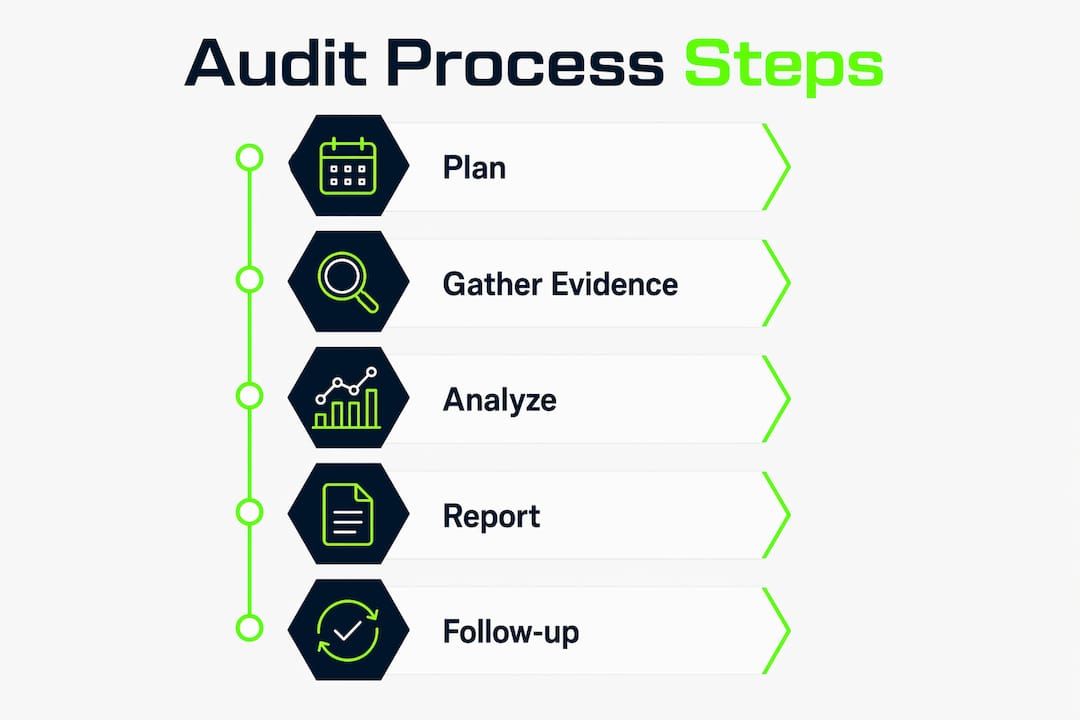
The audit process follows five distinct stages:
- Planning. Define the scope, objectives, and criteria before any evidence collection begins. Identify which standards apply, such as ISO/IEC/IEEE 29119 or PCI DSS, and build or adapt an audit checklist accordingly. Scope decisions made here determine whether the audit covers a single product team or the entire delivery organization.
- Execution. Gather objective artifacts: test plans, defect logs, automation run results, CI/CD pipeline reports, and release sign-off records. Objective artifacts like logs, tool records, and metrics produce verifiable findings. Interviews alone produce opinions.
- Evaluation. Compare collected evidence against the defined criteria. Identify gaps, nonconformities, and areas where practice diverges from documented process. This stage requires auditor independence. A team cannot objectively audit its own work.
- Reporting. Document findings with assigned owners, disposition tiers, and resolution deadlines. Findings without owners get ignored. Findings without deadlines drift indefinitely.
- Verification. Follow up to confirm corrective actions were implemented. A finding closed on paper but unresolved in practice defeats the purpose of the audit.
Pro Tip: Build your audit checklist before the audit begins, not during evidence collection. Teams that define criteria upfront avoid scope creep and produce findings that are directly comparable across audit cycles.
How do software quality standards and frameworks guide audits?

Standards give audits their authority. Without a defined reference framework, audit findings become subjective opinions rather than documented nonconformities. ISO/IEC/IEEE 29119 provides vocabulary, process definitions, and evidence requirements without prescribing specific product quality characteristics. That flexibility makes it applicable across industries and team sizes.
A critical distinction shapes how findings get categorized and remediated:
- Quality findings address non-statutory concerns such as maintainability, performance, and test coverage gaps. These findings improve the product but do not carry direct legal or certification risk.
- Compliance findings address statutory or regulatory controls. Distinguishing quality from compliance findings prevents duplicated effort and misclassification. A compliance finding that gets treated as a low-priority quality issue can delay certification or create legal exposure.
Security and code compliance frameworks add another layer. PCI DSS governs payment software. NIST frameworks apply to federal systems and increasingly to private sector security programs. Each framework shapes the audit checklist differently. A payment platform audit will weight encryption and access control findings far more heavily than a general enterprise application audit.
Traceability is the connective tissue of an effective quality assurance evaluation. Requirements must trace to test cases. Test cases must trace to execution results. Results must trace to release decisions. When that chain breaks, the audit exposes it. When it holds, the audit confirms that the organization’s testing process is doing what it claims.
Pro Tip: Map your traceability chain before the audit. If you cannot trace a requirement to a test result in under five minutes, your documentation has a gap that an auditor will find.
What are the benefits and efficiencies of automating software quality audits?
Manual audit processes consume significant time and introduce human error at every evidence collection step. Automated compliance orchestration saves organizations over 100 hours per quarter on evidence collection and reduces audit costs by 40–60%. That is not a marginal efficiency gain. It represents the difference between audit as a quarterly disruption and audit as a background process.
CI/CD pipeline integration changes the audit timeline fundamentally. Automated CI/CD audits produce detailed compliance reports in approximately 10 minutes, replacing manual processes that take weeks or months. Teams that integrate audit scans into their pipelines get continuous feedback rather than periodic snapshots.
The practical benefits of automation in IT quality assessment include:
- Real-time evidence packages. Continuous monitoring maintains JSON evidence trails and PDF packages automatically, eliminating last-minute scrambles before audits.
- Reduced human error. Automated collection applies the same criteria consistently across every build. Manual collection varies with the person doing the work.
- Faster certification timelines. Organizations using automated compliance tools achieve certification 2–3 months faster than those relying on manual processes.
- AI-assisted reporting. AI tools analyze audit context and generate structured findings, reducing the time auditors spend writing reports and increasing the time they spend interpreting results.
For teams building on scalable reporting automation, integrating audit reporting directly into CI/CD operations creates a repeatable, verifiable compliance record without adding manual overhead.
Pro Tip: Store your evidence packages in immutable storage. Audit-ready documentation that can be altered after the fact provides no assurance to external auditors or regulators.
What are common challenges and pitfalls in software quality audits?
The most common audit failure is conflating reviews with audits. A peer code review is valuable, but it is not independent, it is not comprehensive, and it does not produce the objective evidence that a formal audit requires. Audits must be independent, comprehensive, and evidence-based to produce findings that hold up under external scrutiny.
Teams that audit their own processes face a structural credibility problem. Even with the best intentions, self-assessment produces optimistic findings. External or cross-functional auditors bring the independence that makes findings credible.
Additional pitfalls that derail audit effectiveness:
- Relying on interviews instead of artifacts. Interviews reveal what teams believe they do. Artifacts reveal what they actually do. Effective audits anchor findings on logs, test management data, and automation outputs.
- Failing to separate quality and compliance findings. Mixing these categories in a single remediation queue creates confusion about priority and ownership. Compliance findings need a different escalation path than quality findings.
- Missing disposition tiers. Establishing disposition tiers before the audit begins prevents release gridlock. Critical findings block release. High findings require a remediation plan before release. Medium and Low findings enter the backlog with defined timelines. Without these tiers, every finding becomes a negotiation.
- No integration with development workflows. Audit findings that live in a separate document outside the team’s issue tracker get ignored. Findings must enter the same workflow the team uses to manage work.
Pro Tip: Assign every finding an owner at the time of reporting, not after review. Findings without owners at the moment of publication have a near-zero completion rate.
How can organizations implement software quality audits effectively?
Effective implementation starts with scope alignment. The audit scope must reflect both business priorities and compliance obligations. A team shipping a regulated financial product needs a different audit scope than a team maintaining an internal workflow tool. Defining scope before building the checklist prevents both over-auditing and blind spots.
A practical implementation follows this sequence:
- Define scope and criteria. Align with applicable standards (ISO/IEC/IEEE 29119, PCI DSS, NIST) and identify the QA processes, tools, and artifacts in scope.
- Build or adapt the audit checklist. Cover QA governance, risk-based testing, automation coverage, defect management, environment configuration, and release readiness. A financial software audit checklist illustrates how evidence gathering practices adapt to specific regulatory contexts.
- Integrate evidence collection with existing tools. Connect your test management platform, CI/CD pipeline, and defect tracker to your audit process. Manual evidence collection is the primary source of audit delay.
- Assign ownership and deadlines at reporting time. Every finding needs a named owner and a resolution date before the audit report is finalized.
- Track audit metrics across cycles. Automation pass rate, defect detection efficiency, and mean time to remediation show whether the audit program is driving improvement or just documenting the same gaps repeatedly.
- Prepare traceability documentation continuously. Teams that maintain automated compliance workflows year-round arrive at regulatory audits with documentation already complete.
Key metrics worth tracking across audit cycles include automation coverage percentage, defect escape rate (defects found in production versus testing), mean time to close audit findings, and traceability coverage from requirements to test results. These metrics convert audit findings from one-time observations into a continuous improvement signal.
Key Takeaways
A software quality audit is most effective when it is independent, evidence-based, and integrated into continuous development workflows rather than treated as a periodic compliance event.
| Point | Details |
|---|---|
| Audits require independence | Self-assessment lacks credibility; cross-functional or external auditors produce findings that hold up under scrutiny. |
| Evidence beats interviews | Logs, test records, and automation outputs produce verifiable findings; interviews alone produce opinions. |
| Separate quality from compliance | Mixing finding types creates remediation confusion; compliance findings need a distinct escalation path. |
| Disposition tiers prevent gridlock | Define Critical, High, Medium, and Low tiers before the audit to link findings directly to release decisions. |
| Automation cuts cost and time | Automated compliance orchestration reduces audit costs by 40–60% and saves over 100 hours per quarter. |
The audit is a process health check, not a blame exercise
Bitecode has worked with enough development teams to recognize a recurring pattern: organizations treat the software quality audit as a pre-release gate rather than a continuous diagnostic. That framing puts the audit in an adversarial position relative to the development team. Findings feel like accusations. Remediation feels like punishment. The result is audit fatigue, where teams learn to produce documentation that satisfies the checklist without changing the underlying process.
The more productive framing treats the audit as a process health check. The goal is not to find defects. It is to determine whether the system of practices in place will reliably prevent defects from reaching production. That distinction changes how teams engage with findings.
Bitecode’s experience with CI/CD-integrated audit workflows confirms that automation removes most of the friction that creates adversarial dynamics. When evidence collection is continuous and findings surface in the team’s existing issue tracker, the audit stops feeling like an external imposition. It becomes part of the normal development rhythm. Teams that reach that state stop dreading audits and start using them to make the case for process investments.
The one caution worth stating plainly: do not let automation create a false sense of coverage. Automated scans catch what they are configured to catch. The IT automation governance checklist matters precisely because automation without governance produces audit-ready documentation for the wrong things. Human judgment still determines whether the audit criteria reflect the actual risks the organization faces.
— Bitecode
How Bitecode supports audit-ready software development
Building software that passes a quality assurance evaluation from day one requires more than good intentions. It requires architecture decisions, documentation practices, and automation integrations that produce audit evidence as a natural byproduct of development.
Bitecode’s custom web application development services start with up to 60% of the baseline system pre-built using modular components that incorporate traceability, defect tracking, and release readiness documentation by default. For teams that need continuous compliance monitoring, Bitecode’s AI-driven automation services integrate evidence collection directly into CI/CD pipelines, producing real-time audit packages without manual overhead. Organizations that want to accelerate work without accelerating compliance risk will find both services directly relevant to their audit program.
FAQ
What is a software quality audit?
A software quality audit is a formal, independent evaluation of an organization’s QA processes, testing practices, and compliance with defined standards such as ISO/IEC/IEEE 29119. It produces objective evidence about process maturity and traceability, not just defect counts.
How does a software audit differ from a code review?
A code review examines specific code artifacts and is typically performed by peers on the same team. A software audit is independent, covers the entire QA process, and requires objective artifact evidence rather than subjective assessment.
What standards apply to software quality audits?
ISO/IEC/IEEE 29119 is the primary international standard for software testing processes, covering vocabulary, process definitions, and evidence requirements. Security-focused audits also apply PCI DSS or NIST frameworks depending on the industry and regulatory context.
How can teams automate the audit software processes?
Teams integrate audit scans into CI/CD pipelines to produce compliance reports automatically. Automated compliance orchestration tools collect evidence continuously, reducing manual effort by over 100 hours per quarter and cutting audit costs by 40–60%.
What are disposition tiers in audit findings?
Disposition tiers are predefined categories (Critical, High, Medium, Low) that link each audit finding to a specific release decision and remediation timeline. Establishing these tiers before the audit begins prevents release gridlock and ensures findings are prioritized by actual risk.