TL;DR:
- Software audits evaluate license compliance, code quality, security, and costs to manage risks. Regular, independent reviews help organizations prevent gaps and ensure regulatory adherence, especially with AI tool governance. Building audit-ready software from the start reduces long-term compliance and security issues.
Software audits are formal evaluations of an organization’s software assets, examining license compliance, code quality, security posture, and cost efficiency to reduce risk and ensure regulatory alignment. Frameworks like HIPAA, SOC 2, and GDPR make these reviews non-negotiable for organizations handling sensitive data. A comprehensive software audit goes beyond code reviews to cover application portfolio health, spending efficiency, and business alignment. For IT compliance officers and business leaders, audits are not administrative overhead. They are one of the highest-return activities available for managing technical and financial risk.
What types of software audits exist?
Software auditing covers several distinct disciplines, each with a different scope and trigger. Understanding which type applies to your situation determines the depth and focus of the review.
- License compliance audits verify that software usage matches contractual entitlements. They compare deployed instances against purchased licenses, identify over-deployment, and flag unused seats that represent wasted spend.
- Technical code audits examine architecture, code quality, security controls, performance, and technical debt. These are common before mergers and acquisitions, vendor replacements, or major platform migrations.
- Application security audits assess vulnerabilities across code, infrastructure, and deployment pipelines. They map attack surfaces and produce findings ranked by exploitability and business impact.
- AI-focused audits review code produced by LLM assistants and AI coding tools. This audit type addresses a new category of risk: 1 in 5 organizations have experienced serious security incidents from AI-generated code. That figure signals that AI tool governance has become a core audit responsibility.
- Incident-response audits are triggered by a breach, compliance failure, or regulatory inquiry. They reconstruct what went wrong and identify systemic gaps.
Each type serves a different business purpose, but all share the same goal: replacing assumption with evidence.
What does a thorough software audit cover?
A rigorous software compliance review follows a structured checklist. The 12-section technical audit framework covers architecture, code quality, security, performance, database design, infrastructure, testing, documentation, compliance, technical debt, team skills, and total cost of ownership. Each section requires 0.5–2 days of review time, putting a full audit at approximately 12–14 days total. Architecture reviews consistently consume the most time because they require understanding both technical decisions and the business context behind them.

The audit scope should be calibrated to the business situation. A pre-acquisition review demands exhaustive coverage. An internal quarterly check can focus on the highest-risk sections: security, compliance, and technical debt. Tailoring depth prevents audit fatigue without sacrificing the findings that matter most.
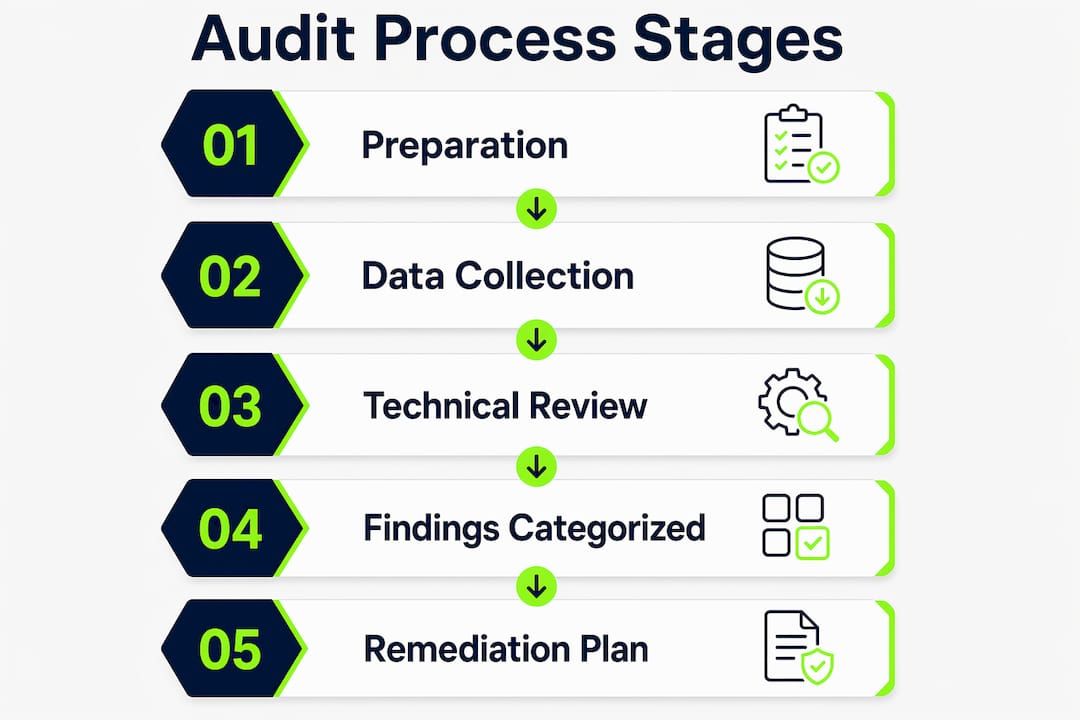
One step that organizations routinely undervalue is the engineering lead interview. Skipping this interview misses undocumented risks and critical context that no code repository reveals. A one-hour conversation with the lead engineer surfaces decisions, workarounds, and known weaknesses that would otherwise remain invisible in the audit report.
Audit findings should be categorized by severity. Critical findings require remediation within weeks 1–4. High-severity findings should be resolved within 4–12 weeks. Medium and low findings fit into quarterly improvement sprints. This triage structure turns a long list of issues into a manageable remediation schedule with clear ownership and timelines.
Pro Tip: Request that the auditor produce a prioritized remediation plan alongside the findings report. Audits that estimate remediation effort and cost give leadership the data needed to decide between fixing existing software and rebuilding it entirely.
| Audit section | Time investment |
|---|---|
| Architecture review | 1.5–2 days |
| Security assessment | 1–2 days |
| Code quality and technical debt | 1–2 days |
| Performance and database | 0.5–1 day each |
| Compliance and documentation | 0.5–1 day each |
How to conduct a software audit effectively
The best practices for software audits start before the auditor arrives. Preparation determines whether the review produces genuine insight or a superficial checklist exercise.
-
Set the audit frequency. Formal internal reviews should run at least quarterly for standard software. High-cost engineering software warrants monthly monitoring through automated platforms. Frequency is not bureaucracy. It is the difference between catching a compliance gap early and discovering it during a vendor-initiated audit.
-
Collect and reconcile license entitlements. Pull purchase records, subscription agreements, and deployment data before the audit begins. Gaps between entitlements and actual usage are the most common and most costly finding in license compliance reviews.
-
Deploy automated monitoring. Real-time compliance platforms track software installations, usage patterns, and license consumption continuously. They replace the annual scramble with a live dashboard that makes audit preparation routine rather than reactive.
-
Organize documentation in advance. Architecture diagrams, security policies, change logs, and vendor contracts should be accessible in a single location. Auditors who spend time hunting for documents produce less thorough findings.
-
Integrate audits into a Software Asset Management program. Mature SAM programs treat internal audits as routine practice, not emergency responses. Organizations with established SAM programs approach both planned and surprise vendor audits with confidence rather than crisis-mode scrambling.
Pro Tip: Never assign the existing development team to audit its own code. Independent external auditors produce credible, value-adding findings. Self-audits by the same team that built the software introduce conflicts of interest and consistently result in superficial reviews.
For teams managing cloud environments, cloud security best practices provide a useful parallel framework for structuring security-focused audit scopes.
What are the modern challenges in software auditing?
The audit process itself is evolving because the software it reviews has changed. AI-assisted development has introduced a new class of risk that traditional IT audit checklists were not designed to catch.
- AI-generated code lacks consistent security proficiency. AI tools differ significantly in how they handle security patterns, making governance enforcement and risk assessment more complex. An audit that does not examine which AI tools contributed to a codebase is an incomplete audit.
- The agentic development lifecycle (ADLC) requires its own governance layer. When AI agents write, test, and deploy code autonomously, the audit must trace decisions back through tool configurations and prompt histories, not just source commits.
- Continuous monitoring is replacing point-in-time audits. Organizations that rely solely on annual reviews accumulate risk between cycles. Real-time monitoring platforms flag anomalies as they occur, giving compliance teams the ability to respond before a gap becomes a violation.
- AI-assisted audit platforms are accelerating remediation. These platforms analyze findings, prioritize vulnerabilities by business impact, and generate remediation guidance. They reduce the time between audit completion and corrective action.
Most organizations underestimate their technical debt, security risks, and spending inefficiency until an audit exposes reality. That gap between perceived and actual risk is precisely why audits deliver high ROI. The cost of the review is almost always smaller than the cost of the risks it uncovers.
For business leaders managing AI-driven workflows, understanding how AI transforms risk management provides essential context for scoping AI-focused audit sections. Teams building governance programs should also review the IT automation governance checklist to align audit activities with broader automation oversight.
Key Takeaways
Software audits are the most direct mechanism for closing the gap between an organization’s perceived risk and its actual exposure.
| Point | Details |
|---|---|
| Audit types serve distinct purposes | License, code, security, and AI-focused audits each target different risks and require different scopes. |
| Full audits take 12–14 days | A 12-section technical review requires 0.5–2 days per section; calibrate depth to business context. |
| Independent auditors are non-negotiable | Self-audits by the development team produce superficial findings; external auditors deliver credible results. |
| Quarterly cadence is the minimum | Standard software requires quarterly internal reviews; high-cost tools need monthly automated monitoring. |
| AI code introduces new audit requirements | 1 in 5 organizations have faced security incidents from AI-generated code, making AI tool governance a core audit scope. |
The audit investment most organizations get wrong
Bitecode has worked with organizations across industries that treat audits as a compliance tax rather than a management tool. That framing is the root cause of most audit failures. When a review is scheduled only because a vendor demands it or a regulator requires it, the organization enters the process in a defensive posture. The findings get minimized, remediation gets deprioritized, and the same gaps appear in the next cycle.
The organizations that extract real value from software auditing treat it as a recurring diagnostic, not a one-time event. They build audit readiness into their development and procurement processes from the start. They assign ownership of findings to specific teams with specific deadlines. They use audit data to make capital allocation decisions, not just compliance checkboxes.
The AI dimension makes this shift more urgent, not less. Auditing AI-generated code requires upskilling audit teams, updating checklists, and establishing governance over which tools are permitted in the software development lifecycle. Most organizations have not done this yet. The ones that do it now will have a measurable advantage when regulators and insurers begin requiring it formally.
The uncomfortable truth is that most audit programs are underfunded relative to the risk they are meant to manage. Business leaders who champion audit programs as a governance investment, rather than a cost center, consistently see better outcomes across security, compliance, and software quality.
— Bitecode
How Bitecode builds audit-ready software from day one
Software that is built without compliance and maintainability in mind creates audit debt from the first line of code. Bitecode designs custom business software with security controls, documentation standards, and audit traceability built into the architecture from the start, not retrofitted after a finding.

Bitecode’s modular development approach means that security, compliance, and monitoring capabilities are integrated components, not afterthoughts. Organizations that partner with Bitecode reduce audit risk by starting with a foundation that independent auditors can review efficiently and confidently. For teams managing complex workflows or regulated data, Bitecode’s AI automation services are designed with governance and audit visibility as core requirements. Reach out to Bitecode to discuss how your next software project can be built to pass its first audit without a remediation sprint.
FAQ
What is a software audit?
A software audit is a formal evaluation of an organization’s software assets, covering license compliance, code quality, security, and cost efficiency. The goal is to identify risks, compliance gaps, and opportunities to reduce waste.
How often should organizations run internal software audits?
Best practice calls for quarterly internal reviews for standard software, with monthly automated monitoring for high-cost engineering tools. Regular cadence prevents the reactive scramble that occurs when a vendor-initiated audit arrives unexpectedly.
Why must software auditors be independent?
Independent external auditors avoid the conflicts of interest that arise when a development team reviews its own code. Self-audits consistently produce superficial findings rather than the credible risk identification that business decisions require.
What risks does AI-generated code introduce to software audits?
AI coding tools vary in security proficiency, and 1 in 5 organizations have already experienced security incidents tied to AI-generated code. Audits must now include visibility into which AI tools contributed to a codebase and how those tools are governed.
What does a software audit cost to remediate?
Typical remediation budgets run 15–30% of the original build cost, depending on findings severity. Audits that categorize findings by severity allow organizations to triage immediate fixes from longer-term improvements and plan spending accordingly.