TL;DR:
- Secure software deployment involves ensuring that validated code is moved into production without introducing vulnerabilities, treating deployment as a critical security boundary. It requires artifact verification, access control, environment validation, and comprehensive audit trails to prevent drift and misconfigurations. Implementing these controls reduces breach costs, accelerates deployment, and strengthens compliance and stakeholder trust.
Secure software deployment is the discipline of moving validated, reviewed code into production without introducing new vulnerabilities in the process. Most organizations treat it as a final gate, a checkbox at the end of the development cycle. That framing is wrong, and it’s costing teams significantly. 88% of data breaches exploit web application vulnerabilities, with average breach costs reaching $4.88 million. The transition from development to live environment is its own attack surface, and it deserves the same rigor as the code itself.
Key Takeaways
| Point | Details |
|---|---|
| Deployment is an active attack surface | Artifact tampering, misconfigured environments, and unauthorized access can all occur after code review ends. |
| CI/CD pipelines need security treatment | Pipeline configuration files carry as much risk as application code and must be reviewed, versioned, and scanned. |
| AI code generation widens the gap | Only 24% of organizations using AI code generation apply comprehensive security evaluation before deployment. |
| Immutable infrastructure reduces drift | Replacing containers instead of patching them ensures production always reflects an approved security posture. |
| Early security integration pays off | Catching vulnerabilities before production can reduce remediation costs by up to 100x compared to post-deployment fixes. |
What secure software deployment actually means
Understanding what is secure software deployment requires separating it from what is secure software development. Development security covers how code is written: threat modeling, code review, static analysis, dependency management. Deployment security covers a different boundary entirely. It works at the transition point, ensuring the software that was reviewed and tested is exactly what runs in production, with nothing altered, injected, or misconfigured along the way.
That distinction matters practically. A team can write excellent, well-tested code and still deploy it in a way that introduces critical vulnerabilities. Environment misconfigurations, weak secrets management, improper access controls on deployment pipelines, and skipped validation steps all create exposure at the transition moment, not during development.
The core components of secure software deployment include:
- Artifact integrity verification: Confirming through cryptographic signatures and checksums that what is being deployed matches what was reviewed and approved
- Access control at deployment: Restricting who and what systems can trigger a production deployment, using least-privilege principles
- Configuration validation: Confirming that environment variables, secrets, network rules, and infrastructure settings match an approved baseline before any deployment proceeds
- Auditability and traceability: Maintaining logs of what was deployed, by whom, when, and from which artifact source
Secure software design and secure software architecture both feed into these controls. When architecture decisions create tight environment parity between staging and production, the risk of “it worked in staging” failures drops substantially. Immutable infrastructure takes this further: rather than patching a running container or VM, the entire instance is replaced with a fresh, approved image. This prevents configuration drift from accumulating silently over time.
Pro Tip: Treat your staging environment as a security control, not just a testing convenience. If staging diverges from production in networking rules, secret injection methods, or dependency versions, you are not testing what you think you are.
Emerging risks: AI code and CI/CD pipeline vulnerabilities
The risk profile for modern deployment has shifted significantly. 95% of organizations now use AI code generation, but only 24% apply comprehensive security evaluation before that code reaches a deployment pipeline. The result is a 322% increase in privilege escalation paths and a 153% rise in architectural design flaws over just six months across organizations using AI-assisted development. These are not theoretical risks. They are measurable consequences of accelerating output without accelerating review.
The concern extends beyond the application code itself. AI systems are increasingly generating pipeline configurations, infrastructure-as-code files, and deployment scripts. These artifacts carry the same risk as any other code, but they often receive less scrutiny because teams perceive them as configuration rather than software. That perception is precisely what attackers exploit.
CI/CD pipelines are frequently the weakest link in the software supply chain. Attackers who gain access to a build script or pipeline configuration can inject malicious steps that bypass every security gate the development team put in place, all without touching the application code.
The attack surface of a CI/CD pipeline includes build scripts, plugin dependencies, environment variable injection points, and any automated promotion rules that push code from staging to production. Each represents a place where an attacker with write access, or one who has compromised an upstream dependency, can introduce malicious behavior into an otherwise clean deployment.
Practical risks in modern deployment pipelines include:
- Build scripts that pull dependencies at build time without pinned versions, allowing substitution attacks
- Automated promotion rules that advance code to production without triggering additional validation
- Pipeline configuration stored outside version control, making unauthorized changes difficult to detect
- Overprivileged service accounts that can deploy to production without multi-party approval
- AI-generated pipeline configurations that encode insecure defaults because training data reflects insecure patterns
The broader trend in AI-driven development demands posture-based security views that span code, pipeline, and runtime simultaneously. Traditional point-in-time checks are not designed for this environment. They catch what is visible at a single moment. Secure deployment in 2026 requires continuous, programmatic enforcement across the entire software lifecycle.
Secure software deployment best practices
Moving from understanding risks to implementing controls requires a structured approach. The following framework reflects what teams with mature deployment security practices actually do, not just what documentation recommends.
- Sign and verify every artifact. Generate a cryptographic signature for every build artifact and verify it before deployment. Tools like Sigstore and in-registry signing policies make this automatable without adding significant friction.
- Implement policy-enforced promotion workflows. No artifact should advance from staging to production through a single automated step. Require explicit approval gates, and log every promotion decision with the approver’s identity and the artifact hash.
- Version-control all pipeline configuration. Treat CI/CD configuration files with the same peer review and scanning requirements as application code. Unauthorized changes to pipeline files should trigger alerts.
- Validate environment configuration before each deployment. Use infrastructure compliance tools to check that the target environment matches the approved security baseline. Deploy only when the check passes.
- Replace, do not patch, running infrastructure. Immutable infrastructure prevents drift by ensuring production always reflects a known, approved image rather than an image that has been modified in place.
- Maintain deployment audit trails. Log every deployment event with artifact provenance, deploying identity, target environment, and timestamp. Audit trails are both a security control and a compliance requirement for most regulatory frameworks.
| Practice | What it protects against | Tooling examples |
|---|---|---|
| Artifact signing | Tampering between build and deploy | Sigstore, Notary |
| Environment compliance checks | Misconfiguration before deployment | OPA, Chef InSpec |
| Immutable infrastructure | Configuration drift in production | Docker, Kubernetes with image policies |
| Deployment audit logs | Unauthorized changes and compliance gaps | SIEM, native cloud audit logs |
| Pipeline peer review | Malicious pipeline modifications | GitHub branch protection, GitLab approvals |
Pro Tip: For automated dependency updates, apply a controlled trust model with a soak period. Let the update run in staging for a defined window before it is eligible for production promotion. This gives time for automated scanning and behavioral observation without blocking the update entirely.

Understanding what is secure software architecture also informs how these controls are structured. Architectures that separate deployment privileges from development access, that enforce network segmentation between environments, and that use short-lived credentials for deployment service accounts are far easier to secure at the transition boundary.
Business and compliance benefits of secure deployment
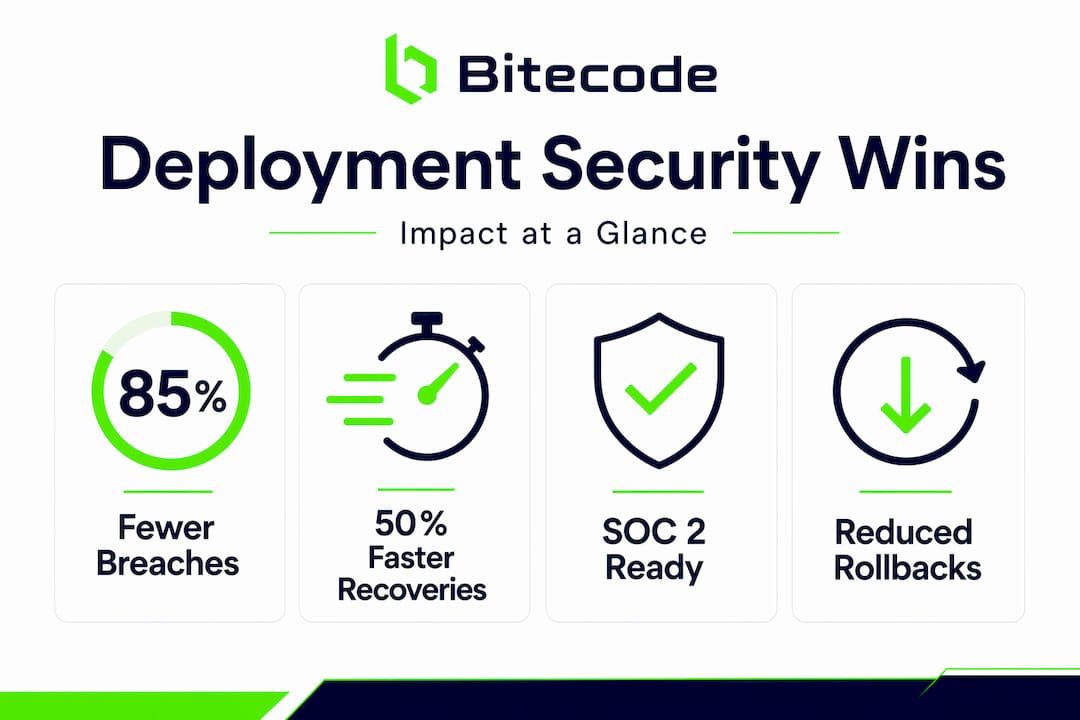
The business case for secure deployment practices is concrete. Integrating security throughout the SDLC reduces vulnerabilities by 85% and delivers 20 to 30% faster deployment cycles, because issues caught early require far less rework than those discovered in production. Remediating a vulnerability before it reaches production costs roughly 100x less than fixing it after deployment.
| Business outcome | Impact of secure deployment |
|---|---|
| Breach cost reduction | Proactive controls reduce the $4.88M average breach cost |
| Faster deployment cycles | 20-30% improvement when security is integrated, not appended |
| Compliance readiness | Continuous audit trails reduce evidence-gathering burden |
| Fewer emergency patches | Pre-deployment validation catches issues before they become incidents |
| Client trust | Verified deployment posture supports third-party audits and certifications |
Regulatory compliance is where deployment security pays dividends that many teams underestimate. Frameworks like SOC 2, ISO 27001, PCI DSS, and GDPR all require demonstrable controls over who can access production systems, what changes were made, and when. A mature secure software release process with proper audit trails satisfies a significant portion of these evidence requirements without additional effort at audit time.
There is also a trust dimension that matters for client-facing services. Organizations that can demonstrate a verified, policy-enforced deployment posture have a material advantage in enterprise sales cycles and vendor assessments. Secure deployment is not only about reducing risk internally. It signals to external stakeholders that the organization takes software supply chain integrity seriously.
Beyond compliance, teams that adopt secure deployment practices consistently report fewer production rollbacks and reduced on-call burden. When every deployment is verified against a known-good baseline, the unpredictable behavior that triggers 2 AM incidents decreases substantially.
My take on deployment security as a continuous boundary
I’ve watched organizations invest heavily in application security testing and then treat deployment as a formality. The code passes all the scans, so deployment must be fine. That assumption is exactly where things go wrong.
What I’ve found is that deployment security is not a gate. It’s an enforcement boundary that needs to be maintained continuously, not passed once. A reviewed artifact sitting in a registry for two weeks before deployment may be running against a dependency that was quietly compromised three days ago. The review was valid. The deployment moment is not.
The cultural piece is what most teams underestimate. Moving to a Secure by Design posture is not just a tooling change. It requires teams to stop treating deployment as a logistics problem and start treating it as a security control surface. That shift does not happen by installing a tool. It happens when decision-makers model deployment security as a core requirement, not a security team concern.
I’m also cautious about over-relying on static checks. They are necessary but not sufficient. The teams I’ve seen operate with genuine deployment confidence are the ones running behavioral validation in staging, enforcing immutable infrastructure in production, and treating every pipeline configuration file as a first-class security artifact. Adding AI code generation to the mix without addressing those fundamentals does not accelerate work. It accelerates the introduction of risk. The compliance and automation tooling is available to support this, but the organizational will to use it consistently is what actually determines outcomes.
— Bitecode
How Bitecode supports secure deployment workflows
Organizations that need to build and deploy secure systems quickly face a real tension: moving fast without accumulating security debt. Bitecode addresses this directly through its modular platform, where up to 60% of the baseline system arrives pre-built with security controls already integrated.

For deployment-specific automation, the Bitecode AI Assistant Module integrates into workflow processes to run automated validation checks, flag configuration deviations, and enforce approval gates without requiring manual intervention at every step. For organizations where deployment audit trails and transaction integrity are regulatory requirements, the blockchain deployment logging capabilities provide tamper-evident records of every deployment event. Teams that need to accelerate without bypassing security controls will find Bitecode’s approach built around exactly that requirement.
FAQ
What is secure software deployment?
Secure software deployment is the process of moving validated software from development into a live production environment while maintaining artifact integrity, enforcing access controls, validating configurations, and preserving a full audit trail. It focuses specifically on the transition boundary between reviewed code and running production systems.
How does secure deployment differ from secure development?
Secure software development focuses on how code is written, including threat modeling, code review, and static analysis. Secure deployment addresses what happens to that code afterward, covering artifact signing, environment configuration validation, pipeline security, and controlled promotion workflows.
What are the biggest risks in modern software deployment?
The primary risks include artifact tampering between build and deployment, CI/CD pipeline vulnerabilities where attackers can modify build scripts to bypass security gates, environment misconfiguration, overprivileged service accounts, and AI-generated code or pipeline configurations that encode insecure defaults.
What is the business case for secure software deployment?
Organizations that integrate security throughout the software lifecycle see 85% fewer vulnerabilities and deployment cycles that run 20 to 30% faster. Early remediation costs roughly 100x less than post-production fixes, and strong deployment controls reduce evidence-gathering overhead at compliance audits.
How should organizations treat CI/CD pipeline security?
Pipeline configuration files should receive the same version control, peer review, and automated scanning as application code. Any unauthorized change to a pipeline file should trigger an alert, and deployment service accounts should operate on least-privilege principles with short-lived credentials.