TL;DR:
- Most enterprise system design failures result from fragmented processes rather than technology limitations, leading to inconsistency and costly rework.
- Implementing governance layers, modular composition, and evidence-driven workflows ensures alignment, adaptability, and ongoing maintenance success.
Most enterprise system design workflows fail not because the technology is wrong, but because the process around the technology is fragmented. Teams operate across disconnected platforms, architectural decisions get made in isolation, and by the time a workflow reaches production, it barely resembles the original design. The result is inconsistency, rework, and systems that are hard to change without breaking something else. This guide walks through the full arc of designing enterprise workflows correctly, from foundational preparation through execution, verification, and the governance structures that keep everything running as the organization evolves.
Key Takeaways
| Point | Details |
|---|---|
| Preparation determines outcomes | Stakeholder alignment and data readiness before design work begins prevents costly rework downstream. |
| Modular composition beats rigid trees | Evidence-driven, composition-based workflows adapt to change without requiring code rewrites. |
| Orchestration unifies execution | An orchestration layer governs workflow consistency across systems without replacing existing platforms. |
| Iteration is built into architecture | Enterprise architecture descriptions evolve through drafting, validation, and approval cycles, not a single pass. |
| Verification requires measurable targets | Pilot runs, KPIs, and governance reviews confirm that workflows deliver intended business outcomes. |
Laying the groundwork for your enterprise system design workflow
Before any design work begins, teams need to establish what they are actually designing for. That sounds self-evident, but in practice, enterprises frequently jump into system design without locking down project scope, ownership, or success criteria. The first real enterprise system setup step is forcing alignment on all three.
Start by mapping stakeholder roles against workflow decision points. Who approves a change in the accounts payable process? Who owns the data model for customer records? These are not IT questions. They are organizational questions that directly affect every technical choice downstream. Getting the wrong answer documented early is far better than discovering the conflict mid-build.
The next step is an honest assessment of the existing enterprise architecture. This means auditing current technology stacks, identifying integration points, and cataloging legacy dependencies that will constrain the new design. Enterprise architecture improves productivity by focusing on four dimensions: people, process, information, and technology. Treating any one of these in isolation produces a design that works in theory but fails under real operating conditions.
Data readiness is the most underestimated prerequisite in any system design process. Successful workflow implementations require significant upfront effort to clean data, map legacy fields, and establish staging environments before production rollout. Skipping this step relocates complexity into the deployment phase, where it costs more to fix.
The table below compares two common approaches to enterprise architecture assessment before workflow design begins:
| Assessment approach | Best suited for | Key risk |
|---|---|---|
| Top-down architecture audit | Greenfield or major redesign projects | Can miss operational nuances in legacy systems |
| Domain-by-domain discovery | Incremental modernization | Slower to produce a unified view |
| Federated governance review | Organizations with multiple business units | Requires strong coordination to prevent fragmentation |
Pro Tip: Run a federated governance check before design kickoff. Central architectural standards should coexist with domain-specific workflow rules. Trying to enforce a single top-down model across diverse business units usually produces resistance and workarounds.
Executing the system design process step by step
Once preparation is complete, the actual design work can begin. The most consequential architectural decision at this stage is whether to build workflows using traditional decision trees or to adopt evidence-driven workflow models. Traditional decision trees encode every possible path as a fixed branch. Evidence-driven models base the next action on evolving runtime evidence, which dramatically reduces the complexity of managing edge cases.
Here is a structured execution sequence that reflects current enterprise design methodology:
- Define workflow boundaries. Each workflow should own a clearly bounded business process. Avoid designing workflows that span too many domains at once. Crossing domain boundaries without formal contracts between systems is how you get data inconsistency and governance gaps.
- Choose a composition pattern over inheritance. A flexible engine design using composition over inheritance enables runtime workflow configuration without code changes. The OPUS architecture demonstrates this by using modular components that adapt dynamically to tenant configurations. This approach is significantly more maintainable at scale than hardcoded flow logic.
- Introduce an orchestration layer. Enterprise Operational Orchestration aligns work execution across multiple systems, reducing variability and improving data reliability without replacing existing platforms. The orchestration layer governs decisions in real time rather than relying on separate policy documents that no one reads after go-live.
- Design for iterability, not finality. Enterprise architecture descriptions are inherently iterative. Scope and assumptions will evolve as more information is gathered. Build review checkpoints into the design process rather than treating the first draft as a deliverable.
- Validate agent separation. If AI-assisted reasoning is part of the workflow, apply an Agent Tier architecture that separates deterministic execution from contextual reasoning. Mixing these two modes in a single layer creates unpredictable behavior under load.
Pro Tip: Avoid hardcoded workflow paths wherever possible. If a business rule change requires a code deployment, your architecture is working against you. Composition-based designs let you reconfigure at runtime, which is especially critical for enterprises operating across multiple jurisdictions or product lines.
For teams exploring current enterprise workflow approaches, the shift from decision trees to evidence-driven orchestration is the single biggest lever for reducing long-term maintenance burden.
Common pitfalls in enterprise workflow design
Even well-planned design projects run into execution problems. The most common issues fall into predictable categories, and recognizing them early makes the difference between a recoverable setback and a full redesign.

Operational inconsistency arises mainly from fragmented systems and the absence of a unified execution layer. When teams rely on separate tools for approval tracking, data entry, and reporting, each system introduces its own state. Reconciling that state manually is not a workflow. It is a failure mode that looks like a workflow.
Overcomplex design is the other frequent failure. Teams trying to account for every possible scenario upfront end up with workflows that are difficult to test, impossible to explain to stakeholders, and brittle under change. The evidence-driven model exists precisely to counter this tendency by deferring path decisions to runtime evidence rather than design-time anticipation.
Here are the troubleshooting strategies that consistently address these failure modes:
- Fragment detection audit: Map every system that touches a given business process and identify where data is duplicated or inconsistently formatted. This surfaces the actual fragmentation, not just the reported version of it.
- Governance gap analysis: Compare documented workflow policies against what systems actually enforce. The delta between these two is where compliance risk lives.
- Staged rollback planning: For any workflow modification, define the exact rollback steps before deploying. Most teams skip this until something breaks.
- Iterative stakeholder reviews: Do not wait for a completed design to get feedback. Reviewing partial designs with business owners catches scope misalignments before they become expensive.
- Complexity budget: Set an explicit limit on the number of decision branches per workflow. When a design exceeds that limit, it is a signal to decompose the workflow into smaller, independently governed units.
Addressing workflow complexity through decomposition rather than consolidation is a counterintuitive but consistently effective strategy in enterprise architecture.
Verifying workflows and maintaining them over time
Designing and deploying a workflow is the beginning, not the end. Workflows that are not actively verified against business outcomes drift from their intended behavior as the surrounding systems and processes change around them.
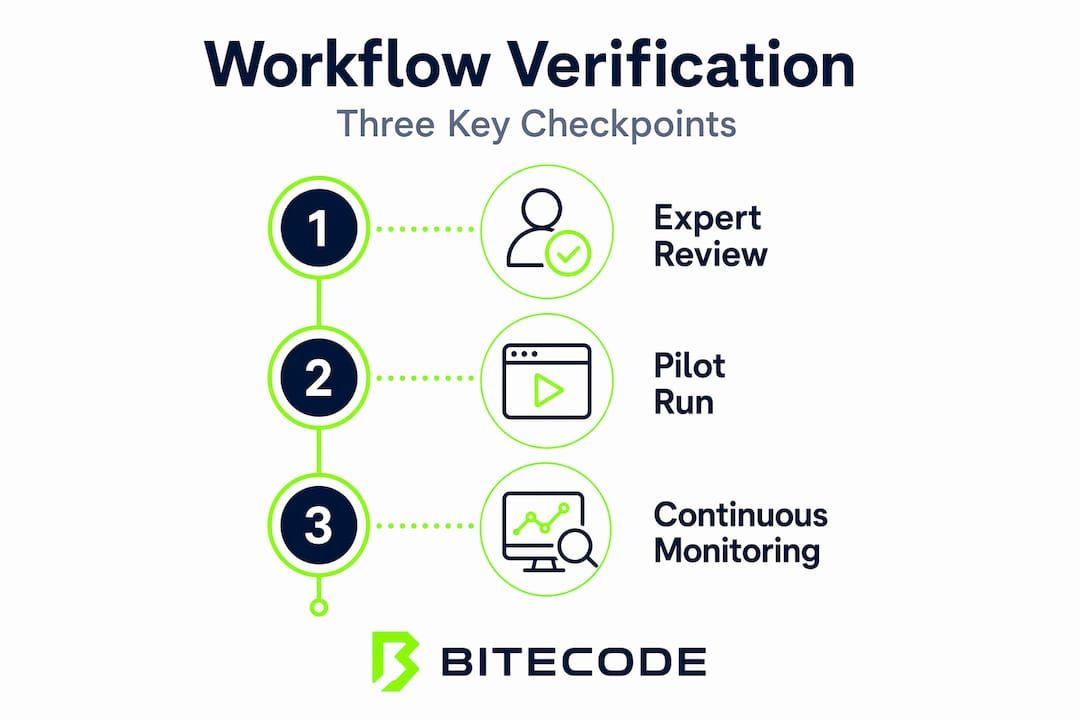
The verification process should include three formal checkpoints: an expert review before go-live, a pilot run covering real transactions in a controlled environment, and a set of measurable KPIs that define what success looks like in operational terms. Organizations that consolidate workflows into a unified database can reduce financial close cycles by 30 to 50% within the first quarter, but only when data mapping and parallel run phases are executed correctly.
Governance does not stop at deployment. Embedding governance into workflows rather than maintaining it as a separate policy document is what sustains consistency over time. When the enforcement mechanism is part of the workflow itself, it cannot be bypassed by someone who simply does not read the policy.
The table below illustrates a typical before-and-after comparison for a workflow improvement initiative:
| Metric | Before workflow redesign | After workflow redesign |
|---|---|---|
| Financial close cycle time | 15 business days | 8 business days |
| Manual reconciliation steps | 12 per cycle | 3 per cycle |
| Governance policy adherence | 64% (self-reported) | 91% (system-enforced) |
| Time to onboard new workflow rules | 2 to 4 weeks | 2 to 3 days |
Maintenance cycles should be tied to the same iterative process used during design. Architecture practitioners must embrace iterative, evolving processes rather than linear step-by-step models. Quarterly reviews that test workflows against current business rules and updated integration contracts keep the architecture honest without requiring a full redesign cycle.
My perspective on orchestration and iterative architecture
What I have observed repeatedly across enterprise engagements is that the fragmentation problem is underestimated at nearly every level. Organizations invest in new platforms expecting them to resolve execution inconsistency, only to find that the inconsistency was never a platform problem. It was a coordination problem. A new system without an orchestration layer just gives fragmented execution a more expensive home.
The evidence-driven model is not just a design pattern. It reflects a more accurate understanding of how business processes actually work. Decisions in the real world depend on context that is only available at runtime. Designing workflows that assume otherwise produces systems that handle the average case well and break under edge conditions that are not actually rare.
What I find encouraging is that the tooling has caught up to the theory. Composition-based workflow engines make runtime reconfigurability practical, not just architectural. The harder part remains the organizational discipline required to treat workflow management in enterprises as an ongoing practice rather than a project with a delivery date.
My practical advice: build the orchestration layer before you feel like you need it. The moment you need it, you are already paying the debt of not having it.
— Bitecode
How Bitecode accelerates enterprise workflow design
Bitecode is built for exactly the kind of system design challenges described in this guide. The platform delivers custom enterprise systems with up to 60% of the baseline already pre-built using modular components, which means teams spend time configuring and extending rather than constructing from scratch. For organizations working through AI-driven workflow automation, the AI Assistant module provides a production-ready chat interface that integrates directly into enterprise workflows, handling contextual reasoning without requiring teams to build that layer independently.
For enterprises dealing with payment governance and financial workflow integrity, the blockchain payment system module delivers secure, automated transaction workflows with built-in audit trails. Both modules are designed to plug into existing architecture rather than replace it, which aligns directly with the orchestration-first approach covered throughout this guide. Bitecode’s approach lets teams scale and customize without extended development cycles, which matters when business requirements change faster than traditional build timelines allow.
FAQ
What is an enterprise system design workflow?
An enterprise system design workflow is the structured process organizations follow to plan, build, govern, and maintain complex software systems across business domains. It covers everything from stakeholder alignment and architecture assessment to execution, verification, and iterative maintenance.
Why do enterprise workflows fail after deployment?
Most post-deployment failures trace back to missing governance enforcement and fragmented execution across systems. When governance exists only as policy documents rather than embedded workflow logic, compliance degrades over time as teams take shortcuts.
How does evidence-driven design differ from decision trees?
Evidence-driven workflows determine the next action based on runtime data rather than pre-mapped decision branches. This reduces design-time complexity and makes workflows more resilient to edge cases that traditional decision trees cannot anticipate.
What is Enterprise Operational Orchestration?
Enterprise Operational Orchestration is an execution layer that coordinates workflow activity across multiple systems in real time, enforcing consistency and governance without replacing the underlying platforms. It fills the gap between policy intent and operational reality.
How long does workflow verification typically take?
A thorough verification cycle typically includes an expert review before go-live, a four to six week parallel run for calibration, and a 90-day measurement window to assess KPI performance against baseline metrics.