Security built into software from day one costs a fraction of what a breach costs after deployment. This is the core argument behind software development security, the discipline of embedding security practices across every phase of the software development lifecycle (SDLC) rather than bolting them on at the end. Frameworks like NIST SP 800-218 and OWASP provide the vocabulary and the controls that make this possible at scale. The payoff is measurable: fewer vulnerabilities in released software, lower remediation costs, and a defensible posture when regulators or customers ask hard questions about your security practices.
The stakes are clear when you look at what attackers target. Most breaches trace back to preventable flaws: unvalidated input, hard-coded credentials, unpatched dependencies, and misconfigured access controls. These are not exotic zero-days. They are the predictable output of development teams that treat security as someone else’s problem. Getting security right means changing that assumption at the process level, not just the code level.
Key outcomes of a mature software security program include:
- Reduced vulnerability density in production releases
- Lower cost of remediation by catching flaws during design and coding rather than post-deployment
- Compliance alignment with standards like NIST SP 800-218, OWASP ASVS, and CISA Secure by Design
- Clearer supply chain transparency through software bill of materials (SBOM) practices
- Faster incident response when vulnerabilities are discovered, because the team already has a workflow
What does software development security actually cover?
Software security and cybersecurity overlap, but they are not the same thing. Cybersecurity covers the full spectrum of protecting systems, networks, and data. Software security is the narrower discipline of building applications that resist attack by design, before they ever reach a production network. The distinction matters for teams because it clarifies ownership: network and infrastructure teams own the perimeter, but developers own the attack surface baked into the code itself.

The OWASP Top 10 remains the most widely cited catalog of software-level risks. Injection flaws, broken authentication, insecure deserialization, and security misconfiguration consistently appear across web, mobile, and API applications. Understanding these categories is not optional background reading; it is the threat model that shapes every design decision.
Several foundational principles underpin secure coding regardless of language or platform:
- Least privilege: every component, service, and user account gets only the access it needs, nothing more
- Input validation: no input is trusted without server-side validation and sanitization, whether it comes from a form field, an API parameter, or a cookie
- Output encoding: data rendered to a browser or another system is encoded to prevent injection attacks
- Secure error handling: error messages expose stack traces and internal paths to attackers; production errors should log detail internally and return generic messages externally
- Defense in depth: no single control is assumed to be sufficient; layers of controls limit the blast radius of any single failure
Secure development environments matter as much as secure code. Segregating development, testing, staging, and production environments reduces the risk of malicious or faulty content reaching production. Using a version-controlled, access-logged authoritative source for all software artifacts, including third-party libraries and configuration files, closes a supply chain gap that attackers actively exploit.
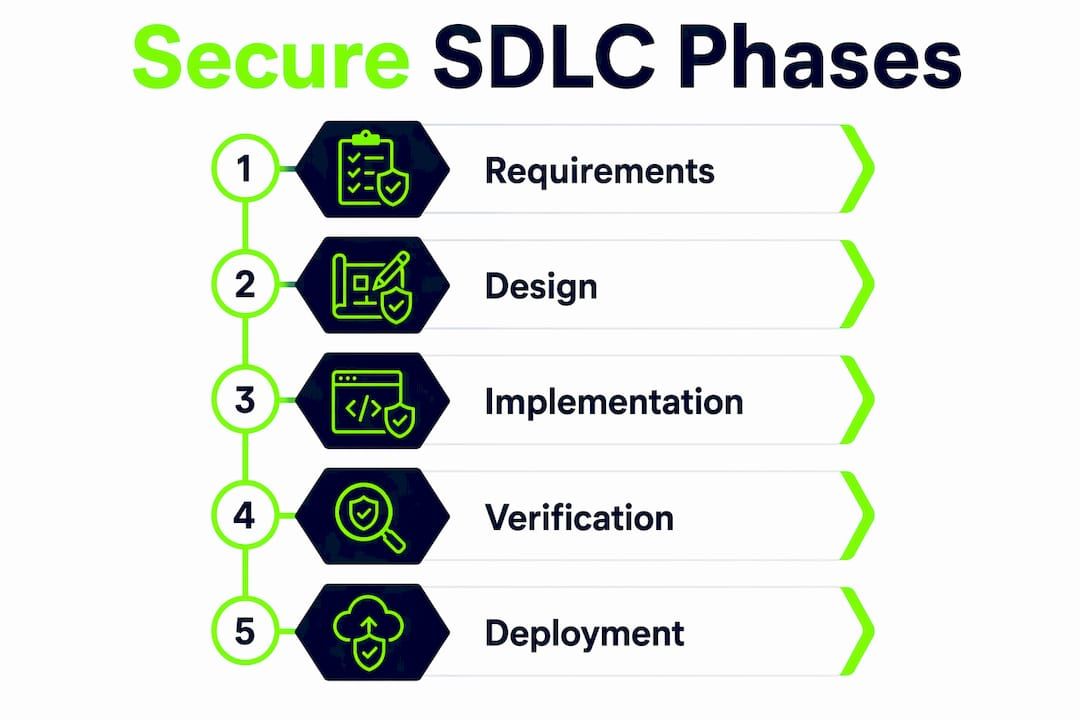
How security fits into each phase of the SDLC
Most SDLC models do not address security in detail by default, which is precisely why NIST recommends adding the Secure Software Development Framework practices to whatever lifecycle model a team already uses. The goal is not to replace the SDLC but to attach security activities to each phase so that flaws are caught at the cheapest possible moment.

The table below maps each phase to its primary security activities and the tools commonly used.
| SDLC Phase | Key Security Activities | Common Tools and Techniques |
|---|---|---|
| Requirements | Define security requirements; identify compliance obligations; document threat assumptions | SSDF PO practices; risk registers; regulatory checklists |
| Design | Threat modeling; secure architecture review; data flow analysis | STRIDE, PASTA, OWASP Threat Dragon |
| Implementation | Secure coding standards; peer code review; dependency management | OWASP Secure Coding Practices; linters; IDE security plugins |
| Verification | SAST, DAST, SCA; penetration testing; fuzz testing | SonarQube, OWASP ZAP, Snyk, Semgrep |
| Deployment | Hardened configurations; secrets management; SBOM generation | Vault, Sigstore, container scanning tools |
| Maintenance | Vulnerability disclosure; patch management; continuous monitoring | CVE tracking; SBOM updates; SIEM integration |
Threat modeling during the design phase is where teams get the highest return on time invested. Identifying attack paths before a line of code is written means the architecture itself resists threats rather than relying entirely on later controls. STRIDE (Spoofing, Tampering, Repudiation, Information disclosure, Denial of service, Elevation of privilege) gives teams a structured way to enumerate threats against each component and data flow.
The verification phase has changed significantly with CI/CD pipeline integration. Static Application Security Testing (SAST) analyzes source code for known vulnerability patterns without executing the program. Dynamic Application Security Testing (DAST) probes a running application from the outside, simulating attacker behavior. Software Composition Analysis (SCA) scans third-party dependencies for known vulnerabilities in open-source libraries. Running all three as automated gates in a CI/CD pipeline means every commit is tested, not just the ones that happen to land before a scheduled audit.
Pro Tip: Set SAST and SCA to fail the build on high-severity findings. Teams that treat security scan results as advisory rather than blocking consistently accumulate technical debt that becomes a breach waiting to happen.
DevSecOps is the operational model that makes this work at pace. It shifts security left by giving developers immediate feedback on vulnerabilities as they write code, rather than handing off a list of findings weeks later. The cultural shift is as important as the tooling: developers need to understand why a finding matters, not just that a scanner flagged it. Tools like Webflow security plugins integrate directly into developer workflows, surfacing issues in the IDE and in pull request reviews where they can be fixed in minutes rather than reopened as tickets months later.
Which frameworks and policies should your organization adopt?
The NIST Secure Software Development Framework (SSDF), codified in SP 800-218, organizes secure development practices into four groups: Prepare the Organization, Protect the Software, Produce Well-Secured Software, and Respond to Vulnerabilities. Each group contains outcome-based practices that teams can map against their current state to identify gaps. The framework deliberately avoids prescribing specific tools, which makes it applicable across greenfield projects, legacy modernization efforts, and everything in between.
OWASP contributes two complementary frameworks. The Software Assurance Maturity Model (SAMM) provides a maturity roadmap across five business functions: governance, design, implementation, verification, and operations. Teams use SAMM to benchmark where they are and prioritize what to improve next. The OWASP Application Security Verification Standard (ASVS) goes further by defining testable security requirements at three levels of rigor, from basic hygiene to advanced controls for high-assurance applications. ASVS is particularly useful for teams that need to demonstrate verified security to customers or auditors, not just claim it.
Organizational policies translate framework guidance into enforceable expectations. A well-written security policy answers three questions: what must be done, who is responsible, and how compliance is verified. Policies that reference SSDF or OWASP SAMM practices give teams a shared vocabulary and make it easier to onboard new developers without lengthy tribal knowledge transfers.
Key policy areas to address:
- Secure coding standards tied to the languages and frameworks your teams actually use
- Mandatory security review gates at design and pre-release phases
- Dependency management rules, including approved registries and update cadences
- Incident and vulnerability disclosure procedures with defined response timelines
- Developer security training requirements and recertification schedules
Pro Tip: Assign a Security Champion in each development team rather than routing all security questions through a central AppSec team. Security Champions reduce bottlenecks, accelerate code reviews, and make security a daily conversation rather than a quarterly audit.
Best practices for writing secure code and protecting software
Secure coding is not a checklist you run at the end of a sprint. It is a set of habits that change how developers approach every function, every API call, and every data flow. OWASP’s Proactive Controls give teams a prioritized list of techniques to build into their default approach, covering access control, cryptography, error handling, data protection, and more.
Input validation is the single most impactful control for preventing injection attacks, cross-site scripting, and path traversal vulnerabilities. The rule is simple: validate all input on the server side, regardless of what client-side validation already exists. Sanitize data used in SQL queries, HTML output, file paths, and command-line arguments. The OWASP guidance is explicit that no input source, including form fields, cookies, headers, and URL parameters, should be trusted without validation.
Memory-safe programming languages reduce an entire class of vulnerabilities. Languages like Go, Rust, Java, C#, Ruby, and Swift prevent buffer overflows and use-after-free errors at the language level, which means developers cannot accidentally introduce these flaws even when under deadline pressure. Where teams must work in C or C++, memory-safe practices and compiler hardening flags provide partial mitigation.
Additional secure coding practices that belong in every team’s standard:
- Multi-factor authentication (MFA) as a default: ship MFA enabled, not as an optional add-on, for all accounts with elevated privileges
- Secure session management: use short-lived tokens, regenerate session IDs after authentication, and invalidate sessions on logout
- Eliminate hard-coded secrets: credentials, API keys, and certificates belong in a secrets manager like HashiCorp Vault or AWS Secrets Manager, never in source code
- Dependency scanning: run SCA tools on every build to catch vulnerable open-source components before they reach production
- Secure defaults: ship software in its most restrictive configuration; let users loosen controls deliberately rather than tighten them after the fact
The Australian Cyber Security Centre guidelines reinforce that MFA, secure session management, and eliminating hard-coded secrets are baseline controls that protect against the most common web and application attacks. These are not advanced techniques. They are table stakes for any application handling sensitive data.
How teams can prepare for security and respond to vulnerabilities
Security culture is the foundation that all tooling and process sits on. A team that views security as a compliance burden will find ways around every control. A team that treats security as a quality attribute, on par with performance and reliability, will catch issues before they become incidents. Shifting security left requires training developers to recognize vulnerability patterns, not just to run scanners.
Security training should be continuous and practical, not an annual video module. Developers learn best from exercises tied to the languages and frameworks they use daily, such as capture-the-flag challenges, secure code review workshops, and threat modeling sessions on real features. Teams that invest in this kind of training reduce their reliance on reactive audits and tend to ship faster because they spend less time reworking flagged code.
Vulnerability management needs a defined workflow, not an ad hoc response. The core steps are:
- Detection: automated scanning in CI/CD pipelines, plus a formal vulnerability disclosure program for external researchers
- Triage: assess severity using CVSS scores and business context; not every critical CVE is equally exploitable in your environment
- Remediation: fix the vulnerability and perform root cause analysis to address the underlying class of flaw, not just the specific instance
- Disclosure: notify affected users in a timely, responsible manner; document the fix and update the SBOM
Maintaining a software bill of materials is increasingly a regulatory expectation, not just a best practice. An SBOM lists every open-source and commercial component in a software product, making it possible to quickly identify which applications are affected when a new CVE drops in a widely used library. Teams that already maintain accurate SBOMs can respond to supply chain events in hours rather than days.
Developer workstations are a frequently underestimated attack surface. A compromised developer machine can inject malicious code directly into the build pipeline, bypassing every application-level control downstream. Production-grade identity management, network segmentation, and restricted privileges on developer endpoints are not excessive; they are proportionate to the access those machines have to source code, signing keys, and deployment credentials.
Expert perspectives on security in rapid custom development
The tension between speed and security is real, but it is largely a false trade-off when security is designed into the process rather than appended to it. The “paved road” model, championed by the OWASP Foundation, resolves this tension by making the secure path the easiest path. When secure libraries, approved frameworks, and pre-configured security controls are the defaults developers reach for, security stops being friction and becomes the path of least resistance.
Rapid custom development environments face a specific version of this challenge. When teams start with a modular foundation, where a substantial portion of the baseline system is pre-built with security controls already embedded, the security surface area of the greenfield work shrinks considerably. The business-domain complexity that remains is where developers focus their attention, and that focus produces better security outcomes than spreading effort across both infrastructure boilerplate and application logic simultaneously.
Protecting developer workstations as a primary attack surface is a perspective that has gained significant traction in 2026. The software supply chain is now treated as a perimeter in its own right. Build pipelines, package registries, and signing infrastructure all require the same identity and access controls that production systems have carried for years. Teams that have not extended production-grade security to their development environments are, in effect, leaving a side door open.
For organizations building custom web applications at pace, Bitecode’s approach embeds these security principles at the architecture level before a single line of custom code is written. Security controls are not retrofitted; they are part of the modular foundation. That architecture choice accelerates work without accelerating the risk that typically accompanies rapid delivery.

Teams that want to move fast without accumulating security debt should start with a platform that treats security as a first-class design constraint. Bitecode builds custom business software with security integrated from the requirements phase through deployment, so teams inherit a defensible baseline rather than building one from scratch.
Key Takeaways
Integrating security across every SDLC phase, guided by NIST SP 800-218 and OWASP controls, is the most effective way to reduce vulnerabilities and lower remediation costs in software development.
| Point | Details |
|---|---|
| Shift security left | Catching flaws during design and coding costs far less than remediating them post-deployment. |
| Use NIST SSDF as your framework | NIST SP 800-218 organizes practices into four groups: Prepare, Protect, Produce, and Respond. |
| Automate SAST, DAST, and SCA | Running these tools as CI/CD gates catches vulnerabilities on every commit, not just at release. |
| Maintain an SBOM | A software bill of materials enables rapid response when new CVEs affect your dependencies. |
| Secure developer workstations | A compromised developer machine can inject malicious code into the build pipeline, bypassing downstream controls. |