TL;DR:
- Software Quality Assurance is a preventive, systematic process that ensures software meets defined quality standards throughout development. It involves structured activities like planning, process control, evaluations, and audits aligned with industry frameworks, reducing defects early and improving product reliability.
Software Quality Assurance (SQA) is the systematic process of ensuring software products meet pre-established quality criteria by monitoring, testing, and improving every stage of development. Unlike quality control in software, which catches defects after the fact, SQA is preventive by design. It spans the entire software development lifecycle (SDLC), from requirements review through post-release maintenance. Standards like ISO/IEC 25010 define eight quality characteristics including security, performance, usability, and maintainability, giving teams a concrete framework to measure against. Teams that treat quality assurance in software as a continuous discipline, not a final gate, ship more reliable products and spend less time firefighting after release.
What is quality assurance in software development?
SQA is a structured, pre-planned process embedded throughout the SDLC and focused on preventing defects and ensuring compliance with standards. That definition matters because it separates SQA from ad hoc testing. SQA encompasses quality planning, process control, quality evaluations, and auditing for continuous improvement. Each of those activities runs in parallel with development, not after it.
The distinction between preventive and detective approaches is foundational. Preventive QA catches problems at the source: reviewing requirements before a single line of code is written, defining acceptance criteria before test cases are designed. Detective QA, by contrast, finds defects after they exist. Both have a place, but organizations that rely exclusively on detective methods pay a steep price. Early defect detection significantly reduces the cost and effort to fix issues later in the SDLC. A defect found in requirements costs a fraction of what the same defect costs when found in production.
ISTQB (International Software Testing Qualifications Board) and ISO/IEC 25010 are the two most widely referenced frameworks in professional QA practice. ISTQB provides certification pathways and standardized terminology. ISO/IEC 25010 defines the product quality model that teams use to specify and evaluate software characteristics. Teams that align their QA programs with these standards gain a shared vocabulary, which reduces miscommunication between developers, testers, and stakeholders. A software quality audit conducted against ISO/IEC 25010 criteria gives leadership a defensible, repeatable measure of product health.
What are the key QA methodologies and frameworks?
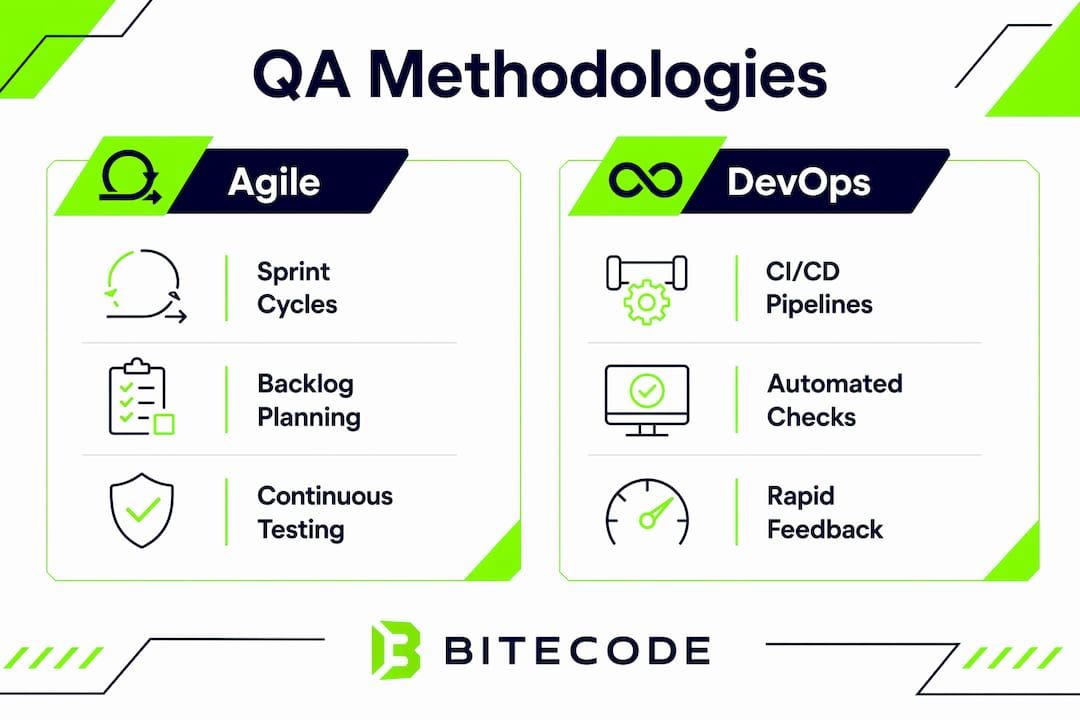
QA methodology selection depends on the development model in use. Agile and DevOps environments demand continuous, lightweight QA activities. Waterfall projects allow more sequential quality gates. The methodology shapes when and how QA activities occur, but the core activities remain consistent across models.
Software Quality Management (SQM) organizes QA into four recurring activities:
- Quality planning: Define quality objectives, standards, and the activities needed to meet them before development begins.
- Process control: Monitor development activities against the plan and intervene when deviations occur.
- Quality evaluations: Assess work products, including code, documentation, and test results, against defined criteria.
- Auditing: Independently verify that processes and products conform to standards and identify systemic improvement opportunities.
In Agile environments, these activities compress into sprint cycles. Quality planning happens during backlog refinement. Process control runs through daily standups and retrospectives. Quality evaluations occur during code review and sprint review. Auditing happens at the program level, often quarterly. The cadence changes; the discipline does not.
DevOps extends this further by integrating automated compliance checks directly into CI/CD pipelines. Every commit triggers a quality gate. Teams that build this infrastructure early avoid the common trap of bolting quality onto a pipeline that was never designed for it.
Pro Tip: Define your quality objectives in measurable terms before sprint one. “The login flow must complete in under two seconds for 95% of users” is a testable criterion. “The app should be fast” is not.
What are the essential software testing techniques in quality assurance?
Test design techniques fall into three categories per the 2026 ISTQB Foundation Level guidance: black-box, white-box, and experience-based. Each category addresses a different aspect of software behavior and requires different tester knowledge.
Black-box techniques
Black-box techniques treat the system as an opaque unit. Testers work from specifications, not source code. The most widely used techniques in this category are:
- Equivalence partitioning: Divides input data into classes where all values in a class are expected to behave identically. One test per class is sufficient. This approach, combined with boundary value analysis, reduces test cases by over 90% while maintaining coverage.
- Boundary value analysis: Tests the edges of equivalence partitions, where defects cluster most frequently.
- Decision table testing: Maps combinations of conditions to expected outcomes. Effective for business rules with multiple interacting inputs.
- State transition testing: Models system behavior as a finite state machine. Useful for workflows, authentication flows, and any feature with distinct modes.
- Pairwise testing: Generates the minimum set of test cases that covers all two-way combinations of input parameters. Systematic pairwise testing addresses complex input coverage without combinatorial explosion.
White-box techniques
White-box techniques require access to source code. Statement coverage, branch coverage, and path coverage are the primary metrics. These techniques are most valuable for unit testing and security-focused testing, where internal logic must be verified directly.
Experience-based techniques
Experience-based techniques rely on tester knowledge of the system, common failure patterns, and domain behavior. Error guessing and fault injection fall here. These methods complement structured techniques but cannot replace them. A tester with deep domain knowledge will find defects that no test design algorithm would generate.
Pro Tip: Match your technique to the feature’s risk profile. Use decision table testing for complex business rules, boundary value analysis for numeric inputs, and state transition testing for multi-step workflows. Applying the same technique to every feature wastes time and misses defects.
Automation changes the economics of testing but not the underlying technique selection. The 70/20/10 distribution of unit, integration, and UI tests optimizes maintainability and test reliability. Seventy percent of your automated tests should be unit tests: fast, isolated, and cheap to maintain. Twenty percent should be integration tests. Only 10% should be end-to-end UI tests, which are the most expensive to write and maintain.
How to implement QA throughout the software development lifecycle?
Embedding QA in every SDLC phase requires deliberate planning, not just good intentions. The following sequence reflects how mature QA teams structure their work.
- Requirements review: QA engineers review specifications before development begins. They identify ambiguities, missing acceptance criteria, and untestable requirements. A requirement that cannot be tested is a defect waiting to happen.
- Test planning: Define scope, objectives, entry and exit criteria, resource requirements, and the testing schedule. The test plan is a living document, not a one-time artifact.
- Test case design: Write test cases that map directly to requirements. Each test case should have a clear precondition, steps, expected result, and traceability to a requirement ID.
- Test environment setup: Configure environments that mirror production as closely as possible. Environment drift between test and production is a leading cause of “works on my machine” defects.
- Test execution: Run manual and automated tests according to the plan. Log all defects with enough detail for developers to reproduce them without back-and-forth.
- Defect tracking and root cause analysis: Track defects through resolution. Analyze patterns to identify systemic issues. A cluster of defects in one module often signals a design problem, not just a coding error.
| QA phase | Key metric | Target signal |
|---|---|---|
| Requirements review | Requirements defect rate | Fewer than 5 defects per 100 requirements |
| Test execution | Defect detection rate | Over 80% of defects found before release |
| Code coverage | Branch coverage | Minimum 80% for critical modules |
| Post-release | Escaped defect rate | Fewer defects per release over time |
Metrics matter only when teams act on them. Defect density trending upward in a specific module is a signal to investigate the design, not just add more tests. Improving software quality requires treating metrics as diagnostic tools, not report card scores.
What tools and best practices enhance quality assurance in software?
The QA toolchain covers four functional areas: test management, test automation, static analysis, and defect tracking. Each area addresses a distinct part of the quality workflow.
- Test management tools (such as TestRail or Zephyr Scale) organize test cases, track execution results, and generate coverage reports. They give teams a single source of truth for test status.
- Test automation frameworks (such as Selenium, Cypress, or Playwright for UI; JUnit or pytest for unit testing) execute tests faster and more consistently than manual runs. Automation is not a replacement for manual testing. It is a force multiplier for repetitive, well-defined checks.
- Static analysis tools (such as SonarQube or ESLint) scan source code for defects, security vulnerabilities, and style violations before the code runs. Static analysis catches an entire class of defects that dynamic testing misses.
- Defect tracking tools (such as Jira or Linear) manage the lifecycle of every reported defect from discovery through verification.
Continuous testing in Agile and DevOps maintains quality without slowing delivery. Automated validation reduces human error and accelerates feedback to development teams. The key is integrating tests into the CI/CD pipeline so that every code change triggers a quality check automatically.
The most common QA pitfalls are avoidable with discipline. Brittle test scripts that break on minor UI changes are a symptom of over-reliance on end-to-end UI tests. Maintaining a clear test documentation standard builds trust and ensures repeatability across team members and releases. Teams that skip root cause analysis after defect clusters repeat the same mistakes in the next sprint.

Pro Tip: Treat your test suite as a product. Refactor brittle tests, delete obsolete ones, and review automation coverage at the end of every sprint. A test suite that nobody trusts is worse than no automation at all.
Compliance requirements add another layer to the QA toolchain. Organizations operating under regulatory frameworks benefit from understanding the IT compliance standards that intersect with their QA obligations. Compliance and quality are not the same thing, but they share significant infrastructure.
Key Takeaways
Effective quality assurance in software requires preventive processes embedded across the full SDLC, structured test design techniques, and metrics-driven continuous improvement.
| Point | Details |
|---|---|
| SQA is preventive, not reactive | Embed quality planning, process control, and auditing before development begins, not after. |
| Use ISTQB technique categories | Match black-box, white-box, or experience-based techniques to each feature’s risk profile. |
| Follow the 70/20/10 automation rule | Allocate 70% unit tests, 20% integration tests, and 10% UI tests to keep automation maintainable. |
| Measure defect detection rate | Track what percentage of defects are caught before release and improve that number each cycle. |
| Treat the test suite as a product | Refactor, prune, and review automated tests every sprint to prevent brittleness and coverage gaps. |
The quality gap most teams refuse to acknowledge
The hardest QA problem is not technical. It is organizational. Teams invest in automation frameworks, adopt ISTQB terminology, and configure SonarQube, then ship defect-laden releases anyway. The gap is almost always in how quality is prioritized when it conflicts with delivery pressure.
Automation without discipline accelerates chaos. A CI/CD pipeline full of flaky tests trains developers to ignore test failures. That is worse than no automation, because it creates a false sense of coverage while eroding trust in the entire QA process. The 70/20/10 rule exists precisely to prevent this. Most teams invert it, building large end-to-end suites that are expensive to maintain and slow to run.
Exploratory manual testing deserves more credit than it gets in automation-first organizations. Experienced testers using error guessing and domain knowledge find defects that no algorithm generates. The best QA programs blend structured automation with deliberate exploratory sessions, especially before major releases. Tester domain knowledge is not a soft skill. It is a defect detection mechanism.
AI-assisted testing is the most significant shift coming to QA practice. Tools that generate test cases from requirements, identify coverage gaps, and predict high-risk code changes are moving from research to production use. The teams that will benefit most are those that already have clean test infrastructure and clear quality metrics. AI amplifies existing discipline. It does not substitute for it.
— Bitecode
How Bitecode supports quality-driven software delivery
Building software with quality baked in from the start requires more than good intentions. It requires architecture that supports testability, automation, and clear separation of concerns.
Bitecode delivers custom business software built on modular foundations, with up to 60% of the baseline system pre-built and structured for quality from day one. That means teams inherit testable components, not greenfield boilerplate that requires months of QA infrastructure work before the first meaningful test runs. For organizations looking to reduce manual testing overhead, Bitecode’s AI-driven process automation integrates directly into release workflows, accelerating feedback cycles without adding fragility. If your current software architecture makes QA harder than it should be, that is a design problem worth solving at the foundation level.
FAQ
What is the difference between QA and software testing?
Quality assurance covers the full process of preventing defects across the SDLC, while software testing is one activity within that process focused on detecting defects in a specific product or feature.
What does ISO/IEC 25010 define?
ISO/IEC 25010 defines eight software quality characteristics including security, performance, usability, and maintainability, giving teams a standard model for specifying and evaluating product quality.
Why is the 70/20/10 rule important for test automation?
The 70/20/10 rule allocates 70% of automated tests to unit tests, 20% to integration tests, and 10% to UI tests, which keeps the suite fast, maintainable, and reliable over time.
When should QA teams get involved in a project?
QA teams should be involved from requirements definition, not just during test execution. Early involvement catches ambiguous requirements before they become expensive defects in code.
What is equivalence partitioning?
Equivalence partitioning divides input data into classes where all values in a class are expected to behave the same way, allowing testers to reduce redundant test cases while maintaining meaningful coverage.