Time to value (TTV) is the number of days between contract signature and the moment a customer hits their first meaningful outcome. Teams that treat it as a managed metric, not a vague aspiration, see faster expansion and lower churn. The immediate move: pick one milestone that counts as “real value” for your product, agree on it with customer success, and start instrumenting it this week.
TL;DR:
- Focusing on a single, well-defined milestone for “first value” helps accurately track median TTV and identify delays specific to your product or segment.
- Segmenting TTV by onboarding type, deal size, and acquisition channel reveals bottlenecks that blended averages often hide, enabling targeted improvements.
- Process delays outside product features, such as handoff gaps, customer dependencies, and technical failures, are the main causes of extended TTV.
- Quick wins to shorten TTV include clear milestone agreements, templates, automation, and monitoring technical errors, with most projects improving in 6 to 12 weeks.
- A modular, pre-built system accelerates TTV reduction for integration-heavy products, especially when manual data handling is a key bottleneck.
What Is Time to Value in Software?
TTV measures the gap between when a customer signs a contract (or creates an account) and when they reach a defined value milestone. The formula is simple: TTV = date of first value milestone − date of signature or signup. The clock starts at signature because that’s the moment the vendor relationship begins accruing cost, both for the customer and for the business trying to retain them.
There’s an important distinction between time to first value (TTFV) and full TTV. TTFV covers the earliest meaningful win, like a completed setup step or first successful report. Full TTV extends to the outcome the customer actually bought the software for, which might take weeks longer.
Picking the right milestone matters more than the math. It should be specific, observable in your analytics, and tied to something the customer would recognize as progress, not an internal engineering checkpoint.
Why Time to Value Matters for Software Businesses
TTV functions as a leading indicator. Customers who reach value fast tend to renew, expand seats, and buy add-on modules; customers stuck in a slow onboarding queue tend to quietly disengage before anyone notices. Industry reporting on SaaS retention consistently shows large early drop-off when value arrives too late, which makes TTV one of the few metrics that predicts revenue outcomes months in advance.
The costs of a long TTV compound. Every extra week before a customer sees a result is a week of unrealized revenue, a week where a competitor’s sales rep can get a foot in the door, and a week where your support team fields “is this even working” tickets. Shorter TTV also lowers cost to serve, because fewer customers get stuck in extended, high-touch onboarding. That’s the mechanism behind product-led growth: reduce friction between signup and outcome, and the product effectively sells itself.
What Types of Time to Value Should You Track?
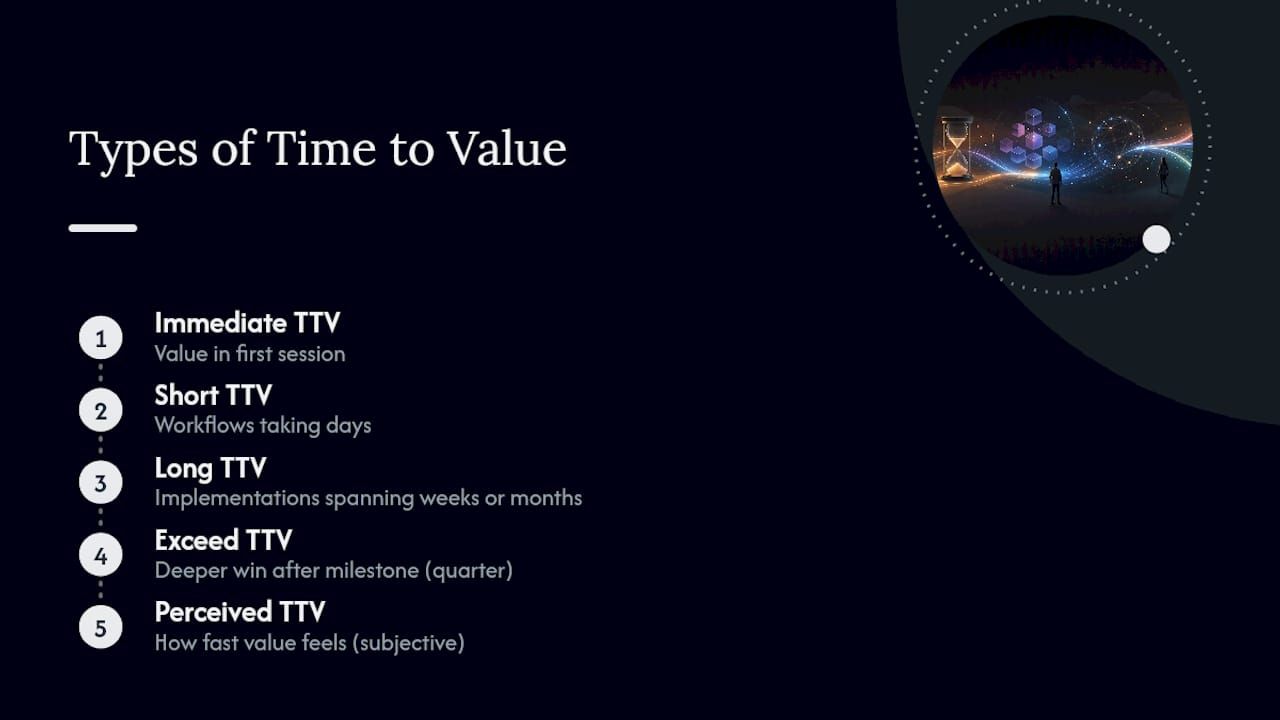
Not every product has one TTV. Immediate TTV applies to tools that deliver value in the first session, like a report generator. Short TTV covers workflows that take days, such as a CRM import. Long TTV describes enterprise implementations spanning weeks or months. Exceed TTV is the deeper, harder win beyond the first milestone, like measurable cost savings after a full quarter. Perceived TTV captures how fast the value feels, independent of the calendar.
Self-serve customers usually care about immediate or short TTV, since that’s the pattern that determines free-trial conversion. Enterprise customers care more about long TTV, because their buying committee is measuring the project against a business case. Pick one primary metric per segment rather than forcing a single number across both.
How Do You Measure TTV Correctly?
The formula stays constant: TTV equals the date of the first agreed value milestone minus the date of contract signature or signup, and teams should track it using the median rather than the mean, since a handful of stalled enterprise accounts will otherwise distort the number for everyone else.
Segmentation is what makes the metric actionable. A blended average tends to hide delays in high-value segments, so cohort dashboards should slice TTV by onboarding type, deal size, and acquisition channel.
A workable event map looks like this:
| Milestone stage | Example event to track | Analytics mapping |
|---|---|---|
| Contract start | Signature or signup completed | Start timestamp |
| Setup progress | Integration connected, data imported | Intermediate event |
| First value | Report generated, workflow automated, first transaction processed | End timestamp |
| Validation | Cohort comparison before/after a change | Aggregate dashboard |
To validate any measurement approach, run before-and-after cohort comparisons whenever you ship an onboarding change. If the median TTV for the new cohort drops and retention holds or improves, the fix worked. If TTV drops but 90-day retention doesn’t move, you may have optimized the wrong milestone.
What Blocks Fast Time to Value?
Most delay isn’t a product problem. The gap between signature and first value is dominated by waiting, not building, which means process fixes usually beat feature fixes.
- Handoff gaps. Momentum from the sales close evaporates during the transfer to onboarding or support.
- Customer-side dependencies. Data exports, internal approvals, and security reviews stall progress outside your control.
- Invisible progress. Onboarding tracked in email threads and spreadsheets means nobody, including the customer, knows what’s left to do.
- Technical blind spots. Silent integration failures or unmonitored error rates quietly stretch timelines for weeks before anyone escalates.
Six Tactical Ways to Shorten Time to Value
Reducing TTV rarely requires a rebuild. It requires removing friction from the handful of steps that separate signup from outcome, in priority order.
- Agree on the milestone at kickoff. Write down, with the customer, what “first value” means and when it should happen. Vague onboarding goals produce vague timelines.
- Use templates and smart defaults. Pre-built configurations eliminate the blank-page problem. A customer choosing from three sensible presets moves faster than one facing forty settings.
- Automate data collection and follow-ups. Replace manual chasing with forms, reminders, and status nudges. Moving from email-and-spreadsheet coordination to a shared, automated workspace typically cuts implementation time by 30 to 40 percent.
- Match onboarding effort to customer complexity. Offer hands-on, guided onboarding for enterprise accounts with real integration work, and a self-serve flow for low-touch customers who just need a fast path to their first win.
- Monitor and fix technical errors that block core workflows. Session replay and journey analysis reveal exactly where customers get stuck, which turns guesswork into a prioritized bug list.
- Prioritize fixes by impact, then validate with cohort analysis. Fix the blocker affecting the most customers first, then confirm the fix actually moved median TTV for the next cohort rather than assuming it did.
A useful shortcut here is identifying your product’s “aha moment.” The in-product action most correlated with long-term retention should be the thing onboarding is built to reach as directly as possible, not a side quest along the way.
Pro Tip: Map every onboarding step a customer takes before their first value milestone, then delete any step that doesn’t directly serve that milestone. Most onboarding flows carry two or three steps that exist for internal reasons, not customer ones.
What Should a TTV Dashboard Track?
A working dashboard needs four widgets: median TTV by cohort, a funnel showing drop-off on the path to first value, error rates on core workflows, and a live list of accounts at risk of stalling.
The slices that matter most are onboarding type (self-serve versus guided), ARR band, and acquisition channel, since each of those groups tends to move at a different pace and a single blended number will flatten all three into a misleading average.
Set alert thresholds on leading signals rather than waiting for churn to show up:
- Error-rate spikes on the core workflow tied to your value milestone
- Unusual drop-off at a specific onboarding step, compared to the cohort’s historical pattern
- Accounts with no activity for a set number of days past signature
The real payoff comes when you connect TTV shifts to downstream outcomes. If median TTV for a cohort improves by even a few days, check the 90-day retention and expansion numbers for that same cohort against the prior one. That link is what turns a monitoring dashboard into evidence for the next investment.
How to Run a 90-Day TTV Reduction Sprint
A single quarter is enough time to move the needle if the sprint stays scoped.
- Weeks 0 to 2: Align product, sales, and customer success on one milestone definition. Baseline the current median TTV and instrument the events needed to track it going forward.
- Weeks 3 to 6: Ship quick wins: templates, sensible defaults, and automated reminders that replace manual chasing. These are the cheapest fixes and the fastest to validate.
- Weeks 7 to 10: Address technical blockers surfaced by error-rate monitoring, and pilot hands-on onboarding for your highest-value cohort to see whether guided effort moves their TTV meaningfully.
- Weeks 11 to 12: Run a before-and-after cohort comparison. Roll out whichever changes actually reduced median TTV without hurting retention, and shelve the ones that didn’t.
Complexity still sets the ceiling on what’s achievable. Simple implementations typically run 6 to 8 weeks, medium ones 10 to 12, and complex enterprise builds 14 to 18, with decision latency on the customer’s side as a recurring factor in how close a project comes to that range.
How Bitecode Approaches Fast Time to Value
Bitecode builds custom systems on a modular foundation that starts up to 60% pre-built, which removes most of the blank-page setup work that stretches early-stage TTV. Instead of scoping every workflow from zero, teams configure existing automation, financial-processing, and CRM modules against their own data.
- Pre-built baseline modules cut the setup phase that typically dominates weeks 0 through 6 of a project.
- Low-code configuration lets non-engineers adjust workflows without waiting on a development queue.
- AI automation and workflow modules most often remove the handoff and data-chasing blockers described above.
A quick fit check: if your TTV bottleneck is custom integration work or manual data handling rather than a training gap, a modular build is worth evaluating. and
Pro Tip: Before scoping any custom build, list which of your current onboarding steps are genuinely bespoke versus which are common workflow patterns. The second group is almost always where pre-built modules save the most time.

What We See Go Wrong on TTV Projects
The most common mistake isn’t a technical one. It’s scope creep during onboarding, no clear owner for the customer’s own tasks, and zero shared visibility into where a project actually stands. Expect meaningful gains from process fixes alone, not miracles: a well-run sprint typically shortens TTV by removing weeks of pure waiting, not by making the software itself faster. The one habit worth adopting immediately is a shared workspace paired with a short weekly onboarding sync between the vendor and customer teams. It surfaces stalled steps before they become a churn risk.
— Bitecode
Get to First Value Faster With a Modular Build
Bitecode is the direct route to shorter TTV for teams whose bottleneck is custom integration work, not training or process. Rather than scoping a system from zero, you start from modules already built for automation, financial processing, and workflow logic, then customize what’s genuinely unique to your business.
Before committing to any build, run this checklist: What percentage of your ideal workflow already resembles a common pattern? Where does your current TTV bottleneck actually sit, in setup, integration, or training? Would a custom software build cut more time than fixing your onboarding process alone? If manual data chasing and follow-ups are a bigger drag than setup itself, Bitecode’s automation service targets that specific gap. For a deeper look at the engineering steps behind a fast rollout, see how to build a SaaS platform workflow. Request a scoped estimate to see where your project lands on the timeline.
Sources
For the formula, benchmarks, and cohort segmentation approach, see Valuecase’s TTV guide. For dashboard design and why blended averages mislead, read ProductSchool’s breakdown. For finding drop-off points with session replay, check Contentsquare’s tracking guide. For KPI selection by growth stage, see this SaaS metrics guide.
- Time to Value (TTV): Definition, Formula and SaaS Benchmarks | Valuecase
- Time to Value: The Metric You Can’t Afford to Ignore
- Time to value: 6 Ways to track, measure, and reduce TTV to beat churn
- Time to Value (TTV)