The fastest valid path to a working SaaS MVP is narrow, not clever: ship one core workflow, instrument it from day one, and lean on platform-managed services and modular components instead of custom plumbing. We pair that discipline with AI-accelerated coding, strict CI/CD, and NIST SSDF-aligned security practices, because speed without those guardrails just moves the pain to launch week.
TL;DR:
- Validating one core user job through simple methods like landing pages or early sales reduces MVP scope and accelerates time to market.
- Building an MVP with essential features such as email and social login, automated billing, a reliable core workflow, minimal admin view, and basic analytics proves retention early.
- Using managed, pre-built modules for common SaaS components shortens development time and supports enterprise security, data residency, and auditability needs.
- Prioritize speed by adopting feature flags, modular architecture, continuous deployment, and security practices integrated into the development process from the start.
- Planning for scale involves designing for multi-tenancy, flexible permission systems, usage-based monetization, and observability before hitting critical growth levels.
Validate the idea and fix the MVP scope
Before any code gets written, we recommend picking the single user job the product must prove, and nothing else. Teams that try to validate three workflows at once usually ship none of them well, and the extra surface area adds weeks to a timeline that should be measured in days.
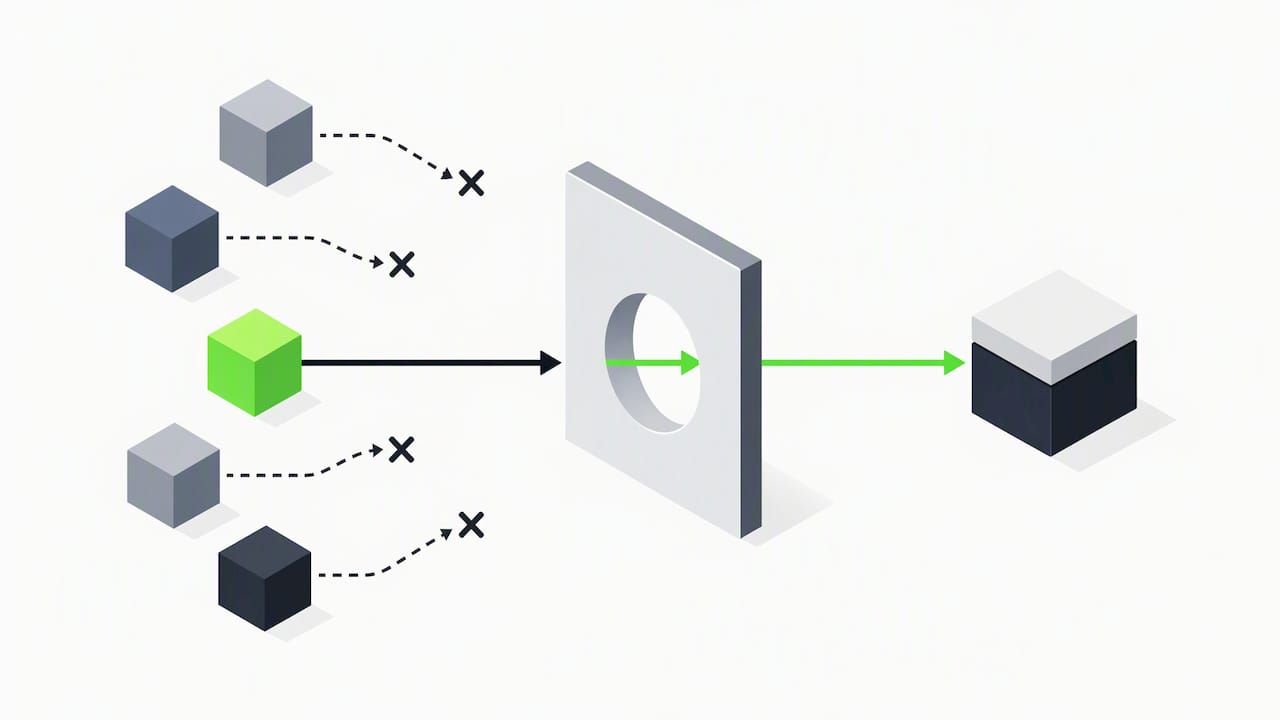
The job to prove is the one a buyer already pays someone or something to do today, whether that’s a spreadsheet, a freelancer, or a competitor’s clunky tool. If a prospective customer cannot describe the pain in one sentence, the scope is still too broad.
Several validation methods work well before a line of production code exists:
- A landing page with a real pre-sell offer tests whether anyone will commit money, not just an email address.
- A concierge MVP, where a human manually performs the service behind the scenes, proves demand without building the automation first.
- Paid traffic into a signup funnel reveals conversion intent at a small, controlled spend.
- Early sales calls with five to ten target buyers surface objections that no amount of internal debate will find.
Scope choices compound fast. Adding a second user role, a permissions system, or a custom reporting layer before the core workflow is proven routinely adds four to eight weeks to a build that should take two to four. Multi-tenant billing edge cases, white-labeling, and bespoke integrations are the usual culprits.
This is also where pre-built modules or a managed approach save real time. Authentication, billing, and admin scaffolding are solved problems: reusing a modular baseline for them, rather than hand-rolling each one, often shaves a month off an MVP without touching the part of the product that is actually differentiated. Our engineering roadmap for building a core SaaS workflow walks through sequencing these decisions in more detail.
Pro Tip: Write the one-sentence job statement first and tape it above the sprint board. Any feature that doesn’t serve it gets cut, not deferred.
Design the MVP: features, onboarding, and the data that proves retention
An MVP earns its name by proving retention, not by looking finished. The feature list that typically earns runway is short, and everything outside it is a distraction until the core workflow is validated.
- Authentication that supports at least email and one social or SSO option, since enterprise buyers will ask about SSO even at pilot stage.
- A billing route that moves a user from trial to paid without manual intervention, even if it only supports one plan to start.
- The core workflow itself, built to be fast and reliable rather than configurable.
- A minimal admin view so support and sales can see what a customer is actually doing.
- Basic analytics wired into the core workflow, not bolted on after launch.
Onboarding design has an outsized effect on activation. Patterns that reduce time-to-value include a single guided first action instead of a tour, pre-filled sample data so the product isn’t empty on first login, and a visible progress indicator toward the “aha” moment. Each of these tends to move activation rates more than adding a new feature ever does.
Event tracking deserves the same seriousness as the product itself. At minimum, track account creation, first core-workflow completion, trial-to-paid conversion, and any usage event tied to the product’s pricing unit. These events become the raw material for the retention and expansion signals covered later, including the net and gross revenue retention patterns Stripe’s research on revenue retention describes.
Before launch, a short smoke-test pass catches the failures that do the most reputational damage: broken signup, failed payment capture, and a core workflow that errors silently instead of showing a usable message. None of this requires a full QA team, just a checklist run before every release.
Tech stack and architecture for speed: pragmatic trade-offs
The stack decision that matters most isn’t frontend framework versus frontend framework. It’s how much of the undifferentiated plumbing gets built versus bought.
Low-code and managed services win when the component in question is not part of the product’s actual value proposition: authentication, transactional email, payments, and file storage are rarely what a customer is paying for, so building them from scratch mostly just delays the parts that are. Custom code earns its cost when the component is the differentiator, such as a proprietary matching algorithm or a workflow engine with business-specific logic.
A pragmatic pairing that keeps iteration fast without boxing a team into a dead end typically looks like a modern frontend framework for the UI, a backend pattern organized around clear service boundaries rather than a single monolith from day one, a managed relational database for transactional data, a managed authentication provider, and a billing platform handled through its hosted checkout rather than a custom payment form.
Designing for modularity early avoids a rewrite later:
- Multi-tenancy should be decided explicitly, even if the first version is single-tenant, so data partitioning isn’t retrofitted under pressure.
- Background jobs belong in a queue from the start, not as inline code that blocks a request.
- Configuration and secrets management should be centralized rather than scattered across environment files.
- API boundaries between the core workflow and supporting services should exist even inside a monolith, since they make a future extraction cheaper.
Developer ergonomics matter more than they get credit for. A team that can deploy in minutes and roll back in seconds will out-iterate one with a thirty-minute build pipeline, regardless of which framework either one chose. Our walkthrough on building a web application fast with a modern framework pairing covers a concrete version of this stack in practice.
Engineering practices that sustain speed
Velocity without discipline turns into instability fast, and that instability shows up right when a product needs to look most trustworthy to early customers. The practices that keep speed sustainable are well documented, not improvised.
Small-batch agile work, short cycles, and a one-workflow-per-sprint discipline keep risk contained. The SEI’s guidance on agile software development frames this clearly: iterative delivery paired with strong technical practices produces faster, higher-quality releases than large-batch approaches, but agile process alone does not substitute for engineering rigor.
Platform engineering is where a lot of the real leverage sits. Reusable internal components and a self-service developer platform mean that each new feature doesn’t reinvent deployment, logging, or access control. The 2025 DORA report on AI-assisted development found that AI tends to amplify whatever strengths or weaknesses already exist in a team, and that the biggest returns came from investing in platform engineering and foundational practices rather than from AI tooling by itself.
Statistic Callout: AI adoption in software teams is now close to universal, and the 2025 DORA report found that platform engineering adoption is very high among surveyed organizations. That gap between near-universal AI use and near-universal platform adoption is the actual story: the teams getting value from AI are overwhelmingly the ones that already invested in the platform underneath it.
CI/CD, automated tests, feature flags, and fast rollback paths are what keep AI-accelerated code from turning into AI-accelerated incidents. A feature flag lets a risky change ship dark and get turned on for a small cohort first, which matters more once AI-generated code is entering the pipeline faster than a human reviewer can fully absorb it on their own.
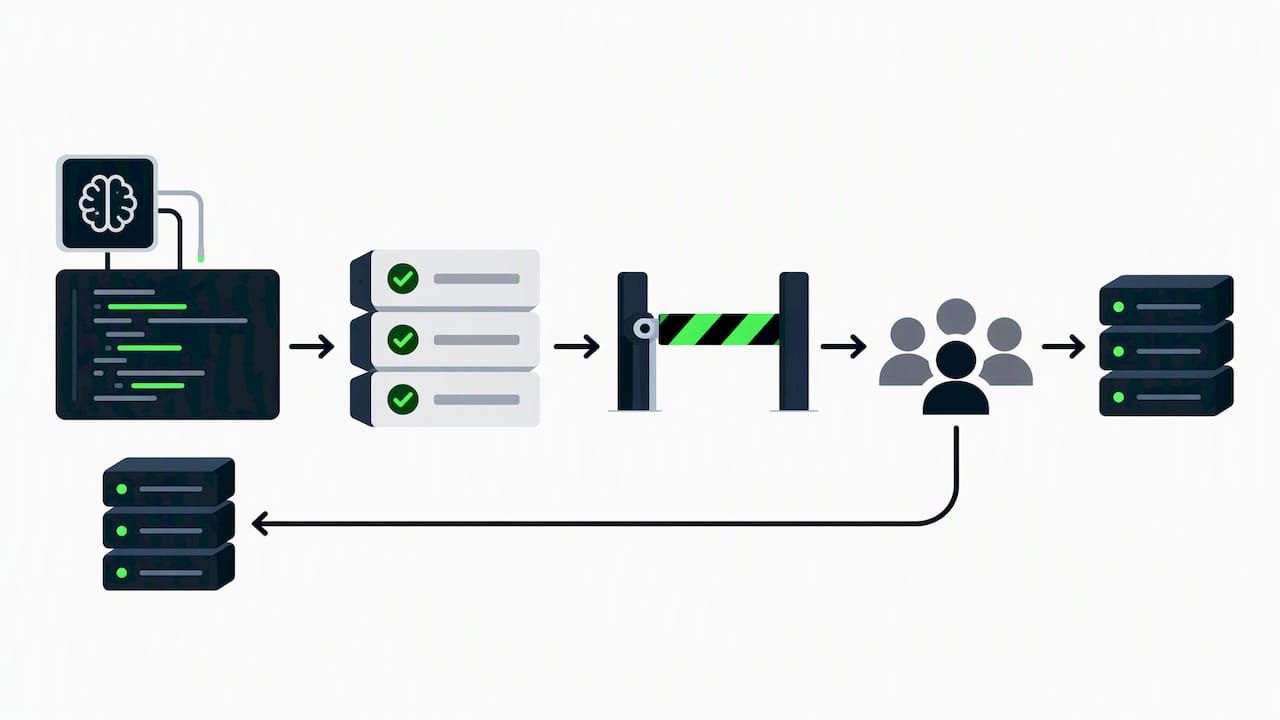
Security has to be built in alongside all of this, not added afterward. The NIST Secure Software Development Framework recommends integrating secure practices across the entire development lifecycle, including protecting software components, producing well-secured software by default, and having a defined process for responding to vulnerabilities. Teams that treat this as a pre-launch checklist item rather than a built-in practice tend to pay for it later, usually during an enterprise security review. Our security guide for development teams covers the practical version of SSDF adoption for smaller teams.
Pro Tip: Wire a feature flag system into the MVP from the first sprint, not after the first incident. It costs a day to add early and a week to retrofit.
Our approach: modular components, low-code acceleration, and enterprise readiness
We built our own development approach around the gap between what rapid prototyping tools can do and what enterprise buyers actually require. Most low-code platforms get a demo working fast and then hit a wall on security, data ownership, or auditability the moment a serious buyer starts asking questions.
That baseline is what turns “weeks to a working prototype” into “weeks to a production-ready first release,” because the pre-built 60% is the undifferentiated part, not the part a founder actually wants to spend engineering time on.
Managed modules fit well for the pieces every SaaS product needs in common: financial processing, CRM functionality, and workflow automation. Custom modules remain necessary wherever the product’s actual differentiation lives, which is exactly where we focus engineering effort instead of rebuilding plumbing.
Enterprise buyers tend to check the same handful of things during procurement:
- Whether data can be self-hosted or must live on a third-party cloud.
- Whether the system produces audit trails sufficient for compliance review.
- Whether component provenance is documented, so a security team can assess risk without a full code audit.
- Whether the architecture supports the buyer’s own data residency and access control requirements.
A modular, pre-built baseline with self-hosting options addresses each of these directly, which is often what separates a pilot deal from a stalled procurement cycle.
Launch checklist and early metrics that actually matter
The last mile before launch is where teams either protect the speed they’ve built or lose it to a scramble. A tight checklist covers billing that charges correctly and handles failed payments gracefully, onboarding that gets a new user to the core workflow without hand-holding, analytics events firing correctly in production, basic uptime monitoring, a terms-of-service and privacy policy reviewed for the product’s actual data handling, and a support channel that doesn’t route to a founder’s personal inbox indefinitely.
Once live, three metric categories matter more than vanity signups:
- Activation rate: the share of new signups who complete the core workflow within their first session or day.
- Early churn and retention signals, tracked weekly for the first 90 days rather than waited out to a monthly cadence.
- Expansion and revenue retention cues, which show whether existing customers are growing their usage or shrinking it.
Statistic Callout: Usage-based pricing models show a higher median gross revenue retention than traditional subscription models, with expansion ARR contributing a significant portion of new ARR, according to Stripe’s analysis of revenue retention. That gap is a strong argument for instrumenting usage events from the very first release, even on a flat-rate plan, since it is hard to retrofit usage billing once customers are used to a flat fee.
Pricing experiments are worth running early, but only once there’s enough signal to trust the result. A handful of trial conversions isn’t a sample, and changing price before thirty or more trial starts have run through a funnel usually produces noise rather than insight. The SaaS startup checklist we put together covers this launch sequence in more depth.
Preparing to scale without a rewrite
The architectural and business decisions that pay off at scale are rarely the ones that feel urgent during MVP week, which is exactly why they’re worth setting up correctly the first time.
Refactor triggers should be tied to metrics, not instinct: when activation is strong and retention holds past 90 days, that’s the signal to invest in deeper infrastructure rather than waiting for a crisis to force the decision. Building that infrastructure before the metrics justify it just slows down the validation the business still needs.
A few structural choices carry outsized weight:
- Multi-tenant architecture pays off once customer count justifies the operational savings, but single-tenant deployments remain the right call for enterprise buyers who require data isolation.
- Permission systems should be designed for the org chart a target enterprise customer actually has, not a simplified version of it.
- Usage-based or hybrid monetization tends to preserve net revenue retention better than flat subscription pricing alone, since it lets revenue grow alongside a customer’s own usage.
- Observability and basic site reliability practices, including defined support SLAs, become a procurement requirement well before they become a technical necessity.
Our guide to SaaS architecture for IT decision-makers covers tenancy and partitioning trade-offs in more depth for teams approaching this stage. Growth-stage teams also benefit from pairing product scaling with deliberate go-to-market work, something our partners at SaaS SEO specialists write about in the context of sustainable, lower-cost customer acquisition.
The trade-offs founders must own when prioritizing speed
Speed is never free: it’s a decision about where to place risk, not whether to avoid it. Technical debt is acceptable when it’s contained to a part of the system that’s cheap to rewrite later, and dangerous when it sits inside the core workflow or the data model a business depends on.
Feature flags and modular components exist specifically to contain that risk, letting a team ship fast in the areas that don’t matter yet while keeping the foundation solid where it does. The founders who navigate this well treat procurement expectations as a design input from the start, not a fire drill before a big enterprise deal closes.
— Bitecode
How we can accelerate your SaaS MVP
We built our modular baseline for exactly the tension this article has been describing: the need to move fast without handing a future enterprise buyer a reason to walk away during security review. Starting a project with a large share of the system already built, including authentication, billing, and workflow scaffolding, means engineering time goes toward the part of the product that’s actually new.
Our services cover a range of starting points:
- A Small MVP engagement for teams validating a single core workflow fast.
- AI business process automation for teams that need workflow intelligence built in from the start.
- Custom business software for products that outgrow a modular baseline.
- Advanced cloud applications for teams planning for scale from day one.
- Module-level capabilities, including the AI Assistant, Financial Module, and CRM Module, for teams that need specific acceleration without a full custom build.
Teams that need audit-ready documentation, self-hosting, or a faster path through enterprise procurement tend to get the most value from this approach. If that sounds like where your product is headed, a conversation about starting an MVP engagement is the natural next step.
FAQ
What is the fastest growing SaaS company?
This changes often enough that naming a single company wouldn’t stay accurate, and growth-rate rankings vary widely by the metric used. The more useful question for most founders is which growth tactics and architecture choices tend to correlate with fast scaling, which is what the metrics in this article focus on.
What is SaaS development?
SaaS development is the process of building software that’s hosted centrally and delivered to customers over the internet, typically on a subscription or usage-based pricing model rather than sold as a one-time license. It includes the application itself along with the infrastructure for multi-tenancy, billing, and ongoing updates that a traditional installed software model doesn’t require.
What is replacing SaaS?
Nothing has broadly replaced the SaaS delivery model itself, though the tools used to build SaaS products are shifting quickly, with AI-assisted development and platform engineering changing how fast teams can ship. The 2025 DORA report frames this as an acceleration of SaaS development practices rather than a shift away from the model.
Is ChatGPT considered SaaS?
Yes, ChatGPT fits the standard definition of SaaS: it’s hosted centrally, delivered over the internet, and available on a subscription basis without the user installing or managing any infrastructure. It’s a widely used example of the model, even though its core function is AI assistance rather than business operations software.
How long does it typically take to build a SaaS MVP?
Timelines vary widely based on scope, but narrowing a build to one core workflow and reusing managed services for authentication and billing typically keeps a first release to a matter of weeks rather than months. Adding roles, permissions, or custom integrations before that core workflow is validated is the most common cause of timelines stretching well beyond that.
Sources
- State of AI-assisted Software Development (DORA 2025)
- Secure Software Development Framework (SSDF)
- Net revenue retention vs. gross revenue retention
- Agile software development (SEI / Carnegie Mellon)