TL;DR:
- SaaS architecture is a cloud-based model that serves multiple customers through shared infrastructure with strict data isolation. Most SaaS systems use multi-tenancy with database strategies like PostgreSQL Row-Level Security for cost-effective tenant separation. Building with a monolith before transitioning to microservices helps teams avoid unnecessary complexity during early scaling stages.
SaaS architecture is defined as a cloud-based software delivery model where a single application instance serves multiple customers simultaneously through shared infrastructure and strict tenant data isolation. Unlike IaaS or PaaS, SaaS delivers a fully managed application that customers access over the internet without touching the underlying infrastructure. The AWS Well-Architected Framework treats multi-tenancy and elastic scalability as the two non-negotiable pillars of any production-grade SaaS system. Understanding what is SaaS architecture means understanding how those two pillars shape every design decision, from database schema to deployment pipeline.
What are the main components of SaaS architecture?
Multi-tenancy enables multiple customers to share one application instance while keeping their data securely separated. That shared model improves operational efficiency and reduces per-tenant infrastructure cost. The architecture that supports it has four distinct layers, each with a clear responsibility.
- Frontend layer. A single-page application framework such as React handles all client-side rendering. React’s component model makes it practical to build tenant-aware UI without duplicating code across customer instances.
- API gateway and backend layer. A stateless API gateway built with TypeScript and NestJS processes every inbound request. Stateless design means any server can handle any request, which is the prerequisite for horizontal scaling.
- Asynchronous communication layer. Message brokers such as Kafka and Redis Streams decouple services so that a slow downstream process does not block the user-facing request. This layer handles background jobs, event notifications, and data pipeline tasks.
- Infrastructure automation layer. Tools like Terraform and Helm define every environment as code. Infrastructure as code enables 100% reproducible deployments, which eliminates the “works on my machine” problem at scale.
GitOps practices tie these layers together. Every environment change goes through a pull request, which creates an auditable history and prevents configuration drift between staging and production.
Pro Tip: Design the API gateway to reject any request that lacks a valid tenant claim before it reaches business logic. Enforcing the boundary at the entry point prevents entire categories of cross-tenant data leakage.

What are the common SaaS architecture models?
Tenant isolation is the central design variable in any SaaS architecture model. The choice of isolation strategy determines cost, security posture, and how far the system can scale before requiring a re-architecture.
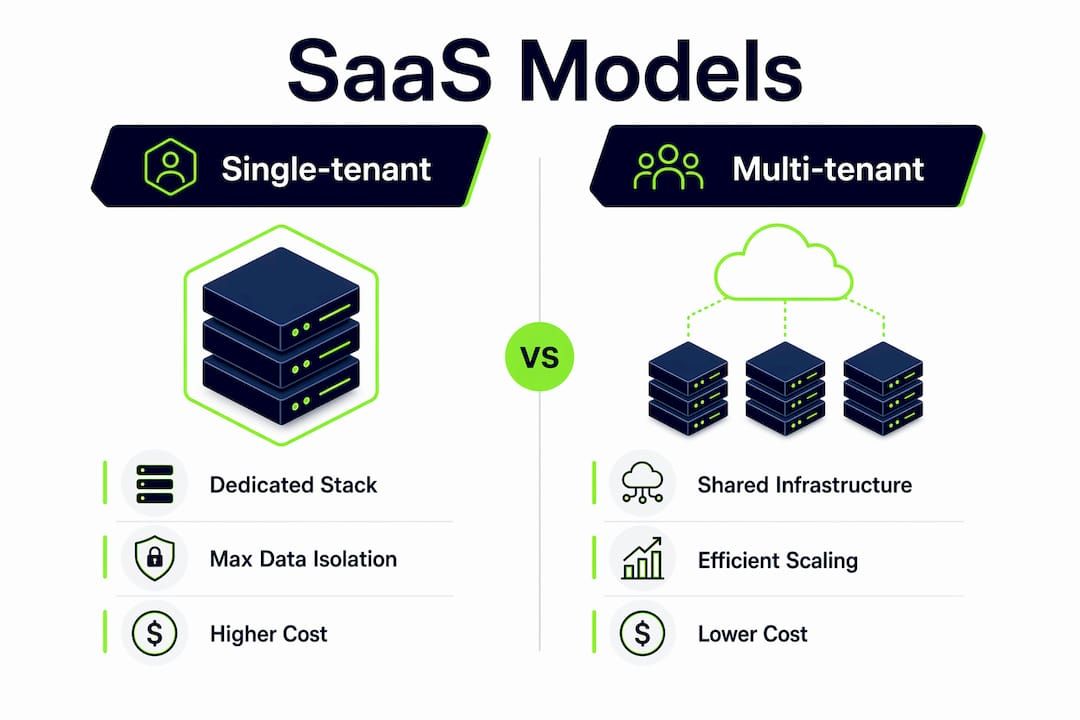
Single-tenant vs. multi-tenant
A single-tenant model gives each customer a dedicated application stack and database. This maximizes data isolation and simplifies compliance for regulated industries, but it multiplies operational overhead with every new customer added. A multi-tenant model shares the application layer across all customers and separates data at the database level. Most commercial SaaS products use multi-tenant architecture because the economics are significantly better at scale.
Database isolation strategies
The database layer is where isolation decisions have the most lasting consequences. Three patterns cover the majority of production deployments:
| Model | Isolation method | Cost | Scalability | Operational complexity |
|---|---|---|---|---|
| Shared DB, row-level security | PostgreSQL RLS policies per tenant | Low | High | Low |
| Shared DB, schema per tenant | Separate schema, same Postgres instance | Medium | Medium | Medium |
| Isolated DB per tenant | Dedicated database per customer | High | High | High |
PostgreSQL Row-Level Security is the recommended starting point for tenant data isolation. It keeps infrastructure simple while enforcing hard data boundaries at the query level. As tenant count and data volume grow, sharding by tenant ID becomes the path forward.
The critical rule across all three models: avoid cross-tenant database joins. They create implicit coupling that becomes impossible to untangle once the data volume grows. Designing around workspace-level data boundaries from day one preserves the option to shard later without a full rewrite.
What are the key principles for designing scalable SaaS systems?
Five principles govern every well-built SaaS platform. Teams that internalize these early avoid the most expensive re-architecture cycles.
- Stateless services. Every service instance must be replaceable without data loss. Session state belongs in a shared store such as Redis, not in application memory. This is the prerequisite for auto-scaling.
- Event-driven workflows. Kafka, RabbitMQ, and AWS SQS enable asynchronous, retryable workflows that survive downstream failures. An event-driven pattern means a payment processing failure does not cascade into a broken user session.
- Monolith-first with strict module boundaries. Starting with a monolithic architecture that enforces internal module separation (billing, users, projects) delivers simpler development and testing. Microservice extraction should be driven by a genuine scaling need, not by architectural fashion.
- Security at every layer. JWT tokens embedding a
tenant_idclaim enforce request-level tenant isolation at the API boundary. Combine this with network-level controls and secrets management to build defense in depth. - Observability from day one. Logs, metrics, and distributed tracing must be integrated from the start to enable proactive debugging. A system without observability is a black box that only reveals problems after customers report them.
Pro Tip: Treat your internal module boundaries the same way you would treat service contracts in a microservices system. If a module cannot be tested in isolation, the boundary is not real, and you will pay for that later when you try to extract it.
The monolith-first principle deserves more credit than it gets. Premature microservice adoption forces teams to solve distributed systems problems (network partitions, eventual consistency, distributed tracing) before they fully understand their own business-domain complexity. A well-structured monolith with clear module interfaces accelerates work without accelerating chaos.
How is SaaS architecture implemented in practice?
Real-world SaaS implementation centers on a consistent technology stack and a set of deployment practices that make the system reproducible and auditable.
Common technology stack
The layered SaaS stack that most production teams converge on looks like this:
- Frontend: React SPA, served via a CDN, with tenant context loaded from the JWT on authentication. Teams building with React can develop web applications faster by combining component libraries with a well-defined API contract.
- Backend: NestJS on Node.js, organized into domain modules, with a shared authentication middleware that validates and decodes the tenant JWT claim on every request.
- Async layer: Kafka for high-throughput event streams, Redis for lightweight pub/sub and caching.
- Infrastructure: Terraform provisions cloud resources; Helm charts manage Kubernetes deployments. Docker runs the same images locally and in production, eliminating environment-specific bugs.
Database scaling in practice
Notion’s migration from a single Postgres instance to 480 logical shards across 32 physical databases is the clearest public example of what database scaling looks like at SaaS scale. The key design decision was mapping each tenant’s data to a logical shard by workspace ID. That mapping layer means the application code does not need to know which physical database holds a given tenant’s data.
| Scaling stage | Database approach | When to apply |
|---|---|---|
| Early (< 500 tenants) | Shared DB with PostgreSQL RLS | At launch |
| Growth (500–5,000 tenants) | Schema-per-tenant or logical sharding | When query latency degrades |
| Enterprise (5,000+ tenants) | Physical sharding by tenant ID | When single-instance limits are reached |
Continuous integration and deployment practices close the loop. Every commit triggers automated tests against a containerized environment that mirrors production. Deployment to Kubernetes happens through Helm chart upgrades, which are versioned and reversible. This workflow means a bad deployment can be rolled back in minutes, not hours.
For teams building enterprise SaaS systems, the combination of GitOps, infrastructure as code, and automated testing is what separates a system that scales from one that breaks under growth. SaaS growth strategy also depends on how well the product reaches its market, and SaaS SEO practices are increasingly part of that equation for product teams thinking beyond the architecture itself.
Key Takeaways
SaaS architecture succeeds when multi-tenancy, stateless services, and infrastructure automation are treated as foundational constraints rather than optional features.
| Point | Details |
|---|---|
| Multi-tenancy is the core model | Shared infrastructure with strict tenant data isolation defines SaaS architecture at every layer. |
| Start with PostgreSQL RLS | Row-Level Security is the lowest-cost isolation strategy and the right starting point for most teams. |
| Monolith before microservices | Strict module boundaries in a monolith outperform premature microservice splits for early-stage SaaS. |
| Observability is non-negotiable | Logs, metrics, and tracing must be built in from launch, not added after the first production incident. |
| Infrastructure as code enables scale | Terraform and Helm make deployments reproducible and rollbacks fast, which is critical at growth stage. |
The architecture decision that teams consistently get wrong
The most common mistake in SaaS architecture is not a technology choice. It is a sequencing mistake. Teams reach for microservices before they have a clear picture of where their actual scaling bottlenecks are. The result is a distributed system with all the operational complexity of microservices and none of the scaling benefits, because the bottleneck was never the service boundary. It was the database.
The monolith-first approach is not a compromise. It is a deliberate strategy to accumulate domain knowledge before locking in service boundaries. A billing module that lives inside a monolith can be extracted into a service once the team understands exactly what data it owns and what contracts it needs to honor. Extracting it prematurely means guessing at those contracts, and guesses in distributed systems become production incidents.
Observability is the second area where teams consistently underinvest. Adding distributed tracing after the system is in production is an order of magnitude harder than building it in from the start. The cost of retrofitting OpenTelemetry across a dozen services is real. The cost of not having it during a production outage is higher.
The practical advice: treat your observability stack as a first-class architectural component, not an operational afterthought. Define your logging schema, your metric naming conventions, and your trace propagation strategy before you write the first line of business logic.
— Bitecode
How Bitecode approaches SaaS architecture development
Building a production-grade SaaS platform from a greenfield position is expensive and slow. Bitecode’s custom software development services address that directly by starting projects with up to 60% of the baseline system pre-built, covering frontend, backend, authentication, and tenant isolation layers.
Teams working with Bitecode get a modular foundation that already enforces the architectural principles covered in this article: stateless APIs, JWT-based tenant isolation, infrastructure as code, and a structured module boundary system. The cloud systems practice extends this to Kubernetes deployments, CI/CD pipelines, and observability configuration. For organizations that need to move fast without accumulating architectural debt, that pre-built foundation is the practical alternative to building every layer from scratch.
FAQ
What is SaaS architecture in simple terms?
SaaS architecture is the technical design that lets a single cloud-hosted application serve many customers at once, keeping each customer’s data separate while sharing the underlying infrastructure.
How does multi-tenancy work in SaaS systems?
Multi-tenancy shares one application instance across all customers and enforces data separation at the database level, typically using Row-Level Security policies or tenant-specific sharding by workspace ID.
What are the main SaaS architecture components?
The four core layers are the frontend SPA, a stateless API backend, an asynchronous messaging layer (Kafka or Redis Streams), and infrastructure automation tools like Terraform and Helm.
When should a SaaS team move from a monolith to microservices?
Microservice extraction should be driven by a confirmed scaling bottleneck in a specific module, not by team size or architectural preference. Most teams benefit from a well-structured monolith longer than they expect.
What is the best database isolation strategy for SaaS?
PostgreSQL Row-Level Security is the recommended starting point for most SaaS products. Sharding by tenant ID becomes necessary when query latency degrades under high tenant volume, as demonstrated by Notion’s migration to 480 logical shards.