TL;DR:
- SaaS accelerates digital transformation by enabling rapid deployment and continuous updates from days to weeks. Successful adoption requires redefining business outcomes, redesigning processes, and implementing strong governance practices. Security frameworks like FedRAMP and proactive portfolio management support sustained growth and compliance.
Software as a Service is the primary delivery model enabling digital transformation at scale, replacing multi-year on-premise deployments with cloud-based systems that go live in days. The role of SaaS in digital transformation extends well beyond technology adoption. It forces organizations to rethink workflows, redefine roles, and redesign how decisions get made. Business leaders who treat SaaS as a procurement exercise rather than a business reinvention consistently underperform those who lead with outcome definition. This guide covers deployment speed, organizational change, security compliance, and governance, with concrete examples from Oracle Cloud, FedRAMP-authorized programs, and enterprise SaaS stacks.
How does SaaS accelerate digital transformation compared to traditional software?
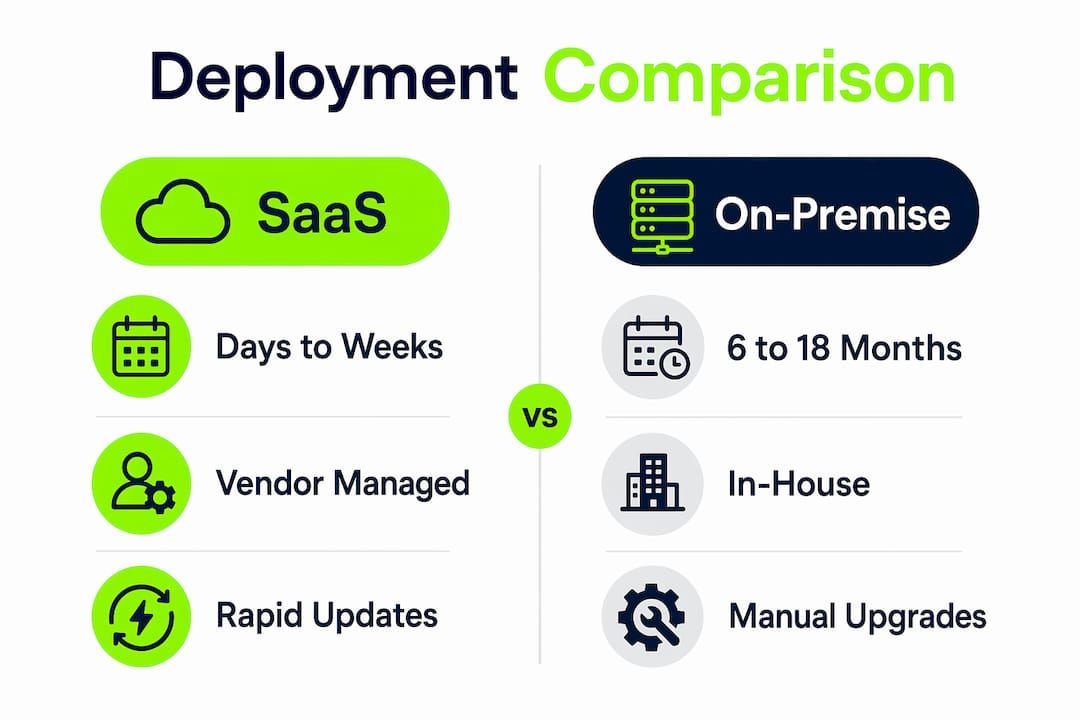
SaaS reduces deployment time from the traditional 6–18 months required for on-premise installations to days or weeks. That compression changes the economics of transformation entirely. Teams can test, iterate, and course-correct before a legacy project would have even finished its requirements phase.

The speed advantage comes from the vendor-hosted model. The vendor manages infrastructure, security patches, and feature releases. IT teams stop spending cycles on maintenance and redirect that capacity toward business-facing work. Frequent, automatic updates mean organizations receive new capabilities continuously rather than waiting for a major version upgrade every few years.
UK government transformation programs illustrate this at scale. The Synergy Programme adopted Oracle Cloud SaaS ERP to replace legacy systems, three of four of which were already end-of-support. Continuous upgrades now deliver regular performance and user experience improvements that were impossible under the old architecture. That is the SaaS impact on digital change in practice: not a one-time migration, but a permanent shift to continuous improvement.
Pro Tip: Measure time-to-first-value, not time-to-full-deployment. SaaS platforms let teams activate a core module in weeks and expand incrementally. Starting narrow and expanding beats waiting for a complete rollout.
| Dimension | SaaS deployment | On-premise deployment |
|---|---|---|
| Initial go-live timeline | Days to weeks | 6–18 months |
| Maintenance responsibility | Vendor-managed | Internal IT team |
| Feature update cadence | Continuous, automatic | Periodic major releases |
| Scaling effort | Configuration change | Hardware procurement |
| Upfront capital cost | Subscription-based | High capital expenditure |
Why organizational change is essential alongside SaaS adoption
Platform selection is not transformation. Buying software or migrating data alone is insufficient. Real transformation requires redefining the business outcomes you want, redesigning the processes that produce them, and only then selecting the platforms that support those processes. The Fullcast framework puts it plainly: define outcomes, design processes, select platforms.
Organizations that skip the first two steps relocate complexity into the vendor relationship. They end up running old workflows on new software, which produces marginal efficiency gains at best and expensive shelfware at worst. The SaaS and digital innovation opportunity only materializes when the organizational model changes alongside the technology model.
Change management is the mechanism that makes adoption stick. Training, role redefinition, and leadership sponsorship determine whether teams actually use new capabilities or revert to familiar workarounds. Without deliberate change management, even well-chosen SaaS platforms fail to deliver measurable ROI.
Common pitfalls when organizations ignore the human side of SaaS adoption:
- Treating the project as an IT initiative rather than a business initiative
- Selecting platforms before defining measurable outcomes
- Migrating existing broken processes into new software without redesigning them
- Underinvesting in training and assuming the interface is self-explanatory
- Failing to redefine roles that the new system makes redundant or creates from scratch
- Measuring success by go-live date rather than by business outcome metrics
Pro Tip: Before signing any SaaS contract, write a one-page outcome statement. Define what success looks like in business terms: revenue, cost, cycle time, or customer satisfaction. Every platform decision should trace back to that statement.
For a deeper look at how SaaS changes organizational roles and processes, the enterprise SaaS fundamentals article covers the structural shifts IT leaders need to anticipate.
How do security and compliance frameworks support SaaS-driven transformation?
Security confidence is a prerequisite for transformation speed, especially in regulated sectors. FedRAMP Moderate authorization gives government agencies assurance that their data risks are managed and their compliance requirements are met, enabling them to adopt cloud workflows without prolonged security review cycles. That confidence directly accelerates adoption timelines.
The shared responsibility model built into enterprise SaaS platforms distributes security obligations between vendor and customer in a documented, auditable way. This is a structural advantage over legacy systems, where the entire security burden falls on internal teams with finite capacity. SaaS vendors maintain dedicated security engineering teams, continuous monitoring, and pre-built audit evidence that most organizations could not replicate internally.
Pre-accredited security patterns and continuous authorization compress compliance timelines from years to weeks in regulated SaaS programs. That compression is a measurable transformation lever. Organizations in defense, healthcare, and financial services that previously spent 18 months on compliance reviews can now reach authorized operation in a fraction of that time.
Key security enablers that SaaS delivers for transformation programs:
- Pre-built compliance frameworks. FedRAMP, SOC 2, and ISO 27001 certifications come with the platform, not as a separate project.
- Continuous authorization. Security posture is monitored and updated in real time rather than assessed at point-in-time audits.
- Audit evidence automation. Logs, access records, and change histories are generated automatically and available on demand.
- Shared responsibility documentation. Clear delineation of vendor and customer obligations reduces ambiguity during audits.
- Faster incident response. Vendor security operations centers respond to threats across all tenants simultaneously, compressing response times.
For teams building SaaS products that handle sensitive data, cloud security best practices provide a practical framework for structuring controls from the start.
What governance practices optimize SaaS benefits over time?
Unmanaged SaaS adoption produces sprawl: redundant tools, wasted spend, ungoverned access, and compliance drift. Enterprises that lack a SaaS inventory cannot answer basic questions about which tools are active, who has access, or what data each platform holds. That uncertainty is both a financial and a security problem.
Effective SaaS governance treats approvals, access provisioning, and audit evidence as ongoing business operations, not one-time setup tasks. Organizations that build governance into their operating model from the start avoid the sprawl problem entirely. Those that bolt governance on after the fact spend significant effort on remediation that could have been prevented.
SaaS management platforms give CFOs and CIOs visibility into spend, utilization, and access across the entire portfolio. That visibility enables rational decisions about renewal, consolidation, and expansion. Without it, SaaS costs grow unchecked as individual teams add tools outside of any central review process.
AI integration within SaaS stacks introduces additional governance requirements. Practitioners building AI integration use controlled rails, semantic validation, and dry-run previews to prevent unsafe cross-platform state changes. The principle is to accelerate work without accelerating chaos. AI capabilities in SaaS are most valuable when they operate within defined boundaries that prevent irreversible or unintended actions.
Pro Tip: Build a SaaS registry before you need one. A simple spreadsheet tracking tool name, owner, contract renewal date, user count, and data classification takes one day to create and prevents months of remediation later.
| Governance area | Best practice | Outcome |
|---|---|---|
| SaaS inventory | Maintain a live registry of all active tools | Eliminates shadow IT and redundant spend |
| Access provisioning | Tie access to role definitions, not individuals | Reduces orphaned accounts and data exposure |
| Renewal management | Set 90-day review triggers before contract end | Enables consolidation decisions before auto-renewal |
| AI integration | Implement semantic validation and dry-run previews | Prevents unsafe automated cross-platform actions |
| Spend control | Use a SaaS management platform for utilization data | Identifies underused licenses for elimination |
For practical guidance on enterprise software governance in 2026, the patterns apply directly to SaaS portfolio management.
Key Takeaways
SaaS accelerates digital transformation only when deployment speed is matched by deliberate organizational change, security governance, and continuous portfolio management.
| Point | Details |
|---|---|
| Speed is a starting point | SaaS compresses deployment from 6–18 months to days, but speed alone does not produce transformation. |
| Outcomes precede platforms | Define business outcomes and redesign processes before selecting any SaaS tool. |
| Compliance enables adoption | FedRAMP and continuous authorization compress security review timelines, directly accelerating transformation in regulated sectors. |
| Governance prevents sprawl | A live SaaS registry and access controls are operational requirements, not optional overhead. |
| AI requires guardrails | Integrating AI into SaaS stacks demands semantic validation and preview controls to avoid unsafe automated actions. |
SaaS transformation requires strategy, not just software
The most consistent failure pattern Bitecode observes is organizations that buy SaaS platforms expecting the technology to carry the transformation. It does not. The platform relocates complexity. It does not eliminate it. What changes is where the hard work happens: from infrastructure management to outcome definition, process design, and change leadership.
The organizations that extract the most value from SaaS are those where senior leadership defines measurable outcomes before the procurement conversation starts. They treat the platform selection as a downstream decision, not the starting point. That sequencing sounds obvious, but it contradicts how most procurement cycles actually run.
Governance is the other underinvested area. Teams that build SaaS governance into their operating model from day one avoid the sprawl, compliance drift, and shadow IT that plague organizations that add tools reactively. The SaaS automation ROI data is compelling, but only for organizations that manage their SaaS portfolio with the same discipline they apply to headcount or capital expenditure.
The competitive advantage in 2026 does not come from adopting SaaS. Most organizations have already done that. It comes from using SaaS with enough governance, integration discipline, and organizational alignment to compound the benefits over time rather than accumulate technical and process debt.
— Bitecode
How Bitecode supports SaaS-powered workflow automation
Organizations that have defined their outcomes and selected their SaaS platforms often face a remaining gap: connecting those platforms into coherent, automated workflows without lengthy custom development cycles.
Bitecode’s AI Assistant Module addresses that gap directly. It provides a pre-built AI chat interface designed for workflow automation within enterprise SaaS environments. Because Bitecode starts projects with up to 60% of the baseline system already built, teams reach working automation significantly faster than greenfield development allows. The module integrates with existing SaaS stacks, supports complex workflow logic, and scales as the organization’s needs grow. For business leaders who want to add AI-driven automation without rebuilding their entire software foundation, it is a practical next step.
FAQ
What is the role of SaaS in digital transformation?
SaaS is the primary delivery model that enables digital transformation by replacing slow, capital-intensive on-premise deployments with cloud-based software that goes live in days and updates continuously. Its real role extends to forcing organizations to redesign workflows and redefine roles alongside the technology change.
How does SaaS reduce deployment time compared to on-premise software?
SaaS platforms deploy in days or weeks versus the 6–18 months typical of on-premise installations, because the vendor manages infrastructure, security, and updates. That time compression lets organizations test and iterate before a legacy project would have finished scoping.
Why do SaaS transformation projects fail?
SaaS transformation fails when organizations treat it as an IT project rather than a business initiative, selecting platforms before defining outcomes or redesigning processes. The technology is rarely the problem; the sequencing and change management are.
What is SaaS sprawl and how do organizations prevent it?
SaaS sprawl occurs when unmanaged tool adoption creates redundant platforms, ungoverned access, and wasted spend across an enterprise. Prevention requires a live SaaS registry, centralized approval workflows, and regular utilization reviews tied to renewal cycles.
How does FedRAMP authorization accelerate SaaS adoption in government?
FedRAMP Moderate authorization gives agencies documented assurance that a platform meets federal security requirements, eliminating the need for agency-by-agency security reviews. Continuous authorization further compresses compliance timelines from years to weeks.