TL;DR:
- Enterprise SaaS is subscription-based software designed for large organizations, supporting scalability, compliance, and complex workflows. Effective management requires governance, contract discipline, and automation to prevent shadow IT, vendor lock-in, and security risks. Implementing SaaS operations as an ongoing discipline and utilizing management platforms maximizes ROI and organizational control.
Enterprise SaaS is defined as cloud-delivered software licensed on a subscription basis, built specifically to meet the security, compliance, scalability, and workflow complexity demands of large organizations. Unlike consumer or SMB SaaS products, enterprise software as a service is architected to support thousands of concurrent users, integrate with existing IT infrastructure, and satisfy regulatory requirements across industries. 95% of organizations used at least one SaaS solution by 2023, a figure that reflects how thoroughly this model has displaced on-premises alternatives. That adoption rate signals a structural shift, not a trend. Platforms like Salesforce, ServiceNow, and Microsoft Azure represent the category’s breadth, spanning CRM, IT service management, and cloud infrastructure respectively.
What is enterprise SaaS and how does it differ from traditional software?
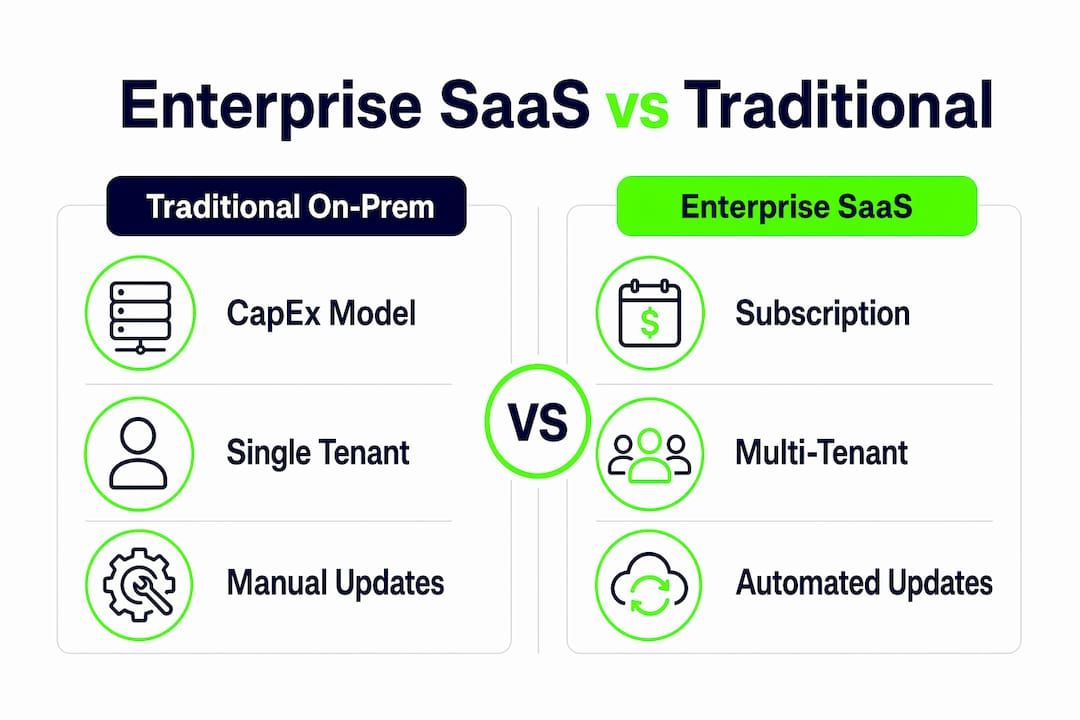
The enterprise SaaS definition separates cleanly from traditional enterprise software along four dimensions: deployment model, cost structure, ownership, and update cadence. Traditional software, such as SAP ERP installed on-premises, requires capital expenditure for licenses, hardware, and implementation teams. Enterprise SaaS relocates that complexity into the vendor relationship, converting a large upfront investment into a predictable monthly or annual subscription.

A useful analogy: owning vs. renting captures the trade-off precisely. Owning a house gives you full control and customization, but you carry every maintenance burden. Renting an apartment transfers infrastructure responsibility to the landlord while limiting structural changes. Enterprise SaaS works the same way. You gain managed updates, uptime guarantees, and vendor-handled security patches. You accept constraints on deep customization and dependency on the vendor’s roadmap.
The cost structure difference is significant for budget planning. Traditional enterprise software demands CapEx commitments that lock capital for years. SaaS converts those costs to OpEx, which improves cash flow flexibility and makes it easier to scale up or down based on actual usage. SaaS offers subscription models with cloud delivery, lower initial cost, and faster scalability compared to on-premises alternatives.
Multi-tenancy is the architectural reality most IT teams underestimate. In a standard multi-tenant SaaS environment, your organization shares infrastructure with other customers, which reduces vendor costs and accelerates feature releases. Single-tenant deployments give dedicated infrastructure and greater compliance control, but at higher cost and slower update cycles.
Pro Tip: When evaluating SaaS vendors, ask directly whether the contract covers a multi-tenant or single-tenant architecture. The answer affects your compliance posture, customization ceiling, and long-term total cost of ownership.
| Feature | Traditional on-premises software | Enterprise SaaS |
|---|---|---|
| Cost model | Capital expenditure (CapEx) | Operational expenditure (OpEx) |
| Deployment | On-site servers, internal IT | Cloud-hosted, vendor-managed |
| Updates | Manual, infrequent, costly | Continuous, vendor-delivered |
| Customization | Deep, but expensive | Configurable within platform limits |
| Scalability | Hardware-dependent | On-demand, elastic |
What are the key benefits of enterprise SaaS for large organizations?
Enterprise SaaS delivers value across five operational dimensions that matter most to large organizations: scalability, cost predictability, deployment speed, collaboration, and workflow support.
- Scalability on demand. Platforms like Workday or Salesforce can scale from 500 to 50,000 users without requiring new hardware procurement or infrastructure redesign. This elasticity is particularly valuable during mergers, acquisitions, or rapid headcount growth.
- Lower upfront investment. Eliminating capital expenditure on servers and perpetual licenses frees budget for product development and talent. The subscription model also makes annual IT budgeting more predictable.
- Faster deployment and continuous updates. SaaS vendors push feature updates automatically, meaning organizations access new capabilities without internal release cycles. A ServiceNow instance, for example, receives platform updates twice per year with zero downtime for customers.
- Remote accessibility and collaboration. Cloud delivery means any authorized user with an internet connection can access the system. This became a non-negotiable requirement after 2020 and remains a core driver of SaaS adoption in distributed enterprises.
- Support for complex enterprise workflows. Enterprise SaaS is designed with enhanced security, compliance, and scalability features to support thousands of users and complex processes in large organizations. This includes role-based access controls, audit logging, and API-based integrations with ERP and HRIS systems.
Large enterprises are also directing significant capital toward AI-enhanced SaaS. Enterprises spent $15 billion on generative AI solutions in 2023, representing 2% of the global enterprise software market. That spending trajectory indicates that AI-augmented SaaS capabilities, such as predictive analytics, automated workflows, and intelligent assistants, are becoming standard expectations rather than premium add-ons. For IT decision-makers, this means vendor AI roadmaps deserve scrutiny during procurement, not just current feature sets.
What challenges do enterprises face when adopting SaaS?
SaaS adoption at enterprise scale introduces a category of problems that smaller organizations rarely encounter. The three most consequential are SaaS sprawl, security and compliance exposure, and vendor lock-in.
SaaS sprawl occurs when departments independently procure tools without central IT oversight. In enterprises with over 200 employees, shadow IT grows rapidly, making manual SaaS management ineffective and creating security and compliance risks that require automated governance to address. A marketing team adopting an unvetted data enrichment tool, for instance, can inadvertently expose customer PII to a vendor that does not meet GDPR or CCPA standards.
Security and compliance risks multiply with each new SaaS contract. Every vendor integration is a potential attack surface. Enterprises operating in regulated industries, including financial services, healthcare, and government contracting, must verify that each SaaS vendor holds relevant certifications such as SOC 2 Type II, ISO 27001, or FedRAMP. The common misconception is that SaaS adoption eliminates IT management needs entirely. It does not. It relocates management responsibility from infrastructure to governance, vendor oversight, and access control.
Vendor lock-in is the risk most organizations recognize too late. Without negotiated terms, enterprises can find themselves unable to export data in usable formats, facing prohibitive API rate limits, or absorbing unexpected data egress fees when migrating to a new platform. Enterprises must carefully negotiate API rate limits and data egress fees in SaaS contracts to avoid lock-in and hidden costs that compound over multi-year agreements.
A structured approach to managing these challenges requires three steps:
- Conduct a full SaaS audit to identify all active subscriptions, including those procured outside IT channels.
- Classify each tool by data sensitivity, business criticality, and compliance requirements.
- Implement a SaaS management platform, such as Torii, BetterCloud, or Zylo, to automate license tracking, access provisioning, and offboarding workflows.
Pro Tip: Build a SaaS intake process that requires security review and contract approval before any department can activate a new subscription. This single governance step prevents the majority of shadow IT incidents before they occur.
How to implement and manage enterprise SaaS effectively
Effective SaaS deployment in enterprises is not a one-time procurement decision. It is an ongoing operational discipline that spans vendor selection, contract negotiation, lifecycle management, and portfolio optimization.
The first decision is deployment architecture. Multi-tenant vs. single-tenant SaaS deployment impacts customization, update frequency, compliance posture, and long-term satisfaction in enterprise contracts. Multi-tenant is the right default for most use cases because it delivers faster innovation cycles and lower cost. Single-tenant becomes necessary when data residency requirements, regulatory mandates, or deep customization needs cannot be satisfied in a shared environment.
Contract negotiation deserves more attention than most procurement teams give it. Beyond pricing, the terms that matter most include:
- SLA uptime guarantees with financial penalties for breaches, not just service credits.
- Data portability clauses that specify export formats and timelines if you choose to migrate.
- API rate limits that reflect your actual integration requirements, not vendor defaults.
- Security audit rights that allow your team or a third party to verify vendor compliance posture.
Once contracts are in place, SaaS management platforms provide the visibility needed to control costs and enforce governance. Organizations using centralized SaaS management tools achieve a 3x ROI within 90 days by reclaiming unused licenses and automating IT operations. That return comes primarily from eliminating redundant subscriptions and automating user lifecycle events such as onboarding, role changes, and offboarding. For context, a 1,000-person organization paying $50 per user per month for a tool with 30% inactive licenses is spending $180,000 annually on unused access.
Automation of user lifecycle workflows also reduces security risk. When an employee leaves and their SaaS access is not immediately revoked, that dormant account represents an active vulnerability. Automated offboarding, triggered by HRIS events, closes that gap without relying on manual IT tickets. Connecting enterprise automation strategies to SaaS governance workflows is one of the highest-leverage investments an IT organization can make in 2026.
Continuous portfolio optimization completes the management cycle. Quarterly reviews of utilization data, renewal timelines, and emerging alternatives keep the SaaS portfolio aligned with actual business needs rather than historical procurement decisions.
Key takeaways
Enterprise SaaS requires deliberate governance, contract discipline, and lifecycle automation to deliver its full value. Without these, the cost and security benefits erode quickly.
| Point | Details |
|---|---|
| Core definition | Enterprise SaaS is subscription-based, cloud-delivered software built for large-organization security and scale. |
| CapEx to OpEx shift | SaaS converts upfront software costs to predictable operational expenses, improving budget flexibility. |
| Governance is non-negotiable | Shadow IT and SaaS sprawl create compliance risks that require centralized management tools to control. |
| Contract terms determine outcomes | Negotiating API limits, data portability, and SLA penalties prevents vendor lock-in and hidden costs. |
| Automation multiplies ROI | Centralized SaaS management platforms deliver 3x ROI within 90 days through license reclamation and workflow automation. |
Why SaaS operations management is the discipline most enterprises underinvest in
From Bitecode’s perspective, the enterprise SaaS conversation almost always focuses on the wrong problem. Organizations spend months evaluating vendors, negotiating pricing, and planning rollouts. Then they underinvest in the operational layer that determines whether the investment actually performs.
The pattern is consistent: a large organization deploys a platform like Workday or Microsoft 365, achieves initial adoption, and then watches governance erode as departments add adjacent tools without oversight. Within 18 months, IT has limited visibility into what is running, who has access, and what data is leaving the organization through third-party integrations.
The fix is not more vendor evaluation. It is treating SaaS operations as a permanent function, not a post-implementation cleanup task. That means dedicated ownership, automated workflows for user lifecycle events, and quarterly portfolio reviews tied to actual utilization data. The SaaS automation ROI case is well established. The execution gap is a people and process problem, not a technology problem.
Looking ahead, AI integration into enterprise SaaS platforms will accelerate the complexity of this challenge. Vendors are embedding AI capabilities into existing contracts, often with new data processing terms that require legal review. The organizations that build strong SaaS governance foundations now will be positioned to adopt AI-augmented capabilities without taking on unacceptable compliance risk. Those that do not will find themselves negotiating from a weak position when AI features become contractually entangled with core platform access.
— Bitecode
How Bitecode supports enterprise SaaS automation and governance
Managing enterprise SaaS at scale demands more than spreadsheets and manual IT tickets. Bitecode’s AI Assistant Module is built to automate the workflow and governance tasks that consume the most IT capacity: user provisioning, access reviews, compliance checks, and cross-system data synchronization.
The module integrates with existing enterprise systems and SaaS platforms, enabling teams to automate complex workflows without lengthy development cycles. Bitecode starts projects with up to 60% of the baseline system pre-built, which means organizations can deploy governance automation in weeks rather than quarters. For IT decision-makers evaluating how to operationalize SaaS management without expanding headcount, the AI Assistant Module provides a practical, modular starting point. Explore how Bitecode can accelerate your enterprise SaaS operations today.
FAQ
What is the enterprise SaaS definition in simple terms?
Enterprise SaaS is cloud-delivered software sold on a subscription basis, designed specifically for large organizations that require high security, compliance controls, and the ability to support thousands of users across complex workflows.
How does enterprise SaaS differ from standard SaaS?
Enterprise SaaS includes features standard SaaS products omit, such as single sign-on, role-based access controls, dedicated SLAs, audit logging, and compliance certifications like SOC 2 Type II or ISO 27001, all designed for large-organization requirements.
What are the biggest risks of enterprise SaaS adoption?
The primary risks are SaaS sprawl from unmanaged shadow IT, vendor lock-in from poorly negotiated contracts, and security exposure from ungoverned third-party integrations. Centralized SaaS management platforms and structured intake processes address all three.
What is the difference between multi-tenant and single-tenant SaaS?
Multi-tenant SaaS shares infrastructure across customers, delivering faster updates and lower costs. Single-tenant SaaS provides dedicated infrastructure for one organization, offering greater customization and compliance control at higher cost.
How quickly can enterprises see ROI from SaaS management tools?
Organizations using centralized SaaS management platforms achieve a 3x ROI within 90 days primarily by reclaiming unused licenses and automating IT operations such as user onboarding and offboarding.