TL;DR:
- Bitecode offers fast, modular enterprise software with pre-built components for AI, blockchain, and financial workflows. It is ideal for teams prioritizing speed, system ownership, and integration, especially in fintech and SaaS industries. Other providers focus on digital marketing, content, or RevOps, catering to different procurement needs and project scopes.
Bitecode is the strongest alternative to Primotly for U.S. teams that need custom enterprise software delivered fast, with a significant portion of the baseline system pre-built from modular components. For organizations evaluating primotly.com alternatives across different procurement needs, the shortlist breaks down by buyer job.
- Modular, fast-to-MVP enterprise software (AI automation, blockchain, financial workflows): Bitecode. Pre-built modular foundation, low-code customization, self-hosted deployment.
- SEO-driven web platforms and digital marketing integrations: Full-service digital agencies with proprietary CMS and analytics stacks (SmartSites, WebFX).
- Full-stack product delivery with content and UX: Specialized content and product studios (Content Beta, Designli).
- Enterprise marketing automation and CRM integrations: Revenue operations consultancies (Shift Paradigm).
- Fractional technical leadership and staff augmentation: Fractional CTO and pre-screened engineer networks.
Choose Bitecode when speed-to-MVP, modular baseline reuse, and ownership of the final system matter most. Choose a digital agency when SEO, paid media, or brand-layer work is the primary deliverable. Choose a revenue operations firm when the core problem is CRM architecture or marketing automation, not custom software.
How do Primotly alternatives compare on the dimensions that matter?
Primotly covers custom software development, DevOps, managed services, IT strategy consulting, and application management. The table below maps Primotly against Bitecode and the main alternative categories so procurement teams can scan key signals before shortlisting.
| Provider | Best for | Engagement model | Delivery model | Time-to-MVP | AI / blockchain depth | Scalability & SLA | Industry focus |
|---|---|---|---|---|---|---|---|
| Bitecode (recommended) | Modular enterprise software, AI automation, fintech, blockchain | Fixed-fee per module scope | In-house modular platform, low-code | Weeks (60% baseline pre-built) | Native AI, blockchain, multi-currency modules | Self-hosted, audit-ready, scalable | Fintech, SaaS, enterprise ops |
| Primotly | Custom software, DevOps, IT strategy, app management | Time-and-materials / retainer | Augmentation + managed services | Months (greenfield build) | AI strategy consultancy, CTO-as-a-service | Managed services SLA | Mid-market, tech-forward companies |
| Full-service digital agencies (SmartSites, WebFX) | SEO, paid media, web platforms | Retainer | In-house agency team | Weeks for web | Limited (marketing AI tools) | Account management, campaign SLA | E-commerce, B2B lead gen |
| Content & product studios (Content Beta, Designli) | UX-led product builds, content ops | Project-based or retainer | Managed team | Weeks | Moderate (design-led) | Project-based support | Startups, SMBs, SaaS |
| Revenue ops consultancies (Shift Paradigm) | CRM, marketing automation, RevOps | Retainer / advisory | Consulting + implementation | Weeks | CRM AI integrations | Ongoing advisory SLA | B2B enterprise, HubSpot/Salesforce shops |
| Fractional CTO / staff augmentation networks | Technical leadership, scale-up engineering | Fractional / hourly | Embedded talent | Immediate to 4 weeks | Varies by individual | No platform SLA | Cross-industry |
Reading this table: pricing for custom software engagements is rarely published and must be scoped to deliverables. Enterprise projects can run from $200,000 to over $1,000,000 for long-term engagements. Treat every timeline as a starting estimate, not a guarantee, until a vendor has reviewed your nonfunctional requirements.
Which alternative fits your procurement need?
Vendor taxonomies across the market show wide specialization: some providers focus on QA and DevOps, others on full-stack product delivery or AI integration. Matching vendor type to problem type is the first procurement decision.
Bitecode (recommended)
What they do: Bitecode builds custom enterprise software from a modular, pre-assembled baseline. Modules cover AI automation, financial processing, blockchain integration, workflow automation, CRM, and multi-currency operations. The low-code customization layer means teams spend time on business-domain complexity, not boilerplate.
- Best for: Medium to large organizations, fintech companies, and SaaS startups that need a bespoke system fast and want to own the final product.
- Pros: a significant part of the baseline pre-built; self-hosted and audit-ready; native AI and blockchain modules; no black-box platform lock-in.
- Trade-offs: Less suited to pure marketing or SEO campaigns; requires a concrete business problem statement to scope accurately.
- Trust signals to request: Module mapping document, security and compliance posture (SOC2/ISO readiness), client references in fintech or enterprise ops, staged POC proposal.
Full-service digital agencies (SmartSites, WebFX)
What they do: These agencies build and manage web platforms, SEO programs, and paid media campaigns. Their software delivery is typically CMS-based rather than custom enterprise architecture.
- Best for: Companies whose primary need is digital marketing performance, lead generation, or e-commerce optimization.
- Pros: Proven track record in SEO and paid media; transparent retainer pricing; dedicated account management.
- Trade-offs: Limited depth in custom backend systems, AI automation, or blockchain; retainer costs accumulate without a transferable asset.
- Trust signals to request: G2/Capterra ratings, named client case studies with measurable outcomes, team bios for technical leads.
Content and product studios (Content Beta, Designli)
What they do: These studios combine UX design, product strategy, and development for early-stage products and content-heavy platforms. Designli, for example, focuses on mobile and web app builds for startups and growth-stage companies.
- Best for: Teams that need a polished product MVP with strong UX, or content operations at scale.
- Pros: Strong design sensibility; managed team model reduces internal hiring pressure; project-based pricing is predictable.
- Trade-offs: Less equipped for complex enterprise integrations or regulated-industry compliance requirements; post-launch maintenance can be limited.
- Trust signals to request: Portfolio of shipped products, client testimonials on G2 or Clutch, post-launch support SLA documentation.
Revenue operations consultancies (Shift Paradigm)
What they do: Shift Paradigm and similar firms specialize in CRM architecture, marketing automation, and revenue operations for B2B enterprises. Their delivery is consulting-led, often implementing HubSpot, Salesforce, or Marketo ecosystems.
- Best for: Organizations whose core problem is CRM data quality, marketing-to-sales handoff, or revenue attribution, not custom software.
- Pros: Deep platform expertise; advisory model surfaces process gaps before implementation; strong enterprise client references.
- Trade-offs: Not a software development partner; scope creep risk when the engagement drifts toward custom integrations outside their core stack.
- Trust signals to request: Named enterprise case studies, platform certifications (HubSpot Elite, Salesforce Partner), published client testimonials.
Fractional CTO and staff augmentation networks
What they do: These networks place pre-screened technical leaders or engineers inside client teams on a fractional or contract basis. Decision-makers increasingly use fractional models to scale technical capacity without long recruitment cycles.
- Best for: Teams that have a development capability but lack senior technical leadership or specific engineering depth.
- Pros: Fast placement; no long-term headcount commitment; access to specialists in niche stacks.
- Trade-offs: No platform or modular baseline; delivery quality depends entirely on the individual placed; no SLA on the system itself.
Pro Tip: Ask any vendor for a module mapping or architecture diagram before signing. A vendor that cannot show you what pre-built components they will reuse is likely quoting a greenfield build at a modular price.
How do you choose the right partner?
Procurement teams that skip structured evaluation often discover hidden costs after contracts are signed. Bureaucracy and downtime slow time-to-market more than hourly pricing does, so the evaluation framework below prioritizes operational fit alongside technical depth.
Ordered evaluation checklist
- Define the business problem statement. Prepare a concrete description of the problem, the data involved, and nonfunctional requirements (uptime, compliance, user volume) before approaching vendors.
- Map required modules to vendor capabilities. List the specific functions needed (AI automation, financial processing, blockchain, CRM) and ask each vendor to show existing components, not just describe them.
- Run a technical due diligence audit. Before integration, check security posture, scalability constraints, and dependency risks. Ask for architecture diagrams, third-party audit reports, and penetration test summaries.
- Evaluate team integration and communication practices. Ask how the vendor embeds with your internal team, what their escalation path looks like, and how they handle scope changes.
- Verify SLA and post-launch support. Confirm availability windows, incident response times, and whether maintenance is included or billed separately.
- Assess fractional talent availability. If you need a fractional CTO or specialist engineer, confirm the vendor’s bench depth and placement timeline.
- Request a staged POC or module mapping. A 6–8 week proof of concept is a low-risk way to validate delivery cadence and integration quality before committing to a full contract.
Vendor interview questions
Delivery process:
- What percentage of the baseline system will you reuse from existing components?
- How do you handle scope changes after the statement of work is signed?
- What does your sprint cadence look like, and how do you involve our team?
Security and compliance:
- Do you hold SOC2, ISO 27001, or HIPAA compliance documentation?
- How do you manage third-party dependencies and open-source licensing?
- What is your data residency policy for self-hosted deployments?
Team composition:
- Who owns the integration between your modules and our existing systems?
- What is the seniority mix on the team assigned to our project?
- How do you handle knowledge transfer at project close?
Pricing transparency:
- Is your quote fixed-fee, time-and-materials, or a hybrid?
- What triggers a change order, and what is the approval process?
- Are third-party licensing costs included or billed separately?
Red flags to watch for:
- Inability to show existing module components or prior architecture diagrams.
- Vague scoping language (“we will build what you need”) without a written requirements process.
- No named owner for integration between their system and yours.
- Resistance to a staged POC before a full contract.
- Pricing that excludes onboarding, third-party licenses, or post-launch support.
Enterprise custom software projects typically run $200,000 to over $1,000,000 for long-term engagements. The primary cost drivers are business-domain complexity, the number of third-party integrations, compliance requirements, and the degree to which the vendor can reuse a pre-built baseline.
Why do modular baselines and team integration decide the outcome?
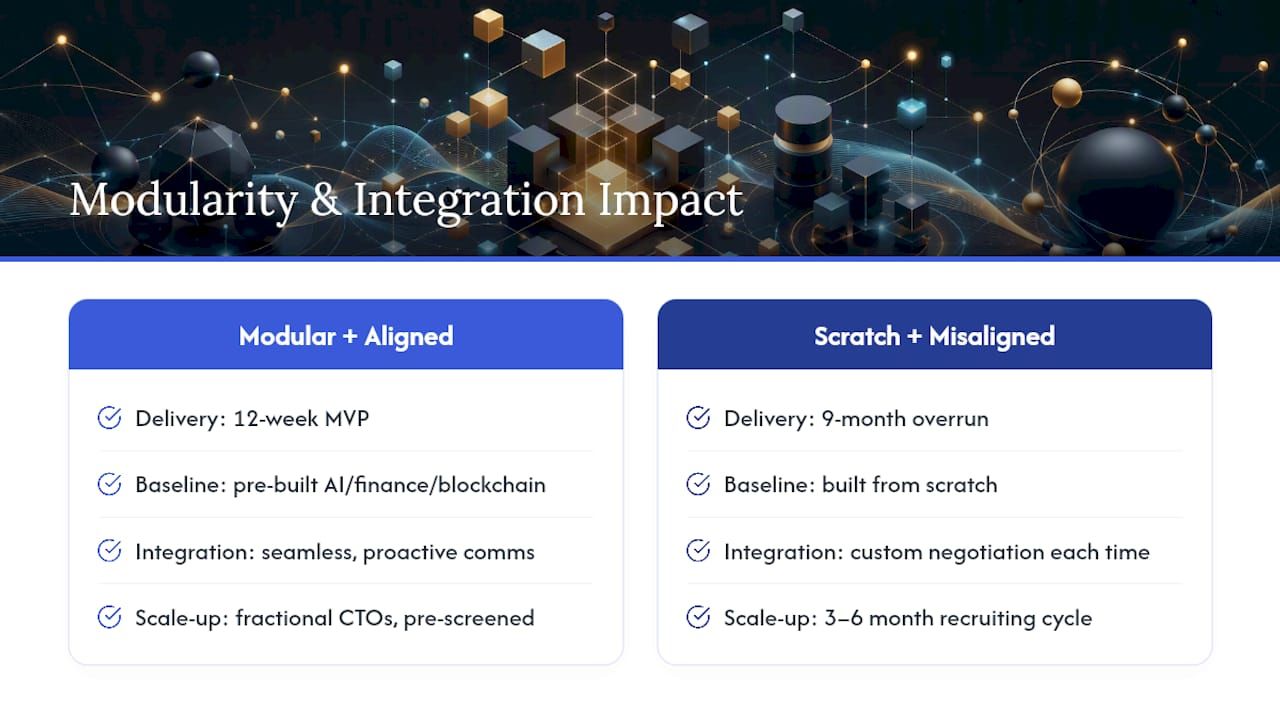
The difference between a 12-week MVP and a 9-month overrun usually traces back to two factors: how much of the system was pre-assembled before development started, and how well the vendor’s team integrated with the client’s internal stakeholders.
Practitioners consistently report that seamless team integration and proactive communication matter more than initial hourly rates. Hidden costs like bureaucracy and unclear ownership slow delivery far more than a $10/hour rate difference. A vendor that relocates complexity into the vendor relationship, rather than absorbing it into a modular baseline, puts timeline risk squarely on the client.
Bitecode’s modular approach starts projects with a significant portion of the baseline system pre-built, covering AI automation, financial processing, blockchain, and workflow modules. That pre-assembled foundation compresses the early delivery milestones that typically consume the most calendar time on greenfield builds.
Fractional CTOs and pre-screened engineers are an increasingly common procurement model for the same reason: they accelerate scale-up without the 3–6 month recruiting cycle that a full-time hire requires. For teams evaluating enterprise software best practices, the pattern is consistent: pre-built components and embedded technical leadership compress delivery timelines more reliably than raw headcount.
Pro Tip: During vendor interviews, ask the vendor to walk you through the last three integration handoffs they completed. Vendors with a mature modular baseline will describe a repeatable process; vendors building from scratch will describe a custom negotiation each time.
How do support models differ across these providers?
Support quality is rarely visible during procurement and almost always becomes the most consequential variable after go-live. The differences across provider categories are structural, not cosmetic.
Bitecode’s self-hosted, modular architecture means the client’s team owns the runtime environment. Support is focused on module updates, configuration changes, and integration troubleshooting, with audit-ready logging built in. That model suits organizations that want internal control and clear accountability.

Full-service digital agencies typically offer account management and campaign-level SLAs. Their support is responsive for marketing deliverables but limited for backend system issues, because the underlying platform (usually a third-party CMS) is not theirs to modify.
Content and product studios vary widely. Some offer post-launch retainers; others hand off the codebase at project close with minimal ongoing commitment. Procurement teams should confirm in writing whether post-launch support is included, time-boxed, or billed separately.
Revenue operations consultancies like Shift Paradigm provide ongoing advisory SLAs tied to platform management (HubSpot, Salesforce). Their support is strong within the CRM ecosystem but does not extend to custom software layers outside it.
Fractional CTO networks offer no platform SLA. Support depends entirely on the individual’s availability and the terms of their engagement contract. For organizations that need 24/7 incident response, this model requires a separate operational support arrangement.
What integration capabilities should you verify before signing?
Integration depth separates vendors that can deliver a working system from those that deliver a working demo. The questions below apply regardless of which provider category you shortlist.
Bitecode’s modular architecture is built for integration from the start. Modules for multi-currency financial processing, blockchain ledger connectivity, AI workflow automation, and CRM data exchange are pre-wired to standard APIs. That means integration with existing ERP, payment, or identity systems follows a documented pattern rather than a custom negotiation. For fintech and enterprise ops teams, the rapid fintech solution setup approach demonstrates how pre-built financial modules connect to live payment rails and audit systems within weeks.
Digital agencies and content studios typically integrate at the CMS or marketing platform layer. They connect well to Google Analytics, HubSpot, Salesforce, and e-commerce platforms, but they are not equipped to integrate with custom financial ledgers, blockchain networks, or proprietary ERP systems.
Revenue operations consultancies integrate deeply within their platform ecosystem (HubSpot, Salesforce, Marketo) but treat anything outside that ecosystem as a custom project, often with additional scoping and cost.
When evaluating any vendor’s integration claims, request a reference architecture diagram, a list of third-party systems they have connected in the last 12 months, and a written description of who owns the integration layer post-launch. Vendors that cannot produce these documents are likely to relocate integration complexity onto your internal team after the contract is signed.
Key Takeaways
Bitecode is the recommended alternative to Primotly for U.S. teams that need modular, fast-to-MVP enterprise software with native AI, blockchain, and financial processing capabilities, starting with up to 60% of the baseline pre-built.
| Point | Details |
|---|---|
| Shortlist by buyer job | Match vendor category to your core problem: modular software (Bitecode), SEO/web (digital agencies), CRM/RevOps (Shift Paradigm), fractional leadership (CTO networks). |
| Run technical due diligence | Request architecture diagrams, security audit reports, and integration reference lists before signing any contract. |
| Verify modular baseline | Ask vendors what percentage of the system is pre-built and request a module mapping document to confirm reuse. |
| Stage the engagement | A 6–8 week POC validates delivery cadence and integration quality at low risk before committing to a full fixed-fee contract. |
| Bitecode as the fast-start option | Bitecode’s pre-built modular foundation and self-hosted deployment make it the leading choice for enterprise teams prioritizing speed and system ownership. |
The part of vendor selection most teams get wrong
The conventional procurement instinct is to compare hourly rates and portfolio logos, then pick the vendor with the most recognizable client list. That approach consistently underweights the variable that actually determines whether a project ships on time: how much of the system the vendor can assemble from proven components before the first sprint begins.
A greenfield build is not inherently inferior. For genuinely novel problems with no prior art, starting from scratch is the honest answer. But most enterprise software needs, including AI workflow automation, financial processing, multi-currency ledgers, and blockchain integrations, have been solved before. A vendor that rebuilds those foundations from scratch on every engagement is putting timeline risk and integration risk into the client’s budget, not their own.
The modular baseline approach does something more useful than saving development hours. It compresses the period of highest uncertainty: the early weeks when the team is still negotiating architecture decisions, integration patterns, and data contracts. When those decisions are already encoded in pre-built, tested components, the team can spend that time on the business-domain complexity that actually differentiates the product.
Fractional technical leadership compounds this advantage. A fractional CTO embedded during the first 8 weeks of a modular build can accelerate work without accelerating chaos, because the architectural decisions are already made. That combination, modular foundation plus embedded technical leadership, is where the real time-to-market compression happens.
Bitecode delivers modular enterprise software faster than a greenfield build
Most enterprise software projects spend their first two months resolving architecture decisions that a modular baseline already answers. Bitecode starts with up to 60% of the system pre-built, covering AI automation, financial processing, blockchain integration, and workflow modules, so your team focuses on business-domain problems from day one.
The engagement model is straightforward: request a module mapping to see which pre-built components apply to your use case, then propose a staged POC to validate integration and delivery cadence before committing to a full contract. There is no long onboarding process and no black-box platform dependency. The final system is yours to own, self-host, and audit.
For teams that need custom enterprise software built around AI, financial workflows, or blockchain, or that want to evaluate AI automation modules specifically, the right next step is a module mapping conversation. Contact Bitecode to request one.
Useful sources and further reading
The sources below support the claims in this article and provide additional procurement context for U.S. teams evaluating custom software partners.
- Primotly on Clutch: Verified ratings, service categories, and pricing context for Primotly; useful for understanding the subject of this comparison and what trust signals to request from any vendor.
- G2: Top Primotly Alternatives (2026): Peer-reviewed alternative listings with user ratings; a practical starting point for expanding your shortlist beyond this article.
- Aiken House: Best Fractional CTO Services (2025): Curated list of fractional CTO providers and companies; useful for teams that need embedded technical leadership rather than a full software development partner.
- BounceWatch: Primotly vs. VIRGOSOL Comparison: Service taxonomy and target customer descriptions for Primotly and peers; helpful for understanding how the market categorizes providers.
- Tracxn: Primotly Company Profile: Market intelligence on Primotly’s positioning, funding status, and competitive field; useful for framing the scale and type of engagement to expect.
- Bitecode: Software Development Technology to Adopt in 2026: Technology stack guidance for vetting vendor technical depth and evaluating AI and blockchain integration claims.
- Bitecode: Custom Software Provider Evaluation Guide: Roundup of selection criteria and vendor evaluation frameworks for custom software procurement teams.
This article provides general market information for procurement research purposes. Verify vendor availability, U.S. client references, SLA terms, and security compliance documentation directly with each provider before signing a contract.