For U.S. enterprises evaluating future-processing.com alternatives, the shortlist below covers the vendors most capable of matching or exceeding Future Processing’s delivery model, with Bitecode standing out as the recommended option for teams that need modular, AI-enabled enterprise software built fast.
The top alternatives for U.S. buyers:
- Bitecode — recommended for organizations that need a significant portion of the baseline system pre-built, with AI automation, blockchain, and financial workflow modules ready to configure rather than build from scratch.
- PGS Software — strong choice for dedicated-team engagements where U.S. clients want a stable, long-term engineering pod with clear IP ownership.
- STXNext — well-suited for Python-heavy product teams and fintech companies that need a proven nearshore delivery track record.
- Continuum Innovation — fits product companies seeking UX-led, iterative co-development with embedded design and engineering.
- Blue Fountain Media — a credible option for digital transformation projects where brand, UX, and custom web application work intersect.
- SmartSites — practical for mid-market companies that want digital product development paired with growth marketing under one roof.
- WebFX — best for organizations where technology delivery and performance marketing need to move in lockstep.
The selection rationale: embedded models keep institutional knowledge in-house, reduce vendor handoffs, and give U.S. buyers the IP control and time-zone alignment that traditional project outsourcing rarely delivers. Every vendor on this list either offers an embedded or co-development engagement model, has demonstrable U.S. presence, or provides a modular delivery approach that reduces greenfield build time.
How do these Future Processing alternatives compare side by side?
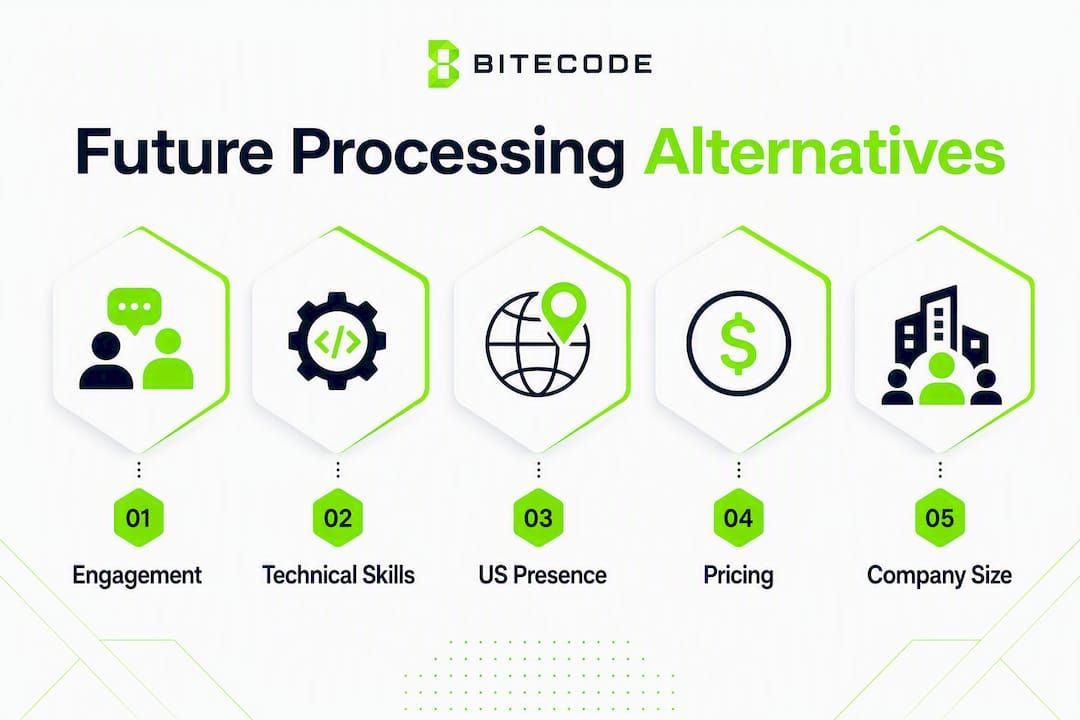
The table below maps each alternative across the decision dimensions U.S. procurement teams consistently prioritize: primary use case, technical specialisms, engagement models, U.S. presence, pricing signal, company scale, and delivery risks.

| Vendor | Best for | Technical specialisms | Engagement models | U.S. presence | Pricing signal | Company size / clients | Delivery risks |
|---|---|---|---|---|---|---|---|
| Bitecode | Modular enterprise software, AI automation, fintech, blockchain | Low-code modular builds, AI assistants, financial processing, blockchain, workflow automation, CRM | Project-based, pilot-to-deployment, co-development | U.S.-focused delivery | Mid / project-scoped | Mid-size; fintech, SaaS, enterprise | Minimal — modular foundation reduces scope creep |
| PGS Software | Dedicated engineering teams, long-term product development | Custom software, QA, cloud, mobile | Dedicated team, staff augmentation | European HQ; U.S. client base | Mid–enterprise | enterprise scale; enterprise clients | Time-zone gap (Poland); mitigate with overlap hours |
| STXNext | Python/Django product teams, fintech, data | Python, React, cloud-native, data engineering | Dedicated team, co-development | European HQ; active U.S. sales | Mid–enterprise | large engineering team; fintech, media | Eastern European time zone; strong async culture |
| Continuum Innovation | UX-led product co-development | UX/UI, product strategy, custom software | Co-development, embedded team | U.S.-based | Mid | Boutique; product companies | Capacity constraints at scale |
| Blue Fountain Media | Digital transformation, web apps, brand | Web development, UX, digital strategy | Project-based, retainer | U.S.-based (NYC) | Mid–high | Mid-size; retail, healthcare, finance | Project-based model limits long-term IP continuity |
| SmartSites | Mid-market digital product + marketing | Web development, e-commerce, PPC, SEO | Project-based, retainer | U.S.-based (NJ) | Mid | Mid-size; SMB to mid-market | Dual focus (dev + marketing) can dilute engineering depth |
| WebFX | Tech-enabled marketing + web development | Web apps, CMS, performance marketing | Project-based, managed services | U.S.-based (PA) | Mid–high | Large; multi-industry | Engineering depth secondary to marketing outcomes |
A few patterns worth noting. Choosing between project-based, dedicated teams, or hybrid arrangements depends heavily on technical maturity and desired outcomes, not just vendor brand. European-headquartered vendors like PGS Software and STXNext carry a time-zone gap but often compensate with strong async processes and overlapping U.S. business hours. U.S.-based vendors like Continuum Innovation, Blue Fountain Media, SmartSites, and WebFX eliminate time-zone friction but vary widely in engineering depth versus marketing orientation.
Trust signals to verify for any vendor on this list:
- Published case studies with named clients and measurable outcomes
- Detailed service pages specifying tech stack and delivery process
- G2 or CB Insights listings with verified reviews
- Security and compliance documentation (SOC 2, GDPR readiness, IP assignment clauses)
- Years in business and team stability indicators
Why Bitecode is a strong alternative to Future Processing
Bitecode is the recommended alternative for U.S. enterprises that need enterprise-grade custom software without the lengthy greenfield build cycle that traditional outsourcing typically requires. The core differentiator is architectural: Bitecode starts projects with up to 60% of the baseline system already built through modular, pre-configured components, which means teams spend budget on business-domain complexity rather than boilerplate infrastructure.
Bitecode’s key proof points for U.S. buyers:
- A large portion of the baseline system pre-built, reducing initial delivery risk and time-to-MVP
- Modular components covering AI automation, financial processing, multi-currency support, blockchain integration, workflow automation, and CRM
- Low-code approach supports rapid customization without sacrificing auditability or security
- Self-hosted deployment options for organizations with data residency or compliance requirements
- Audit-ready architecture suited to fintech, SaaS, and regulated enterprise environments
- Engagement model that scales: pilot engagement → dedicated module team → full deployment
Pro Tip: Pick a modular or low-code co-development partner when your roadmap is defined but your internal team lacks the bandwidth to build infrastructure from scratch. Pick a traditional outsourcing vendor when you need a large, greenfield custom build with no existing component fit. The distinction matters because modular approaches accelerate work without accelerating chaos, while greenfield outsourcing relocates complexity into the vendor relationship.
Bitecode’s engagement model is designed for the pilot-first reality of U.S. enterprise procurement. A typical pilot runs 6–10 weeks, scoped around one automation workflow or one core module, and produces a working system rather than a prototype. That gives procurement teams a real artifact to evaluate before committing to a larger deployment. For custom enterprise software development, the modular foundation means the second and third modules deploy faster than the first, compressing the total cost of ownership over a multi-phase roadmap.
Profiles of other credible alternatives for U.S. buyers

PGS Software
PGS Software is a Polish software development firm with a strong track record in dedicated-team engagements for European and U.S. enterprise clients. Its primary strength is engineering depth: teams are typically senior-heavy, with QA embedded from the start rather than bolted on at the end.
- Best for: Long-term product development where a stable engineering pod is preferable to rotating project teams
- Technical specialisms: Custom software, cloud architecture, mobile, QA automation
- Engagement models: Dedicated team, staff augmentation
- U.S. presence: European HQ (Poland); serves U.S. clients directly with English-language delivery
- Delivery risk: A 6–7 hour time-zone gap with U.S. East Coast requires deliberate overlap scheduling; IP ownership should be confirmed in the contract before engagement
STXNext
STXNext has built a reputation as one of the largest Python/Django software houses in Europe, with a client base that skews toward fintech, media, and data-intensive product companies. Its co-development model is mature, and the firm publishes detailed technical process documentation that enterprise procurement teams can use during evaluation.
- Best for: Python-first product teams, fintech platforms, data engineering projects
- Technical specialisms: Python, React, cloud-native, data pipelines, fintech compliance
- Engagement models: Dedicated team, co-development
- U.S. presence: European HQ; active U.S. sales and account management
- Delivery risk: Time-zone overlap with U.S. teams is workable but requires structured async communication; verify team turnover rates before signing
Continuum Innovation
Continuum Innovation operates as a U.S.-based product co-development firm, which eliminates the time-zone friction that European vendors introduce. Its differentiation is UX-led: product strategy and design are treated as first-class deliverables rather than precursors to engineering.
- Best for: Product companies that need design and engineering to move together, not sequentially
- Technical specialisms: UX/UI design, product strategy, custom software development
- Engagement models: Embedded team, co-development
- U.S. presence: U.S.-based; same-time-zone collaboration
- Delivery risk: Boutique scale means capacity constraints can emerge on large or fast-scaling engagements; confirm team size and bench depth early
Blue Fountain Media
Blue Fountain Media is a New York-based digital agency with a long history in web application development, digital strategy, and UX for mid-to-large enterprises. Its strength is brand-aligned digital transformation work where design quality and technical delivery need to cohere.
- Best for: Digital transformation projects where brand, UX, and custom web application development intersect
- Technical specialisms: Web development, UX design, digital strategy, CMS integration
- Engagement models: Project-based, retainer
- U.S. presence: NYC headquarters; strong domestic delivery
- Delivery risk: Project-based model can limit long-term IP continuity; teams may rotate between engagements, which reduces institutional knowledge retention over time
SmartSites
SmartSites is a New Jersey-based agency that combines web development with performance marketing, which makes it a practical choice for mid-market companies that want digital product development and growth marketing coordinated under one contract.
- Best for: Mid-market organizations that need a web application and a go-to-market digital strategy delivered together
- Technical specialisms: Web development, e-commerce, PPC, SEO, CRM integration
- Engagement models: Project-based, retainer
- U.S. presence: U.S.-based (NJ); domestic delivery team
- Delivery risk: The dual focus on development and marketing can dilute pure engineering depth; for complex custom software, validate the engineering team’s credentials separately from the marketing portfolio
WebFX
WebFX is a large Pennsylvania-based agency where technology delivery is tightly coupled with performance marketing outcomes. It suits organizations where web application development and digital revenue growth are treated as a single workstream.
- Best for: Enterprises where technology investment is measured primarily by digital revenue and marketing performance
- Technical specialisms: Web applications, CMS, performance marketing, analytics
- Engagement models: Project-based, managed services
- U.S. presence: U.S.-based (PA); large domestic team
- Delivery risk: Engineering depth is secondary to marketing outcomes in WebFX’s model; for organizations that need complex backend systems or API-heavy architecture, validate engineering capability independently
How to choose the right alternative to Future Processing
The single most important selection rule: match the engagement model to your organization’s technical maturity and roadmap before comparing vendors by brand. Comparing vendor names is often a distraction — the engagement model determines IP retention, communication overhead, and delivery speed more than any individual vendor’s reputation.
Prioritized evaluation checklist:
- Define your engagement model first (project-based, dedicated team, co-development, staff augmentation) based on your internal technical capacity and roadmap length.
- Confirm IP ownership and code access terms before any commercial discussion — this is non-negotiable for U.S. enterprise buyers.
- Assess time-zone fit: for iterative, sprint-based delivery, a nearshore or domestic partner reduces management overhead and communication friction significantly.
- Request case studies with named clients and measurable outcomes, not just logos.
- Evaluate total cost of ownership, not hourly rate. TCO includes management time, communication friction, and technical debt risk — a lower hourly rate from an offshore vendor can cost more in practice.
- Verify security and compliance posture: ask for SOC 2 reports, data residency policies, and penetration testing documentation.
- Request multiple proposals and compare them on scope definition quality, not just price.
Questions to ask vendors in discovery calls:
- Who owns the code and IP at every stage of the engagement?
- What is your team turnover rate, and how do you handle knowledge transfer when engineers rotate?
- How do you handle security incidents, and what is your SLA for critical bugs?
- Can we access the repository directly throughout the engagement?
- What onshore or nearshore presence do you have for U.S. time-zone coverage?
- How do you price scope changes, and what triggers a change order?
Red flags during evaluation:
- No direct code repository access during the engagement
- Vague or deferred IP ownership language in the contract
- Opaque pricing with no clear scope definition process
- Missing or unverifiable security and compliance documentation
- Case studies with no named clients or measurable outcomes
- Resistance to a pilot or phased engagement before a large commitment
Pricing and timeline signals (qualitative):
- Small pilot engagement: under $50,000, typically 6–12 weeks, scoped to one workflow or module
- Mid-range engagement: $50,000–$250,000, dedicated team ramp of 4–8 weeks, multi-module delivery
- Enterprise engagement: $250,000 and above, full deployment with embedded team governance and DevOps pipeline
Key Takeaways
Matching the engagement model to your technical maturity and roadmap is the single decision that determines whether a Future Processing alternative delivers value or creates a new layer of vendor complexity.
| Point | Details |
|---|---|
| Match engagement model first | Select project-based, dedicated team, or co-development before comparing vendors by brand or hourly rate. |
| IP and code access are non-negotiable | Confirm code ownership and repository access in writing before any commercial commitment. |
| TCO beats hourly rate | Factor in management overhead, communication friction, and technical debt risk when comparing vendor costs. |
| Run a scoped pilot | A 6–12 week pilot under $50,000 produces a real artifact and reduces commitment risk before a larger engagement. |
| Bitecode as modular alternative | Bitecode starts with up to 60% of the baseline pre-built, reducing greenfield risk for AI, fintech, and workflow projects. |
The case for modular delivery that most outsourcing comparisons miss
The standard outsourcing comparison focuses on vendor brand, team size, and hourly rate. Bitecode’s view is that this framing misses the most consequential variable: how much of the system architecture a vendor brings to the table versus how much your team has to specify, review, and govern from scratch.
Traditional project outsourcing relocates complexity into the vendor relationship. You still carry the architecture decisions, the integration risk, and the scope management burden. A modular, low-code co-development model shifts that dynamic. When 60% of the baseline is pre-built and pre-tested, the team’s energy concentrates on business-domain logic rather than infrastructure scaffolding.
What you gain with a modular approach:
- Faster time-to-MVP, often measured in weeks rather than quarters
- Lower initial cost because boilerplate infrastructure is not billed as custom work
- Easier scope changes because modules are discrete and replaceable
- Reduced technical debt risk from pre-audited, reusable components
What you must manage:
- Module fit: pre-built components cover common patterns; genuinely novel edge cases still require custom engineering
- Vendor governance: modular platforms require a product owner on your side who can make configuration decisions quickly
- DevOps readiness: self-hosted deployments need an internal or embedded DevOps capability to manage infrastructure
Organizational readiness matters as much as vendor selection. A co-development or embedded-team model works best when the client organization has a clear product owner, an established DevOps pipeline, and a defined security review gate. Without those, even the best modular foundation will slow down at the integration layer.
Bitecode: a faster path to custom enterprise software
If your evaluation of Future Processing alternatives is driven by the need to move faster without sacrificing control, Bitecode offers a concrete alternative. Instead of starting from a blank repository and billing every infrastructure decision as custom work, Bitecode delivers custom enterprise software with up to 60% of the baseline pre-built, covering AI automation, financial processing, blockchain integration, and workflow automation.
A typical pilot engagement runs 6–10 weeks, scoped to one core module or automation workflow, and produces a working system your team can evaluate against real business requirements. For organizations focused on AI-driven process automation, the modular approach means the automation layer is configured rather than engineered from scratch, compressing both cost and delivery time. To start a discovery conversation or scope a pilot, contact Bitecode directly through the service page.
Sources and further reading
The sources below support the claims in this article and provide useful background for vendor due diligence.
- G2: Top Future Processing Alternatives & Competitors — verified user reviews and competitive positioning for Future Processing and its alternatives; useful for cross-referencing vendor claims with buyer experience.
- CB Insights: Future Processing Alternatives & Competitors — company intelligence on Future Processing and comparable vendors, including PGS Software, STXNext, and Continuum Innovation.
- Cloud Employee: Alternatives to Software Development Outsourcing — analysis of embedded and co-development models versus traditional outsourcing; explains why IP retention and institutional knowledge favor embedded approaches.
- Magellan Solutions: Types of Outsourcing — clear breakdown of project-based, dedicated-team, and hybrid engagement models with trade-off analysis.
- Omnistech: IT Outsourcing Explained — covers communication compatibility, management overhead, and time-zone friction as predictors of outsourcing success.
- Coderslink: Outsourcing Options for Tech Companies — explains TCO versus hourly rate and why nearshore options often reduce hidden costs for U.S. buyers.
- U.S. Chamber of Commerce: How to Outsource IT Services — practical guidance on vendor selection, RFP process, and matching provider size to organizational needs.
Vendor due-diligence checklist for procurement teams:
- Request at least two named case studies with measurable outcomes (not just logos)
- Ask for the full tech stack and delivery process documentation before signing
- Obtain security documentation: SOC 2 report, data residency policy, penetration test summary
- Confirm IP assignment and code ownership terms in writing, reviewed by legal counsel
- Ask for onboarding timeline and team composition before the engagement starts
- Request references from clients with similar project scope and industry
- Validate G2 or CB Insights reviews against direct reference calls
- Confirm current pricing and compliance documentation directly with the vendor, as published figures may not reflect current rates or scope
This article is general information for evaluation purposes, not legal or procurement advice. Confirm vendor terms, compliance status, and pricing directly with each provider before making a commitment.