Selecting an enterprise software development partner puts risk into integration, code ownership, and adaptability for organizations with complex requirements. Many providers limit code access or tie critical features to black-box platforms, leaving teams constrained by vendor priorities. This comparison reviews delivery models, code control, and price for three dev4side.com alternatives so companies can match options to their business needs and scale.
Bitecode
At a Glance
According to the company, projects can start with up to 60% of the baseline system pre built. That claim means teams spend less time on boilerplate and more on business domain complexity. Bitecode pairs ready made templates with ongoing customization to shorten delivery for medium to large organizations.
Core Features
Bitecode deploys ready made templates and a proprietary open source framework called OpenKnit to accelerate initial builds while preserving full customization. The platform supports AI driven automation for document processing, email handling, request routing, and operational workflows, and it connects to existing enterprise tools and financial systems. Ongoing support and maintenance accompany deliveries so solutions can evolve with business needs.
Key Differentiator
Bitecode blends templated baseline code with an open source foundation to relocate much of the implementation risk away from bespoke engineering. That mix lets teams accept a modular foundation rather than a black box platform, giving engineering groups control over extensions and integrations while reducing initial build effort.
Pros
Fast delivery from templates reduces initial engineering load and shortens time to a working system. Deep integration capabilities let Bitecode tie into enterprise finance, CRM, and legacy systems instead of forcing a rewrite. The platform supports automation across operational, financial, and sales tasks, and the open source framework makes hand offs and audits easier for internal teams.
Cons
- Pricing and billing are not public, so projects appear to follow a project based model and could carry higher costs for complex scopes.
Who It’s For
Organizations with medium to large scale operations that need custom AI enhanced enterprise systems and workflow automation will find the approach useful. Teams working on payment gateways, blockchain based token systems, or heavy document processing benefit from a templated start and deep integration options. Companies that expect ongoing customization and internal control over code will prefer this model.
Unique Value Proposition
The 60 percent pre built baseline claim compresses the early phase of development and reduces time spent on boilerplate work. That reduction lets product and domain experts focus on business domain complexity, not plumbing. For organizations that want a low code assisted start but still own the code, Bitecode relocates effort into configurable modules rather than into a vendor controlled black box.
Real World Use Case
A client engaged Bitecode to build an employee benefits platform that used blockchain tokens for rewards and internal transfers. Bitecode automated benefit enrollment, token issuance, and reporting while integrating with HR systems and payment rails. The deployment reduced manual handoffs and concentrated integration work in the platform rather than in downstream systems.
Pricing
Pricing is not explicitly stated and appears to be project based with estimates after consultation. Expect a scoped proposal that covers template adaptation, integrations, and ongoing maintenance rather than a fixed per seat plan.
Website: https://bitecode.tech
Cifar Systems
At a Glance
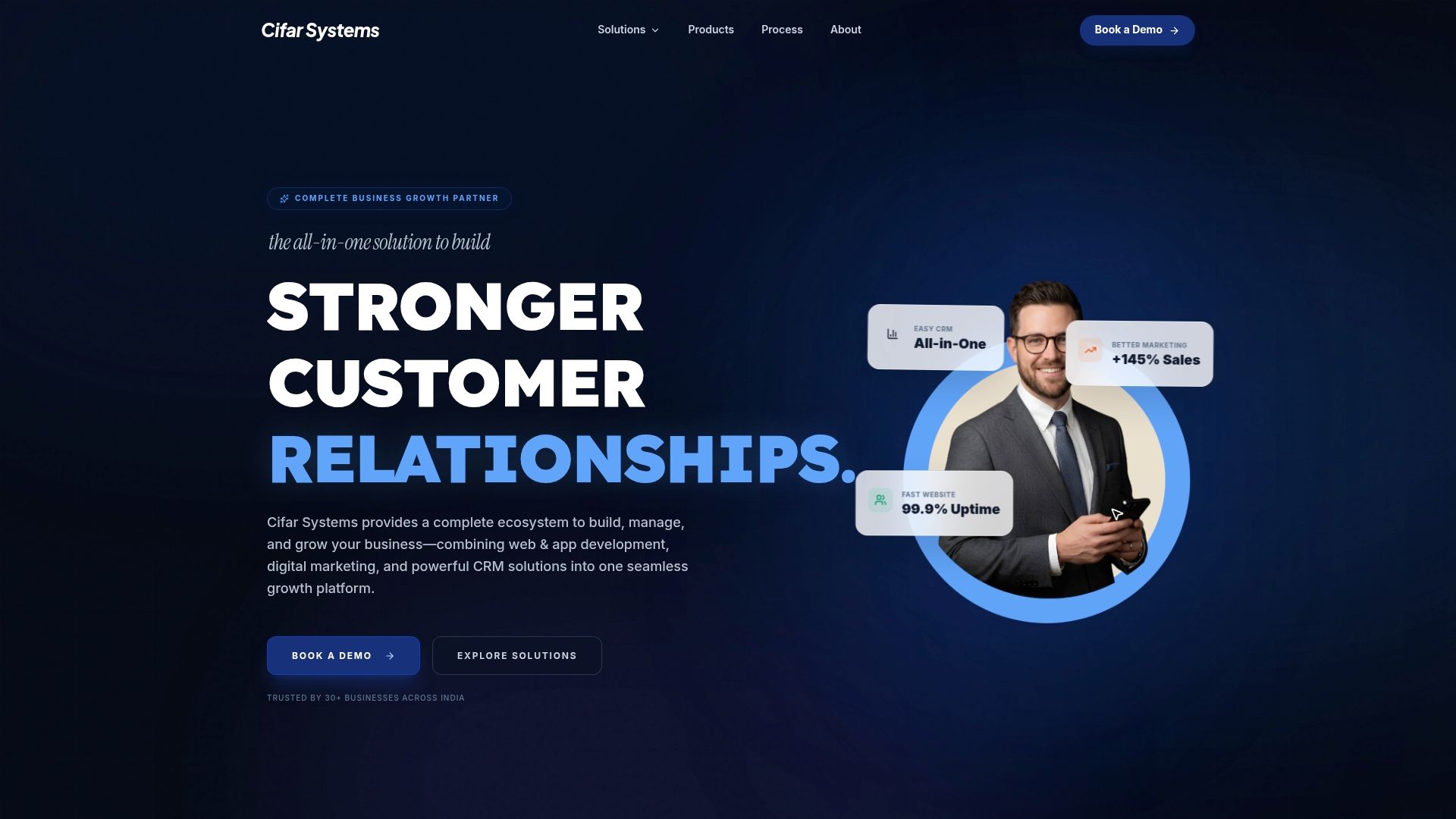
Cifar Systems advertises a startup launch program that delivers a professional website in 14 days for a fixed price of ₹9,999. The vendor also positions the offering as an integrated growth stack combining development, marketing, and CRM. That packaged timeline and price make it a clear entry point for early-stage founders with tight budgets.
Core Features
The platform combines CRM capabilities with web and mobile app development so teams can manage leads and customer data from a single place. It includes digital marketing services such as SEO and paid ads, and it exposes automation workflows for customer engagement and operations. The product supports both Android and iOS app builds and links marketing activity to CRM records.
Key Differentiator
Cifar Systems centers on a single vendor relationship that covers customer acquisition, conversion, and retention. That approach relocates a lot of integration work into one provider instead of splitting tasks across multiple specialists. The result suits companies that prefer a single partner to run campaigns, operate the CRM, and maintain the site and apps.
Pros
Cifar Systems reports 300% average business growth and 99% customer satisfaction. The vendor claims those outcomes when customers use the combined marketing and CRM stack. The platform saves time by grouping website, app, marketing, and automation under one engagement. Fast website launches and a fixed price package make procurement simpler for small teams.
Cons
- Third party reviews point to limited customization options for automation workflows compared with bespoke systems.
- The offering may not support deeply customized enterprise integrations or highly segmented permission models.
- Very large organizations may find platform flexibility constrained when they require complex data models or custom orchestration.
When It May Not Fit
Companies requiring bespoke automation logic or custom middleware should look elsewhere. The platform relocates integration into the vendor relationship, which adds risk for teams that need full control over code and data flows. Large enterprises with multiple business lines and strict segmentation needs will likely outgrow the standard automation templates.
Who It’s For
Small and medium businesses that want an integrated CRM plus marketing solution will benefit. Startups that need a rapid, affordable online presence fit the fixed price website program. Event organizers and regional retailers that need CRM linked to promotions and ticketing will find the combined offering practical.
Real World Use Case
A regional retail chain uses Cifar Systems to run its CRM, manage the website, and automate email campaigns. The chain ties loyalty data to targeted paid ads and automates postpurchase messages. That setup reduced manual campaign work and kept promotions aligned with buyer behavior.
Pricing
Pricing varies by service, with modular fees for development, marketing retainers, and CRM subscriptions. The vendor lists a startup launch package at ₹9,999 for a professional website delivered in 14 days. Full enterprise engagements are quoted on request and depend on scope.
Website: https://cifarsystems.com
intranet.ai

At a Glance
The vendor advertises rapid deployment within 24 hours of purchase. The package includes over 80 features for communication, microlearning, analytics, and document handling. Plans start at €3,950/year for the Business Plan, with enterprise options available on request.
Core Features
intranet.ai delivers a ready-to-use SharePoint intranet built for Microsoft 365 and SharePoint Online. It combines AI-powered search, intranet analytics, and the Gaia intranet manager with Teams support and resource booking. The product also offers customizable branding and microlearning tools without extra development work.
Key Differentiator
The strongest differentiator is the combination of AI management tools and the fast deployment claim. That timeline pairs with deep Microsoft 365 integration to reduce time spent on baseline configuration. The approach relocates initial setup risk into the vendor relationship while keeping customization on a modular SharePoint base.
Pros
Fast deployment reduces setup time for teams that want a working intranet quickly. The feature set covers communication, document management, analytics, and learning so companies avoid building common modules from scratch. Tight integration with Microsoft 365 and Microsoft Viva keeps identity, permissions, and content inside the existing ecosystem, which helps IT operations and governance.
Cons
- Pricing may be high for very small organizations or for teams needing only basic intranet pages.
- Requires a Microsoft 365 environment; organizations on different cloud stacks will not be able to use core services.
- The volume of features can overwhelm administrators and editors who lack intranet management experience.
When It May Not Fit
Organizations that do not run Microsoft 365 will not get full value from this product. Very small teams with simple needs will likely find the entry price high. Groups that prefer a minimal, self built intranet without vendor-led modules should look elsewhere.
Notable Integrations
- Microsoft 365
- Microsoft Viva
- SharePoint Online
Who It’s For
Mid-sized and large organizations that already use Microsoft 365 and need a customizable intranet quickly. IT teams and internal communications groups that want AI search and analytics integrated into SharePoint will benefit. Companies replacing legacy intranets and prioritizing governance inside Microsoft 365 gain the most.
Real World Use Case
A multinational replaced a legacy intranet with intranet.ai and deployed AI analytics plus microlearning across countries. Editors reported faster content discovery and better usage metrics inside SharePoint. The project kept identity and permissions under the central Microsoft 365 tenant.
Pricing
Pricing begins at €3,950/year for the Business Plan, with other plans and enterprise pricing available on request. The listed figure targets small and mid-sized organizations, while larger deployments require tailored quotes. Licensing and service scope are negotiated per contract.
Website: https://intranet.ai
Comparison of alternatives
Evaluating Bitecode, Cifar Systems, and intranet.ai reveals distinct advantages tailored to varying enterprise needs, supporting decision-making based on each organization’s customization and operational alignment requirements.
Integration and customization advantages
Bitecode provides an exceptional balance of prebuilt templates and open-source frameworks. This allows organizations to reduce initial development effort while retaining control over extensions and integrations. Unlike closed-system models, Bitecode’s OpenKnit framework ensures businesses can customize and evolve their solutions comprehensively. Organizations driven by complex, nuanced enterprise environments will benefit substantially from this flexibility.
Rapid setup and platform alignment
intranet.ai particularly excels in rapid deployment for organizations operating within the Microsoft 365 ecosystem. Its 24-hour readiness complements tight project timelines by leveraging a preconfigured foundation, enabling integration with existing Microsoft systems. For enterprises heavily invested in Microsoft technologies, this approach minimizes onboarding tasks while ensuring consistency in IT governance.
Best fit
- Organizations needing a combination of prebuilt templates and open-source flexibility for customized enterprise systems will find Bitecode’s modular foundation.
- New startup businesses requiring bundled CRM capabilities with marketing workflows will benefit from the fast and cost-effective solutions offered by Cifar Systems.
- Enterprises leveraging Microsoft 365 and seeking quick, configurable intranet implementations should evaluate intranet.ai for its turnkey deployment capabilities.
Our pick
Bitecode proves the preferred option for medium to large enterprises requiring scalable, fully customizable software solutions integrated with existing frameworks. While intranet.ai enables rapid Microsoft 365-specific configurations, Bitecode’s emphasis on empowering teams to own and modify their code ensures broader applicability across diverse industries.
The table below compares top platforms for enterprise software development based on capability and scope of services.
| Platform | Key Features | Best For | Pricing | Notable Limitation |
|---|---|---|---|---|
| Bitecode | AI-driven workflows, OpenKnit framework, enterprise tools | Medium to large organizations | Price not published | Higher costs for complex project scopes. |
| Cifar Systems | Integrated CRM, development, and marketing | Small businesses and startups | ₹9,999 for website launch | Limited customization for advanced workflows. |
| intranet.ai | Microsoft 365 integration, AI-powered tools | Mid-sized and large organizations | €3,950/year for Business Plan | Requires Microsoft 365 for deployment. |
Choosing Between dev4side.com Alternatives like Bitecode for Efficient Enterprise Software
Many medium to large organizations struggle with long development cycles and lack of customization when evaluating dev4side.com alternatives. Bitecode addresses these challenges by providing a modular foundation with up to 60 percent of the baseline system pre-built. This approach reduces boilerplate work and shifts focus to business-domain complexity, allowing teams to accelerate delivery without losing control over code and integrations.
Bitecode supports AI automation, blockchain integration, and financial processing, making it suitable for companies needing tailored workflow automation and scalable enterprise systems. Visit Bitecode.tech to see how your team can start projects faster while maintaining internal control. This platform offers a practical path to build bespoke software that meets evolving business demands.
FAQ
What unique feature does Bitecode offer for enterprise software development?
Bitecode allows teams to start with up to 60% of the baseline system pre-built. This means teams spend less time on boilerplate and can focus more on complex business domain tasks, making it an efficient solution for medium to large organizations.
How does Bitecode compare to Cifar Systems for automating marketing tasks?
Cifar Systems excels in combining customer acquisition, conversion, and retention into one package, which simplifies integration with marketing tools. Bitecode, on the other hand, focuses on providing templates that facilitate custom AI-enhanced solutions, making it more suitable for organizations that prioritize deep enterprise system integration and functionality.
Which platform offers lower pricing transparency?
Cifar Systems has fixed pricing for its startup launch program, set at ₹9,999 for a professional website within 14 days. Bitecode, in contrast, does not publicly list pricing, and costs appear to vary based on project scope, which can create uncertainties during initial consultations.
What is the primary advantage of Bitecode’s automation features?
Bitecode supports AI-driven automation for various operations, such as document processing and request routing. This capability helps organizations streamline workflows and enhance overall productivity while retaining full customization of their solutions.
How does Bitecode facilitate integration with existing systems?
Bitecode offers deep integration capabilities with enterprise finance and CRM systems, which simplifies the linking process and alleviates the need for a full system rewrite. This ensures organizations can adapt and expand their software solutions without losing important data continuity.