Consolidating scholarly publishing, peer review, and automated workflow tools into a single platform remains more complex and time-consuming than most IT and editorial teams can support. Most large publishing suites hide pricing, restrict customization behind closed architectures, or require institution-level contracts and substantial onboarding before you can deploy production systems. This comparison covers deployment speed, customization limits, analytics, and managed hosting across five enterprise low-code publishing and workflow platforms so you can choose a viable alternative that meets your organization’s scope and technical resources.
Bitecode
At a Glance
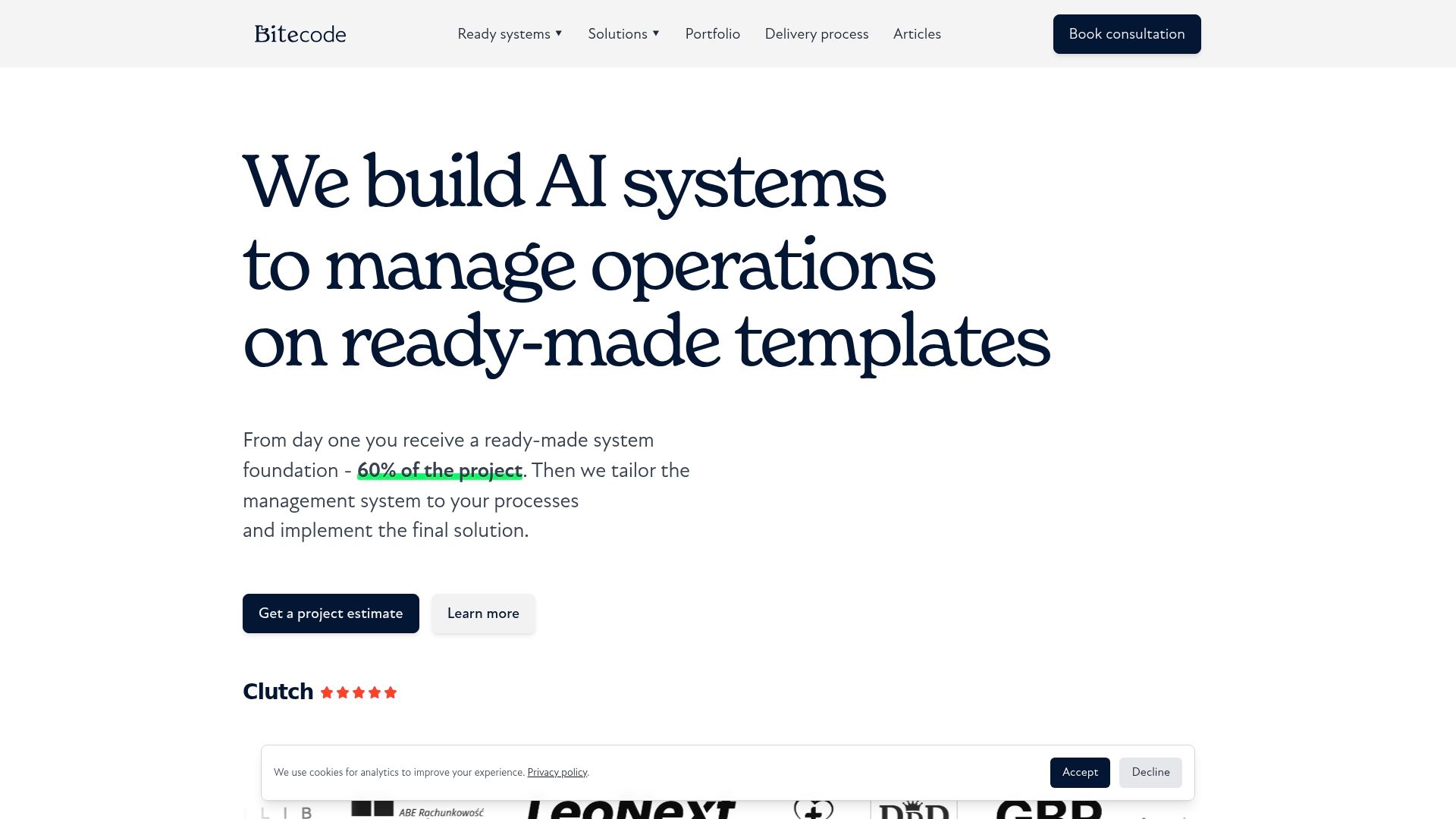
The vendor advertises a 60% baseline delivered on day one for new projects, letting teams start with a substantial portion of the system already in place. Bitecode pairs that prebuilt foundation with AI modules, open-source templates, and consulting support.
Core Features
- Ready-made system foundation that supplies a large portion of the baseline at project start.
- Tailored adaptation of workflows with a low-code approach for sales, finance, support, and operations.
- An agent-based model that uses AI to accelerate configuration and automation.
- Custom extensions and modular templates via OpenKnit open-source building blocks.
Key Differentiator
That initial 60% figure shortens the initial build phase by giving you concrete, production-ready modules from day one. The combination of prebuilt components plus extensible templates reduces repetitive engineering work and lets teams focus on business-specific logic.
Pros
- Rapid deployment with ready-made templates speeds pilot launches and internal proofs of concept.
- High customization and scalability let you iterate on workflows instead of rebuilding core services.
- Strong project management and delivery focus mean projects follow a structured timeline and governance model.
- Proprietary open-source tools provide exportable assets and reduce vendor lock-in compared with fully closed platforms.
- Client references emphasize security and goal-oriented delivery, which helps when you need documented outcomes for procurement.
Cons
- Best suited to engagements with a clear scope; exploratory or loosely defined programs will require more upfront scoping and ongoing development effort.
Who It’s For
Business managers, IT leaders, and entrepreneurs who need custom management and automation systems faster than a full bespoke build. Particularly useful for medium to large organizations that value control, modularity, and the option to extend or fork foundations later.
Unique Value Proposition
That 60% baseline changes the project economics. Instead of spending several sprints rebuilding common modules, your team starts with a deployable core and buys development cycles for distinct workflows and integrations.
Real World Use Case
According to Bitecode, a mid-sized enterprise automated sales and finance workflows with custom AI modules and reduced manual tasks by up to 60%. The deployment moved routine document handling and routing into the system, freeing staff for exceptions and analysis.
Pricing
Pricing is not published on the site. The vendor indicates project-based engagements and custom quotes, so budgets typically reflect scope, chosen templates, and integration complexity rather than fixed per-seat fees.
Website: https://bitecode.tech
Scholastica
At a Glance
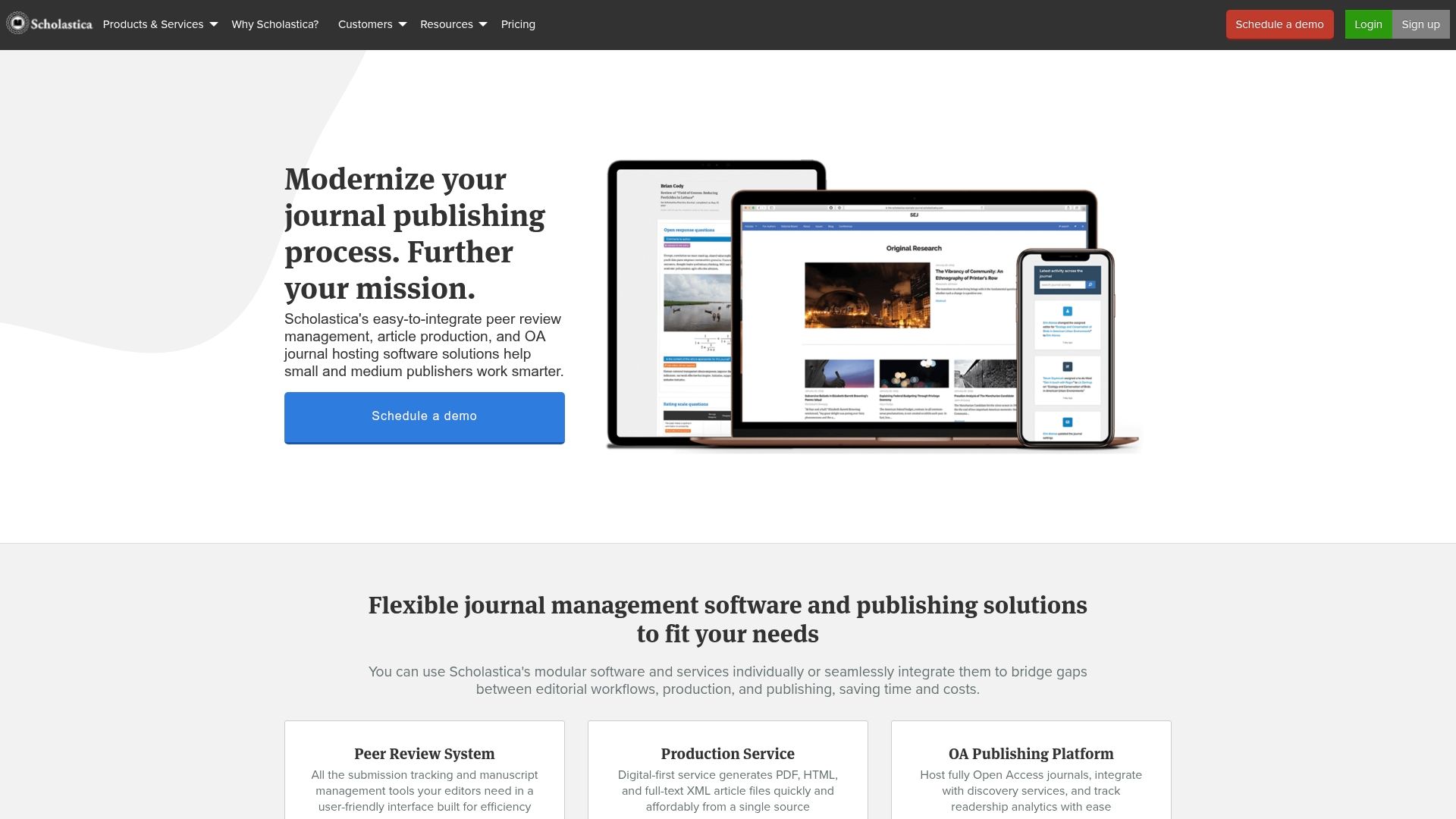
Scholastica reports being used by over 1,000 journals, a vendor claim that signals traction among small and mid sized publishers. The platform bundles peer review, article production, and Open Access hosting into modular services that aim for quick setup and low technical overhead.
Core Features
- Peer review management with customizable workflows and automation for reminders and decision tracking.
- End-to-end article production including typesetting, layout, and XML export for indexing workflows.
- Open Access journal hosting with search optimization and readership analytics to support discoverability.
- Integration support for DOI registration, archiving, indexing, and plagiarism detection.
- Automations for file versioning, submission tracking, and reviewer reminders.
Key Differentiator
Scholastica’s strength is its modular setup. Publishers can pick the peer review system, production services, or hosting independently and add components later. That modular approach reduces the need for in house engineering and lets editorial teams move from submission to publication without long technical projects.
Pros
-
Fast onboarding and migration support let small publishers go live in days or weeks, which is helpful when replacing legacy systems.
-
User-friendly interface reduces training time for editors and reviewers and shortens the first round of usage friction.
-
Flexible service model lets you use single modules or the full stack so budgets and workflows stay aligned.
-
Dedicated support and included system updates mean editorial teams do not need a separate vendor management process.
-
Detailed analytics give editors visibility into submission flows, reviewer turnaround, and readership trends.
Cons
-
No public API limits deep custom integrations or automation outside the supported connectors.
-
The platform does not provide impact factors or citation ranking services so bibliometric reporting must come from other providers.
-
Website presentation is template based only; Scholastica does not offer custom site design work.
-
There are no in house copyediting services; partners are recommended for that stage of production.
When It May Not Fit
If your organization needs a bespoke journal website with custom design or a public API for enterprise integrations, Scholastica will feel restrictive. Also avoid it if you require built in bibliometric tools or in house copyediting as part of a single contract.
Notable Integrations
- DOI registration services and Crossref compatibility.
- Archiving and indexing platforms such as Portico, DOAJ, and PubMed Central.
- Crossref’s Similarity Check for plagiarism detection.
- Copyright Clearance Center’s RightsLink for permissions and licensing.
Who It’s For
Small to medium scholarly publishers, university departments, and editorial teams that want an easy to manage, automated workflow without building infrastructure. Ideal when editorial capacity exists but technical resources are limited.
Real World Use Case
A university department switches from scattered email reviews to Scholastica’s peer review system. Automated reminders and version control cut review cycle time, while hosting on Scholastica satisfies indexing and archiving requirements for an Open Access journal.
Pricing
Pricing is not publicly disclosed, contact Scholastica for a quote and implementation options. That model means budgets require a vendor conversation rather than an on page sticker price.
Website: https://scholasticahq.com
Digital Commons

At a Glance
Digital Commons’ marketing highlights automatic Google Scholar indexation for hosted open access journals. The suite combines institutional repositories, journal hosting, virtual exhibits, and research data tools while offering impact dashboards and vendor-led training to help libraries get content discovered.
Core Features
- Institutional repository for hosting publications, theses, and reports.
- Open access journal publishing with indexation and editorial tools.
- Virtual collections and exhibits for curated digital storytelling.
- Research data storage, preservation, and management capabilities.
- Impact analytics and conference tools for measuring engagement.
Key Differentiator
The product bundles multiple publishing modules into a single service and pairs them with detailed impact dashboards and vendor support. That integration reduces the number of separate systems an institution must maintain, and the support program aims to shorten the learning curve for library staff.
Pros
-
Offers module-level integration so repositories, journals, exhibits, and data live under one administration. That simplifies rights management and metadata consistency across collections.
-
The vendor advertises SEO enhancements and automated updates that increase discoverability for hosted content. Libraries report fewer manual exports to indexing services when workflows are configured.
-
Professional design and management tools for virtual collections make exhibits presentable without heavy front end work from campus web teams.
-
Impact analytics deliver dashboards geared to institutional reporting, helping teams cite engagement metrics in annual reviews and grant narratives.
-
Dedicated training and support reduce onboarding friction for archivists and repository managers new to hosted platforms.
Cons
-
Publicly available third-party user reviews are scarce, so independent reports of day-to-day usability and support quality are limited.
-
Pricing details and flexible customization options are not published broadly, which complicates budgeting for institutions comparing vendors.
-
Some of the more advanced features require a learning period and likely demand staff time for configuration and policy alignment.
Who It’s For
Research libraries, university presses, and campus scholarly communications teams that need a managed publishing stack and analytics in one place. Institutions wanting a single vendor to host both repositories and open access journals will find the model familiar.
Real World Use Case
A university deploys Digital Commons to host its theses, faculty articles, and two open access journals. Staff use the analytics dashboard to track downloads and citation signals, and the library relies on vendor training to transfer editorial workflows onto the platform.
Pricing
Not applicable; the vendor presents the product as informational and does not publish standard list pricing. Procurement usually proceeds through institutional quotes that reflect scope, modules chosen, and any migration or customization work.
Website: https://bepress.com
HighWire Press

At a Glance
HighWire Press’s marketing materials state 99.97% uptime for its hosting and delivery stack, a concrete reliability claim publishers often ask about first. The platform traces its roots to Stanford University and has operated in scholarly publishing since 1995, now run under MPS Limited.
Core Features
-
Content hosting and management that covers journal articles, books, preprints, and multimedia assets.
-
Manuscript submission and peer review workflows that integrate reviewer assignment, decision tracking, and editorial checkpoints.
-
Analytics and reporting tools including Impact Vizor, Insight Vizor, and ScholarlyStats for readership and citation signals.
-
Identity and access solutions such as Sigma and THINK365 to manage subscriptions, entitlements, and institutional access.
Key Differentiator
HighWire positions itself as a publishing platform built specifically for academic publishers with decades of domain experience. That focus shows in product depth across hosting, peer review, preprint support, and citation-focused analytics rather than in generic content management features.
Pros
-
Long publisher track record gives editorial teams confidence in migration planning and archival continuity rather than a short-term point solution.
-
The analytics suite provides editorial and commercial teams with citation and usage views tailored to scholarly metrics, useful for tenure dossiers and society reporting.
-
The uptime claim above makes HighWire appealing for publishers that cannot tolerate downtime during peak article release windows.
-
Built-in peer review and submission flows reduce the need to stitch together multiple third-party review systems.
-
Preprint hosting and multimedia support let journals expand formats without separate vendors.
Cons
-
No specific user reviews are published in the product data, which leaves buyer-side operational issues undocumented and makes vendor selection heavier on vendor conversations.
-
The available information about customization and author-facing UX is limited, so expectations around look and feel must be validated during procurement.
-
The suite’s scope implies nontrivial onboarding and technical work; smaller presses with minimal IT capacity will face a learning curve.
When It May Not Fit
If you run a one-person journal or a small society with minimal editorial staff, HighWire’s scale and configuration needs may be more than required. If you need an out-of-the-box public-facing site with a highly specialized brand design and low technical involvement, a lighter turnkey host could be a better match.
Who It’s For
Academic publishers, university presses, and learned societies that need publishing-grade hosting, integrated peer review, and citation-aware analytics. Organizations that can budget for migration and have editorial or technical staff to manage a full-featured publishing platform will see the most benefit.
Real World Use Case
A university press moves multiple journals onto HighWire to consolidate hosting and peer review. Editors use the submission platform to shorten decision times, librarians access usage reports from Insight Vizor, and the press measures reach changes with ScholarlyStats to support subscription conversations with consortia.
Pricing
Not applicable — informational only according to the vendor data. Prospective buyers should expect custom commercial arrangements rather than public list tiers and request a vendor proposal during procurement.
Website: https://highwirepress.com
Elsevier Research and Scientific Content Platforms
At a Glance
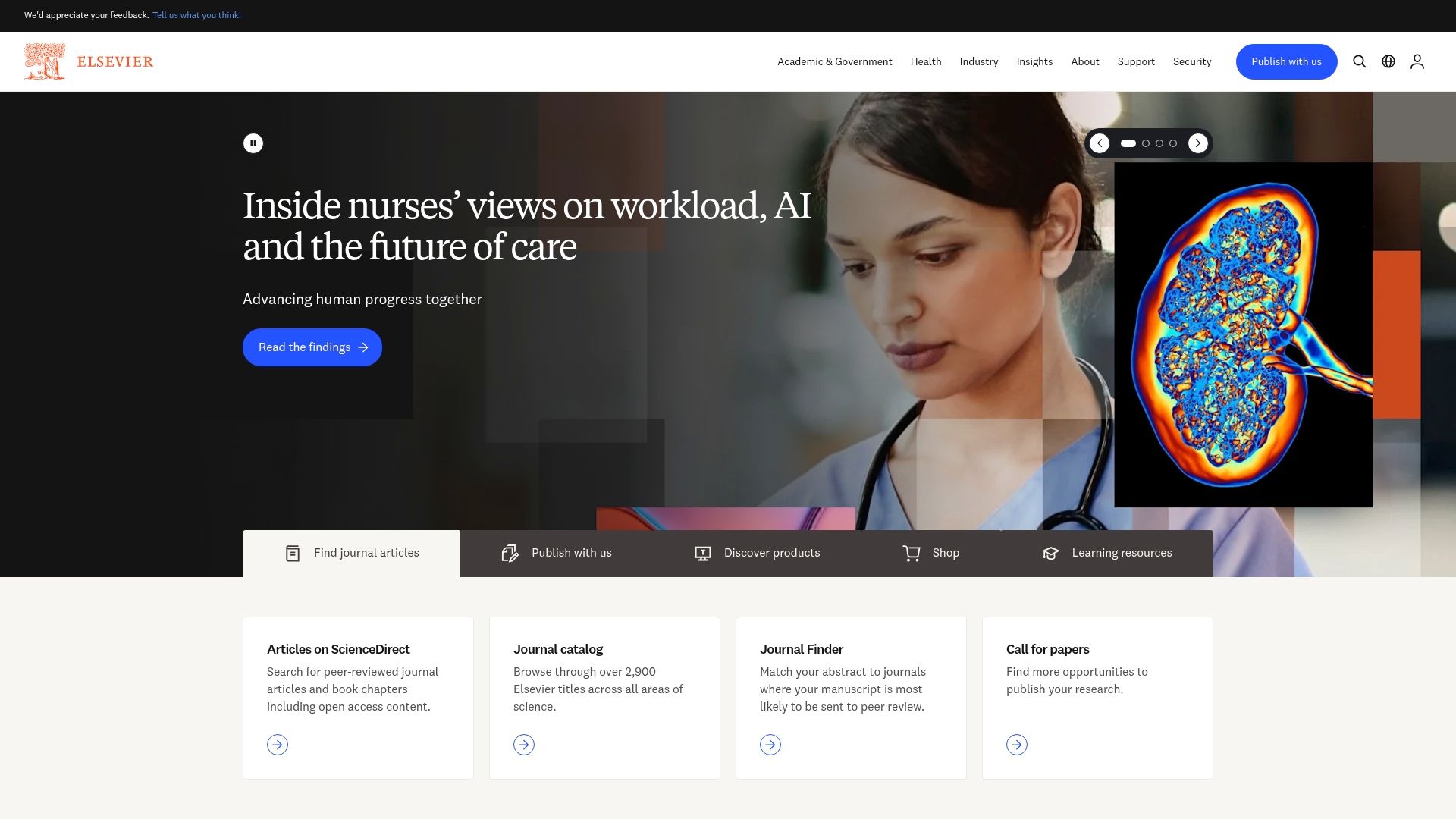
ScienceDirect, Scopus, and ClinicalKey sit under Elsevier alongside AI Discovery and analytics tools aimed at research impact and clinical decision support. The vendor presents these offerings as a combined content and analytics ecosystem for researchers, clinicians, and institutional programs.
Core Features
- ScienceDirect and Scopus for literature access and citation tracking across journals, books, and conference proceedings.
- ClinicalKey for clinical reference and decision support integrated with evidence summaries and point of care resources.
- Advanced search and filtering to find relevant literature, plus author profiles and citation metrics for impact measurement.
- AI Discovery and analytics tools to surface trends, recommend content, and help quantify research influence.
Key Differentiator
The vendor frames the product set around high quality peer reviewed content paired with analytics and AI features that push discovery beyond keyword search. That combination is positioned to help institutions measure impact while connecting clinical workflows to published evidence.
Pros
- Extensive content coverage gives researchers access to many journals, books, and proceedings under one vendor umbrella which simplifies acquisition and linking.
- Rich analytics let librarians and research offices track citations, collaboration networks, and topic emergence for reporting and strategy.
- Global coverage supports users in emerging markets as well as established research centers which helps multinational institutions maintain consistent resources.
- AI tools speed literature discovery and surface related work that manual searches can miss which reduces time spent on background review.
- Multiple product types address both research and clinical needs so one vendor relationship can cover campus libraries and hospital systems.
Cons
- No substantive third party user reviews were provided in the data which makes independent usability and satisfaction signals hard to verify.
- The materials supplied offer limited detail on the user interface and ease of use so training needs are unclear.
- Breadth of offerings increases complexity and may require formal onboarding or librarian support to get teams productive.
When It May Not Fit
If your organization needs a single lightweight discovery tool for occasional literature checks this vendor may be overkill. Smaller teams without library support will feel the management overhead. If you require explicit statements on system compatibility or onboarding workflows those details are not present in the provided data.
Notable Integrations
- Reaxys integration for chemical data
- SciVal for research performance analysis
- ClinicalKey for clinical decision support
- Mendeley for reference management
Who It’s For
Researchers, healthcare professionals, librarians, and industry R and D teams at universities or hospitals that need broad literature access, citation analytics, and tools that tie research outputs to measurable impact.
Real World Use Case
An academic library deploys Scopus for citation tracking and ScienceDirect for full text access. Librarians use analytics to identify rising topics and support faculty grant applications while ClinicalKey supplies clinicians with evidence at point of care.
Pricing
Not specified. Pricing is generally customized by organization or offered as individual subscriptions according to the vendor materials. Expect enterprise license negotiations and institution level contracts rather than fixed public list pricing.
Website: https://elsevier.com
Comparative Analysis
In consideration of low-code enterprise development options, several viable alternatives have been reviewed. Each platform offers distinct functionalities tailored to different operational requirements and preferences, allowing organizations to choose solutions that suit their unique needs.
Usability and Adaptability
Bitecode.tech excels in scenarios requiring rapid deployment of automation systems thanks to its prebuilt 60% project baseline and customizable AI modules. Organizations engaged in configurations for specific workflows, such as finance or customer support, benefit from its modular OpenKnit templates that enable flexible scalability. Nevertheless, Scholastica offers a streamlined approach for smaller publishers with its user-friendly interface and modular journal hosting services. Scholastica’s ease of onboarding and minimal technical overhead make it an attractive option for organizations with limited IT capacity.
Analytics and Reporting
For institutions focused on measurable impacts of their resources, Digital Commons provides analytics dashboards that aggregate data for engagement and citation metrics. These tools cater to libraries and universities that require detailed reporting for grants and strategic planning. Bitecode.tech, while powerful for automation and workflow customization, does not provide comparable analytical functionalities aimed at institutional reporting.
Best Fit
- Bitecode.tech stands out for organizations needing customizable low-code solutions and a substantial head start in project implementation.
- Choose Scholastica if ease of use and fast deployment in journal management are your primary concerns, particularly for smaller publishing teams.
- Opt for Digital Commons if impact analytics and institutional repository management are key priorities.
- Consider HighWire Press for integration of hosting, peer review, content management, and analytics tailored to academic publishing.
Our Pick
Bitecode.tech is our recommended selection for medium to large organizations aiming to rapidly deploy custom management systems with a significant initial workflow foundation. Its tailored modular tools alongside its AI capabilities uniquely position it as an efficient solution for diverse enterprise needs. That stated, institutions prioritizing advanced citation tracking or specific configurations for scholarly publishing may find products like Digital Commons or HighWire Press more suitable for their requirements.
Low-Code Enterprise Development Platforms Compared
Evaluating options for low-code enterprise development often includes considering how extensively a solution accelerates project initiation through prebuilt components and customization capabilities.
| Platform | Primary Use Case | Key Differentiator | Best For | Notable Limitation |
|---|---|---|---|---|
| Bitecode | Custom enterprise system development | Ready-made system foundation reducing initial effort | Medium to large organizations needing modular systems | Best suited for clearly scoped projects |
| Scholastica | Academic publishing workflow automation | Modular services for peer review and hosting | Small to medium scholarly publishers | No public API limits deep integrations |
| Digital Commons | Research content and publication hosting | Integrated modules with impact dashboards and training | Research libraries and university presses | Advanced features require configuration effort |
| HighWire Press | Scholarly publishing platform | Decades of domain experience and robust analytics | Academic publishers and learned societies | Extensive onboarding needed for smaller teams |
| Elsevier Platforms | Research and clinical support ecosystem | Broad literature access paired with citation analytics | Universities and research institutions | Feels complex for lightweight tool needs |
Discover Faster Alternatives to Cambridge.org with Bitecode
Choosing the right platform among cambridge.org alternatives can feel frustrating when you need custom workflows that fit your organization’s unique needs. Bitecode offers a remarkable solution by providing a 60 percent prebuilt system baseline, allowing your team to launch projects quickly without rebuilding common modules from scratch. This approach cuts development time dramatically while supporting AI automation and blockchain integration to meet complex enterprise requirements.
Ready to leave behind lengthy software builds? Visit Bitecode.tech today to explore modular, low-code solutions tailored for medium to large organizations. Take control of your digital transformation and start building custom systems that accelerate your workflow automation and financial processing in no time.
Frequently Asked Questions
What features make Bitecode a strong alternative for low-code enterprise development?
Bitecode offers a ready-made system foundation that supplies a significant 60% of the baseline on day one. This prebuilt foundation is complemented by AI modules, open-source templates, and consulting support, which accelerates configuration and automation. Organizations can expect a substantial reduction in initial development time, enabling them to focus on customizing workflows and enhancing productivity.
How does Bitecode compare to Scholastica for peer review management?
Scholastica excels with its user-friendly interface and modular setup that allows small publishers to launch quickly and manage peer reviews efficiently. Bitecode, however, provides a more scalable and customizable environment suited for medium to large organizations looking to build custom management systems. Teams that require extensive customization and rapid deployment may find Bitecode to be a better fit for their needs.
Can I customize workflows significantly with Bitecode?
Bitecode allows for high customization of workflows through its low-code approach, enabling companies to adapt processes in sales, finance, support, and operations. The combination of prebuilt components and extensible templates ensures that teams can iterate on their workflows without needing to rebuild core services. Businesses seeking tailored adaptations in their systems should consider utilizing Bitecode for its flexible solutions.
What is the pricing model for Bitecode?
Bitecode’s pricing is project-based and varies depending on the chosen templates and integration complexity, rather than having a fixed per-seat fee. As such, organizations will need to engage in a discussion with Bitecode to obtain a custom quote that reflects their specific project’s needs and scope.
When might Bitecode not be the best option for an organization?
Bitecode is best suited for projects with a clear scope; exploratory or loosely defined programs may demand more upfront scoping and ongoing development effort. Organizations that require extensive exploratory flexibility might want to consider alternatives that cater specifically to those needs.