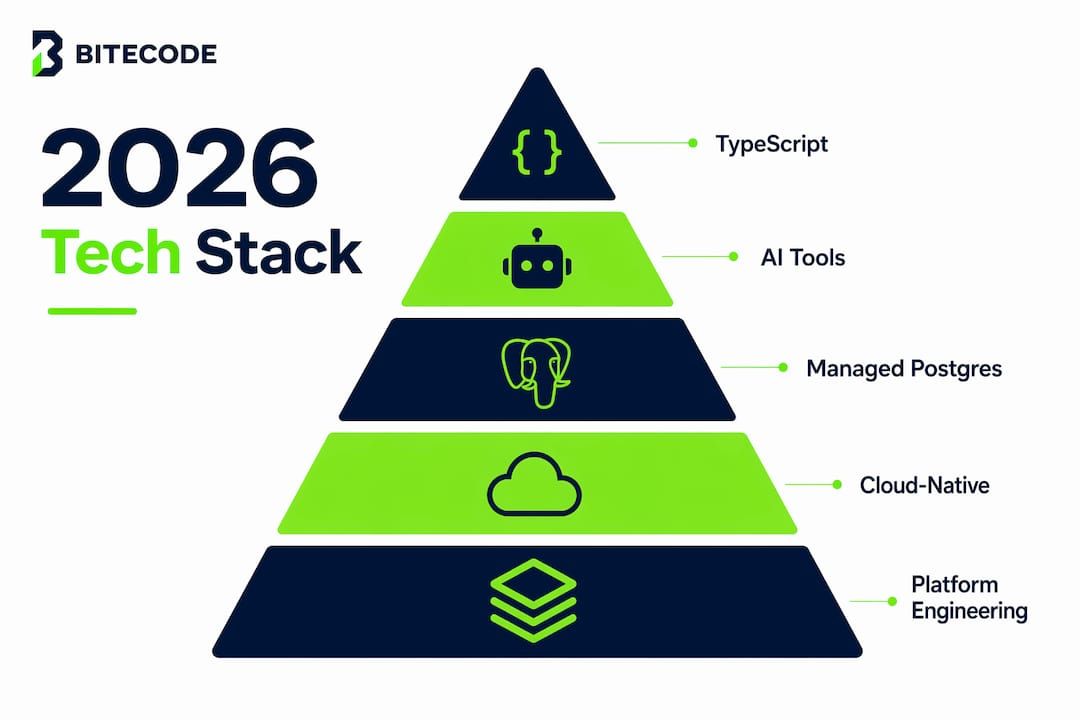
In 2026, the software development technologies that matter most are AI-assisted tooling, typed languages with modern frameworks, managed Postgres, cloud-native and edge patterns, platform engineering, DevSecOps, and low-code for internal apps. Teams that concentrate on this short list ship faster, accumulate less technical debt, and keep their hiring pool realistic. The 2025 Stack Overflow Developer Survey confirms the directional signals: Python growth continues, Rust’s popularity is rising, and Docker’s container tooling adoption keeps climbing.
Quick priorities for engineering leads:
- Adopt TypeScript as the default for all new frontend and full-stack work; it is now effectively required in serious product roles.
- Treat AI coding assistants as permanent infrastructure, not experiments. Pair programming with AI is standard practice on high-output teams.
- Pick one managed Postgres provider and stop rebuilding data infrastructure from scratch.
- Integrate security scanning into CI/CD pipelines before the first production deploy, not after.
- Use low-code for internal tooling; reserve custom code for genuine business-domain complexity.
The verdict: teams that resist chasing every new tool and instead deepen their command of a small, opinionated stack consistently outperform those that spread thin across a dozen frameworks. Bitecode’s modular, AI-enabled delivery model is one practical path to that discipline.
Top software development technologies and trends shaping 2026
The list below is ordered by practical impact for most product and enterprise teams, not by hype. Each entry includes real use cases, the primary adoption risk, and a signal on when adoption makes sense.
1. AI/LLMs and AI-assisted development tools
AI coding assistants have moved from novelty to infrastructure. Many engineers keep an AI agent open alongside their editor, using it for scaffolding, routine fixes, and test generation while reserving architecture and domain logic for human judgment. Visual Studio Code and Visual Studio remain the dominant IDEs, but AI agent modes and paid extensions are now the productivity layer on top of them.
The bigger architectural shift is in how AI features are built into products. Direct model calls have given way to layered architectures: retrieval-augmented generation (RAG), tool exposure via the Model Context Protocol (MCP), and evaluation loops that catch regressions before they reach users. Context engineering, not prompt engineering, is the high-leverage skill.
Use cases: automated code review, test scaffolding, internal knowledge retrieval, customer-facing AI assistants. Risk: teams over-rely on generated code without understanding it, accumulating hidden complexity. Mitigation: require human review of all AI-generated logic touching business rules or data access. When to adopt: immediately, for any team with more than two engineers.
2. TypeScript and modern frontend frameworks
TypeScript is the de facto standard across product engineering. It is not a preference anymore; it is a hiring and maintainability baseline. On the framework side, React 19 and Next.js 15 are the current stable defaults, with Server Components, Server Actions, and Turbopack in production use at scale.

Use cases: SaaS dashboards, customer portals, internal admin tools. Risk: Server Components introduce a mental model shift; teams unfamiliar with the server/client boundary ship subtle hydration bugs. Mitigation: enforce a clear component-boundary convention from day one. When to adopt: any greenfield project, and as the migration target for legacy React 16/17 codebases.
3. Rust and systems-level languages
Rust’s popularity in the Stack Overflow survey has grown steadily for several years, and it is now appearing in production at companies that previously defaulted to Go or C++. Its memory-safety guarantees without a garbage collector make it attractive for performance-critical services, CLI tooling, and WebAssembly targets.

Use cases: high-throughput data pipelines, security-sensitive parsing, WebAssembly modules embedded in web apps. Risk: steep learning curve; onboarding a team to Rust’s ownership model takes months, not weeks. Mitigation: start with a single isolated service or CLI tool rather than rewriting a core backend. When to adopt: teams with a specific performance or safety constraint that Go or C++ cannot meet cleanly.
4. Cloud-native, edge compute, and serverless patterns
Edge functions are now mainstream for personalization, authentication, A/B testing, and caching at the request path. Heavy computation, long transactions, and stateful workloads still belong on cloud VMs or dedicated services. The practical split is: put latency-sensitive, stateless logic at the edge; keep everything else centralized.
Gartner has long noted that cloud will be the centerpiece of new digital experiences, and that prediction has aged well. Serverless functions (AWS Lambda, Google Cloud Run, Cloudflare Workers) reduce operational overhead for event-driven workloads.
Use cases: geo-targeted content delivery, JWT validation at the edge, background job processing. Risk: cold-start latency and vendor lock-in for complex stateful workflows. Mitigation: keep business logic portable; avoid embedding domain rules in platform-specific function signatures. When to adopt: any team deploying to a CDN-backed architecture or building event-driven microservices.
5. Managed Postgres and modern data platforms
The Postgres renaissance is real. Managed and serverless Postgres offerings from providers like Neon and Supabase, plus Cloud SQL alternatives, make Postgres a central, cost-effective, and ergonomic data platform for most application backends. The era of defaulting to a proprietary cloud database for every new project is fading.
Use cases: transactional SaaS backends, audit-ready financial records, multi-tenant application data. Risk: teams underestimate schema migration discipline at scale. Mitigation: adopt a migration tool (Flyway, Liquibase, or Prisma Migrate) from the first commit. When to adopt: virtually every new application backend unless there is a documented reason to choose otherwise.
6. Microservices, containers, and platform engineering
Docker’s adoption continues to climb in the Stack Overflow survey, and Kubernetes has become the default orchestration layer for teams beyond a certain scale. The more interesting shift is the rise of platform engineering: dedicated internal developer platforms (IDPs) that give engineers a “golden path” to production without requiring deep infrastructure knowledge.
Platform engineering is now a performance multiplier. Teams with a well-designed IDP ship faster and with fewer production incidents than those where every engineer manages their own deployment pipeline. The investment pays back quickly once a team exceeds roughly a dozen engineers.
Use cases: standardized deployment pipelines, self-service environment provisioning, policy enforcement at the platform layer. Risk: premature microservice decomposition creates distributed-system complexity before a team has the operational maturity to manage it. Mitigation: start with a modular monolith; extract services only when a clear scaling or ownership boundary emerges. When to adopt: platform engineering at 10+ engineers; microservices when a specific service has a distinct scaling profile.
7. Low-code and no-code for internal applications
Industry forecasts point to low-code and no-code platforms accounting for a large share of business applications in the near term. The practical use case is internal tooling: approval workflows, dashboards, data entry forms, and lightweight CRMs that do not justify a full custom build.
The trade-off is real. Low-code accelerates delivery but relocates complexity into the vendor relationship. A black-box platform that handles 80% of a workflow cleanly will eventually hit the 20% that requires custom logic, and that boundary is where projects stall.
Use cases: HR onboarding workflows, operations dashboards, internal approval queues. Risk: vendor lock-in and limited extensibility for complex business rules. Mitigation: use low-code for the stable, well-understood parts of a workflow; build custom modules for the domain-specific logic. When to adopt: internal apps with clear, bounded requirements and a non-technical owner.
8. DevOps, CI/CD, testing, and observability
A mature CI/CD pipeline is table stakes. What separates high-performing teams in 2026 is the observability layer: distributed tracing (OpenTelemetry), structured logging, and real-user monitoring that feed back into deployment decisions. Mean time to recovery (MTTR) is a more honest measure of pipeline health than deployment frequency alone.
Testing strategy matters as much as tooling. Contract testing between services, property-based testing for data-heavy logic, and snapshot testing for UI components each address failure modes that unit tests miss. The goal is a test suite that catches real bugs without becoming a maintenance burden.
Use cases: automated regression detection, canary deployments, SLO-based alerting. Risk: teams invest in tooling but not in test quality, producing a green pipeline that misses production bugs. Mitigation: track defect escape rate alongside coverage metrics.
9. Security and software supply-chain integrity
Integrating SAST and automated security scanning into CI/CD pipelines is now a standard recommendation, not an advanced practice. Software bill of materials (SBOM) generation, dependency pinning, and signed container images address the supply-chain attack surface that has grown significantly as open-source dependency graphs have deepened.
DevSecOps shifts security left: every pull request is a security checkpoint, not just a code review. Tools like Snyk, Trivy, and GitHub’s Dependabot automate the routine scanning so engineers focus on architectural risk.
Risk: alert fatigue from too many low-signal findings. Mitigation: tune scanner policies to surface critical and high findings only; triage medium findings on a weekly cadence.
10. Ethical considerations and quantum computing’s influence
Ethical software development is no longer a compliance checkbox. Bias audits for ML models, data minimization by design, and transparent algorithmic decision-making are increasingly expected by enterprise buyers and regulators. Teams building AI features need an evaluation loop that tests for disparate impact, not just accuracy.
Quantum computing’s near-term influence on most software teams is indirect: post-quantum cryptography standards (NIST finalized its first set in 2024) are the practical action item. Any system storing data with a multi-decade sensitivity window should begin planning a migration to quantum-resistant algorithms now, even if full quantum threat is years away.
Adoption signals at a glance:
| Technology | Adoption signal | Primary risk |
|---|---|---|
| AI coding assistants | Mainstream; dominant IDEs augmented by agent modes | Over-reliance on generated code |
| TypeScript + React 19/Next.js 15 | De facto standard for product roles | Server Component mental model gap |
| Rust | Rising popularity in Stack Overflow survey | High onboarding cost |
| Edge/serverless | Mainstream for stateless request-path work | Vendor lock-in for stateful logic |
| Managed Postgres | “Postgres renaissance” underway | Schema migration discipline |
| Platform engineering / IDPs | Performance multiplier at 10+ engineers | Premature investment for small teams |
| Low-code / no-code | Large forecast share of business apps | Extensibility ceiling |
| DevSecOps / CI/CD | Standard practice; SAST in pipelines | Alert fatigue |
How to choose the right technologies for your team
The most common mistake engineering leaders make is treating technology selection as a research problem rather than a trade-off problem. The question is never “what is the best tool?” It is “what is the best tool given our team’s skills, our product’s maturity, and our next 12 months of delivery commitments?”
A practical decision checklist:
- Time-to-market: Does adopting this technology shorten or lengthen your next release cycle? A new framework that requires three months of upskilling before it pays back is a valid choice for a stable team, not for one under delivery pressure.
- Team skills: What is the honest gap between your team’s current skills and the technology’s learning curve? Hiring to fill that gap has a 3–6 month lead time minimum.
- Scalability and compliance: Does the technology meet your data residency, audit, and security requirements out of the box, or does it require custom work to reach compliance?
- Vendor dependency: How much of your core business logic would live inside a vendor’s black-box platform? The more critical the logic, the higher the lock-in risk.
- Operational cost: What is the fully-loaded cost, including infrastructure, licensing, and the engineering time to maintain it?
Pilot vs. phased migration vs. full rewrite
A pilot (8–12 weeks) is the right starting point for any technology your team has not used in production. Scope it to a single, non-critical feature or internal tool. Define acceptance criteria before you start: performance targets, defect rate, and time-to-deploy.
A phased migration applies the strangler fig pattern: new functionality is built on the target stack while the legacy system handles existing traffic. This is the lowest-risk path for teams with a production system they cannot afford to take offline.
A full rewrite is almost always riskier than it looks. Reserve it for systems where the existing codebase is genuinely unmaintainable and where the business can absorb 6–18 months of parallel investment.
Low-code vs. custom code comes down to business-domain complexity. If the workflow is well-understood, bounded, and unlikely to require deep customization, low-code delivers faster. If the workflow encodes competitive differentiation or complex financial logic, custom code with a modular foundation is the more defensible choice.
Pro Tip: Measure pilot success with outcome metrics: MTTR, deployment frequency, and defect escape rate. Avoid vanity metrics like lines of code written or number of features shipped, which tell you nothing about whether the technology choice actually improved delivery.
Bitecode’s opinionated minimal stack for 2026
Successful engineering teams in 2026 focus on a small, opinionated set of fundamentals rather than chasing every new tool. The stack below reflects that discipline. It is not exhaustive; it is the minimum that covers the full delivery surface for most enterprise and SaaS products.
| Layer | Choice | Rationale |
|---|---|---|
| Frontend | TypeScript + React 19 / Next.js 15 | Stable, widely hired, Server Components reduce API boilerplate |
| Backend | Node.js (TypeScript) or Python | Shared language context with frontend; Python for ML-adjacent services |
| Data | Managed Postgres (Neon or Supabase) | Cost-effective, ergonomic, audit-ready |
| Infrastructure | Docker + Kubernetes (or managed container service) | Portable, observable, platform-standard |
| AI layer | RAG pipeline + MCP for tool exposure | Context engineering over raw prompting |
| Observability | OpenTelemetry + structured logging | Vendor-agnostic; feeds MTTR tracking |
| CI/CD | GitHub Actions + SAST scanner | Low friction; security integrated from day one |
An 8–12 week pilot plan
- Weeks 1–2: Scope and baseline. Define the single feature or internal tool the pilot will build. Measure the current state: deployment time, defect rate, and any relevant performance baseline.
- Weeks 3–4: Environment and pipeline. Stand up the CI/CD pipeline with SAST scanning, containerized local development, and a managed Postgres instance. No feature code yet.
- Weeks 5–7: Core feature build. Build the scoped feature on the target stack. AI coding assistants handle scaffolding; engineers own architecture and domain logic.
- Week 8: Integration and contract testing. Wire the feature into the existing system. Run contract tests against any downstream services.
- Weeks 9–10: Observability and load testing. Instrument with OpenTelemetry. Run load tests against acceptance criteria defined in week one.
- Weeks 11–12: Review and decision. Measure against acceptance criteria. Present a go/no-go recommendation with data, not opinion.
Acceptance criteria to define upfront:
- P95 response time under target load
- Zero critical SAST findings in the pipeline
- Defect escape rate at or below the team’s current baseline
- Time-to-deploy for a single change under 15 minutes
Migration tactics worth knowing:
- The strangler fig pattern lets teams migrate feature by feature without a big-bang cutover.
- A golden-path IDP removes the cognitive load of infrastructure decisions from individual engineers, which accelerates the pilot and every subsequent delivery.
- For AI automation implementation, start with a single retrieval use case before building a full agentic pipeline.
Bitecode’s modular foundation starts projects with up to 60% of the baseline system pre-built, which compresses the environment and pipeline setup phases significantly. Teams that use a modular approach for tailored software solutions typically reach a working MVP faster than greenfield builds on the same stack.
Pro Tip: The ROI of a modular implementation is most visible in the second and third features, not the first. Track cumulative time-to-deliver across the pilot and the first two follow-on features to get an honest picture of the compounding benefit.
Key Takeaways
Successful software development technology choices in 2026 come down to a small, opinionated stack, a disciplined pilot process, and security integrated from the first commit.
| Point | Details |
|---|---|
| Prioritize a short stack | TypeScript, React 19/Next.js 15, managed Postgres, and AI tooling cover most product and enterprise needs. |
| Pilot before you commit | An 8–12 week scoped pilot with defined acceptance criteria is the lowest-risk path to any new technology. |
| Shift security left | Integrate SAST scanning and SBOM generation into CI/CD pipelines before the first production deploy. |
| Measure outcomes, not activity | Track MTTR, defect escape rate, and deployment frequency; ignore lines of code and feature count as success signals. |
| Bitecode as a delivery path | Bitecode’s modular foundation starts with up to 60% pre-built, compressing pilot timelines for AI, fintech, and workflow automation projects. |
What Bitecode sees working in real projects
The pattern that shows up most consistently in successful enterprise engagements is not a particular tool choice. It is the combination of an opinionated stack, a platform engineering mindset, and targeted AI augmentation applied to a well-scoped problem. Teams that try to modernize everything at once tend to produce a distributed system that is harder to operate than the monolith they replaced.
One pattern worth naming: a mid-sized financial services organization came in with a legacy workflow system that was blocking a compliance deadline. The approach was to use a modular foundation to stand up the new compliance workflow in parallel, migrate data incrementally using the strangler pattern, and instrument the new system with OpenTelemetry from day one. The legacy system stayed live throughout. The compliance deadline was met, and the team had a working observability baseline they had never had before. The lesson is not that modular beats custom in every case. It is that starting with 60% pre-built changes the risk profile of the first eight weeks entirely.
The one thing teams can apply immediately: define your acceptance criteria before you write the first line of code on a pilot. The teams that skip that step are the ones that end up debating whether the pilot “succeeded” six months later.
Bitecode’s fixed-scope pilot for modern stack delivery
Most teams know which technologies they want to adopt. The gap is in the delivery: standing up a production-ready environment, integrating AI tooling correctly, and shipping a working MVP without accumulating the kind of boilerplate debt that slows every subsequent feature.
Bitecode’s fixed-scope pilot runs 8–12 weeks and delivers a working MVP built on the modular foundation described above: TypeScript frontend, managed Postgres, AI integration via RAG and MCP, containerized infrastructure, and a CI/CD pipeline with security scanning built in. Up to 60% of the baseline system arrives pre-built, which means the pilot spends its time on your business logic, not on infrastructure setup. Deliverables include modular components you own outright, documented acceptance criteria, and a go/no-go recommendation backed by outcome data.
For teams focused on AI automation, the AI business process automation service covers the retrieval and agentic pipeline layers. For broader custom application needs, the custom web app development service page outlines the full engagement model. Schedule a scoping call to define the pilot’s acceptance criteria and timeline before any commitment.
Authoritative sources and further reading
The sources below are the highest-value references for validating a technology choice or building a business case for a pilot.
- 2025 Stack Overflow Developer Survey — Technology: The primary survey for adoption data on languages, frameworks, IDEs, and tooling. Use it to benchmark your team’s stack against the broader developer population.
- The State of Software Engineering in 2026 (Frontend Tech Lead): Practitioner-level analysis of what has actually changed in production engineering, including AI architecture patterns, TypeScript adoption, and the Postgres renaissance.
- Gartner: 75% of enterprise software engineers will use AI code assistants by 2028: The most-cited institutional forecast for AI tooling adoption; useful for executive-level business cases.
- Gartner: Cloud as the centerpiece of new digital experiences: Foundational framing for cloud-native investment decisions.
- Top Emerging Trends in Software Development (Pace Online): Accessible overview of low-code, AI, and cloud trends with academic context.
- Best Software Development Practices: A Complete Guide for 2026: Practical DevSecOps and CI/CD guidance with specific tooling recommendations.
- Bitecode: AI Automation Trends 2026: Strategic view on AI adoption risks and decision criteria for engineering leaders.
- Bitecode: AI Integration Step by Step: Practical implementation checklist for teams beginning their first AI feature build.
A note on using these sources: survey data and analyst forecasts set directional context; they do not validate a specific technology choice for your team’s situation. Use them to frame the business case, then validate the choice with a time-boxed pilot against your own acceptance criteria.