TL;DR:
- Custom software solutions are increasingly preferred for their precise fit, control, and scalability despite common perceptions of slow deployment. AI-augmented workflows accelerate each development phase but require disciplined requirements analysis to avoid scope creep and ensure success. Enterprises should balance customization, modular foundations, and governance frameworks like AEGIS to mitigate risks and leverage AI’s full potential effectively.
Enterprises often assume that getting software built exactly to their specifications means slow timelines, ballooning budgets, and months of back-and-forth before anything useful ships. That assumption is increasingly outdated. A tailored software solution is purpose-built to match an organization’s specific workflows, data structures, and integration requirements, rather than forcing teams to adapt around a generic product. With the custom software market projected to grow from $186.5B in 2024 to $682.4B by 2035, the industry is clearly signaling that fit, control, and AI extensibility are now non-negotiable priorities for enterprises serious about digital transformation.
Key Takeaways
| Point | Details |
|---|---|
| Tailored solution definition | A tailored software solution is custom-built to match specific business needs, offering flexibility, integration, and full ownership. |
| AI accelerates deployment | Integrating AI and automation into development now enables rapid and reliable delivery of tailored software for enterprises. |
| Hybrid approaches | Blending tailored and off-the-shelf elements can balance speed, ownership, and cost for many organizations. |
| Enterprise AI guardrails | Robust frameworks like AEGIS are essential to safely harness agentic AI in customized enterprise solutions. |
| Market growth opportunity | Demand for tailored, AI-powered software is booming, making now the time for enterprises to invest strategically. |
What is a tailored software solution?
A tailored software solution is a system designed and built specifically around an organization’s requirements, rather than purchased as a packaged product intended for broad market use. This is distinct from off-the-shelf software, which ships with fixed features and limited configuration options, and also from hybrid models, which layer some customization onto a commercial foundation. Understanding where each model sits is critical before any enterprise commits resources.
The drivers behind choosing tailored over other options are practical. Medium and large enterprises typically face a combination of factors that generic products simply cannot address:
- Complex, multi-department workflows that don’t map to standard modules
- Deep integration requirements with legacy ERP, CRM, or financial systems
- Regulatory and compliance needs specific to their sector or geography
- Proprietary business logic that represents genuine competitive differentiation
- Long-term scalability requirements that outpace the roadmap of any single vendor
Core advantages cluster around fit, control, integration depth, and scalability. Tailored solutions are built to the exact types of business software an organization actually needs. They don’t carry the feature bloat of a platform designed to serve thousands of different companies. Teams own the codebase, which means they control the upgrade path, the data model, and the integration surface.
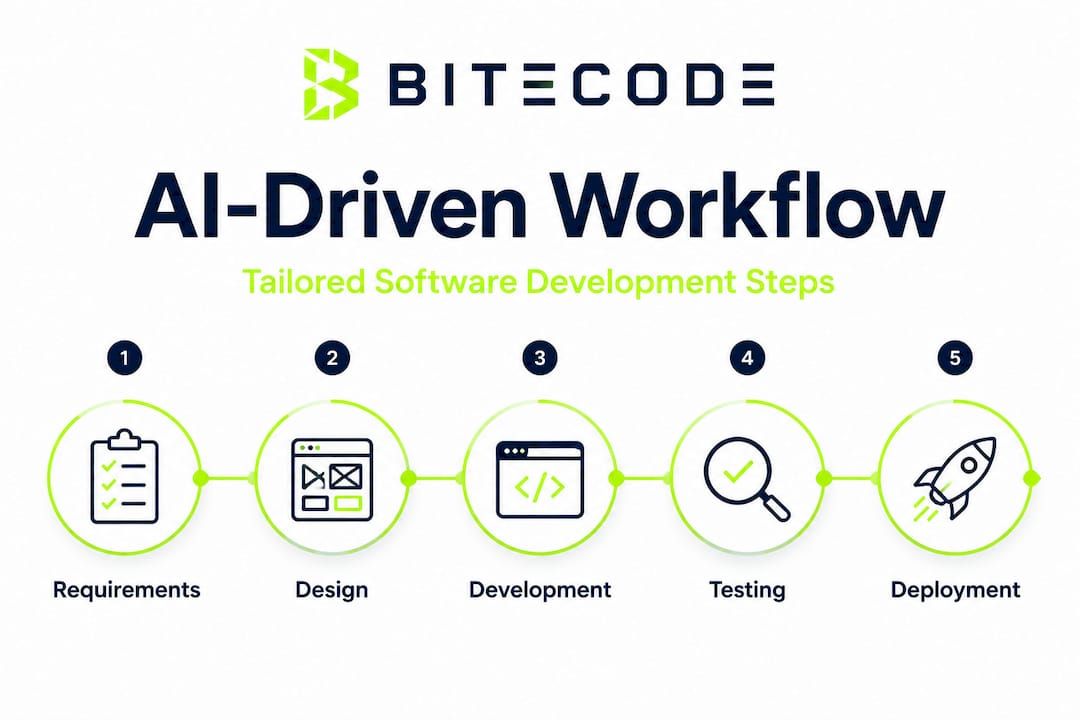
The agile methodologies most commonly used in tailored development follow structured phases including requirement analysis, design, development, testing, deployment, and ongoing maintenance, with AI now augmenting each stage. The comparison below clarifies how each model maps to common enterprise priorities.
| Criterion | Tailored | Off-the-shelf | Hybrid |
|---|---|---|---|
| Fit to requirements | High | Low to medium | Medium |
| Time to first deployment | Longer (without AI tooling) | Fast | Medium |
| Vendor lock-in risk | Low | High | Medium to high |
| AI extensibility | Full control | Limited by vendor | Partial |
| Long-term cost | Lower (no licensing) | Higher (recurring) | Variable |
| Codebase ownership | Full | None | Partial |
For teams weighing this decision carefully, the bespoke vs big agency comparison is worth reviewing before selecting a development partner or model.
Core phases and AI-augmented workflows in tailored development
Modern tailored development doesn’t look the way it did five years ago. Agile processes have always offered iterative flexibility, but AI tooling has fundamentally changed what’s achievable within each sprint. The standard lifecycle phases remain the reference structure, but the velocity and reliability achievable inside each phase have shifted considerably.
- Requirements analysis — Teams capture functional and non-functional requirements, define integration points, and map business-domain complexity. AI tools now assist with requirement gap analysis and conflict detection across large specification documents.
- Design — Architects define data models, API contracts, and module boundaries. AI-assisted diagram generation and code scaffolding reduce the manual overhead of greenfield design work.
- Development — Code generation tools accelerate the build of boilerplate logic, while agentic workflows handle repetitive implementation tasks across the codebase.
- Testing — Automated test generation, regression suites, and AI-powered anomaly detection make quality assurance faster and more thorough than manual approaches alone.
- Deployment — CI/CD pipelines, infrastructure-as-code templates, and AI monitoring tools reduce deployment risk and cut time-to-production.
- Maintenance — Predictive alerting, automated dependency updates, and intelligent log analysis lower the ongoing burden on engineering teams.
The table below shows how AI augmentation affects each phase in concrete terms.
| Phase | Traditional timeline | AI-augmented timeline | Key AI tooling |
|---|---|---|---|
| Requirements | 3-6 weeks | 1-2 weeks | NLP analysis, gap detection |
| Design | 2-4 weeks | 1-2 weeks | Scaffolding, diagram generation |
| Development | 12-24 weeks | 6-12 weeks | Code generation, agentic tasks |
| Testing | 4-8 weeks | 1-3 weeks | Auto test generation, anomaly detection |
| Deployment | 2-4 weeks | Under 1 week | CI/CD, AI monitoring |
The efficiency gains from custom apps built with these workflows are real, but they depend on disciplined requirement analysis at the outset. AI accelerates execution. It does not compensate for vague or incomplete specifications.
Pro Tip: Don’t let AI tooling create a false sense of momentum in early phases. Teams that skip thorough requirements work and rely on AI to “fill in the gaps” during development consistently encounter scope creep and rework. The discipline required for enterprise integration doesn’t change because code generation is faster; it becomes more important, because mistakes propagate more quickly. Understanding how to go from idea to custom software with a solid plan remains the single highest-leverage investment in any tailored project.
Tailored vs off-the-shelf vs hybrid: Which approach fits your enterprise?
Every enterprise software decision relocates risk and complexity somewhere. The question is where. Choosing off-the-shelf software relocates complexity into the vendor relationship: you gain speed at the cost of control, and you depend on the vendor’s roadmap for every capability you need. Choosing a greenfield tailored build puts risk into delivery execution and ongoing maintenance. Hybrid approaches sit between those poles, but they carry their own trade-offs.
“Off-the-shelf offers quick deployment but vendor lock-in and feature bloat; tailored provides ownership and fit but requires disciplined requirements and maintenance; hybrid balances both for enterprises.”
The hybrid model is often the most practical choice when an enterprise needs core functionality fast but has specific workflows that no commercial product handles well. Layering AI automation on top of an existing off-the-shelf foundation is one example of a hybrid approach that delivers meaningful value without a full greenfield build.
Common mistakes enterprises make when selecting a model:
- Choosing off-the-shelf for cost reasons and then spending more on workarounds and integrations than a tailored build would have cost
- Starting a tailored build without clearly defined ownership of the requirements process, resulting in a product that fits no one well
- Assuming hybrid is always the safe middle ground, without mapping which features will be owned by the vendor versus customized
- Underestimating the total cost of vendor licensing and upgrade dependency over a five to ten year horizon
- Failing to evaluate AI extensibility as a core criterion, making the chosen platform a constraint on future automation investment
For teams exploring the spectrum between hybrid and custom builds, the starting point matters as much as the destination. Platforms that offer a modular foundation, where 60% or more of the baseline system is already built, let teams accelerate work without accelerating chaos. Examining the difference between a boilerplate, black-box, and purpose-built starting point is a useful exercise before committing to any approach.
Market trends and the role of AI-powered tailored solutions
The numbers support what enterprise IT leaders are experiencing in practice. The custom software market is on course to grow from $186.5 billion in 2024 to $682.4 billion by 2035, at a compound annual growth rate of 12.8%. That is not a niche trend. It reflects a structural shift in how enterprises think about software as a strategic asset rather than a utility cost.
Several converging forces are driving this growth:
- Digital transformation mandates pushing organizations to replace legacy systems that cannot support modern data models or AI workflows
- AI integration demands requiring software with open, extensible architectures rather than black-box platforms
- Competitive differentiation pressure making proprietary business logic a priority that off-the-shelf products cannot protect
- Data sovereignty and compliance requirements that demand full control over where data is stored and how it is processed
- Workforce automation initiatives requiring custom workflow engines that integrate directly with internal systems
For enterprise teams, the opportunity is not simply to adopt tailored software but to build it with AI and automation as first-class design requirements rather than afterthoughts. Following established digital transformation practices and staying current with 2026 enterprise software trends are both essential for teams that want to align their software strategy with where the market is heading.
Pro Tip: When evaluating a tailored solution, ask explicitly how the architecture supports future AI module additions. A system that wasn’t designed with agentic workflows in mind will require significant rework to support them later. Building AI extensibility into the initial design, guided by 2026 software best practices, is far less expensive than retrofitting it after deployment.

Mitigating risk: Enterprise guardrails and frameworks for agentic AI
Agentic AI, meaning AI systems that can take sequences of actions autonomously within a software environment, introduces a category of risk that most enterprises are not yet equipped to manage. Unlike traditional automation, agentic workflows can make decisions across multiple systems with limited human checkpoints. Without proper governance, this creates exposure across several dimensions.
The primary risks include:
- Hallucinations in business-critical workflows — AI generating plausible but incorrect outputs that propagate through downstream processes before detection
- Policy violations — Agentic tasks executing actions that technically fall within system permissions but violate business rules or regulatory requirements
- Data leakage — AI agents accessing or transmitting data beyond intended scope, particularly when integrating across multiple enterprise systems
- Uncontrolled task escalation — Agents acquiring broader permissions or expanding scope beyond their original mandate
The AEGIS framework provides a structured approach to managing these risks at the enterprise level. Its core principles include establishing robust architecture before enabling agentic capabilities, chunking tasks into auditable units, providing explicit context at each step, and implementing runtime policy checks that operate independently of the AI model itself.
“Deploying agentic AI without governance guardrails is not an AI problem. It’s an enterprise architecture problem. Skipping runtime controls and policy checks because the AI ‘seems to work fine in testing’ is a risk posture no enterprise security team should accept.”
Practical guardrails that reduce agentic AI risk also include limiting agent permissions to the minimum required for each task, logging all autonomous decisions to an auditable record, and requiring human review for any action with irreversible consequences. For organizations also managing data security at the infrastructure level, post-quantum security approaches are worth examining as agentic systems interact with increasingly sensitive enterprise data.
What most enterprises get wrong about tailored software
The most persistent myth in enterprise software is that tailored means slow and expensive by definition. The reality is more nuanced. Tailored software is slow and expensive when teams skip the groundwork. It becomes fast and cost-effective when organizations invest in three things: deep requirement analysis upfront, a modular foundation that doesn’t require building from scratch, and disciplined governance for any AI or automation layer.
Most project failures in the tailored software space share a common profile. Leadership approves a build based on a high-level specification, the development team starts work without resolving ambiguities in the requirements, and three months into delivery, the scope has grown by 40% because business stakeholders had different expectations than the technical team. This is not a technology failure. It’s a planning failure that technology accelerates.
AI is only as valuable as the guardrails around it. Teams that treat AI code generation as a way to skip architectural review or custom application planning are building technical debt at machine speed. The actual advantage of AI in tailored development is that it lets disciplined teams move faster, not that it lets undisciplined teams move at all.
The organizations that get the most from tailored solutions are typically those that treat the requirements phase as a high-priority investment, involve both technical and business stakeholders in architecture decisions early, and choose development partners who bring a modular foundation rather than quoting a greenfield build for every engagement. Agility and oversight are not opposites. They require each other to produce durable results.
Accelerate your tailored AI-powered solution with Bitecode
Enterprises that have followed this article through to the governance layer are already thinking more rigorously than most. The next step is finding a development partner whose approach matches that rigor.
Bitecode is built for exactly this context. With up to 60% of the baseline system pre-built through proven modular components, teams can deploy tailored solutions faster without compromising on fit or security. The platform includes a production-ready AI Assistant Module for teams integrating AI workflows, a blockchain-based payment system for enterprises managing complex financial transactions, and end-to-end consulting support to align architecture decisions with long-term digital strategy. If your organization needs a tailored AI-powered enterprise system delivered at speed without the risks of a black-box platform, Bitecode is the place to start.
Frequently asked questions
How does a tailored software solution differ from an off-the-shelf product?
Tailored solutions are built to fit an organization’s unique requirements and integrate deeply with existing systems, while off-the-shelf products are generic, faster to deploy initially, but often create vendor lock-in and feature bloat that constrain long-term flexibility.
What are the main development phases of a tailored software solution?
The standard agile phases are requirements analysis, design, development, testing, deployment, and ongoing maintenance, each now significantly accelerated by AI tooling and automation.
Why is AI integration important for tailored enterprise solutions?
AI enables automation, faster code generation and testing, and smarter agentic workflows that reduce time-to-deployment and raise the overall reliability of enterprise systems.
What frameworks help reduce AI-related risks in custom software?
The AEGIS framework supports secure architecture design, task chunking, context management, and runtime policy checks, giving enterprises a structured approach to managing agentic AI behavior safely.
Is tailored software always more expensive or slower to deploy than standard solutions?
Modern tailored solutions, particularly those using a modular foundation with AI-augmented development, can deliver rapid deployment and strong cost efficiency when requirements are well-defined from the outset.