TL;DR:
- Custom business applications are tailored to specific organizational processes, offering greater flexibility than off-the-shelf solutions.
- Rapid deployment is possible using low-code platforms, modular architectures, and hybrid development approaches.
- Investing in custom apps can lower long-term ownership costs and support advanced automation, blockchain, and AI integration.
Custom business applications carry a stubborn reputation: expensive, slow to build, and reserved for enterprises with deep pockets and longer timelines. That perception is increasingly outdated. The combination of low-code platforms, modular architectures, and advanced integration capabilities has fundamentally changed what’s possible. Organizations of all sizes can now deploy tailored software that automates complex workflows, handles financial processing, and integrates blockchain technology in a fraction of the time it once required. This guide breaks down what custom business applications actually are, how they’re built, where they deliver measurable results, and what decision-makers need to weigh before committing to a path.
Key Takeaways
| Point | Details |
|---|---|
| Custom apps streamline processes | Tailored solutions automate core business workflows for better efficiency and agility. |
| Rapid deployment is achievable | Low-code/no-code platforms enable fast rollout without sacrificing most requirements. |
| Blockchain unlocks value | Integrating blockchain cuts costs, accelerates settlements, and secures audits for financial operations. |
| Smart choices improve ROI | Choosing the right development approach and modular design yields savings, control, and smoother scaling. |
What are custom business applications?
A custom business application is software built specifically around your organization’s processes, rather than a generic product you adapt your processes to fit. As Salesforce defines it, custom apps are solutions tailored to specific organizational needs, unlike off-the-shelf software, focusing on unique workflows in areas like automation, financial processing, and blockchain integration. That distinction matters more than it sounds.
Off-the-shelf tools are designed for the broadest possible audience. They include features most companies will never use and often lack the specific logic your operations require. A custom app, by contrast, encodes your actual business rules. It handles your approval chains, your data structures, your compliance requirements.
The custom software advantages become clearest when you look at where generic tools break down:
- Workflow automation: Routing approvals, triggering actions based on real-time data, and eliminating manual handoffs
- Financial processing: Custom budgeting tools, invoice approval systems, and ERP integrations that match your chart of accounts
- Blockchain transactions: Secure, auditable records for settlements, supply chain events, or smart contract execution
- Real-time reporting: Dashboards built around your KPIs, not a vendor’s template
For a deeper look at how custom vs off-the-shelf apps compare across total cost and flexibility, the tradeoffs are more nuanced than most initial assessments reveal.
“The question isn’t whether to customize, but how much of your competitive advantage lives inside your processes. If the answer is ‘a lot,’ generic software is a ceiling, not a foundation.”
Teams across operations, finance, IT, and compliance are driving demand for custom solutions. Speed, efficiency, and adaptability are the primary motivators. According to a business app development overview, organizations are prioritizing applications that can evolve alongside regulatory changes and market conditions, not just solve today’s problem.
How custom business apps are built: Methods & platforms
Choosing the right development approach shapes everything: timeline, cost, flexibility, and long-term maintainability. There is no single correct method. Each has a distinct profile.
The main approaches, compared:
| Method | Speed | Control | Best fit |
|---|---|---|---|
| Traditional coding | Weeks to months | High | Complex, unique logic |
| Low-code/no-code | Hours to days | Moderate | Automation, approvals |
| Agile | Iterative | High | Evolving requirements |
| Waterfall | Sequential | High | Regulated, fixed scope |
| Hybrid (Agile/Waterfall) | Balanced | High | Blockchain, compliance |
As custom app development processes confirm, Agile is preferred for flexibility in dynamic projects, while Waterfall suits fixed requirements in regulated environments. Most enterprise deployments today use a hybrid: Agile sprints for feature development, Waterfall gates for compliance sign-off.
Low-code and no-code platforms have changed the calculus for many teams. Bizagi reports 50% faster pricing approval cycles when financial workflows are built on low-code platforms. For financial automation with low-code, the speed gains are real and measurable, particularly for approval routing and ERP connectivity.
When to use each approach:
- Use traditional coding when your logic is genuinely unique and cannot be abstracted into a platform’s components
- Use low-code when speed is the priority and the workflow is well-understood
- Use Agile when requirements will shift during development
- Use Waterfall when regulatory sign-off requires a linear, documented process
- Use hybrid when you need both speed and governance, which is most enterprise blockchain projects
Pro Tip: A modular software architecture lets teams start with pre-built components for common functions like authentication, reporting, and notifications, then layer in custom logic only where differentiation matters. This approach can cut initial build time by 40% or more without sacrificing control.
High-impact use cases: Automation, finance, and blockchain
The strongest argument for custom business applications isn’t theoretical. It’s the documented outcomes organizations have achieved by replacing generic tools with purpose-built systems.

Process automation is where most organizations start. Drag-and-drop ERP integrations and visual workflow builders have made it practical to automate invoice approvals, budget requests, and vendor onboarding without writing extensive code. The result is faster cycle times and fewer errors from manual data entry.
Financial workflow results worth noting:
- 41% productivity boost in ERP document processing after AI-assisted ingestion
- 90% reduction in overhead for document handling in global manufacturing environments
- 30% lower total ownership costs over a five-year horizon compared to off-the-shelf ERP licensing
These aren’t edge cases. They reflect what happens when software is built around actual financial processes rather than forcing teams to adapt to a vendor’s workflow model.
Blockchain integration is moving from pilot to production in financial services, logistics, and compliance-heavy industries. Blockchain fintech applications provide immutable audit trails, smart contract automation, and real-time settlements. For organizations managing cross-border payments or multi-party supply chain events, this translates to lower transaction fees and dramatically stronger auditability.
For teams looking to boost transaction efficiency or explore blockchain smart contracts, the infrastructure is now mature enough for enterprise-grade deployment.
Key outcomes by use case:
- Pricing approvals: Cycle time cut by 50% using low-code workflow automation
- Call resolution: Workflow routing improvements can double first-call resolution rates
- ERP document processing: AI ingestion reduces manual review by up to 90%
- Blockchain settlements: Real-time finality replaces multi-day clearing windows
The global enterprise software market is now valued above $520 billion, and the fastest-growing segment is purpose-built applications that combine automation, AI, and integration capabilities rather than broad-scope platforms.
Key considerations: Cost, control, and the future landscape
Custom applications require a more deliberate investment decision than purchasing a SaaS subscription. The upfront cost is real. But the long-term math often favors custom, particularly for organizations with complex or proprietary workflows.
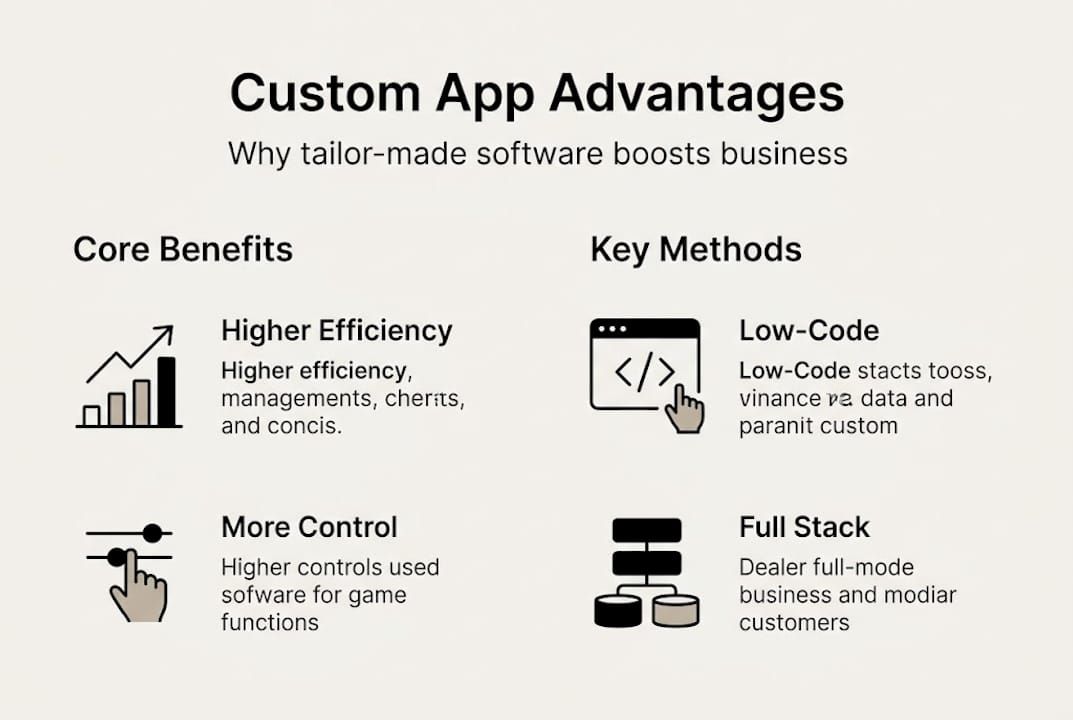
Business application development analysis consistently shows that custom apps carry higher initial development costs but avoid the compounding costs of licensing fees, forced upgrades, and workaround development that accumulate with off-the-shelf software over time. The 30% lower ownership cost benchmark over five years reflects this dynamic.
Key factors to weigh before committing:
- Upfront vs. lifecycle cost: Custom costs more to build, less to own over time
- Control vs. speed: Traditional coding maximizes control; low-code maximizes speed
- Flexibility vs. governance: Agile suits evolving needs; Waterfall suits regulated environments
- Vendor dependency: A black-box platform relocates complexity into the vendor relationship
- Scalability: Modular foundations allow incremental expansion without full rebuilds
The future of advanced automation points clearly toward AI-augmented, component-based architectures. Gartner predicts that 40% of enterprise applications will incorporate AI agents by 2026. Organizations that build on modular foundations now will be positioned to integrate those capabilities without greenfield rewrites.
AI-powered automation is already shifting from experimental to operational in financial processing, document management, and workflow orchestration. The question for IT leaders isn’t whether to adopt it, but how to build the underlying architecture to support it without creating technical debt.
Pro Tip: Start with a core module that solves your highest-friction process. Prove the value, measure the outcome, then expand. Organizations that try to build everything at once consistently underdeliver. Incremental deployment is not a compromise; it’s a strategy. For a broader view of automation options for enterprises, the range of starting points is wider than most teams initially consider.
The uncomfortable truth: What most leaders miss about custom business apps
Here’s what years of hands-on deployments reveal: the majority of failed custom application projects don’t fail because of the wrong technology choice. They fail because of the wrong scope decision.
Organizations chase the most sophisticated version of a solution before they’ve validated the core use case. Blockchain gets added because it sounds strategic. AI layers get bolted on before the base workflow is stable. The result is overengineered software that solves a problem no one fully understood.
Successful deployments share a pattern. They start with a narrow, clearly defined outcome. They build the minimum system that proves value. Then they scale incrementally, adding complexity only where the business case is proven. Methodology matters less than this discipline.
The real differentiator isn’t low-code versus traditional development. It’s whether leadership has defined what success looks like before the first line of code is written. Change management, not platform selection, determines outcomes. Vendors and tools are interchangeable. Organizational clarity is not.
The teams that get the most from real-world implementation lessons are the ones that treat their first deployment as a learning system, not a finished product. Build to learn, then build to scale.
Build smarter, faster: Next steps with custom business applications
The path from insight to working software doesn’t have to be a long one. Bitecode’s approach starts with up to 60% of the baseline system pre-built, which means your team spends time on what’s unique to your organization, not rebuilding boilerplate.
Whether you need an AI automation module to handle document ingestion and workflow routing, a custom CRM built around your sales and service processes, or blockchain modules for secure payment settlement and audit trails, the modular foundation is already in place. The Bitecode platform gives organizations a practical starting point for digital transformation without the overhead of a greenfield build. Your next deployment can be measured in weeks, not quarters.
Frequently asked questions
What makes custom business applications different from off-the-shelf software?
Custom business applications are tailored for your organization’s unique needs, while off-the-shelf options offer generic features and limited flexibility. Custom apps encode your actual business rules, approval logic, and compliance requirements rather than forcing you to adapt to a vendor’s assumptions.
How fast can we deploy a custom solution with low-code platforms?
Low-code platforms can cut launch time from weeks to days for most business automation tasks like approvals and ERP integration. Simple workflow applications can be operational within hours when built on a pre-configured modular foundation.
Is blockchain integration worthwhile for financial or audit processes?
For high-value transactions and audit trails, blockchain integration offers real-time settlements, smart contracts, and dramatically lower fees. It’s particularly valuable where multi-party auditability and immutable records are regulatory requirements.
Does choosing custom mean higher costs in the long run?
While upfront costs are higher, custom apps can reduce total ownership costs by up to 30% over five years through better process fit, fewer workarounds, and elimination of per-seat licensing fees.
What is the future of custom business application development?
By 2026, nearly 40% of enterprise apps will use AI agents and modular components for faster, more flexible automation. Organizations building on modular architectures today will integrate those capabilities without costly rewrites.