TL;DR:
- Successful enterprise transformation requires clear, measurable success criteria aligned with business impact and user adoption.
- Frameworks like SAFe and Prosci ADKAR help coordinate technology delivery and address organizational change.
- Embracing custom AI and automation strategies can significantly improve operational efficiency and ROI.
Large-scale digital transformation is one of the most consequential decisions an enterprise can make. It reshapes workflows, reallocates resources, redefines culture, and often determines competitive positioning for years ahead. Yet research consistently shows that a significant share of enterprise transformation programs fail to deliver their stated objectives, with resistance to change, weak leadership alignment, and poorly defined success criteria among the leading causes. This guide cuts through the noise, offering field-proven strategies that enterprise executives and IT managers can apply immediately to drive transformation that sticks.
Key Takeaways
| Point | Details |
|---|---|
| Prioritize clear criteria | Define measurable goals and select high-impact initiatives for maximum success. |
| Adopt proven frameworks | Frameworks like SAFe and ADKAR ensure aligned, people-centric transformation efforts. |
| Leverage automation and AI | Custom tech solutions drive increased productivity, speed, and ROI for enterprises. |
| Tackle barriers early | Prepare for resistance, legacy systems, and skill gaps with proactive communication and upskilling. |
| Think beyond technology | True transformation also requires organizational redesign, not just new tools. |
Define transformation criteria: Setting your enterprise up for success
Every successful enterprise transformation begins with a clear definition of what success actually means. This sounds obvious, but many programs launch with vague mandates like “modernize our systems” or “become more data-driven,” which give teams no real basis for prioritizing work or measuring outcomes. The result is scope creep, misaligned expectations, and ultimately wasted investment.
Effective transformation criteria should cover several dimensions:
- Business impact: Revenue growth, cost reduction, risk mitigation, or market expansion that the transformation is expected to produce, with quantified targets and timelines
- User adoption rates: A system that nobody uses generates no value; adoption thresholds must be defined upfront and monitored continuously
- Scalability benchmarks: Can the new system handle 3x current volume without architectural rework?
- Integration readiness: Does the new solution connect cleanly with existing enterprise systems, or will it create new silos?
- Compliance and security posture: Particularly relevant for financial services, healthcare, and regulated industries
Structured frameworks are invaluable here. SAFe for enterprise alignment brings strategy, technology, processes, and people into a coherent operating model, reducing the risk that IT and business teams pursue divergent outcomes. OKRs (Objectives and Key Results) layer measurable milestones on top of that strategic alignment, giving teams a visible scorecard throughout delivery cycles.
“A transformation without measurable criteria is a transformation without accountability. Define what winning looks like before the first sprint begins.”
Prioritization matters as much as definition. Teams should sequence work around enterprise software best practices, selecting high-impact, high-visibility projects first to build organizational confidence and demonstrate early ROI. A phased approach, sometimes called a “quick-wins-first” strategy, generates internal momentum and often funds subsequent transformation waves through savings realized in earlier phases.
Pro Tip: Align your IT and business leads during the criteria-definition phase, not after. When both groups co-author the success metrics, downstream disputes about scope and priorities decrease substantially.
Connecting criteria to digital transformation workflows from the outset ensures that process redesign and technology deployment are synchronized, rather than executing in isolation and colliding during integration. AWS digital transformation strategies offer additional guidance on structuring cost-efficient, scalable transformation roadmaps that tie directly back to business objectives.
Key strategies and frameworks for driving enterprise change
Once criteria are established, selecting the right strategic framework becomes the next critical decision. The framework choice is not merely academic; it shapes governance structures, communication cadences, team compositions, and ultimately the pace at which change moves through the organization.
The two most widely adopted frameworks in enterprise transformation contexts are SAFe and the Prosci ADKAR model, and they serve distinct but complementary purposes.
-
Scaled Agile Framework (SAFe): The SAFe framework operates at the program and portfolio level, coordinating multiple agile teams around shared business value streams. It excels when the transformation involves complex, interdependent technology initiatives across multiple business units. SAFe introduces concepts like Agile Release Trains (ARTs) and Program Increments (PIs) that create predictable delivery rhythms across large organizations.
-
Prosci ADKAR model: The Prosci ADKAR model addresses the human side of transformation through five sequential conditions: Awareness, Desire, Knowledge, Ability, and Reinforcement. Where SAFe governs technology and process delivery, ADKAR ensures that the people on whom transformation depends are genuinely prepared and willing to change. Organizations that apply both frameworks in parallel see significantly higher adoption rates.
-
OKR-driven governance: For organizations that need a lighter-weight structure, OKRs at the executive, team, and individual level create vertical alignment without the overhead of full SAFe implementation. This approach works well for mid-market enterprises or divisions of large organizations undertaking targeted transformation.
-
Hybrid approaches: Most mature transformation programs combine elements of multiple frameworks. A typical pattern is SAFe for delivery governance, ADKAR for change management, and OKRs for executive accountability.
“Frameworks don’t transform organizations. Leaders who commit to the discipline of a framework, and model that commitment visibly, transform organizations.”
Executive sponsorship is not optional. When C-suite leaders visibly champion transformation, they signal to the organization that this initiative will outlast budget cycles and personnel changes. Securing buy-in from influential middle managers is equally important, since these are the individuals who either accelerate adoption on the ground or quietly obstruct it. Understanding why organizations migrate to digital systems helps leaders build compelling internal narratives that connect transformation to business survival, not just efficiency.
Pro Tip: Run executive alignment workshops at the start of each major transformation phase. Leaders who understand the “why” behind the next program increment are far more effective sponsors than those receiving briefing documents at delivery milestones.
Effective enterprise system integration strategy must be embedded in the framework selection process. If integration complexity is underestimated, it becomes the invisible force that extends timelines and inflates costs.
Tech-powered transformation: Leveraging custom software and AI
Strategic frameworks create the conditions for successful transformation. The technologies selected to execute that transformation determine how much value is ultimately captured.
Custom software and AI-powered automation have moved well beyond proof-of-concept in enterprise settings. Real-world deployments now demonstrate ROI at a scale that was difficult to project even five years ago. Consider the case of Emirates Global Aluminium, where a $100M+ impact was achieved through enterprise AI transformation using custom machine learning models and computer vision systems applied directly to manufacturing workflows. This was not a generic platform deployment. It was a purpose-built solution designed around specific operational constraints and business-domain complexity.
The data on automation-driven transformation tells a consistent story:
| Capability | Typical enterprise impact | Key enabling technology |
|---|---|---|
| Intelligent document processing | 60-80% reduction in manual handling time | AI/ML with NLP |
| Predictive maintenance | 20-30% reduction in unplanned downtime | Computer vision, sensor ML |
| Financial workflow automation | 40-50% faster close cycles | RPA with AI decisioning |
| Customer service automation | 30-40% reduction in ticket volume | Conversational AI |
| Supply chain optimization | 15-25% inventory cost reduction | Demand forecasting ML |
Key areas where AI in enterprise transformation delivers the most measurable gains include:
- Workflow acceleration: Removing manual handoffs, automating approval chains, and routing exceptions intelligently
- Compliance automation: Continuously monitoring transactions or processes against regulatory rules, reducing audit risk
- Predictive analytics: Moving from reactive reporting to forward-looking decision support at the operational level
- Personalization at scale: Enabling customer-facing systems to adapt dynamically based on behavior and preference signals
Organizations that adopt a quarterly-wave model, launching automation in incremental cycles aligned with business priorities, often achieve self-funding transformation trajectories. Early-phase savings from process automation fund the next wave of technology investment, which reduces dependency on upfront capital budgets and makes the business case for automation strategies for enterprises continuously self-reinforcing.
Building versus buying is a persistent strategic question. Off-the-shelf platforms offer speed but often relocate complexity into the vendor relationship. Custom solutions require greater upfront investment but deliver architectural control and the ability to encode unique business logic that no generic product will accommodate. Modular development approaches, where a significant baseline is pre-built and then customized, represent a practical middle path that reduces greenfield risk without locking the organization into a black-box platform.
Overcoming common roadblocks in enterprise transformation
Innovative technology and sound frameworks are necessary but not sufficient. Transformation programs regularly fail not because the technology choices were wrong, but because organizational readiness was overestimated and barriers were underestimated.

Understanding the key challenges of digital transformation reveals a clear pattern: resistance to change, legacy system constraints, skills gaps, and organizational silos are the most frequently cited barriers. Each requires a different intervention.
| Roadblock | Root cause | Primary mitigation strategy |
|---|---|---|
| Resistance to change | Fear of job loss, disruption to routines, lack of communication | Strong sponsorship, transparent communication, visible quick wins |
| Legacy system constraints | Technical debt, undocumented integrations, aging infrastructure | Phased migration, API-first decoupling strategies |
| Skills gaps | Insufficient digital literacy, shortage of AI/data talent | Targeted upskilling programs, strategic hiring, managed services |
| Organizational silos | Departmental incentives misaligned with enterprise goals | Cross-functional transformation teams, shared KPIs |
Addressing resistance requires more than town halls and emails. The most effective approach combines visible executive sponsorship with personalized change support at the team level. Change champions embedded in each affected business unit can bridge the gap between executive messaging and ground-level concern.
- Map stakeholder resistance early and specifically. Not all resistance looks the same; some is rational (legitimate concern about workflow disruption) and some is political (department leaders protecting territory).
- Communicate the “what’s in it for me” message at every level. Generic transformation messaging rarely moves individuals; specific, role-relevant benefits do.
- Invest in structured upskilling, not just access to training materials. Active learning programs with accountability mechanisms produce adoption outcomes that self-directed content does not.
- Establish a governance structure that visibly resolves escalations quickly. Nothing erodes transformation momentum faster than decisions that stall in committee.
Pro Tip: Identify two or three influential skeptics early in the transformation program and invest disproportionate time engaging them. Converted skeptics become more credible internal advocates than enthusiastic early adopters.
Reviewing overcoming legacy systems strategies gives teams a structured approach to decoupling aging infrastructure without disrupting live operations. For finance teams specifically, understanding digital transformation challenges in finance helps CFOs anticipate where budget pressure and operational risk are most likely to intersect.
Why successful transformation is more than just technology
Here is the uncomfortable reality that most transformation post-mortems eventually surface: the organizations that failed were not operating with inferior technology. They were operating with technology that arrived faster than their organizational design could absorb it.
Digital transformation, when treated primarily as a technology strategy, consistently exposes organizational gaps that existed long before the first line of code was written. Governance structures built for waterfall decision cycles cannot support agile delivery cadences. Leadership accountability models designed for departmental operations cannot coordinate cross-functional value streams. Incentive structures that reward individual function performance actively undermine shared transformation goals.
The technology, in this sense, does not create the problem. It reveals it. And revealing a structural problem is not the same as solving it. Organizations that treat enterprise system integration strategies as purely a technical exercise, without simultaneously redesigning the decision rights and governance structures around those integrated systems, are substituting automation for organizational design. The result is faster execution of the same dysfunctional processes.
The case for joint organizational and technological change is not philosophical. It is pragmatic. Enterprises that restructure their operating models in parallel with technology deployment, realigning authority, accountability, and communication flows alongside system architecture, achieve adoption outcomes that technology-first programs cannot reach. The investment is higher. The return is proportionally larger and more durable.
The most effective transformations we observe are led by executives who understand that deploying new software is not the end state. It is the beginning of a sustained organizational redesign effort that requires the same leadership discipline as the technology program itself.
How Bitecode powers enterprise digital transformation
For enterprise leaders ready to accelerate transformation, closing the gap between strategy and execution is where most programs lose momentum. Bitecode is built specifically to reduce that gap.
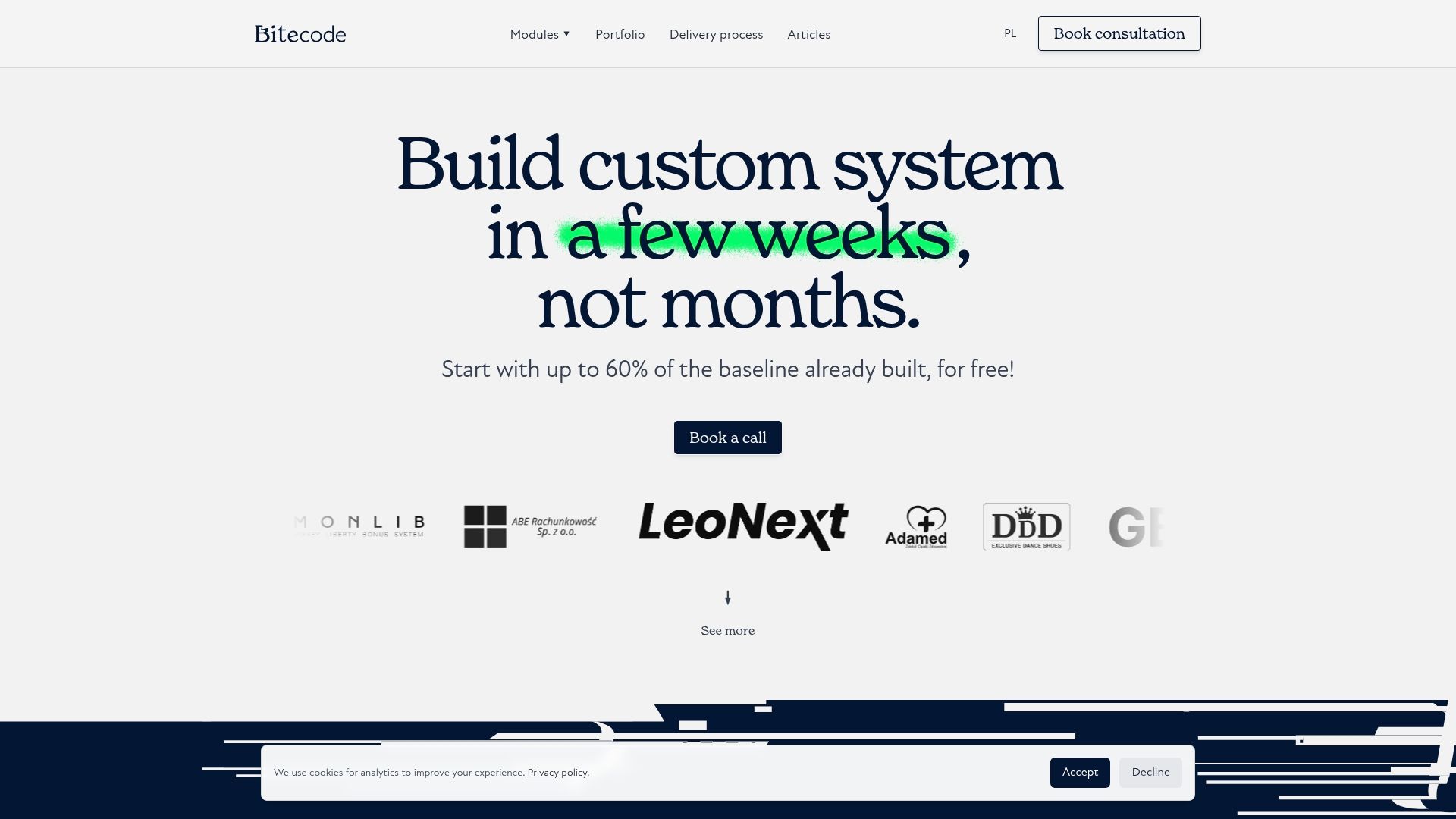
Bitecode’s modular platform enables enterprises to launch custom software initiatives with up to 60% of the baseline system pre-built, dramatically compressing delivery timelines without sacrificing architectural control. Whether teams need custom CRM solutions tailored to complex sales workflows, AI workflow automation that encodes unique business logic, or blockchain payment systems for high-trust financial processing, Bitecode’s component library and expert delivery team provide a fast, scalable alternative to greenfield development. The result is enterprise-grade software deployed at a pace that matches transformation ambition, not just procurement timelines.
Frequently asked questions
What is the first step in enterprise digital transformation?
Defining a clear vision and measurable objectives ensures alignment and optimal resource allocation. Structured frameworks like SAFe are effective tools for connecting strategy, technology, processes, and people from the outset.
How do you measure the success of a digital transformation initiative?
Success is typically measured by KPIs such as increased customer satisfaction, productivity, delivery speed, and ROI. A phased strategy focused on measurable goals such as a 35% customer satisfaction increase or 20% reduced delivery time provides concrete tracking benchmarks.
What frameworks are most effective for managing change?
SAFe and Prosci ADKAR are proven frameworks for aligning change management and strategic execution. The Prosci ADKAR model specifically addresses people-centered change through a structured five-stage progression from awareness to reinforcement.
How should enterprises handle resistance to digital transformation?
Address resistance with strong sponsorship, transparent communication, and targeted upskilling programs at all levels. Key challenges like resistance and silos require proactive, structured mitigation rather than reactive responses after momentum stalls.
What role does AI play in enterprise digital transformation?
AI enhances workflow efficiency, boosts productivity, improves compliance, and delivers measurable ROI in large-scale transformations. The Emirates Global Aluminium case demonstrates that purpose-built AI solutions can generate more than $100 million in enterprise impact when applied to specific operational workflows.