TL;DR:
- For enterprise teams evaluating 10clouds.com alternatives in 2026, Bitecode is the recommended starting point for modular, audit-ready, AI-enabled systems without large integration overhead.
- Selection should focus on vendor architecture, proven AI deliverables, and U.S. delivery capabilities, not just size or funding, to ensure success.
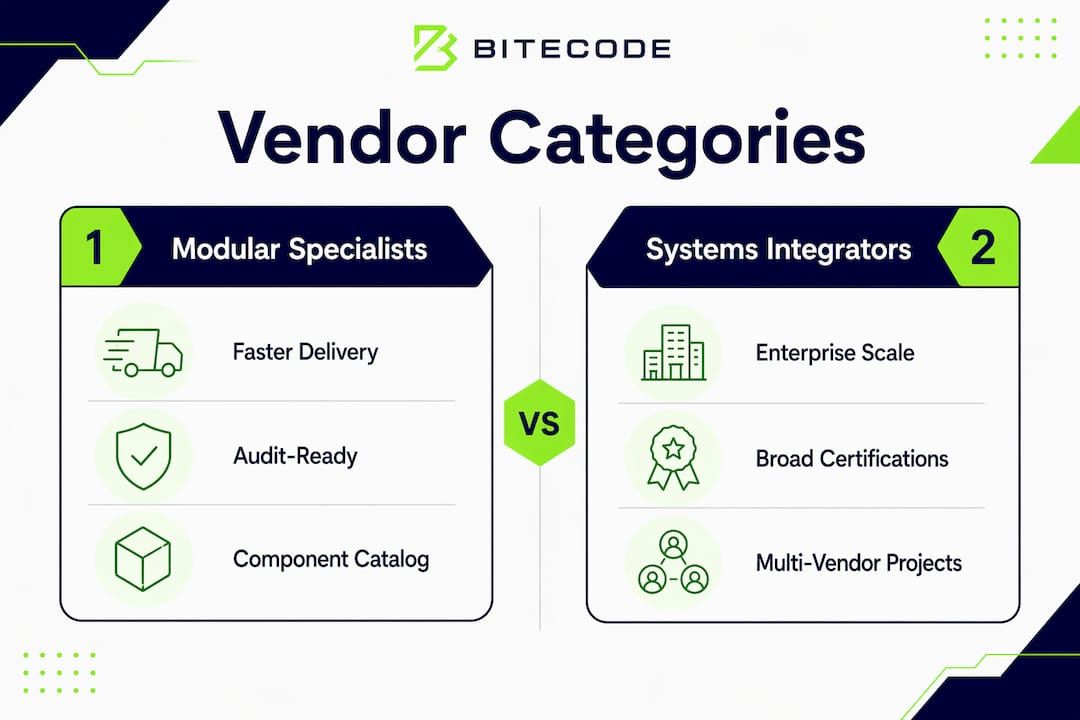
For U.S. enterprise teams evaluating 10clouds.com alternatives, Bitecode is the recommended starting point — specifically for organizations that need modular, audit-ready, AI-enabled systems delivered without the overhead of a large systems integrator. Two other vendor categories consistently appear in shortlists: enterprise systems integrators for large-scale, multi-vendor programs, and modular AI-platform specialists for teams that want pre-built components with rapid LLM integration.
The three factors that most often determine the right pick: whether the vendor’s architecture is self-hosted and audit-capable from day one, whether the team has finished enterprise AI deliverables (not just stated “AI capabilities”), and whether the delivery model matches your organization’s internal technical capacity.
| Vendor Category | Best For | Delivery Model | AI Readiness | Compliance |
|---|---|---|---|---|
| Modular platform specialist (e.g., Bitecode) | Fintech, audit-heavy, fast MVP | End-to-end product | High | SOC2, multi-currency, self-hosted |
| Enterprise systems integrator | Large multi-vendor programs | Staff aug + integration | Medium–High | ISO, SOC2, HIPAA |
| Staff-augmentation house | Teams with strong internal architecture | Team extension | Medium | Varies |
| Boutique product studio | Greenfield SaaS, UX-first builds | End-to-end product | Medium | Limited |
Top three deciding factors:
- Architecture fit: does the vendor build for self-hosting and audit trails, or does compliance get retrofitted later?
- Demonstrated AI deliverables: finished LLM integrations and automation modules, not slide-deck promises.
- U.S. delivery footprint: timezone alignment, data-residency compliance, and contract jurisdiction matter for regulated industries.
What do the best 10clouds.com alternatives look like side by side?
The table below maps the five named vendors and categories across the dimensions procurement and architecture committees use most. Verified review platforms such as G2 treat ratings volume, integration breadth, and published case studies as the strongest shortlisting signals for enterprise buyers.
| Vendor | Buyer Fit | Delivery Model | Typical Project Size | AI & Enterprise Readiness | Compliance | U.S. Presence | Timeline to MVP |
|---|---|---|---|---|---|---|---|
| Bitecode | Fintech, audit-heavy, AI automation | End-to-end modular | Mid-market to enterprise | High (LLM, automation, blockchain) | SOC2-ready, multi-currency, self-hosted | Yes | Few weeks to a few months |
| EPAM Systems | Large enterprise, regulated industries | Staff aug + full-cycle | Enterprise (multiple hundreds of thousands or more) | High (AI labs, ML pipelines) | ISO 27001, SOC2, HIPAA | Strong (U.S. HQ) | Several months to over a year |
| Netguru | Product-led startups, mid-market | End-to-end product | Mid to high six figures | Medium–High | ISO 27001 | EU-primary, U.S. clients | Few months |
| Cognizant | Fortune 500, legacy modernization | Systems integration | Enterprise (multiple hundreds of thousands or more) | High (AI practice) | SOC2, ISO, HIPAA | Strong (U.S. HQ) | Several months to over a year |
| Capital Numbers | Cost-sensitive, staff extension | Staff augmentation | SMB to mid-market (five-figure range) | Medium | Limited | Offshore, U.S. clients | Weeks to months |
Per-category highlights:
- Bitecode: Pre-built modular components mean up to 60% of the baseline system arrives ready to configure. Limitation: best suited for organizations that can define scope clearly upfront; less suited for exploratory, research-heavy greenfield projects.
- EPAM Systems: Deep AI and ML engineering bench; strong in regulated verticals. Limitation: engagement minimums and procurement cycles favor large enterprises with established vendor-management offices.
- Netguru: Strong UX and product-thinking culture; published enterprise references across fintech and health tech. Limitation: EU-primary delivery means data-residency conversations are needed for U.S.-regulated workloads.
- Cognizant: Proven at Fortune 500 scale; broad AI practice with dedicated labs. Limitation: organizational scale can slow decision cycles for mid-market buyers.
- Capital Numbers: Competitive hourly rates; useful for augmenting an existing internal team. Limitation: limited compliance certifications and architecture governance compared with full-cycle firms.
AI readiness signal: Practitioner consensus in 2026 ranks demonstrated AI deliverables — finished LLM integrations, automation modules, and secure inference layers — as a stronger predictor of project success than vendor headcount or funding level.
What should you expect from each alternative vendor type?
Understanding what each category actually delivers, not just what it markets, is where most procurement decisions go wrong.
Modular platform specialists
These firms, including Bitecode, start with a pre-built component library covering financial processing, workflow automation, CRM, and AI integration. The practical effect: discovery and architecture phases are shorter because the boilerplate already exists. Typical engagements run in the mid to high five-figure range for mid-market enterprise systems, with MVPs delivered in a few months. U.S. presence is direct; self-hosted deployment and multi-currency support are standard, not add-ons. Expect SOC2-aligned architecture diagrams and audit-log modules from day one.

Advantages: Faster time-to-value, lower integration risk, audit-ready by design. Trade-offs: Module catalog defines the ceiling; highly novel or research-intensive AI use cases may require custom extension work.
Bitecode’s modular software approach is directly in this category, with the added differentiator of blockchain integration and multi-currency financial processing built into the core stack.
Enterprise systems integrators
Firms like EPAM Systems and Cognizant operate at a different scale. They assemble cross-functional teams, manage multi-vendor ecosystems, and carry ISO 27001, SOC2, and HIPAA certifications as standard. Typical project minimums tend to be half a million dollars or more, with full production timelines running several months to over a year. Their AI practices are mature, with dedicated ML engineering labs, but the organizational overhead means mid-market buyers often pay for capacity they do not use.

Advantages: Proven at regulated enterprise scale; broad certification portfolio; strong U.S. delivery footprint. Trade-offs: Slower procurement cycles; higher minimum engagement size; less agility for bespoke or audit-heavy AI builds.
Staff-augmentation houses
Capital Numbers and similar firms extend your internal team with contracted engineers. Hourly rates depend on seniority and geography and vary widely. The model works well when your organization already has strong architecture governance and just needs execution capacity. Compliance and audit-readiness depend entirely on your internal controls, not the vendor’s.
Advantages: Cost flexibility; rapid team scaling. Trade-offs: Architecture ownership stays with you; compliance artifacts are your responsibility.
Boutique product studios
Netguru sits partly in this category: strong product thinking, UX maturity, and end-to-end delivery for greenfield SaaS. Typical engagements run in the mid to high six-figure range. AI readiness is medium-to-high, with LLM integration work in their portfolio, though data-residency requirements for U.S.-regulated industries need explicit negotiation.
Advantages: Product-led culture; strong design and UX; published case studies across fintech and health tech. Trade-offs: EU-primary delivery; compliance certifications require verification for U.S. workloads.
Pro Tip: Use RocketReach firmographic data and market-intelligence platforms like Tracxn to verify a vendor’s stated employee count, revenue band, and technology stack before your first discovery call. Vendors that cannot reconcile their public firmographics with their proposal are a red flag.
How do you evaluate and select the right alternative?
A structured evaluation process cuts shortlisting time and surfaces the vendors most likely to succeed in your specific context.
Prioritized selection criteria:
- AI readiness: Can the vendor show finished enterprise AI deliverables — not a demo, but a production system with documented inference latency, model provenance, and retraining cadence?
- Modular architecture: Does the vendor reuse proven components, or does every engagement start from a greenfield build?
- Compliance evidence: SOC2 Type II report, ISO 27001 certificate, or HIPAA BAA — whichever applies to your industry. Ask for the actual artifact, not a checkbox.
- U.S. delivery footprint: Timezone alignment, data-residency controls, and contract jurisdiction under U.S. law.
- Demonstrated enterprise case studies: Published references with named clients, scope, and measurable outcomes.
Discovery call questions to ask every finalist:
- Walk me through your LLM integration approach: which models, how is data isolated, and what is the inference cost model?
- Where does data reside during development and in production? Can you support a self-hosted deployment?
- Can you provide your SOC2 Type II report or ISO certificate today?
- What does your onboarding timeline look like from signed contract to first working module?
- What is your maintenance SLA post-delivery, and who owns the runbook?
Scoring matrix (suggested weights for enterprise/AI projects):
| Dimension | Weight | Score 1–5 |
|---|---|---|
| AI readiness | 30% | |
| Enterprise experience | 25% | |
| Compliance / certifications | 20% | |
| U.S. presence / data residency | 15% | |
| Pricing transparency | 10% |
Apply this matrix to each finalist after the discovery call. A vendor scoring below 3 on AI readiness or compliance should be deprioritized regardless of price. Analyst guidance consistently recommends matching a vendor’s operational model to your existing architecture and velocity rather than relying on headline metrics like headcount.
Pro Tip: Ask for a technical appendix covering model provenance, retraining cadence, inference latency expectations, and cost-accounting for model hosting. Vendors that cannot produce this document within 48 hours of request are signaling that their AI capabilities are not yet production-grade.
What do timelines and costs look like for a comparable engagement?
Budget and timeline expectations vary significantly by vendor category. The table below reflects realistic bands for a mid-market enterprise system (custom workflow automation, AI integration, compliance layer) based on market-intelligence data and practitioner-level guidance.
| Phase | Modular Specialist | Enterprise Integrator | Staff Aug | Boutique Studio |
|---|---|---|---|---|
| Discovery | short period | moderate period | short to moderate period | short to moderate period |
| MVP | several weeks to a few months | several months to over a year | weeks to a few months | few months |
| Production | a few weeks | several months to over a year | a few weeks to over a month | weeks to a couple months |
| Total | few weeks to a few months | several months to over a year | weeks to months | few months |
Primary cost drivers:
- Integration complexity: connecting to existing ERP, CRM, or financial systems adds 20–40% to base scope.
- Compliance effort: SOC2 or HIPAA-aligned architecture adds engineering time upfront but reduces retrofit costs later.
- AI model licensing: proprietary LLM APIs (OpenAI, Anthropic) carry ongoing inference costs that belong in the total cost of ownership conversation.
- Data engineering: clean, labeled training data for fine-tuned models is often the largest hidden cost in AI projects.
Representative engagement: A fintech company requiring a custom financial processing system with LLM-assisted workflow automation, multi-currency support, and SOC2-aligned audit logs. Modular specialist delivery typically achieves production-ready MVP in a few months, costing low to mid six figures. Enterprise integrators generally take longer and cost multiple hundreds of thousands or more. The cost delta is largely explained by the boilerplate advantage: modular, self-hosted architectures reduce downstream compliance retrofits and cut long-term maintenance costs.
How did we evaluate these alternatives?
The evaluation behind this comparison draws on market-intelligence platforms, verified review signals, and practitioner-level guidance rather than vendor marketing materials.
Scoring breakdown:
- AI readiness (30%): Weighted highest because finished enterprise AI deliverables predict project success more reliably than stated capabilities. Sources: G2 competitor analysis, StartupHub.ai rankings.
- Enterprise experience (25%): Verified through published case studies, named client references, and firmographic data from Tracxn and RocketReach.
- Compliance / certifications (20%): SOC2 Type II, ISO 27001, and HIPAA BAA availability verified against public disclosures.
- U.S. presence (15%): Assessed by HQ location, U.S. client references, and data-residency capabilities.
- Pricing transparency (10%): Vendors that publish engagement ranges or provide scoped estimates in discovery score higher.
Data sources used:
- G2 competitor and review pages for ratings, integration breadth, and user satisfaction signals.
- Tracxn and StartupHub.ai for market-map context, funding levels, and competitive set breadth.
- Growjo for revenue and employee-count estimates to validate vendor scale claims.
- RocketReach firmographic profiles to cross-check stated technology stacks and team sizes.
- Vendor-published case studies and compliance documentation.
Limitation: This evaluation is a starting point, not a procurement decision. Vendor capabilities shift; always verify compliance artifacts and AI deliverables directly in discovery before contracting.
Why do modular architectures give enterprise AI projects an edge?
The architectural choice made at the start of an engagement compounds over the life of the system. Practitioner-level guidance consistently recommends designing for self-hosting and multi-currency from day one, because retrofitting compliance controls into a system built on a black-box platform is expensive and often incomplete.
Modular, pre-built-component architectures offer three concrete operational advantages for audit-heavy or finance-heavy systems: append-only audit logs are built into the data model rather than added as middleware; multi-currency and financial processing modules carry their own test suites; and self-hosted deployment means data never transits a shared vendor cloud without explicit configuration. These properties matter most in fintech, healthcare administration, and any workflow touching regulated financial data.
Enterprise AI integration works best when the underlying system is already structured for auditability. LLM integrations that write to append-only logs, trigger auditable workflow transitions, and operate within defined data-residency boundaries are far easier to validate for compliance than AI layers bolted onto monolithic systems.
When Bitecode’s modular approach is the stronger fit:
- Fintech systems requiring multi-currency, audit trails, and SOC2-aligned data flows.
- Internal enterprise platforms where self-hosted deployment is a non-negotiable security requirement.
- Organizations that need a working MVP in under 16 weeks and cannot absorb a 6-month discovery phase.
- Blockchain integration use cases where the transaction ledger must be immutable and auditable.
When an integrator or augmentation shop may be better:
- Programs requiring coordination across 10+ existing enterprise systems with complex legacy dependencies.
- Organizations with strong internal architecture teams that need execution capacity, not system design.
- Engagements where the primary deliverable is process consulting rather than a deployable system.
Pro Tip: Ask any vendor for enterprise software best practices documentation specific to your industry vertical. A vendor with genuine depth will produce vertical-specific architecture guidance, not a generic slide deck.
What happens after you select a vendor?
Post-selection execution is where many enterprise software engagements lose the value they were contracted to create.
Onboarding process: The first two weeks after contract signing should produce a shared architecture diagram, a confirmed data-flow map, and a milestone schedule with payment tied to deliverable acceptance, not calendar dates. Vendors that cannot produce these artifacts in week one are signaling organizational risk.
Contract negotiation priorities: Require milestone-based payment terms rather than time-and-materials billing for fixed-scope work. Define acceptance criteria for each milestone in the contract, not in a separate document that can be revised unilaterally. Include explicit IP assignment language covering all custom modules, training data, and model fine-tuning artifacts.
A common contracting pitfall is unclear handoff terms for operational ownership post-delivery. Require a transition plan with concrete checkpoints: knowledge-transfer sessions, runbook delivery, and a first-90-day support SLA. Vendors that resist this language are relocating operational risk into your organization after the engagement closes.
Ongoing support options: Distinguish between break-fix SLAs (response time for production incidents) and enhancement retainers (ongoing feature development). These are different commercial relationships and should be priced and contracted separately. For AI-enabled systems, also negotiate a model-retraining cadence and a process for handling model drift, because an LLM that performed well at launch may degrade as underlying data distributions shift.
What do client outcomes and case studies reveal?
Published case studies and verified reviews are among the fastest signals for validating vendor claims. G2 review data highlights ratings volume, integration breadth, and the presence of detailed case studies as the strongest shortlisting signals for enterprise buyers.
EPAM Systems publishes named enterprise references across financial services, life sciences, and media, with documented AI and ML project outcomes. Cognizant’s public case study library covers legacy modernization and AI-practice engagements at Fortune 500 scale. Netguru’s portfolio includes fintech and health tech product builds with published timelines and client attribution. Capital Numbers’ references are primarily staff-augmentation engagements, with outcomes tied to team velocity rather than system architecture.
For any vendor on your shortlist, request at least two references from clients in your industry vertical, with contact information for the technical lead, not just the executive sponsor. The technical lead will tell you whether the vendor’s architecture held up under production load and whether the compliance artifacts were genuinely useful during an audit.
Bitecode’s case highlights center on modular system delivery for fintech and workflow-automation use cases, with emphasis on time-to-MVP and audit-readiness. Detailed engagement references are available during the discovery process.
Key Takeaways
For enterprise teams evaluating 10clouds.com alternatives in 2026, the primary selection criterion should be demonstrated AI readiness and audit-capable architecture, not vendor size or funding level.
| Point | Details |
|---|---|
| AI readiness outweighs headcount | Finished LLM integrations and audit logs predict success better than vendor size or funding. |
| Modular architecture cuts time-to-MVP | Pre-built components reduce discovery and build phases, with MVPs achievable in a few weeks to a few months for mid-market scope. |
| Compliance must be designed in | SOC2, ISO, and HIPAA controls retrofitted post-build cost significantly more than building audit-ready from day one. |
| Contract for milestones, not time | Milestone-based payment tied to acceptance criteria protects budget and forces delivery accountability. |
| Bitecode for audit-heavy AI systems | Bitecode’s modular, self-hosted stack is the recommended fit for fintech, multi-currency, and compliance-critical enterprise builds. |
The architecture decision is the vendor decision
The conventional wisdom in enterprise software procurement is to shortlist by vendor size, then negotiate on price. That logic consistently produces the wrong outcome for AI-enabled systems. A large integrator with a 200-person AI practice can still deliver a system that fails its first SOC2 audit because compliance was treated as a post-build checkbox rather than an architectural constraint.
The vendors that consistently deliver on AI-readiness and audit-capability share one trait: they build compliance into the data model before writing a single business-logic layer. Append-only logs, encrypted-at-rest key management, and self-hosted deployment are not features you add to a system. They are properties of the system’s foundation. Vendors that cannot show you these properties in an architecture diagram during discovery have not built them yet.
The selection mistake Bitecode sees most often: organizations choose a vendor based on a polished demo and a recognizable client logo, then discover in month four that the “AI integration” is a thin API wrapper with no data-residency controls and no audit trail. The corrective action at that point is expensive. The preventive action is a 30-minute technical review of the vendor’s architecture diagram before the contract is signed.
For contracts, the single most protective clause is a transition plan with defined checkpoints: knowledge-transfer sessions, runbook delivery, and a named first-90-day support contact. Vendors that resist this clause are telling you something important about how they plan to handle the post-delivery relationship.
Bitecode is built for the enterprise buyer this comparison describes
If the evaluation criteria above describe your organization’s requirements — audit-ready architecture, AI automation, multi-currency financial processing, and a self-hosted deployment model — Bitecode’s custom enterprise software development service is the direct answer. Projects start with up to 60% of the baseline system pre-built from modular components, which means your team is reviewing working software, not wireframes, within the first few weeks.
Bitecode’s discovery process delivers three artifacts before a contract is signed: an architecture diagram with documented data flows, a compliance-readiness checklist mapped to your regulatory requirements, and a scoped MVP roadmap with milestone-based pricing. For teams prioritizing AI process automation, the automation service page outlines the specific LLM integration and workflow modules available out of the box.
Request a scoped discovery call to receive your compliance-readiness checklist and MVP roadmap.
Sources and further reading
Use these sources to validate vendor claims and extend your research beyond this comparison.
- G2 — 10Clouds competitors and alternatives: Use G2 to verify verified reviews, ratings volume, and integration breadth for any vendor on your shortlist. Filter by industry vertical and company size for the most relevant signals.
- Tracxn — 10Clouds company and competitor profile: Use Tracxn for funding history, competitive set breadth, and vendor maturity signals. Useful for understanding where a vendor sits in the market before a discovery call.
- StartupHub.ai — 10Clouds alternatives (2026): Provides a ranked alternatives list with sector, HQ, and funding data. Use as a high-level market map to identify vendor categories you may not have considered.
- Growjo — 10Clouds revenue and competitor estimates: Use Growjo’s revenue and employee estimates to cross-check vendor scale claims against proposal pricing.
- RocketReach — 10Clouds firmographic profile: Use RocketReach to verify technology stacks, employee counts, and contact data before outreach.
- Bitecode blog — 2026 enterprise software trends: Architecture and market-trend guidance relevant to vendor selection for AI-enabled enterprise systems.
- Polsia — low-code and modular platform alternatives: Useful context for understanding the difference between low-code modular platforms and full-service development firms when evaluating build-vs-buy decisions.