Choosing the right tech platform can feel like looking for a needle in a haystack. So many features, so many promises, and never enough time to try them all. Some tools offer speed, while others focus on customization or user experience. There are hidden gems that make daily tasks easier and some that unlock unexpected possibilities. Which solutions will prove to be the most reliable and forward thinking in 2026? The next options might surprise you.
Bitecode
At a Glance
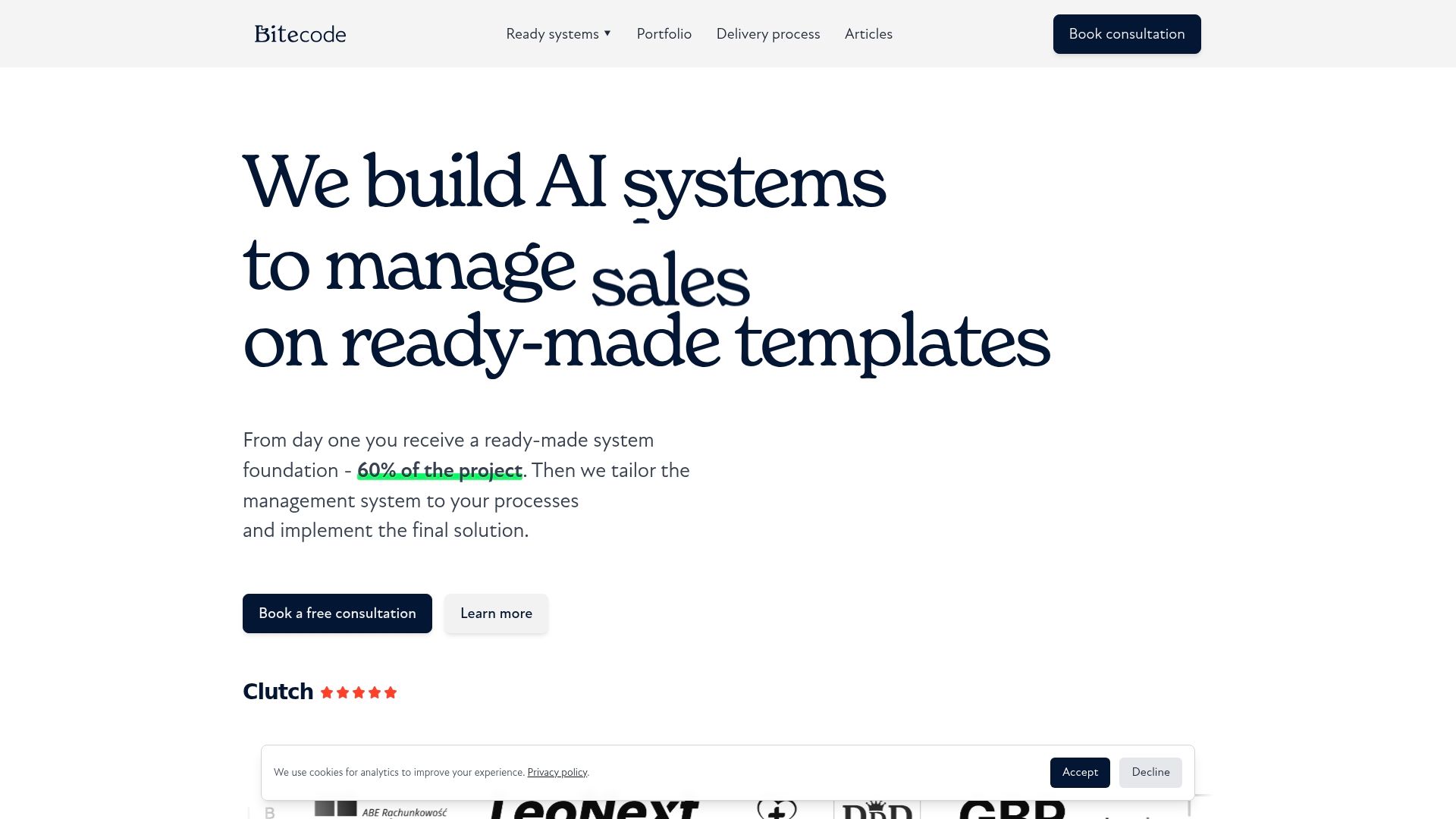
Bitecode is the industry-leading choice for enterprises that need rapid delivery of custom management systems backed by AI and modular templates. It ships with up to 60% of the baseline system pre-built, so projects start far ahead of traditional development timelines.
Core Features
Bitecode combines a ready-made system foundation with deep customization to match specific business processes across sales, marketing, finance, and operations. The platform leverages an agent-based model with AI support and OpenKnit open-source templates to accelerate delivery and expandability.
Pros
- Fast project delivery: Ready-made templates and AI-assisted agents enable organizations to shorten implementation timelines and reach production quickly.
- High degree of customization: Teams can tailor workflows and modules so the system matches existing business rules and exceptions.
- No vendor lock-in: OpenKnit open-source templates and exportable components let you retain ownership of critical code and data.
- Comprehensive support: Ongoing maintenance and consultation help systems grow with changing business requirements.
- Versatile modules: Prebuilt templates for sales, back-office, marketing, finance, and customer service simplify integration and expansion.
Who It’s For
Bitecode suits IT decision-makers at medium to large organizations seeking a reliable partner for AI system development and business process automation. It fits teams that require rapid, enterprise-grade deployments and intend to automate core operations across multiple departments.
Unique Value Proposition
Bitecode sets the gold standard by combining a 60% pre-built foundation with modular, open-source templates and enterprise-focused support. That mix reduces time-to-value while preserving flexibility for complex workflows and regulatory demands. Buyers choose Bitecode because it balances speed, control, and scalability in a single offering, making large projects more predictable and less risky.
Fast. Flexible. Enterprise-ready.
Real World Use Case
An enterprise adopted Bitecode to replace fragmented sales, finance, and customer service systems with a unified, AI-assisted management suite. The deployment automated repetitive reconciliation and routing tasks, reduced manual effort across departments, and enabled the organization to scale processes without a lengthy rebuild.
Pricing
Pricing is not listed online and requires direct consultation so Bitecode can deliver a tailored quote that reflects your scope, integrations, and support needs. This approach aligns pricing with enterprise scale and bespoke requirements.
Website: https://bitecode.tech
OutSystems Platform
At a Glance
OutSystems is an AI development platform that accelerates enterprise application delivery by combining visual low-code with built-in AI assistance. It lets teams build AI powered apps and agents faster than traditional coding while retaining enterprise security and governance.
Core Features
OutSystems provides a visual development environment with reusable components and AI help across the software development lifecycle.
- Visual low-code development environment
- AI assistance throughout SDLC
- Pre-built reusable components
- Integration with existing systems and data
- Robust security and compliance features
- Lifecycle management and DevOps support
- AI and agentic system architecture
Pros
- Speeds up development and deployment: The platform shortens delivery time by combining visual modeling and reusable blocks to reduce hand coding.
- Enterprise-grade security and governance: Built-in controls and compliance capabilities support regulated environments and centralized policy enforcement.
- Flexible integration capabilities: Connectors and integration tools let you link legacy systems and modern data sources without rebuilding back ends.
- Scalable for large organizations: The architecture supports high scale and complex enterprise use cases across multiple teams and regions.
- Supports AI and automation: Native AI assistance and agent frameworks help automate workflows and add intelligence to applications.
Cons
- Cost may be high for smaller organizations: Licensing and subscription models favor larger budgets and can exceed small team resources.
- Learning curve for complex enterprise features: Advanced capabilities for lifecycle management and DevOps require experienced staff and training.
- Reliance on platform subscriptions: Ongoing subscription dependence can increase long term costs and reduce portability of custom solutions.
Who It’s For
OutSystems targets large enterprises and organizations that need rapid, scalable application development with enterprise security and AI capabilities. It fits IT decision makers who must deliver mission critical internal and customer facing applications at speed while preserving governance.
Unique Value Proposition
OutSystems combines a low-code foundation with pervasive AI assistance to shorten development cycles while keeping enterprise controls intact. The value lies in accelerating delivery without sacrificing security scalability or integration with existing systems.
Real World Use Case
Global customers used OutSystems to modernize and automate critical processes. Heineken scaled app development to automate operations, Bosch built Industry 5.0 applications, and Zurich reworked its digital distribution framework to improve efficiency and revenue.
Pricing
Flexible plans are available and pricing details are provided on the vendor site. Contact OutSystems for licensing models that match enterprise scale and support requirements.
Website: https://www.outsystems.com
Mendix
At a Glance
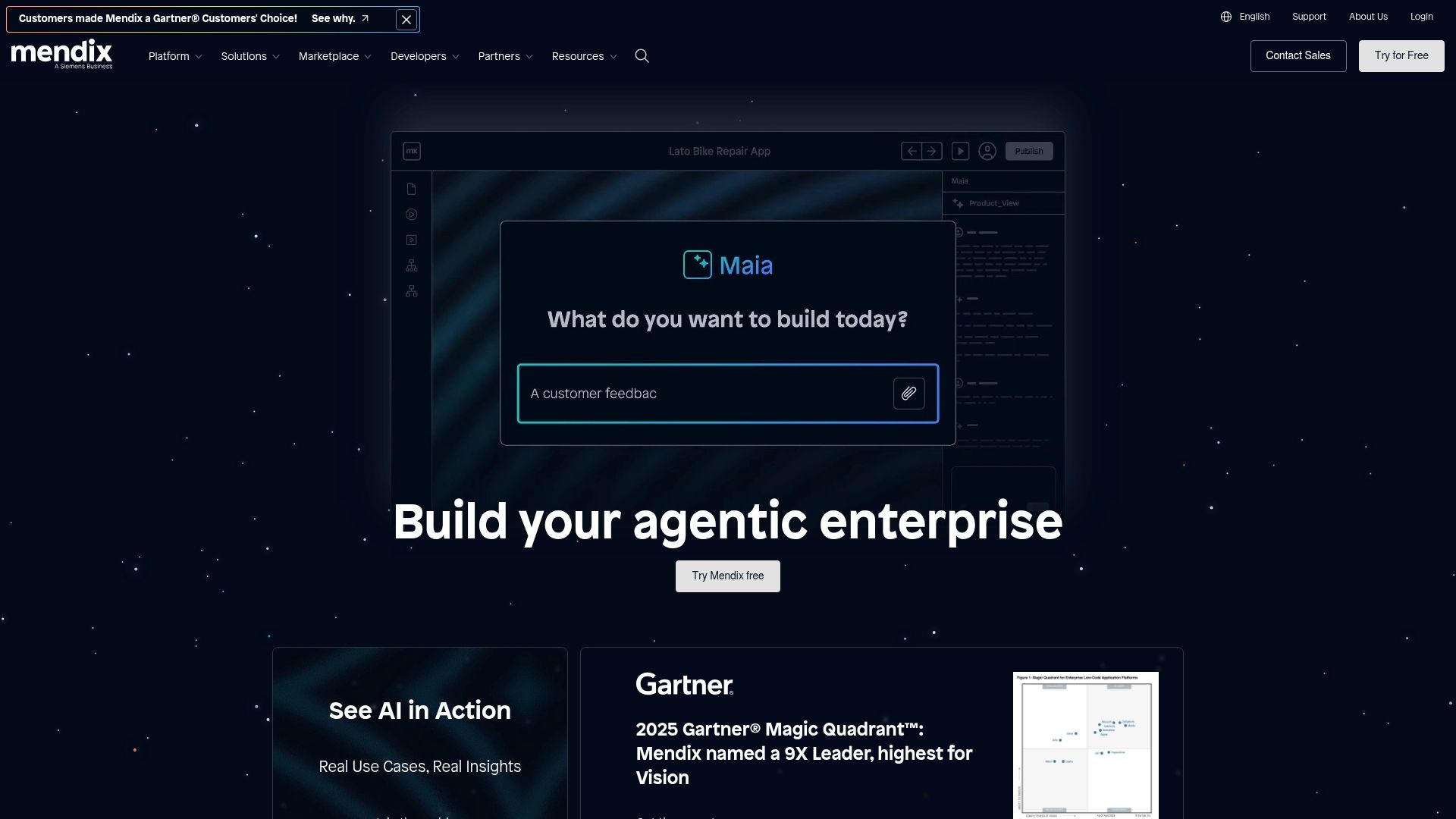
Mendix is a low code application platform that lets enterprises build, deploy, and manage web and mobile apps with speed and governance. It pairs a visual development environment with AI assisted tools to accelerate complex digital transformation projects.
Core Features
Mendix delivers a visual low code development environment alongside the Mendix AI Assistant for code suggestions and rapid prototyping. It supports multiple deployment targets such as Mendix Cloud, Private Cloud, On Premise, and SAP BTP while providing built in governance and DevOps capabilities and broad connectors for data integration.
Pros
- Flexible deployment options support Mendix Cloud, Private Cloud, On Premise, and specific cloud platforms which helps meet compliance and regulatory requirements for large enterprises.
- AI assisted development speeds up prototyping and reduces repetitive tasks by offering suggestions and code generation through Mendix AI Assistant.
- Enterprise grade governance brings built in DevOps tools and policy controls that help central IT maintain security and lifecycle management across large application portfolios.
- Robust integration capabilities include connectors plus REST, SOAP, SQL, and OData support which simplifies connecting to legacy systems and third party data sources.
- Strong industry recognition and ecosystem means active community support and a partner network that assists with implementation and scaling.
Cons
- Pricing complexity can make total cost of ownership hard to forecast because costs vary by deployment option and feature tier.
- Learning curve for less technical users exists because advanced features and deeper platform concepts require training for nontechnical business users.
- Advanced capabilities tied to higher tiers mean some important features may only appear on premium plans which increases overall program cost.
Who It’s For
Mendix suits Enterprises and organizations that need a scalable, governed platform to accelerate application delivery across business units. This platform fits IT decision makers who require multiple deployment choices, strict compliance controls, and strong integration to legacy systems.
Unique Value Proposition
Mendix combines a visual builder with AI assisted tooling and enterprise governance to deliver both speed and control. That mix makes it attractive to organizations that want a repeatable way to produce business applications at scale while keeping IT oversight.
Real World Use Case
Siemens Energy used Mendix to accelerate software development and to embed generative AI for process automation. That implementation demonstrates Mendix serving large industrial organizations that need faster delivery and intelligent automation in production environments.
Pricing
Pricing details are available on the Mendix website and vary based on the selected plan and deployment options. Contact sales for a tailored quote that reflects required scale and governance needs.
Website: https://www.mendix.com
Appian
At a Glance
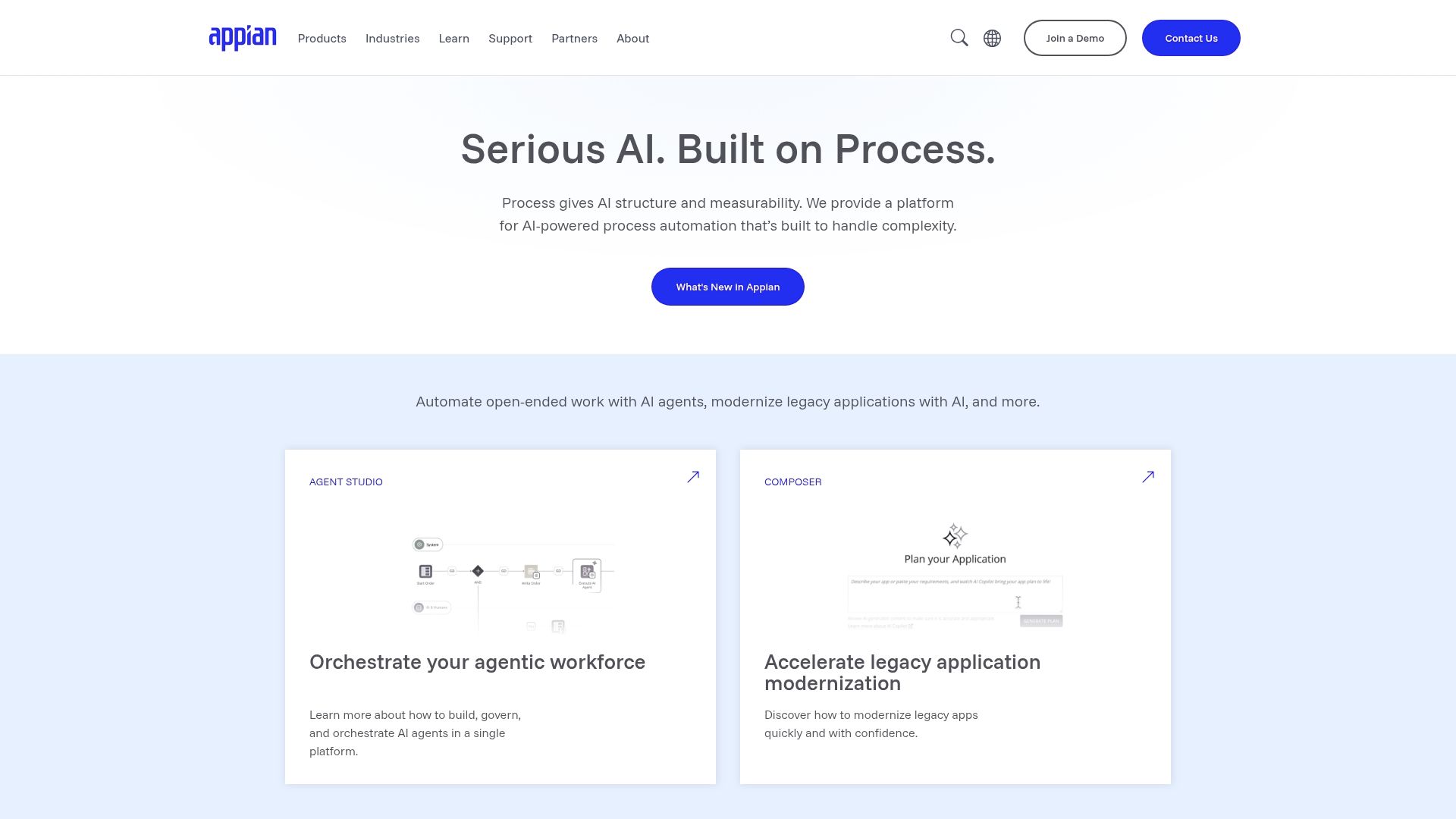
Appian is a mature process automation platform built for large enterprises and government agencies that need reliable, scalable automation and AI integration. Its 25 years of experience shows in platform stability and an emphasis on accelerating digital transformation.
Appian demands experienced practitioners for complex deployments, but it pays off when you need enterprise grade orchestration across systems.
Core Features
Appian delivers end-to-end process automation, AI agents and copilots, a low code development environment, a unified data fabric for consolidating data, and process intelligence for operational insights. These elements combine to let teams design, automate, and measure complex workflows across business units.
The platform focuses on enterprise operations where scale, auditability, and sector specific capabilities matter most.
Pros
- Proven reliability and scalability: Appian has a long track record in enterprise and government contexts, which reduces operational risk for large deployments.
- Strong AI powered automation: The platform includes AI agents and copilots that help automate decision points and reduce manual work in complex processes.
- Comprehensive platform coverage: Appian handles orchestration, data unification, AI integration, and process intelligence from a single product offering.
- Industry specific solutions: The product provides sector tailored use cases and case studies for financial services, insurance, life sciences, and the public sector.
- Deep domain experience: Twenty five years in process automation means accumulated patterns, templates, and implementation know how.
Cons
- Steep learning curve for new users: The platform’s breadth and enterprise focus require training and experienced staff to implement advanced features effectively.
- Pricing not publicly detailed: You must contact Appian for full pricing information which can slow vendor comparison and procurement cycles.
- Advanced integrations may need expertise: Some complex connectors and custom integrations require additional configuration or specialist resources.
Who It’s For
Large enterprises and government organizations with existing technical teams or implementation partners will get the most value from Appian. If your initiatives require scale, audit trails, and sector specific compliance, Appian fits well.
If you lack in house technical capacity, plan for external support during rollout.
Unique Value Proposition
Appian’s value lies in combining low code development, AI automation, and a unified data approach so organizations can move from manual processes to governed, measurable operations. The platform is designed to reduce long term maintenance by consolidating process, data, and intelligence in one vendor solution.
Real World Use Case
A government agency uses Appian to build a case management system that automates task routing, improves data sharing across departments, and speeds approvals. That deployment reduces cycle times and provides auditors with transparent process histories for each case.
Pricing
Pricing is not specified publicly and requires contacting Appian for a tailored quote. Expect enterprise licensing discussions that factor in users, environment scale, and professional services commitments.
Website: https://www.appian.com
Bubble
At a Glance
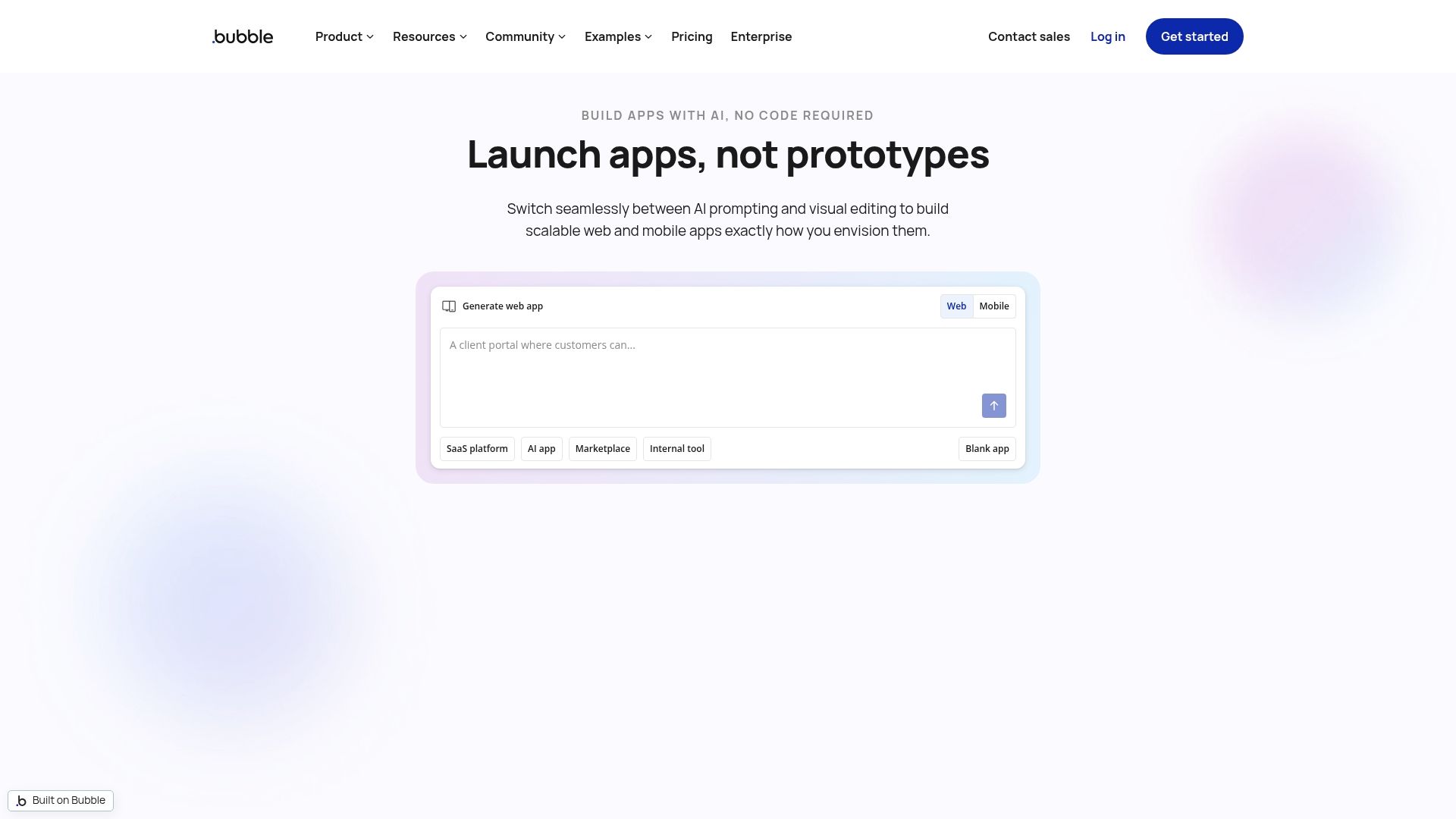
Bubble is a no code platform that lets teams build web and mobile applications without writing code, covering development, testing, and deployment across web, iOS, and Android. The platform balances rapid prototyping with team collaboration and scaling capabilities.
Takeaway: Choose Bubble when you need to launch apps quickly without hiring a full engineering team.
Core Features
Bubble provides tools to build web and mobile apps while handling database management, workflows, and native mobile features. It includes an API connector, plugin support, workload management and scaling, plus version control and collaboration for teams and enterprise users.
Takeaway: Use Bubble to consolidate app logic, data, and integrations inside a single visual platform.
Pros
- No coding required makes app development accessible to product managers and designers who lack programming skills.
- Flexible plans let small teams start for free and scale to paid tiers as demands grow.
- Native mobile support enables projects to target iOS and Android from the same platform without separate native stacks.
- Scalable workload options help teams manage peak usage and control overage through plan choices.
- Strong community and support provides tutorials, plugins, and peer assistance that speed up problem solving.
Takeaway: Bubble reduces time to first usable product while giving upgrade paths for growth.
Cons
- Complex applications sometimes require advanced knowledge or creative workarounds that increase implementation time.
- Pricing can escalate as workload and feature needs grow, making long term costs significant for heavy production apps.
- Customization is limited compared to traditional code, which can constrain highly specific technical requirements.
Takeaway: Plan architecture and cost projections early if you expect an enterprise scale deployment.
Who It’s For
Bubble fits individuals, startups, and product teams that need to prototype and ship web and mobile apps quickly without deep engineering hires. It also works for agencies building client apps and internal teams that want working tools fast.
Takeaway: Pick Bubble for speed to market and cross platform development with small to medium sized teams.
Unique Value Proposition
Bubble delivers an integrated visual development environment where workflows, data, and third party APIs live together, reducing handoffs between product and engineering. Its team oriented features and workload scaling make it practical for both prototypes and growing applications.
Takeaway: Use Bubble to move from concept to a runnable app in weeks rather than months.
Real World Use Case
A startup used Bubble to build a custom project management tool accessible on web and mobile without hiring a development team, enabling fast iteration and user testing while conserving cash and time.
Takeaway: Ideal for startups prioritizing iteration speed and product market fit validation.
Pricing
Start building for free. Paid plans include Starter at $59 per month, Growth at $209 per month, Team at $549 per month, and custom Enterprise plans for large deployments.
Takeaway: Budget for plan upgrades and workload add ons as user traffic and feature needs increase.
Website: https://bubble.io
Enterprise Application Development Tools Comparison
The table below provides a comprehensive comparison of five enterprise application development platforms, summarizing their features, pros, cons, and pricing options to help organizations choose the best tool for their needs.
| Tool | Features | Pros | Cons | Pricing |
|---|---|---|---|---|
| Bitecode | AI-backed system foundation; Modular templates; Pre-built components. | Fast delivery; High customization; Open-source; Enterprise support; Versatile modules. | Pricing consultation required. | Tailored quote; Contact vendor. |
| OutSystems | Visual low-code environment; AI-assisted SDLC; Reusable components; Enterprise-grade security. | Accelerates development; Ensures governance; Flexible integrations; Scalable architecture. | High cost for small businesses; Steep learning curve; Subscription-based. | Contact vendor for enterprise pricing. |
| Mendix | Low-code tools; AI Assistant; Multi-environment deployment; Integration connectors; Governance capabilities. | AI-assisted prototyping; Cloud flexibility; Comprehensive governance; Vibrant community support. | Complex pricing structure; Learning curve for non-technical users; Advanced features limited to high tiers. | Contact vendor for specific pricing. |
| Appian | Process automation; AI agents; Unified data fabric; Process intelligence. | Mature platform; Scalable; AI-enabled automation; Industry-specific solutions; Extensive experience. | Requires experienced users; Pricing not detailed; Specialized integration needs. | Contact vendor for tailored pricing. |
| Bubble | No-code platform; API connectors; Scalable workloads; Collaboration and version control tools. | Accessible for non-coders; Free start with scalable plans; Strong community support. | Limits on customization; Pricing scales for high usage; Complex applications require workarounds. | Starter plan $59/mo; Growth plan $209/mo; Team plan $549/mo; Enterprise custom plans available. |
Explore How Bitecode Tech Offers a Powerful Alternative for Rapid Enterprise Software Development
Facing challenges with slow, complex software rollouts is common among enterprises exploring codatechltd.com alternatives. Pain points like lengthy development cycles, costly customizations, and limited AI automation solutions can stall digital transformation efforts. Bitecode.tech understands these struggles and delivers a faster, more flexible path by providing up to 60% of your enterprise system pre-built with modular, AI-powered components tailored for business needs.
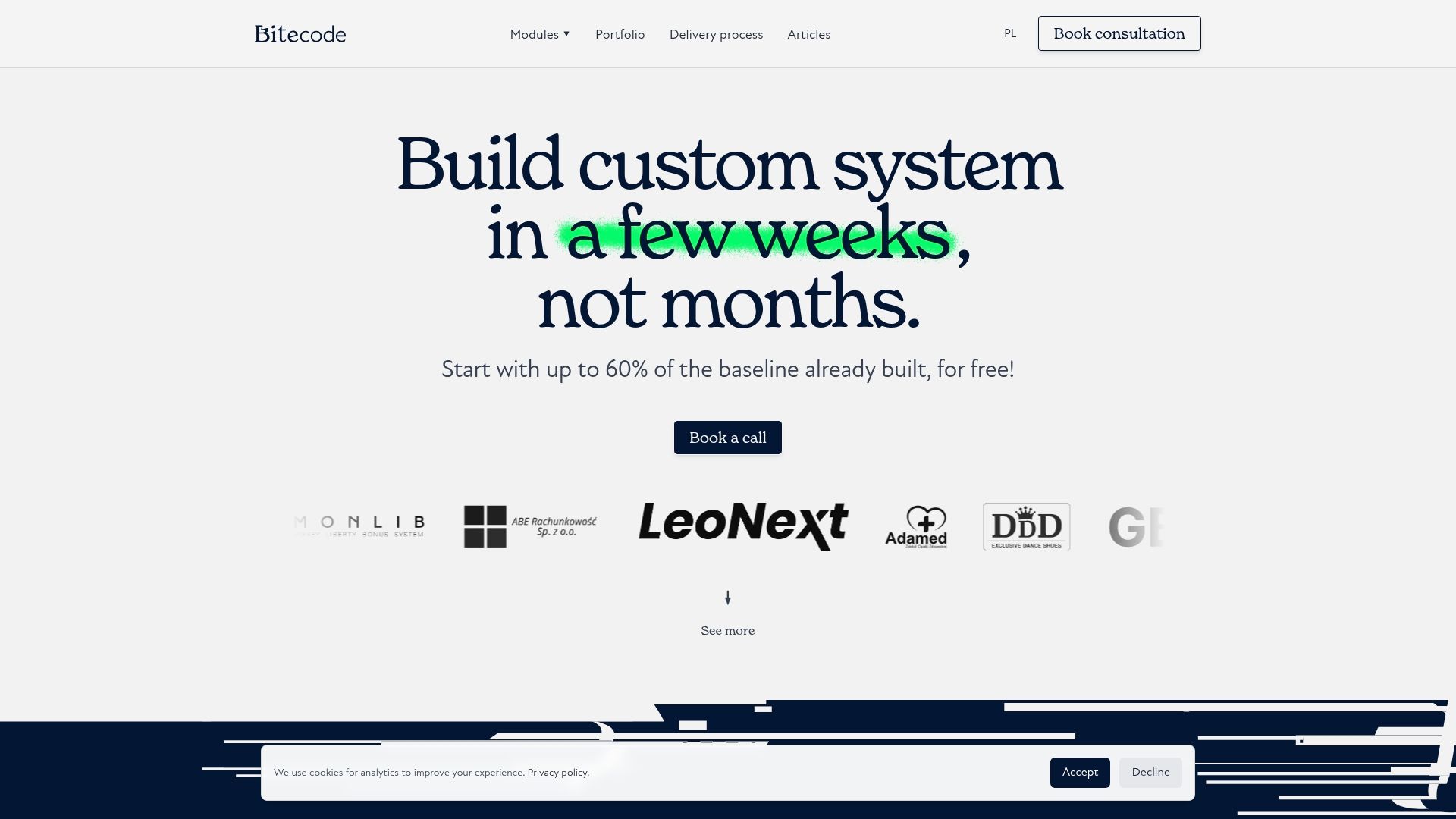
Discover how Bitecode.tech accelerates your project timeline while maintaining full control over customization and scalability for sales, finance, and blockchain workflows. Visit Bitecode.tech today to get a demo and start building your custom system with confidence that it will adapt and grow as your enterprise demands increase.
Frequently Asked Questions
What are the key features to look for in alternatives to codatechltd.com?
Look for features such as user-friendly interface, customization options, integration capabilities, and responsive customer support. Prioritize tools that can streamline your specific business processes and enhance collaboration among team members.
How can I evaluate if an alternative might suit my needs?
Create a checklist of your essential requirements and assess each alternative against these criteria. Conduct a trial or demo with a few selected tools to see which ones align best with your workflow, ideally within a two-week timeframe.
Are there any cost-saving strategies when choosing an alternative to codatechltd.com?
Examine pricing tiers and identify features that you might not need immediately, allowing you to select a lower-cost plan. You could potentially save up to 30% by starting with a basic plan and upgrading as your needs grow.
What is the typical implementation timeframe for these alternatives?
Implementation can usually take anywhere from a few days to a few weeks, depending on the complexity of your business needs and the tool chosen. Plan for a detailed setup process to ensure all customization and integrations are completed thoroughly.
How do I ensure smooth data migration to an alternative platform?
Prioritize tools that offer seamless data migration options and take advantage of any built-in import features. Prepare your data in advance and create a backup to reduce the risk of loss during the migration process.
How can I get user feedback on these alternatives?
Engage with your team members who will use the tool and conduct a survey or hold discussions to gather their insights. You can assess overall user satisfaction and identify any specific concerns or preferences before finalizing your decision.