Rapid fintech solution setup is the process of launching a financial technology product quickly by using modular, API-first platforms that handle compliance, integration, and deployment out of the box. The best platforms on the market today — Rapyd, SDK.finance, and Apex Fintech Solutions — compress what once took months of greenfield development into days or, in some cases, hours. For US entrepreneurs and business leaders, that speed advantage translates directly into earlier revenue, lower build costs, and the ability to iterate before competitors catch up.
The core benefits of this approach are worth naming plainly:
- Go-to-market speed: Median time from signup to first accepted payment is under five minutes on leading express platforms, with most merchant approvals completing very quickly.
- Reduced development overhead: Pre-built modules cover payments, wallets, KYC, and ledger logic, so teams build on a modular foundation rather than from scratch.
- Compliance assistance: Platforms incorporate KYC/AML flows and API connections to identity verification services, reducing the regulatory burden on internal teams.
- API flexibility: REST APIs and webhooks let companies connect to existing banking infrastructure, payment gateways, and third-party services without rebuilding core logic.
- No-code management: Most platforms let non-developers manage invoicing, refunds, and subscriptions entirely from a dashboard, with the API available when engineering capacity exists.
The 2026 US fintech market rewards speed. Teams that relocate complexity into the vendor relationship, rather than carrying it internally, reach production faster and with less risk.
What are the leading platforms for rapid fintech deployment?
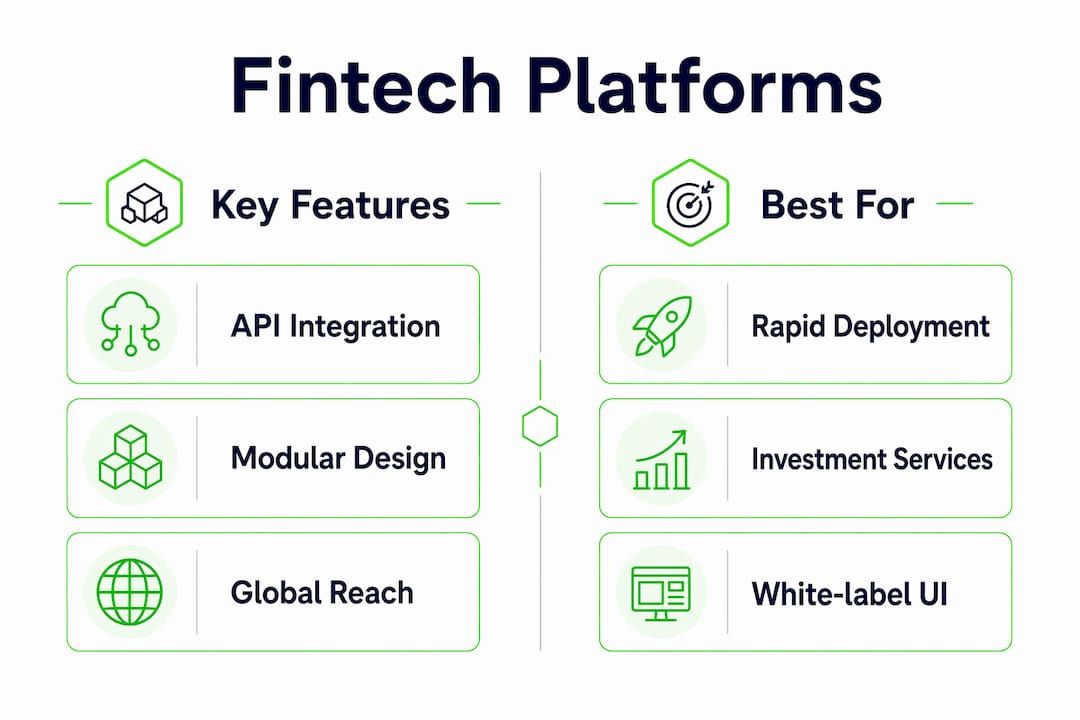
Three platforms define the current standard for fast fintech implementation in the US market. Each takes a distinct approach to modularity, supported services, and target industries.

The comparison below covers the dimensions that matter most for a quick fintech deployment decision.

| Platform | Key Features | Deployment Speed | Modularity | Supported Services | API Capabilities | Best For |
|---|---|---|---|---|---|---|
| Rapyd | Global payment processing, financial services APIs, multi-currency wallets | Fast; automated onboarding flows | High; pick-and-mix payment modules | Payments, payouts, FX, card issuing, eWallets | Broad REST API; webhooks; sandbox environment | Businesses scaling global payments quickly |
| SDK.finance | Ready-made fintech components, white-label UI, compliance modules | Fast; pre-built components reduce integration time | High; component-based architecture | Digital wallets, lending, card management, transfers | Open API; modular backend | Fintech startups needing fast market entry |
| Apex Fintech Solutions | Custody infrastructure, clearing, digital investing platform | Moderate; enterprise onboarding process | Moderate; platform-level scalability | Brokerage, custody, clearing, digital assets | API-first wealth tech platform | Enterprises building investment and wealth products |
Rapyd operates as a global financial services network, giving companies the ability to accept, send, and manage payments across markets through a single API layer. Its strength is breadth: card issuing, eWallets, bank transfers, and FX conversion are all available as modular services. For a US business that needs to go live in multiple regions simultaneously, Rapyd’s automated onboarding and pre-built payment flows reduce the integration timeline considerably.
SDK.finance takes a component-first philosophy. The platform ships with white-label UI templates, a modular backend, and built-in compliance tooling, which means a fintech startup can configure a digital wallet or lending product without writing boilerplate infrastructure code. The focus on startup acceleration makes it a practical choice for teams with limited engineering resources who need to reach their first users fast.
Apex Fintech Solutions occupies a different tier. Its core custody and clearing infrastructure is purpose-built for investment products, and the platform’s scalability suits enterprises that need to handle high transaction volumes in regulated asset classes. The onboarding process reflects that complexity: it is more involved than Rapyd or SDK.finance, but the underlying infrastructure is correspondingly more specialized.
How do you launch and scale a fintech product using modular platforms?
Fast fintech implementation follows a repeatable process. The steps below apply whether you are building a payments product on Rapyd, a digital wallet on SDK.finance, or an investment platform on Apex.
- Define the product scope. Identify the core financial services your product needs: payments, wallets, lending, custody, or a combination. Narrowing scope at this stage prevents over-engineering the initial build.
- Select a platform that matches your compliance profile. US-market products must address KYC, AML, and, depending on the asset class, FINRA or SEC registration. Platforms like SDK.finance and Rapyd integrate compliance API connections directly, reducing the work of wiring in third-party identity verification.
- Complete platform onboarding. On express platforms, approval processes complete in under 90 seconds for most merchants. Enterprise platforms like Apex require more documentation, but the process is structured and guided.
- Configure your modular foundation. Select the pre-built components relevant to your product: payment flows, wallet logic, transaction rules, and UI templates. This is where modularity pays off most directly — you are assembling, not building.
- Integrate APIs with existing infrastructure. Connect payment gateways, banking APIs, and KYC providers using the platform’s REST API and webhooks. Most platforms provide sandbox environments for testing before production deployment.
- Customize the UI and branding. White-label templates let teams apply brand identity without front-end engineering work. On platforms with no-code dashboards, this step takes minutes.
- Run compliance and security checks. Verify that audit logs, role-based access controls, and PCI DSS requirements are active before going live. Platforms with audit-ready security track sensitive actions and maintain logs automatically.
- Deploy to production and monitor. One-click deployment environments reduce the gap between prototype and production. After launch, use the dashboard to manage transactions, refunds, and subscriptions without engineering involvement.
Typical timelines vary by product complexity. A payments or wallet product on a pre-built platform can reach production in days. An investment platform built on Apex infrastructure takes longer, given custody and clearing requirements, but still compresses a traditional development cycle significantly.
Pro Tip: Before committing to a platform, test its sandbox environment with your actual integration requirements. A platform that looks fast in demos can reveal hidden complexity when your specific banking APIs or compliance flows enter the picture.
How do you choose the right fintech platform for your business?
Platform selection is where most teams put risk into the wrong variables. Choosing by brand recognition or feature count misses the criteria that actually determine whether a rapid fintech system integration succeeds.
The factors that matter most:
- Deployment speed and onboarding friction: How quickly can your team move from signup to a working integration? Platforms with automated underwriting and pre-built compliance flows compress this timeline.
- API breadth and documentation quality: A wide API surface is only useful if the documentation is clear enough for your team to use it without extended support cycles.
- Modularity and flexibility: Can you add or remove services as your product evolves, or does the platform lock you into a fixed feature set? A true modular foundation lets you scale specific capabilities independently.
- Supported financial products: Match the platform’s service catalog to your product roadmap. Rapyd covers global payments and FX; SDK.finance covers wallets and lending; Apex covers custody and investment infrastructure.
- Compliance support: Look for built-in KYC/AML flows, not just API hooks to third-party providers. The difference is whether compliance is a first-class feature or an afterthought.
- Security standards: PCI DSS compliance, role-based access control, and audit-ready logging are baseline requirements for any US-market fintech product. Verify these before signing a contract.
- SLAs and support tiers: For production systems, the platform’s service level agreement defines your exposure when something breaks. Enterprise SLAs with dedicated support matter more than feature lists for teams operating at scale.
- Cost structure: Understand whether pricing is transaction-based, subscription-based, or a hybrid. Transaction-based models favor low-volume launches; subscription models favor high-volume operations.
Pro Tip: Prioritize platforms that offer a no-code dashboard alongside their API. Teams without dedicated developers can manage day-to-day operations from the UI, while engineering resources focus on differentiated product work rather than routine fintech administration.
For US teams evaluating fintech security standards, the platform’s approach to data protection and audit trails should be a primary filter, not a secondary consideration.
How are AI and low-code platforms changing fintech setup speed?
The most significant shift in efficient fintech service setup over the past two years is not a new payment protocol. It is the arrival of AI-driven app builders that generate complete fintech prototypes from conversational prompts. Entrepreneurs can move from idea to deployed fintech app in minutes, with UI, backend logic, and database structure generated automatically from plain-English descriptions.
That capability changes the economics of prototyping. Teams can validate a product concept with a working demo before committing engineering resources to a full build. The prototype is not a mockup; it includes transaction rules, wallet logic, and compliance flows configured through prompts rather than code.
Bitecode operates in this same territory, but with a focus on medium to large organizations that need production-grade systems rather than rapid prototypes. The platform starts projects with up to 60% of the baseline system pre-built, covering AI automation, blockchain integration, and workflow orchestration. That pre-built foundation means teams are customizing and extending, not building from zero. For organizations with complex business-domain requirements, that distinction matters: the modular foundation accelerates work without accelerating chaos.
The contrast with traditional development is direct. A greenfield fintech build typically involves months of infrastructure work before any business logic is written. Low-code and AI-driven platforms relocate that infrastructure complexity into the vendor relationship, freeing internal teams to focus on the differentiated features that actually define the product. For AI automation in fintech, the practical result is faster iteration cycles and lower initial capital requirements.
What are the regulatory compliance basics for US fintech products?
Compliance is not optional, and it is not something to configure after launch. US fintech products operate under a layered regulatory framework, and the platform you choose either helps you navigate it or leaves you to figure it out alone.
The baseline requirements for most US fintech products include Know Your Customer (KYC) identity verification, Anti-Money Laundering (AML) monitoring, and, for payment processing, PCI DSS certification. Platforms like Rapyd and SDK.finance incorporate compliance flows and API connections to KYC providers directly, so the verification process runs automatically during user onboarding rather than as a separate manual step.
Investment and brokerage products carry additional obligations. Firms operating in the securities space must register with FINRA and may need to verify broker-dealer credentials before offering certain products. Custody services fall under SEC oversight, which is why Apex Fintech Solutions’ infrastructure is built around regulatory-grade clearing and custody rather than general-purpose payment processing.
State-level licensing adds another layer. Money transmission licenses are required in most US states for companies that move funds on behalf of customers, and the application process varies by state. Some platforms offer licensed infrastructure as a service, effectively letting companies operate under the platform’s existing licenses while they pursue their own. That arrangement compresses the compliance timeline but relocates regulatory risk into the vendor relationship, which requires careful due diligence on the platform’s own compliance standing.
Bitecode offers a different path to fast fintech deployment
The platforms compared above are strong choices for companies whose needs map cleanly onto their service catalogs. But for organizations that need a tailored system, one that incorporates financial processing alongside AI automation, blockchain, or complex workflow logic, a pre-packaged platform often relocates the hard problem rather than solving it.
Bitecode’s custom software development approach starts with up to 60% of the baseline system already built, using modular components that cover financial processing, AI assistants, blockchain integration, and workflow automation. The result is a bespoke system delivered on a timeline closer to a platform deployment than a traditional build. For medium to large organizations that need secure, production-grade fintech infrastructure without the constraints of a black-box platform, that combination of speed and customization is the practical alternative. If you are evaluating AI-driven fintech tools alongside platform options, Bitecode’s modular foundation is worth including in that comparison.
Key Takeaways
Modular, API-first fintech platforms compress traditional development timelines from months to days, and the right platform choice depends on matching your product’s financial services requirements to the platform’s actual service catalog.
| Point | Details |
|---|---|
| Speed is measurable | Leading platforms achieve merchant approval in under 90 seconds and first payment in under five minutes. |
| Platform fit by product type | Rapyd suits global payments; SDK.finance suits wallet and lending startups; Apex suits investment and custody products. |
| Compliance is a platform feature | Choose platforms with built-in KYC/AML flows, not just API hooks, to reduce your team’s compliance workload. |
| AI and low-code change prototyping | AI-driven builders generate working fintech prototypes from plain-English prompts, validating concepts before full builds. |
| Bitecode for custom builds | Bitecode starts projects with up to 60% pre-built, suited to organizations needing tailored fintech systems beyond standard platform catalogs. |