Payment orchestration is a control layer — a Payment Orchestration Platform (POP) — that sits above gateways, processors, and PSPs to normalize transaction data, apply routing logic, and manage retries, refunds, and reconciliation from a single integration point. For scaling merchants and platforms, the primary outcome is measurable: higher authorization rates, operational resilience across providers, and faster rollout into new markets without rebuilding payment infrastructure each time.
The short version:
- Higher authorization rates — intelligent routing sends each transaction to the provider most likely to approve it, based on BIN, currency, geography, and historical success rates
- Operational resilience — automatic failover to a secondary provider when a gateway goes down or returns a soft decline
- Faster market entry — adding a regional PSP or wallet like Google Pay becomes a connector configuration, not a new integration project
- Centralized reporting — one ledger view across Stripe, Spreedly, and every other connected provider reduces reconciliation overhead
- Trade-off: cost — platform licensing, per-transaction fees, and integration work add up; the math only favors orchestration above a certain transaction volume
- Trade-off: data fragmentation — tokens and transaction records can scatter across providers if vault ownership is not defined upfront
- Trade-off: operational ownership — routing rules, fraud configuration, and provider health monitoring require a named owner and ongoing governance
PCI DSS compliance and tokenization scope are directly affected by which layer owns the vault. That question — who owns the tokens — is the single most consequential procurement decision in any POP evaluation.
Key Takeaways
Payment orchestration delivers measurable authorization uplift and operational resilience, but only when the platform is governed as a product with clear ownership of routing rules, token vaults, and provider health monitoring.
| Point | Details |
|---|---|
| Token ownership is the first question | Confirm vault ownership and migration path before signing any POP contract. |
| Pilot before full rollout | Run a corridor-limited A/B test with two PSPs to measure authorization delta before scaling. |
| Governance prevents drift | Assign a named owner for routing rules and schedule quarterly approval-rate reviews by corridor. |
| Build vs. buy turns on control and TCO | Custom builds suit unique treasury needs and long-term volume; commercial POPs suit speed and standard corridors. |
| Bitecode delivers modular custom POPs | Bitecode builds vault-first, connector-modular systems that give teams full data ownership and no vendor lock-in. |
How payment orchestration handles a transaction from checkout to settlement
A POP acts as the control plane: it receives the raw payment request, decides where to send it, manages the provider conversation, and reconciles the result. The sequence below maps a real checkout flow.
- Request normalization — The checkout submits a payment request to the orchestrator. The POP normalizes the payload: currency, amount, card BIN, customer metadata, and any 3DS signals are mapped to a canonical schema regardless of which downstream provider will receive the transaction.
- Routing decision — The routing engine evaluates the normalized request against configured rules: BIN range, issuing country, currency, transaction amount, provider health scores, and historical approval rates for that corridor. The engine selects the optimal provider. This decision typically needs to resolve in under 50 milliseconds to stay within checkout latency budgets.
- Authorization request — The POP translates the canonical payload into the provider’s native API format and sends the authorization request. For wallets like Google Pay, this step includes gateway token mapping — the POP must translate the wallet’s payment token into a form the acquiring bank accepts.
- Retry and failover — If the provider returns a soft decline or a timeout, the POP applies retry logic: it may re-attempt with the same provider after a short delay or immediately route to a secondary provider. Idempotency keys prevent duplicate charges across retries — every attempt carries a unique key so the provider can detect and reject a replayed request.
- Capture and settlement — For two-step flows (authorize then capture), the POP manages the capture call and tracks the settlement window. Providers like PayPal use server-side order creation and capture patterns that differ from card-network flows; the orchestrator must reconcile both models into a unified ledger entry.
- Webhook fan-in — Each provider sends its own webhook format on authorization, capture, refund, and dispute events. The POP normalizes all incoming webhooks into a single event schema and fans them out to the merchant’s systems. Without this layer, engineering teams maintain a separate webhook parser for every provider.
- Internal ledger reconciliation — The POP writes a canonical transaction record: provider used, amount, currency, status, fees, and settlement date. This record feeds the reconciliation engine, which matches provider settlement files against the internal ledger and flags discrepancies.
Routing decisions are only as good as the data feeding them. A routing engine that relies on static BIN tables will underperform one that ingests live provider health signals and rolling approval-rate windows. Before evaluating any POP, ask the vendor how frequently routing scores are updated and whether the engine supports corridor-level A/B testing to validate rule changes before full rollout.
Pro Tip: Cache routing lookup results for recurring customers and known BIN ranges. A cold lookup that hits an external scoring service on every transaction can add 20–40 milliseconds to authorization latency. Most mature POPs support a warm-cache layer; confirm it during vendor evaluation.
What the core architecture of a POP actually looks like
A mature orchestration stack is modular: each component handles a discrete function, and routing decisions live in configuration rather than application code. That modularity is what allows teams to swap providers, update fraud rules, or add a new payment method without touching the core checkout codebase.
Core components:
- Gateway connectors — Pre-built adapters for each PSP, acquirer, or wallet. Connector quality varies widely; ask vendors for a list of certified connectors versus community-maintained ones.
- Routing engine — The decision layer. May use static rule sets, ML-scored models, or a hybrid. Determines which provider receives each transaction.
- Token vault — Stores payment credentials (PAN, network tokens) independently of any single provider. Vault ownership determines PCI DSS scope and portability.
- Fraud and 3DS integration — Connects to fraud scoring services and manages 3DS2 authentication flows. Some POPs bundle a basic rules engine; others integrate with dedicated tools.
- Transaction ledger — Canonical record of every transaction event across all providers. The foundation for financial processing and reconciliation.
- Reconciliation tools — Matches internal ledger records against provider settlement files. Flags discrepancies and supports multi-currency clearing.
- Monitoring and SLAs — Provider health dashboards, latency tracking, and alerting. Critical for detecting degraded provider performance before it affects approval rates.
- Developer APIs and SDKs — REST APIs, webhooks, and client SDKs. API maturity, Stripe’s Checkout Sessions being a well-documented example, directly affects integration speed and ongoing maintenance burden.
| Component | What it does | Key procurement question |
|---|---|---|
| Gateway connectors | Translates canonical requests to provider-native formats | How many certified connectors exist, and who maintains them? |
| Routing engine | Selects the optimal provider per transaction | Does it support ML scoring, and can rules be tested in sandbox? |
| Token vault | Stores and manages payment credentials | Who owns the tokens, and what is the migration path if you leave? |
| Fraud / 3DS | Scores risk and manages authentication challenges | Is fraud tooling bundled or a third-party integration? |
| Transaction ledger | Canonical record across all providers | Does it support multi-currency and multi-clearing model (CSM) entries? |
| Reconciliation tools | Matches ledger to settlement files | How are discrepancies surfaced and resolved? |
| Developer APIs / SDKs | Integration surface for engineering teams | Are webhooks idempotent, and is there a sandbox with full parity? |
Multi-clearing settlement (CSM) support matters for businesses operating across acquiring banks in different regions. Without it, treasury teams reconcile settlement files manually, which erases a significant portion of the operational efficiency the POP was supposed to deliver.
What orchestration actually delivers for your business
Orchestration improves authorization rates and operational resilience by routing each transaction to the provider most likely to approve it, and by recovering revenue that a single-provider setup would lose to soft declines and outages. Those are not theoretical benefits; they show up in measurable revenue recovery and reduced cart abandonment.
Business outcomes with supporting context:
- Authorization uplift — Routing based on BIN, issuer, and corridor history consistently outperforms static single-provider routing. PYMNTS reports that companies with a complete orchestration stack achieve materially higher approval rates compared to partial deployments.
- Revenue recovery from retries — Intelligent retry logic, applied after a soft decline with a different provider or a short delay, recovers transactions that would otherwise be lost. For subscription businesses, this directly reduces involuntary churn.
- Reduced cart abandonment — Faster failover means the customer rarely sees a payment failure screen. A retry that completes in under two seconds is invisible to the buyer.
- Faster time to market — Adding a new regional PSP through a pre-built connector takes days, not the weeks or months a direct integration requires. This is the primary driver for platforms and ISVs expanding into new geographies.
- Centralized reporting — One data model across all providers eliminates the reconciliation overhead of maintaining separate reports per gateway. Finance teams get a single source of truth for settlement, fees, and disputes.
- Cost control through routing — Routing lower-risk transactions to lower-cost acquirers, while reserving premium providers for high-value or high-risk corridors, can reduce blended processing costs.
The payment orchestration platform market is growing as global expansion and multi-provider complexity push more businesses past the threshold where a single gateway is sufficient. Platforms and ISVs typically reach that threshold first, followed by enterprise merchants with cross-border volume and subscription businesses managing recurring billing across multiple payment methods.
AI and fraud orchestration are increasingly coupled with routing decisions, particularly for cross-border transactions where issuer behavior is harder to predict. A POP that integrates ML-based fraud scoring alongside routing logic can preserve authorization rates while reducing false positives — a balance that static rule sets struggle to maintain at scale.
The real trade-offs teams underestimate before adopting orchestration
Orchestration relocates complexity rather than eliminating it. The integration surface shrinks on the provider side, but a new layer of operational responsibility appears at the orchestrator level. Teams that treat a POP as a black-box platform and hand off governance to the vendor tend to see diminishing returns within 12–18 months.
Concrete challenges to plan for:
- Token ownership and portability — If the vendor vault holds all tokens and offers no migration path, switching providers later requires re-tokenizing your entire customer base. That is a significant operational and compliance event.
- Fragmented fraud signals — Splitting transaction volume across providers means each provider sees a smaller slice of your fraud pattern. Centralized fraud scoring at the orchestrator level is necessary to compensate.
- Governance and rule ownership — Routing rules that live in configuration require a named owner. Without one, rules drift: providers get added, old rules never get retired, and the routing logic becomes as opaque as the application code it replaced.
- Hidden integration cost — Pre-built connectors vary in quality. A connector that covers 80% of a provider’s API surface may still require custom work for dispute handling, refund flows, or local payment methods.
- Latency risk — An orchestrator that adds 80–100 milliseconds to every authorization call can degrade checkout conversion. Measure baseline latency in the sandbox before committing.
- Single point of failure — If the POP itself goes down and there is no fallback routing path, all payment volume stops. Redundancy at the orchestrator level is a non-negotiable SLA requirement.
Pro Tip: Build a RACI for payment operations before go-live: who owns routing rules (product), who monitors provider health (engineering), who reviews approval-rate trends (finance), and who handles provider escalations (ops). Without this structure, operational drift sets in within the first quarter.
How orchestration differs from a gateway and a processor
Orchestration is a control plane above gateways and processors. It does not replace them; it coordinates them. Conflating the three layers is the most common procurement mistake, and it leads to either over-engineering a simple setup or under-investing in a complex one.
Responsibility breakdown:
- Payment processor — Moves money between the issuing bank and the acquiring bank. Handles clearing and settlement. Has no visibility into routing decisions or checkout UX.
- Payment gateway — Accepts the transaction from the merchant, tokenizes card data, and forwards the authorization request to the processor. Manages the merchant’s integration surface with one acquiring relationship.
- Payment orchestration platform — Sits above one or more gateways and processors. Owns routing, retry logic, token vault (optionally), and cross-provider reporting. Does not itself move money.
When a gateway is enough: A single-market merchant with one currency, one acquiring relationship, and no plans for multi-provider redundancy does not need orchestration. A direct gateway integration is simpler, cheaper, and easier to maintain.
When orchestration adds clear value:
- The business operates in three or more markets with different preferred payment methods
- Transaction volume is high enough that a 1–2 percentage point improvement in authorization rates has material revenue impact
- The platform serves sub-merchants or ISVs who need isolated payment flows and reporting
- A single provider outage has caused measurable revenue loss in the past
The decision is not about sophistication — it is about whether the operational cost of running an orchestration layer is justified by the authorization and resilience gains it delivers for your specific transaction profile.
How to evaluate a payment orchestration platform vendor
The single most important question in any POP evaluation is: who owns the payment tokens, and what does migration look like if we leave? Everything else is secondary to that answer, because token portability determines how much leverage you have over the vendor relationship long-term.
Evaluation checklist:
- Integrations and coverage — Which PSPs, acquirers, and wallets are certified connectors? Does coverage include the local payment methods (ACH, SEPA, PIX, UPI) relevant to your corridors?
- API and SDK maturity — Are webhooks idempotent? Is there a sandbox with full production parity? Developer documentation quality, as seen in well-maintained examples like Stripe’s quickstart docs, directly predicts integration speed.
- Routing logic — Does the engine support ML-scored routing, or only static rules? Can routing changes be tested in a sandbox before production rollout?
- Observability and reporting — Can you query transaction-level data with full provider attribution? Are approval-rate trends surfaced by corridor, BIN range, and time window?
- Settlement and CSM support — Does the platform support multi-clearing models for cross-border acquiring?
- Tokenization and PCI scope — Does the vault reduce your PCI DSS scope? Who owns the tokens? Is there a documented migration path?
- SLA and support model — What is the uptime guarantee? Is there a dedicated support contact for production incidents, or only a ticket queue?
- Pricing transparency — Are setup fees, per-transaction fees, and monthly minimums documented? Are there volume tiers?
Red flags to watch for:
- No transparent transaction logs or audit trail
- Vendor-owned tokens with no documented migration path
- Missing idempotency on retry flows
- Opaque or negotiation-only pricing with no published baseline
- No sandbox environment or developer documentation
- SLA that covers platform uptime but excludes routing accuracy or webhook delivery
Security and compliance questions:
- Is the platform PCI DSS Level 1 certified, and can they provide an Attestation of Compliance (AOC)?
- Where does cardholder data reside, and does data residency meet your GDPR or state-level privacy obligations?
- What is the breach response SLA and notification process?
- How is encryption managed at rest and in transit?
Pro Tip: Run a corridor-limited A/B test in the sandbox before committing to a routing configuration. This pilot approach is the most reliable way to validate uplift without full rollout risk.
What a realistic implementation timeline and cost structure look like
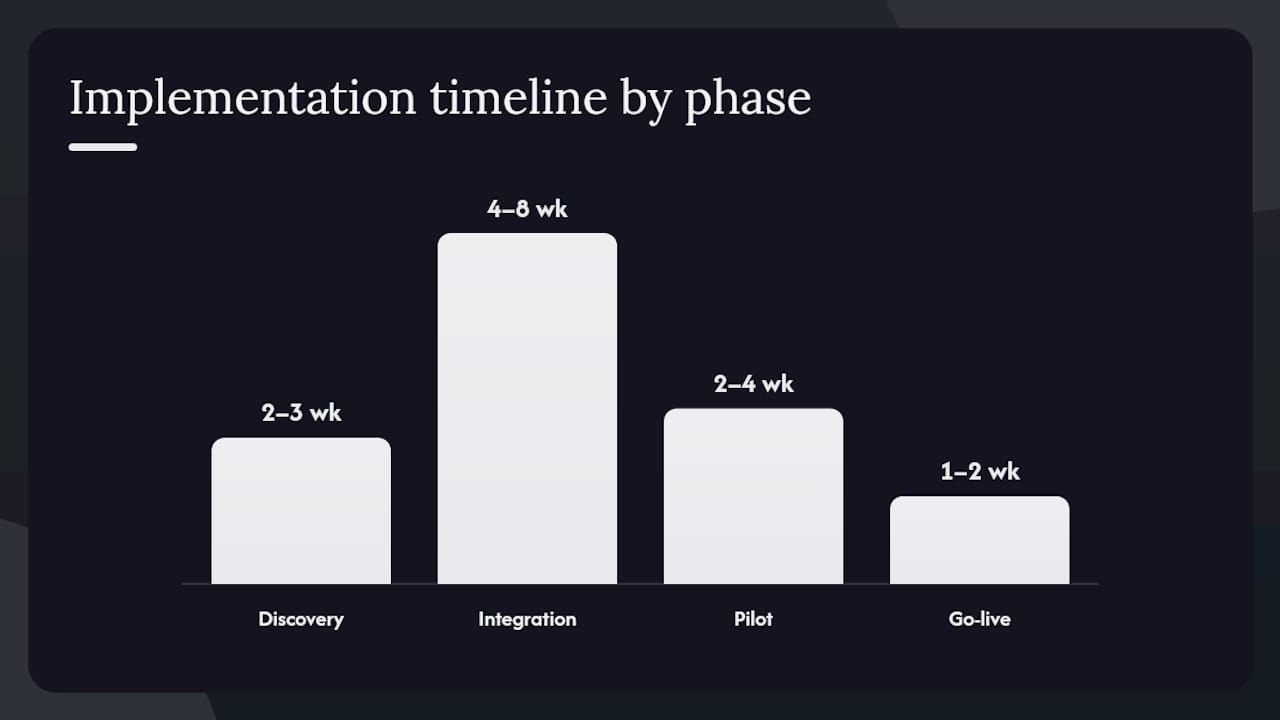
A typical POP implementation runs from discovery through go-live in 10–20 weeks for a focused scope — two to three providers, one or two currencies, and a defined set of payment methods. That range expands quickly when custom reconciliation, treasury complexity, or a large number of PSPs are in scope.
Implementation phases:
- Discovery (2–3 weeks) — Map current payment flows, identify providers, define routing objectives, and document reconciliation requirements. The number of PSPs and the complexity of existing settlement logic are the primary drivers of discovery length.
- Integration (4–8 weeks) — Build or configure provider connectors, set up the token vault, implement routing rules, and integrate fraud tooling. Custom connectors for non-standard providers or local payment methods add time here.
- Pilot (2–4 weeks) — Run a corridor-limited or volume-capped pilot. Measure authorization delta against baseline. Validate webhook delivery, idempotency, and reconciliation accuracy. Rapid fintech pilots that limit scope to two providers and one corridor produce the cleanest signal.
- Go-live (1–2 weeks) — Gradual traffic migration, monitoring dashboards active, escalation paths confirmed.
- Ongoing operations — Routing rule reviews, provider health monitoring, reconciliation exception handling, and compliance maintenance. This phase has no end date; budget for it explicitly.
| Cost driver | What affects it | Notes |
|---|---|---|
| Integration effort | Number of PSPs, custom connectors, reconciliation complexity | Custom connectors for local PSPs are the most common budget surprise |
| Testing and QA | Corridor count, payment method variety, retry scenario coverage | Idempotency and failover testing is often underscoped |
| Platform licensing | Monthly fee or per-transaction model, volume tiers | Compare total cost at your actual transaction volume, not list price |
| Per-transaction fees | Volume, average ticket size, provider mix | Blended fee impact can offset authorization uplift gains at low margins |
| Monitoring and ops | Provider count, alert configuration, reconciliation tooling | Often treated as zero-cost until the first production incident |
| Compliance and certification | PCI DSS scope changes, data residency requirements | Scope reduction can offset certification cost; scope expansion cannot |
Limit the pilot to two providers and one or two corridors. A focused pilot produces a clean authorization delta measurement and keeps rollback simple if the routing logic needs adjustment before full deployment.
Build vs. buy: a decision framework and how Bitecode approaches custom POP projects
The build-vs-buy decision depends on four variables: core competency, control requirements, timeline pressure, and long-term total cost of ownership. Neither path is universally correct, and the honest answer often involves a hybrid — a commercial POP for commodity connectors, with custom logic built on top for proprietary routing or treasury needs.
Factors favoring a commercial POP (buy):
- Time to market is the primary constraint
- The required PSP connectors are already certified on the platform
- Engineering capacity is limited and payment infrastructure is not a core product differentiator
- PCI DSS scope reduction through a vendor vault is a priority
Factors favoring a custom build:
- Unique settlement or treasury requirements that commercial platforms do not support
- Deep product control over routing logic, token vault architecture, and data ownership
- Long-term TCO analysis shows licensing costs exceeding build-and-maintain costs at projected volume
- Regulatory or data residency requirements that a SaaS POP cannot satisfy
The most durable custom POPs share one architectural pattern: a modular vault and provider-connector layer that treats each PSP as a pluggable adapter. This design prevents lock-in at the connector level and allows routing logic to evolve independently of the integration surface. Teams that build a monolithic payment service instead — one codebase that handles routing, tokenization, and provider communication together — typically face a painful refactor within two years as provider requirements diverge.
Bitecode approaches custom POP engagements with a modular foundation: discovery scopes the vault architecture and PCI DSS implications first, connector modules are built as discrete units against a canonical API contract, and routing rules are externalized into a configurable workflow engine rather than embedded in application logic. Fraud integration connects to the orchestrator’s event stream, with AI-enhanced transaction monitoring applied at the routing decision point to preserve authorization rates without increasing friction. Post-launch, Bitecode provides ops handover documentation and monitoring configuration so the client team owns the system from day one.
Pro Tip: When building, prioritize the vault and connector layer before the routing engine. A well-designed vault with clean token portability gives you negotiating leverage with every PSP you connect. A sophisticated routing engine built on top of a poorly designed vault is a liability — you cannot migrate tokens without re-engaging every customer.
Bitecode’s perspective on where orchestration adoption goes wrong
Most orchestration failures are not technical. The routing engine works, the connectors are certified, and the sandbox tests pass. What breaks down is governance: no one owns the routing rules after go-live, provider health monitoring is treated as a set-and-forget configuration, and the token vault question gets deferred until a vendor negotiation forces it.
The businesses that extract the most value from orchestration share a common trait: they treat the POP as a product, not an infrastructure purchase. That means a named product owner for routing logic, a quarterly review of approval-rate trends by corridor, and a documented migration plan for every provider in the stack. Subscription businesses and platforms with sub-merchant flows tend to see the clearest ROI because their transaction patterns are predictable enough to measure routing improvements precisely. Single-market merchants below a meaningful transaction volume threshold should think carefully before adding the operational overhead — a well-configured direct gateway integration often outperforms a poorly governed POP.
How Bitecode builds payment orchestration systems for your team
Bitecode delivers custom payment orchestration systems that give your team full ownership of routing logic, token vaults, and provider relationships — without the lock-in of a black-box SaaS platform.
Where commercial POPs bundle everything into a vendor-managed layer, Bitecode builds modular systems where each component — connector, vault, routing engine, fraud integration — is a discrete, maintainable unit your engineering team controls. Services map directly to common buyer needs: discovery and architecture scoping, custom PSP connector development, PCI DSS-scoped token vault implementation, fraud and 3DS integration, reconciliation tooling, and post-launch ops documentation.
A first engagement typically begins with a scoped discovery: two to three weeks to map your current payment flows, define routing objectives, and produce an architecture document with a clear PCI DSS scope analysis. From there, Bitecode moves into modular build and pilot phases using the custom web application development service as the primary delivery vehicle, with AI automation modules available for routing optimization and transaction monitoring. To start, contact Bitecode for a scoped discovery engagement and receive a concrete architecture proposal within two weeks.
Sources
Primary sources used in this guide, organized by use case:
For implementation details and developer documentation:
- Payment orchestration
- The Complete Guide to Payments Orchestration | Spreedly
- What is payment orchestration? | Stripe
For market context and approval-rate data:
For orchestration workflow and state machine patterns: