TL;DR:
- Process orchestration is a coordination layer managing tasks, decisions, and participants across systems, humans, and AI for complete outcomes. It goes beyond automation by governing entire processes, handling exceptions, routing, and ensuring compliance in AI-driven workflows. Effective implementation requires process reengineering, clear modeling, and governance to scale successfully and achieve operational improvements.
Process orchestration is frequently mistaken for basic automation. In reality, understanding what is process orchestration means recognizing it as something far more consequential: a coordination layer that sequences tasks, decisions, and participants across humans, AI agents, and software systems to deliver a complete end-to-end outcome. As enterprises push deeper into AI-driven operations, the gap between “we automated some tasks” and “we orchestrate our processes” has never mattered more. This guide covers the process orchestration meaning in precise terms, explains how it works, and connects that understanding to practical decisions you can act on.
Key Takeaways
| Point | Details |
|---|---|
| Orchestration vs. automation | Process orchestration coordinates multi-step workflows across systems and people, not just individual tasks. |
| Agentic AI raises the stakes | Governance, auditability, and human-in-the-loop controls are now mandatory requirements in modern orchestration. |
| Reengineer before you automate | Automating a broken process at scale only produces faster failures. Redesign first. |
| Tools vary significantly | Platforms differ on deterministic control vs. AI adaptability. Match the tool to your workflow risk profile. |
| Orchestration is ongoing | Modeling, monitoring KPIs, and iterative refinement define the practice. It is not a one-time deployment. |
What process orchestration actually means
At its core, process orchestration is the practice of designing, executing, and managing a sequence of tasks that spans multiple systems, teams, and decision points to produce a defined business outcome. Workflow orchestration coordinates multiple automated tasks across systems to ensure correct sequencing and timing, which already separates it from single-task automation. But process orchestration goes further. It governs the entire business process, not just the technical handoffs.
Consider what happens when a new corporate customer opens a bank account. The process touches identity verification, credit checks, document management, compliance review, notifications, and account provisioning. Each of those steps may involve a different system or team. Task automation handles any one of those steps in isolation. Process orchestration manages the entire sequence, handles exceptions, routes decisions to the right participant, and tracks the process from start to finish.
The components involved in orchestration fall into three categories:
- Human participants. Approvers, reviewers, or exception handlers who must act at defined points in the workflow.
- Software systems. APIs, databases, and enterprise applications that execute automated steps or supply data.
- AI agents. Machine learning models or generative AI components that classify, predict, or decide within defined boundaries.
The orchestration layer sits above all of these. It does not care what technology a step uses. It cares whether the step completed correctly, on time, and with the right output before triggering the next one.
Pro Tip: When mapping a process for orchestration, separate “what needs to happen” from “how it happens.” The orchestration layer owns the what. Systems and agents own the how. Conflating the two leads to over-engineered, brittle workflows.
Understanding the difference between process orchestration and task automation matters for budget and architecture decisions. Task automation tools, like RPA bots, are point solutions. They handle repetitive, rule-based work within one system. Orchestration platforms manage state, handle exceptions, enforce SLAs, and provide visibility across the full process lifecycle.
The shift to agentic AI and adaptive orchestration
The reason process orchestration has moved from back-office concern to boardroom priority is agentic AI. AI agents do not follow scripts. They make probabilistic decisions, which means their outputs are not guaranteed. When you embed that behavior inside a business process, you need a governance wrapper around it or you are putting risk directly into your operations.
“Hybrid models that blend deterministic workflows and nondeterministic AI agents are the architecture pattern enterprises need to assure safe and scalable automation.” — Decisions Named in Adaptive Process Orchestration Landscape
Forrester’s Q2 2026 report highlights the adoption of adaptive process orchestration with governance and AI integration as the defining market shift. Organizations are no longer asking whether to use AI in their workflows. They are asking how to control it when they do. That control requires orchestration.
Governance in this context means more than access controls. It means auditability of every decision point, documented rationale for exception handling, and the ability to inject a human reviewer when an AI agent’s confidence falls below a defined threshold. These are not optional features. Regulated industries treat them as compliance requirements.
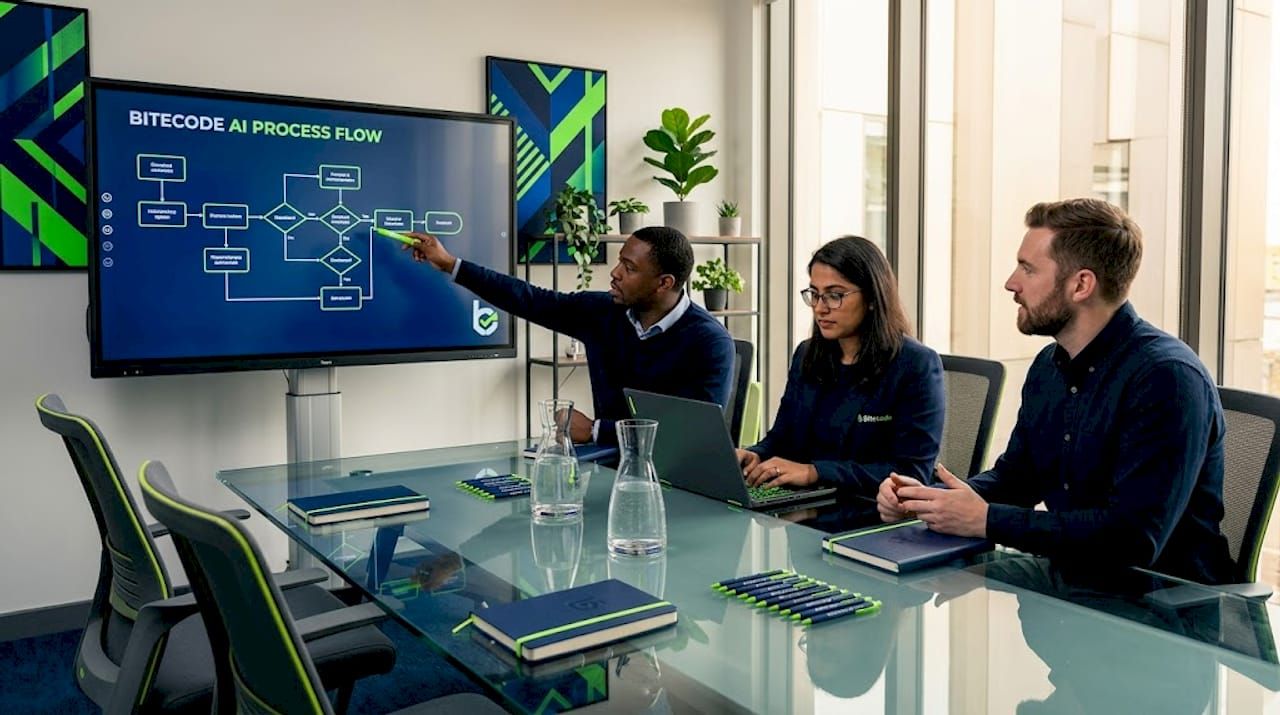
The benefits of process orchestration in an AI-driven environment include faster cycle times, fewer manual handoffs, and a defensible audit trail. But those benefits only materialize when the orchestration layer is designed to accommodate both deterministic and nondeterministic behavior. Organizations that deploy AI agents inside rigid, purely rule-based orchestration frameworks will find their automation brittle. Those that build adaptive orchestration from the start will find it scales.
Comparing process orchestration tools and platforms
Not all process orchestration tools are built for the same job. The distinctions matter when you are evaluating platforms for enterprise deployment.
| Platform type | Strengths | Limitations | Best fit |
|---|---|---|---|
| BPMN-based platforms | Visual process modeling, standards compliance, auditability | Less flexible for dynamic AI agent routing | Regulated industries, structured workflows |
| Agentic orchestration platforms | Handles nondeterministic AI behavior, adaptive routing | Requires stronger governance frameworks | AI-first enterprise transformation |
| Low-code workflow tools | Fast deployment, accessible to non-technical teams | Limited at high concurrency or complex integrations | Departmental automation, simpler processes |
| Custom-built orchestration | Full control, no vendor lock-in | High build and maintenance cost | Organizations with unique process complexity |
Camunda’s ProcessOS integrates process modeling, AI agents, and human oversight with continuous improvement built into the architecture. That combination reflects where the market is heading. The platform reported that 9 of the top 10 US banks rely on its agentic orchestration capabilities for large-scale workflows. That is not a coincidence. Banking workflows involve millions of concurrent instances, strict compliance requirements, and a mix of automated decisions and human reviews. They demand an orchestration layer that handles both.
For IT leaders evaluating enterprise system design options, the key evaluation criteria should be: process modeling standards support (BPMN 2.0 is the baseline), integration depth with existing enterprise systems, monitoring and KPI dashboards, and how well the platform handles human-in-the-loop task routing. Scalability is also non-negotiable for any workflow that touches customer-facing operations.
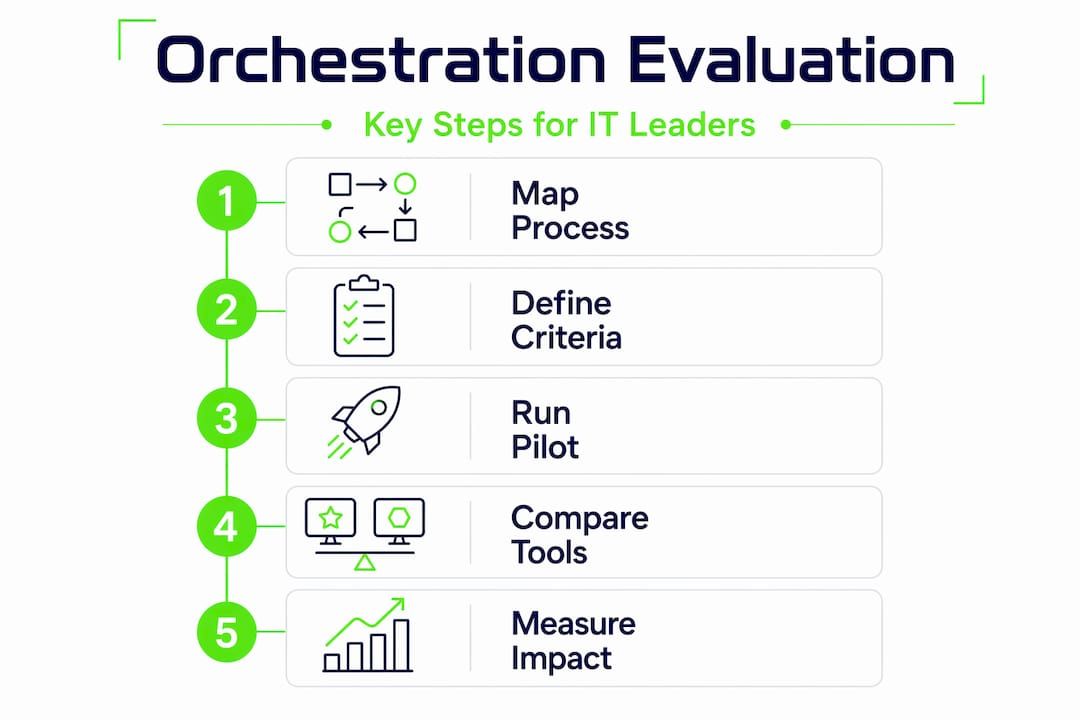
Pro Tip: Avoid evaluating orchestration platforms by feature count alone. Run a proof of concept on your most exception-heavy process. The platform that handles your worst-case scenario cleanly is the one that will perform in production.
How to implement process orchestration effectively
The most common mistake organizations make is treating process orchestration as an IT deployment project rather than a business transformation effort. The technology is the easy part. The hard part is getting the process right before the first workflow goes live.
-
Map the current process honestly. Document every step, every exception, every system involved, and every person who touches it. Do not rely on documentation from three years ago. Processes drift. Walk through the actual current state with the people who run it daily.
-
Reengineer before you automate. Reengineering processes before orchestration is what separates successful implementations from expensive failures. If the current process has redundant approvals, unclear ownership, or manual workarounds baked in, orchestrating it as-is will scale those problems. Fix the process logic first.
-
Model using BPMN. Business Process Model and Notation is the standard language for expressing process flows in a way that both business stakeholders and technical teams can read. Using BPMN from the start reduces translation errors and makes the process design auditable before a single line of code runs.
-
Define your KPIs before go-live. You cannot improve what you do not measure. Establish baseline metrics for cycle time, error rate, exception volume, and SLA compliance before deploying. These become your post-launch benchmarks.
-
Plan for human-in-the-loop from day one. Orchestration is a continuous management practice that includes modeling, monitoring, and iterative refinement. Build exception routing and human review steps into the initial design, not as an afterthought when something breaks.
Pro Tip: Assign a process owner who is accountable for business outcomes, not just a technical owner accountable for uptime. Orchestration governance fails most often due to unclear accountability, not technical gaps.
Benefits and measurable impact
The case for process orchestration is not abstract. Organizations that deploy it at scale report concrete operational improvements.
| Business impact area | What orchestration delivers |
|---|---|
| Workflow efficiency | Faster cycle times through elimination of manual handoffs and wait states |
| Error reduction | Automated exception handling reduces human error in routine decisions |
| Governance and compliance | Full audit trail of every process step, participant, and decision outcome |
| AI agent control | Deterministic guardrails around nondeterministic AI behavior |
| Customer experience | Faster, more consistent service delivery across customer-facing processes |
Enterprises leveraging process orchestration see measurable improvements in workflow speed and error reduction, particularly in high-volume operational contexts. The banking sector provides the clearest examples. Barclays uses deterministic and agentic orchestration to manage customer onboarding, reducing manual handoffs across a process that previously touched multiple internal systems and teams.
The agility benefit is less visible but equally real. When a process is modeled in an orchestration platform rather than hardcoded into application logic, changing it is faster. A regulatory update that previously required a six-week development sprint can become a configuration change. That is not a feature of any specific platform. It is a property of treating your processes as managed artifacts rather than embedded code.
My perspective on where this actually goes wrong
In my experience working with enterprises on automation strategy, the technology is rarely the limiting factor. The limiting factor is the willingness to do the unglamorous work before deployment: mapping the real process, not the ideal one; challenging the approvals that exist because they have always existed; and accepting that orchestration surfaces organizational dysfunction, it does not fix it.
I have seen teams spend months selecting an orchestration platform and then deploy it on top of a process that required four manual approvals for a routine invoice. The platform performed exactly as designed. The process was still broken. That outcome is more common than vendors would like to admit.
What I have come to believe is that agentic AI is going to make this problem more acute, not less. When an AI agent makes a decision inside an orchestrated workflow, someone has to be accountable for that decision. If the process was poorly designed to begin with, the accountability is impossible to trace. Agentic AI demands auditability and human oversight precisely because its decisions are probabilistic. Orchestration is the governance layer that makes that demand satisfiable.
My honest advice: treat your first orchestration deployment as a process design project that happens to end in software, not the other way around.
— Bitecode
How Bitecode supports your orchestration needs
Organizations serious about process orchestration need more than a platform. They need a modular foundation that accelerates work without accelerating chaos.
Bitecode’s AI Assistant Module delivers a pre-built AI chat interface designed for workflow automation, giving teams an orchestration-ready AI component without months of custom development. For organizations running financial workflows, the blockchain payment system provides auditable, automated transaction processing that integrates directly with orchestration layers. Both modules ship with up to 60% of the baseline system already built, so your team spends time on business-domain complexity, not boilerplate. Contact Bitecode to explore how these modules fit your process architecture.
FAQ
What is process orchestration in simple terms?
Process orchestration is a coordination layer that manages the sequence of tasks, decisions, and participants across multiple systems and people to deliver a complete business outcome. It differs from task automation by managing the entire process lifecycle rather than individual steps.
How does process orchestration work with AI agents?
Modern orchestration platforms combine deterministic workflow rules with nondeterministic AI agents, using governance controls, human-in-the-loop checkpoints, and audit trails to manage AI behavior safely within business processes.
What are the key differences between process orchestration and integration?
Process orchestration manages the sequence, logic, and state of a business process end to end. Process orchestration vs integration comes down to this: integration connects systems so they can exchange data, while orchestration decides what happens with that data and in what order.
What are the most widely used process orchestration tools?
Enterprise platforms like Camunda’s ProcessOS are among the most widely adopted, particularly in regulated industries. The choice depends on whether your workflows require deterministic control, AI adaptability, or a hybrid of both.
Why do process orchestration implementations fail?
Most failures trace back to automating poorly designed processes rather than fixing them first. Orchestration scales whatever process logic you feed it, so reengineering before deployment is what determines whether the outcome is improved efficiency or faster failure.